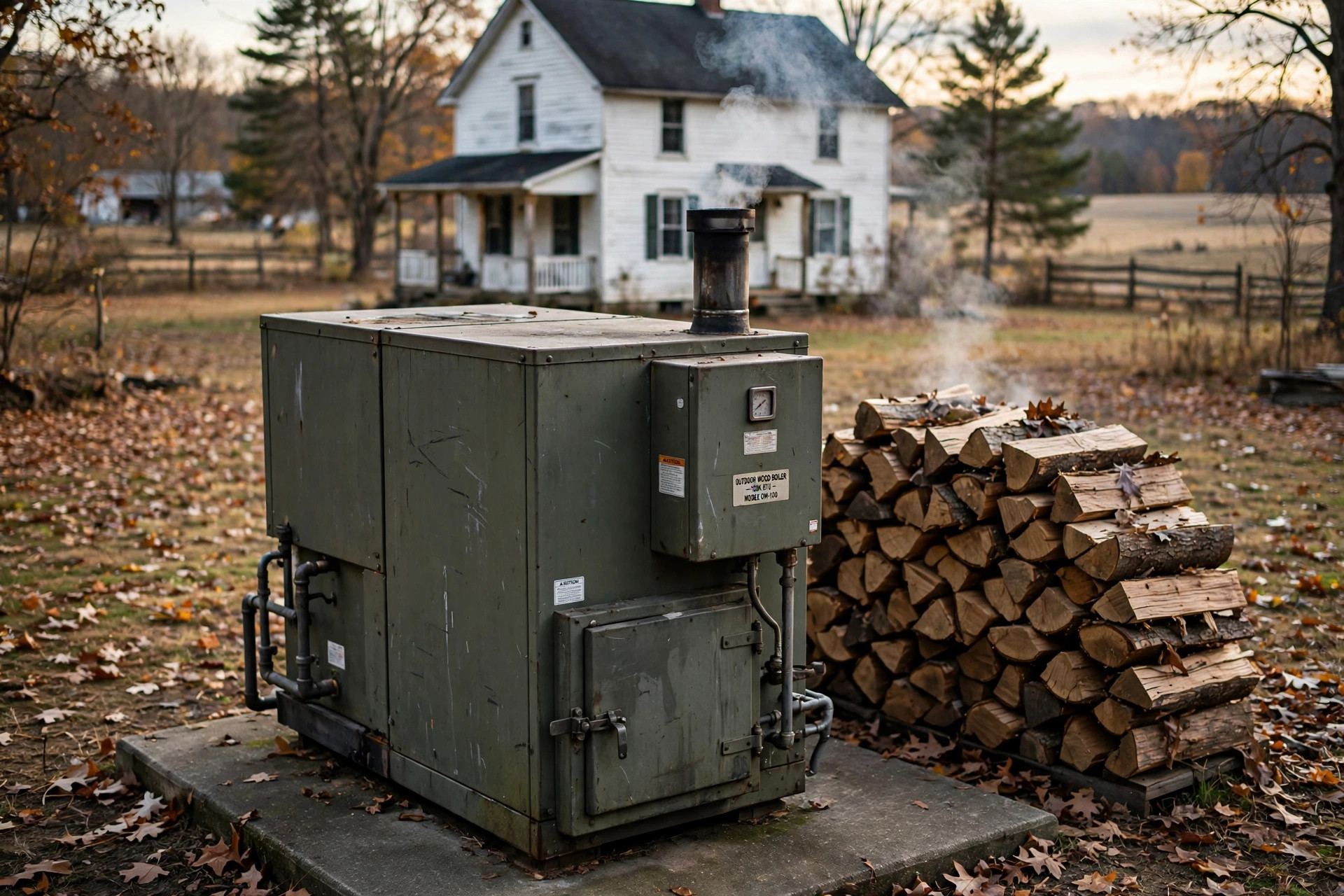

The question of outdoor wood boiler cost installed usa comes up every fall, when propane and oil prices start to climb. An outdoor wood boiler, sometimes called an outdoor wood furnace, is a metal water tank set inside an insulated box that stands outside the house. A fire burns inside it. The heat warms the water. A pump pushes that hot water through buried pipes to the house, where it heats rooms, hot water, and even a shop or pool. Homeowners who heat with wood want to know the full price: the unit, the parts, and the work to put it in. This guide lays out each cost in plain words, based on the standard way these systems are priced across the country.
Why the Price Matters
An outdoor wood boiler is one of the largest heating buys a homeowner can make. The total bill often runs into five figures. That makes it important to plan before signing anything.
The main draw is fuel savings. A family that buys its own firewood, or cuts it on its own land, can spend far less on heat each winter than a family buying propane or heating oil. Over time, the savings can pay for the system. But the payback only works if the true installed cost is known up front.
The price also matters because surprises are common. The boiler itself is only part of the bill. Trenching for the pipes, the concrete pad, the heat exchanger, and the electrical work can add thousands. A homeowner who budgets only for the unit will face an unpleasant shock. Knowing the full outdoor wood boiler cost installed usa figure helps buyers compare the unit against other options, such as a ductless mini split installation, and make a calm decision.
What to Look For Before You Buy: Outdoor Wood Boiler Cost Installed Usa
A good outdoor boiler starts with the right size. Units are rated by square footage and by BTU output. A small cabin may need 100,000 BTU. A large farmhouse with a heated shop may need 200,000 BTU or more. Buying too small means the fire cannot keep up on cold nights. Buying too large means more wood burned than needed and a higher price. A heat-loss calculation for the house is the honest way to size the unit.
Build quality comes next. The firebox should be thick steel, and the water jacket should be welded by a maker with a long record. Look at the door seal, the grates, and the way the ash is removed. A well-made box lasts twenty years or more. A cheap box may fail in half that time.
Check how the unit is certified. The EPA sets emission rules for outdoor wood heaters. Many states and counties add their own rules. Some places limit the stack height, the distance from neighbors, or the types of fuel that may be burned. A look at the current rules on the U.S. Department of Energy site, and a call to the local building office, will show what is allowed. An EPA-qualified unit costs more than a basic one, but it burns cleaner and faces fewer legal limits.
Ask about the parts that come with the boiler. Some sellers quote the bare unit. Others include the pump, the underground pipe, the heat exchanger, and the controls. A quote that looks cheap may leave out thousands of dollars of parts. Get every item in writing.
Finally, study the maker and the dealer. Brands such as those sold through Carrier dealers in the wider heating trade, or dedicated outdoor furnace makers, differ in warranty terms and service networks. Read the warranty. Ask who repairs the unit if something breaks in January. A unit with no local service can sit cold for weeks.
Types of Outdoor Wood Boilers
Conventional Outdoor Boilers
The basic type burns wood in a large firebox and sends the smoke straight up the stack. These units are simple and less costly. They do well where rules are loose and the house sits on a large lot far from neighbors. They burn more wood per unit of heat than the cleaner types.
Gasification Outdoor Boilers
A gasification boiler burns the wood gases in a second chamber at high heat. This step burns off much of the smoke and turns more of the wood into usable heat. These units use less wood and put out less smoke. They cost more to buy. In areas with strict air rules, they may be the only legal choice. Makers that serve the whole heating market, such as Rheem and Trane, publish useful guides on how combustion efficiency works in home heating.
Multi-Fuel and Combination Units
Some outdoor boilers can burn coal or pellets as well as cordwood. A combination unit adds flexibility when wood is scarce or wet. These units cost more and need more care. They suit owners who want a backup fuel.
Indoor-Style Boilers Set Outside
A few owners place an indoor wood boiler inside an outbuilding. The cost math is close to an outdoor unit, but the install work differs. This choice suits farms with a shop building already standing.
For homes that heat water with the boiler, the choice of best boiler for radiant floor heat matters, since outdoor units pair well with radiant floor systems.
Cost and Price: The Full Breakdown
The outdoor wood boiler cost installed usa total falls into parts. Each part is listed here with the usual range seen across the country.
The Boiler Unit
The boiler itself is the largest single cost. Small conventional units for a modest home run from about $4,000 to $7,000. Mid-size units run $7,000 to $11,000. Large gasification units for big homes or multiple buildings run $11,000 to $18,000 or more. The cleaner the burn and the thicker the steel, the higher the price.
Underground Insulated Pipe
Hot water travels to the house through buried insulated pipe. Good pipe is costly: often $12 to $25 per foot, and the run is commonly 50 to 150 feet. A 100-foot run can add $1,200 to $2,500. Cheap uninsulated pipe loses heat in the ground and raises wood use for years, so this is a poor place to save money.
Trenching
A trench must be dug from the boiler pad to the house, usually 2 to 4 feet deep. Hiring a trencher or excavator costs $500 to $2,000 depending on length, soil, and rock. Homeowners with their own equipment can do it themselves and save this cost.
Concrete Pad and Shelter
The boiler sits on a concrete pad. A simple pad costs $300 to $800 in materials, more if hired out. Some owners add a small roof or woodshed over the unit and the wood pile. A basic shelter adds $500 to $2,000.
Heat Exchanger and Indoor Parts
Inside the house, a heat exchanger moves heat from the water loop into the home’s air or water system. A water-to-air exchanger for a forced-air furnace costs $300 to $800. A plate exchanger for radiant floors or a water heater costs $200 to $600. A circulation pump costs $150 to $400. Thermostats and controls add $100 to $300. Guidance on choosing efficient components is published by Energy Star, which rates heating equipment across the country.
Electrical Work
The boiler needs power for the pump, fan, and controls. Running a circuit to the unit costs $200 to $800, depending on distance and the state of the electrical panel.
Labor
A dealer who installs the full system often charges $1,500 to $4,000 for labor. Some owners do the trenching and pad themselves and hire a technician only for the plumbing and controls. Reviews of outdoor furnace installs show that good labor is worth the price, since a bad pipe run cannot be fixed without digging it up again.
Total Installed Cost
Adding it up, a small system with owner-done trenching can land near $7,000 to $10,000. A typical full dealer install runs $12,000 to $18,000. A large gasification system for a big home with a long pipe run can reach $20,000 to $25,000. These are 2026 figures, and local prices vary.
Fuel Cost
Cordwood is the fuel. Prices run $150 to $350 per cord, cut and split, in most regions. A typical home burns 6 to 12 cords per winter. Owners who cut their own wood pay mostly in time and saw fuel. Dry wood matters: wet wood burns poorly and makes more smoke. Plan to season wood for a year before burning it.
Payback
A home that spends $3,000 a year on propane may spend $1,000 to $1,500 on wood instead. At that rate, a $15,000 system pays for itself in 7 to 10 years. Homes with free wood pay back faster. Homes in mild climates pay back slower. Run the numbers for your own fuel prices before buying.
Care and Upkeep
An outdoor wood boiler is a working machine. It needs steady care.
Ash must be removed often, usually every few days in cold weather. Letting ash build up blocks airflow and lowers heat output. The door gasket should be checked each year and replaced when it leaks.
Water treatment is the most overlooked task. The water in the jacket should be treated with the maker’s recommended chemicals and tested each year. Untreated water corrodes the steel from the inside. Many warranties are void if the water is not treated. Test kits and treatment are sold by dealers and covered in upkeep guides from This Old House.
The chimney and heat-exchange surfaces need cleaning. Creosote builds up in the stack and the firebox. A brush and a regular schedule keep the draft strong and lower the risk of a chimney fire.
Wood storage matters too. Keep the pile covered and off the ground. Burn only seasoned hardwood when possible. Never burn trash, painted wood, or treated lumber. These fuels make toxic smoke and can damage the unit.
Plan on spending 30 to 60 minutes a day on the boiler in winter: loading wood, checking the fire, and removing ash. It is a daily chore from first frost to spring.
Safety
Heat and fire demand respect. Set the boiler at the distance the maker and the local code require, often 50 feet or more from the house and away from property lines. Keep the area around the unit clear of leaves, brush, and stored fuel.
Hot water under pressure can scald. The plumbing should include pressure relief valves and be installed to code. Let a licensed plumber or the dealer handle the indoor connections.
Smoke affects neighbors. Burn only dry, clean wood. A smoking boiler on a still night will draw complaints, and many towns have rules against nuisance smoke. Good fuel and a clean burn keep the peace.
Keep a fire extinguisher near the unit and another in the house. Clean the chimney on schedule. Never leave the loading door open and walk away. Teach everyone in the home how the system works and what to do if something looks wrong. Safety rules for home heating equipment are published by the U.S. Department of Energy and by trade sources such as the Family Handyman.
Frequently Asked Questions
How long does an outdoor wood boiler last?
A well-built unit with treated water and regular care lasts 20 to 25 years. Units with thin steel or neglected water treatment may fail in 10 to 15 years. The warranty often covers the firebox for 10 to 20 years.
Can one boiler heat the house and the hot water?
Yes. A sidearm or plate heat exchanger moves heat into the home’s water heater. Many owners also heat a garage, a workshop, a greenhouse, or a pool with the same boiler. Each added load means more wood burned.
How much wood does an outdoor wood boiler use?
A typical American home uses 6 to 12 full cords per heating season. Older, drafty homes use more. Tight, well-insulated homes use less. Gasification units use 20 to 30 percent less wood than basic units for the same heat.
Is an outdoor wood boiler legal in my area?
Rules differ by state, county, and town. Some areas ban them. Others set stack heights, setbacks, or fuel rules. Check with the local building or zoning office before buying. The Lennox and Goodman dealer networks also note that local codes shape every heating install.
Does an outdoor wood boiler need electricity?
Yes. The circulation pump, the draft fan, and the controls all need power. In a power outage, the fire keeps burning but the heat cannot move to the house. Many owners add a small backup generator for outages.
What does it cost to replace an old outdoor boiler?
Replacing the unit while keeping the trench, pad, and pipe is cheaper than a fresh install. If the underground pipe is still sound, a swap can run $6,000 to $12,000. If the pipe must be replaced, the price rises toward a full install. Compare with standard boiler replacement cost figures for indoor units to see the difference.
A Short Final Word
An outdoor wood boiler is a big buy and a daily chore, but for the right home it is a sound one. Know the full installed cost, size the unit to the house, buy quality pipe, treat the water, and burn dry wood. Do those things, and the boiler will give steady heat for decades at a fuel cost far below propane or oil. Get quotes from two or three dealers, check the local rules, and read the warranty before you sign.
References
Carrier. (n.d.). Heating and cooling systems. https://www.carrier.com ENERGY STAR. (n.d.). Energy efficient products. https://www.energystar.gov Family Handyman. (n.d.). DIY home repair and maintenance. https://www.familyhandyman.com Goodman. (n.d.). Heating and cooling equipment. https://www.goodmanmfg.com Lennox. (n.d.). Heating and cooling systems. https://www.lennox.com Rheem. (n.d.). Heating, cooling, and water heating. https://www.rheem.com This Old House. (n.d.). Home renovation guidance. https://www.thisoldhouse.com Trane. (n.d.). Heating and air conditioning. https://www.trane.com U.S. Department of Energy. (n.d.). Energy efficiency and renewable energy. https://www.energy.gov
Was this guide helpful?

About Sarah Mitchell
The My Garden US editorial team writes practical, in-depth home and garden guides for American homeowners — tested advice, no fluff.
You May Also Like
Infrared Wall Heater Reviews for Bedrooms: A Simple Buying Guide
April 4, 2026 0 views
Best Ceiling Fan for High Ceilings Reviews: A Practical Guide
April 11, 2026 0 views
Oil to Gas Boiler Conversion Cost in the USA: A Full 2026 Guide
January 27, 2026 0 views