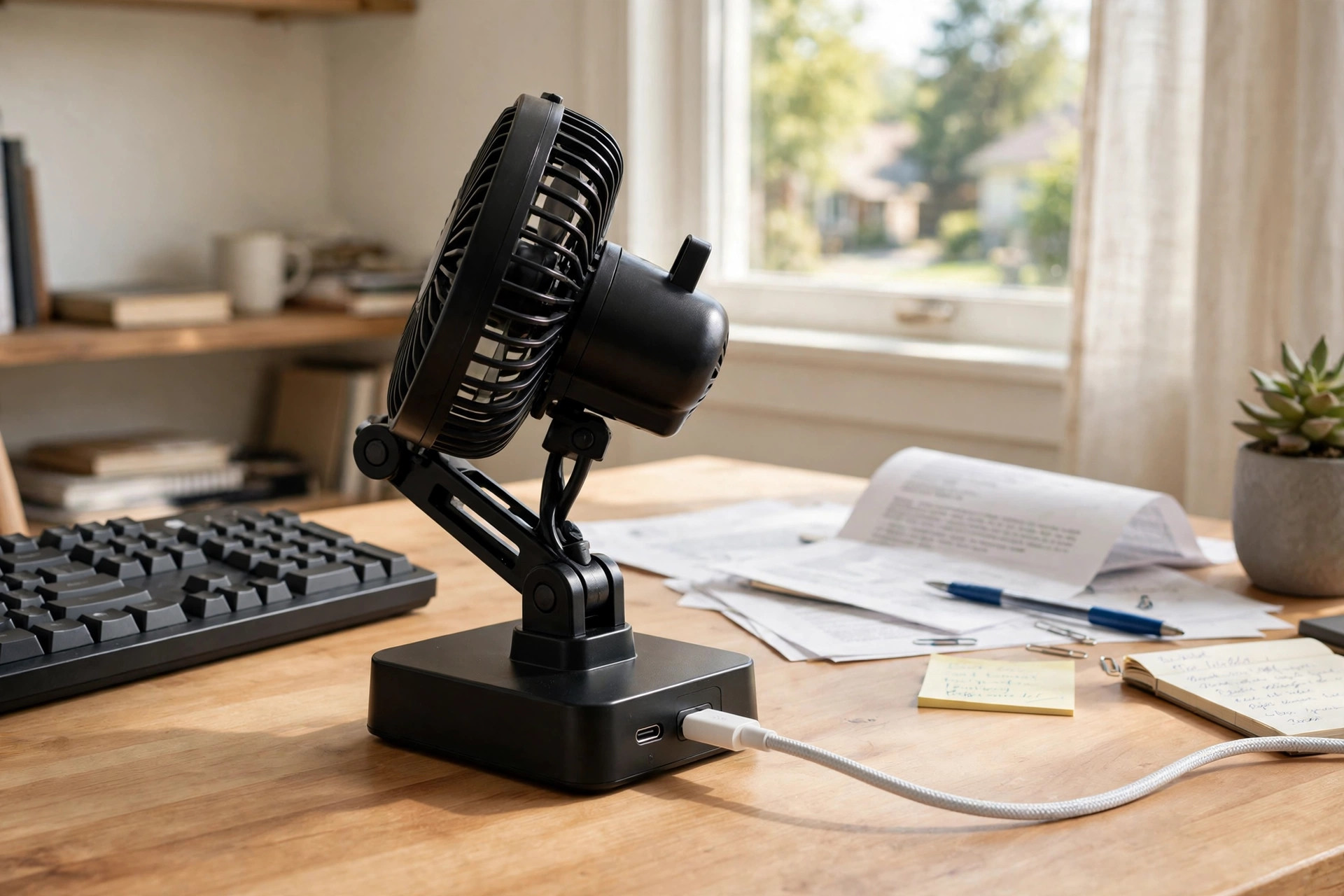

A hot desk makes a long day feel longer. Papers stick to your hands. Your neck feels warm. Your mind slows down. An adjustable desk fan with usb charging port can fix the heat and save you an outlet at the same time. It cools the air around you and charges your phone or small device from the same plug. This guide explains what the fan is, why it helps, and how to pick one that fits your desk and your work.
Why It Matters
A home office is a small space. A big room fan takes up floor room. Central air costs money to run all day. A small fan on the desk sends cool air right where you sit. That is all most people need on a warm afternoon.
The USB charging port adds a second job to the fan. Most desks have phones, earbuds, and watches that need power. Outlets behind a desk are hard to reach. With an adjustable desk fan with usb charging port, you plug the fan into the wall once. Then you plug your phone into the fan. The charger comes to you instead of you crawling under the desk.
This matters most in a small room. A corner desk with hutch for small home office leaves little spare space. Every item on it must earn its place. A fan that also charges a phone earns its place twice. It removes one cord from the mess behind the desk. It keeps your phone in view so you see calls and messages while you work.
Comfort also helps your work. Studies of office comfort have long shown that people think better when they are not too warm. A cool face and neck can lift your mood. You fidget less. You stay at your desk longer. A small fan costs far less than a new air conditioner, and it uses far less power.
What to Look for and How to Choose: Adjustable Desk Fan with Usb Charging Port
Start with size. Desk fans run from four inches to about twelve inches across. A four-inch fan suits a small desk or a shelf. A ten-inch fan suits a wide desk in a warm room. Measure the free space on your desk before you buy. Leave room for papers and a mug. A fan that crowds your keyboard will annoy you more than the heat did.
Look at the base. A heavy base keeps the fan steady. Some fans clamp to the desk edge. A clamp saves desk space. It works well on thin desks. Check that the clamp fits your desk top before you buy.
Adjustable tilt is the heart of an adjustable desk fan with usb charging port. The head should tilt up and down with one hand. Some models also swing side to side on their own. That swing is called oscillation. It spreads air across the desk. If you share the desk area with someone, oscillation helps both of you.
Check the speed settings. Three speeds are normal. Low for quiet work. Medium for a warm room. High for a hot afternoon. A fan with only one speed gives you no choice. Look for a knob or a button you can reach without standing up.
Noise matters in a home office. Fans are rated in decibels, though not every box prints the number. In general, a larger slow blade is quieter than a small fast blade. If you take video calls, a loud fan will hum in your microphone. Look for words like quiet, silent, or low noise on the box. If you can test the fan in a store, set it to high and listen. Guides on home office comfort, such as those at The Spruce, often stress that quiet tools protect your focus during calls.
Now look at the USB port. Check what kind it is. Older models have a USB-A port. Newer ones have USB-C. Make sure the port matches the cable your phone uses. Check the output. A port marked 5V/2A charges a phone at a normal pace. A port marked with fast charge or 18W charges faster. The fan itself still needs wall power for the motor. The USB port draws from the same wall plug.
Ask how the fan gets power. Most plug into a wall outlet. Some can also run on a rechargeable battery. A battery model can move to the porch or the kitchen. But a battery adds weight and cost. For a desk that never moves, a plug-in model is simpler and lasts longer.
Read the cord length. A short cord may not reach your outlet. A cord of four feet or more works for most desks. If your outlet is far, plan for a power strip.
Types and Options
Desk fans with USB ports come in a few common shapes.
The classic round fan looks like a small version of a room fan. It has three or four blades in a round cage. It moves the most air for its size. It tilts up and down. Many models add oscillation. This is the best pick for a warm room.
The bladeless fan has a ring with no visible blades. Air flows through the ring. It is easy to clean and safe for small fingers. It costs more and moves less air than a bladed fan of the same size. It looks modern on a clean desk.
The tower fan is tall and thin. It stands on the desk or on the floor beside it. It takes little desk space and spreads air in a wide path. Some tower models include a USB port on the base. Check the port location. A port low on the base is easy to reach.
The clip fan is tiny. It clips to a shelf or a monitor arm. It cools one person. It rarely has a USB charging port. It suits a very small desk where nothing else fits.
Some models add extras. A timer turns the fan off after you set it. A remote lets you change speed from your chair. A light or a night glow may help in a dark room. Extras add cost. Buy the extras you will use. Skip the rest.
When you plan your desk, think of the fan as part of a set. Good seating matters as much as cool air. An adjustable height stool for standing desk break gives your back a rest between long stretches of sitting. Cool air and a good seat together make the workday easier.
Cost and Price
A basic adjustable desk fan with usb charging port costs between fifteen and thirty dollars. It has three speeds, a tilt head, and one USB-A port. It does the job for most desks.
A mid-range model costs thirty to sixty dollars. It adds oscillation, a quieter motor, a USB-C port, or a timer. The build feels sturdier. The buttons feel better. This range gives the best value for daily home office use.
A high-end model costs sixty to one hundred twenty dollars. It may be bladeless, very quiet, or made by a known brand. It may have fast charging and a remote. Buy this level if the fan will run all day, every day.
Watch for hidden costs. A fan with a USB-C port may not include the cable. A clip model may need a separate mount. Shipping can add to the price on some sites. Retailers such as IKEA and Wayfair list full prices with shipping, so you can compare with no surprise at checkout.
A fan uses little power. A small desk fan draws about ten to thirty watts. That is less than a single old light bulb. The USB port adds a few watts when charging. Running the fan all day costs only a few cents in most homes. Over a summer, it costs far less than running central air for one more hour a day.
Sales help. Fans cost less in spring, when stores stock them. They cost more in a heat wave, when demand spikes. If you can wait, buy before summer starts.
Care and Upkeep
A clean fan moves more air and lasts longer. Dust gathers on blades and grilles. Wipe the grille with a damp cloth once a week. For a deep clean, unplug the fan first. Remove the front grille if the manual shows how. Wash the blades with mild soap and water. Dry every part before you put it back.
Do not let dust sit on the USB port. Dust in the port can block the cable. Blow it out with a short puff of air. A can of compressed air works well. Keep the puff short so no liquid sprays out.
Check the cord each month. Look for cuts or flat spots. A damaged cord is a fire risk. Stop using the fan if the cord feels hot. A warm plug is normal. A hot plug is not.
Oil is not needed on most modern fans. The motor bearings are sealed. If the fan starts to squeak, check the manual. Some models allow a drop of light machine oil on the shaft. Many do not. When in doubt, call the maker.
Store the fan well in winter. Clean it. Wrap the cord loosely. A tight wrap can crack the wire inside. Put the fan in a box or a closet. Keep it dry. A fan stored damp can rust.
The USB port needs little care. Use good cables. Cheap cables can fit loose and wear the port. Pull the cable straight out. Do not yank it sideways. If the port feels loose, stop using it for charging. The fan part still works fine.
Safety
Read the manual before first use. It takes five minutes. It tells you how to clean the fan and what not to do.
Keep water away. Do not put the fan near a sink or a plant you mist. Do not charge a phone with wet hands while touching the fan. Water and wall power do not mix.
Keep the fan stable. Put it on a flat surface. Keep it away from the desk edge. A fan that falls can break its blades or pull its cord. If you use a clamp model, tighten the clamp well.
Mind the blades. A cage grille keeps fingers out. Teach children not to poke sticks or toys through the grille. A bladeless model removes this worry.
Do not cover the fan. Do not drape clothes over it. The motor needs air to stay cool. A covered motor can overheat.
Unplug during storms. A strong surge can harm the motor and anything charging on the USB port. A simple surge protector helps. Unplugging is safest.
Check ratings. In the United States, look for a UL or ETL mark on the fan or its box. The mark means a lab tested it for safety. Reviews and guides at Wirecutter and PCMag often note which models carry these marks.
FAQ
Can I charge any phone from the fan’s USB port? Most phones charge fine. The port gives standard USB power. Very old phones and some fast-charge phones may charge at normal speed, not fast speed. Check your phone’s needs against the port’s output on the box.
Will the fan still work if I do not use the USB port? Yes. The USB port is extra. The fan runs the same with or without a cable plugged in.
Can the fan run on USB power alone? Most models cannot. The fan motor needs wall power. The USB port is an output, not an input. A few battery models can run unplugged for a few hours. Read the box to be sure.
Is it safe to leave the fan on all night? A well-made fan can run for hours. Give it space. Keep it clean. Do not cover it. If the motor smells hot or sounds wrong, turn it off and let it cool. For sleep, many people prefer the low setting.
Does the USB port slow the fan down? No. The fan and the port draw power side by side from the wall. Charging a phone does not change the fan speed.
How loud are these fans? It varies. Small cheap fans can hum on high. Larger or mid-range fans often run quiet. If noise matters, look for a low decibel rating or a quiet mark on the box. Brand guides from makers like Herman Miller, Steelcase, and UPLIFT Desk treat low noise as a key part of office comfort, and their advice applies to small desk tools too.
A Short Final Word
An adjustable desk fan with usb charging port is a small tool that does two jobs. It cools your desk. It charges your phone. Pick a size that fits your desk. Pick a noise level that fits your work. Check the USB type before you buy. Keep it clean and it will serve you for years.
Your desk should feel like a good place to work. Cool air helps. A tidy desk helps. Simple art on the wall helps. If you want ideas for the wall behind your calls, look at home office wall art for professional background. Small changes add up. A fan, a good seat, and a clean desk can turn a warm, dull room into a place where work gets done.
References
Herman Miller. (n.d.). Office furniture and ergonomic seating. https://www.hermanmiller.com IKEA. (n.d.). Home furnishings. https://www.ikea.com PCMag. (n.d.). Technology product reviews. https://www.pcmag.com Steelcase. (n.d.). Office furniture and workplace research. https://www.steelcase.com The Spruce. (n.d.). Home and garden advice. https://www.thespruce.com UPLIFT Desk. (n.d.). Standing desks and ergonomic office furniture. https://www.uplift-desk.com Wayfair. (n.d.). Furniture and home goods. https://www.wayfair.com Wirecutter. (n.d.). Product reviews from The New York Times. https://www.nytimes.com/wirecutter
Was this guide helpful?

About Emily Rodriguez
The My Garden US editorial team writes practical, in-depth home and garden guides for American homeowners — tested advice, no fluff.
You May Also Like

Home Office Filing Cabinet Lateral Two Drawer: A Complete Guide
February 6, 2026 0 views
Home Office Wall Clock With Silent Movement
May 7, 2026 0 views
Ergonomic Chair for Home Office with Arms: A Practical Buying Guide
April 27, 2026 0 views