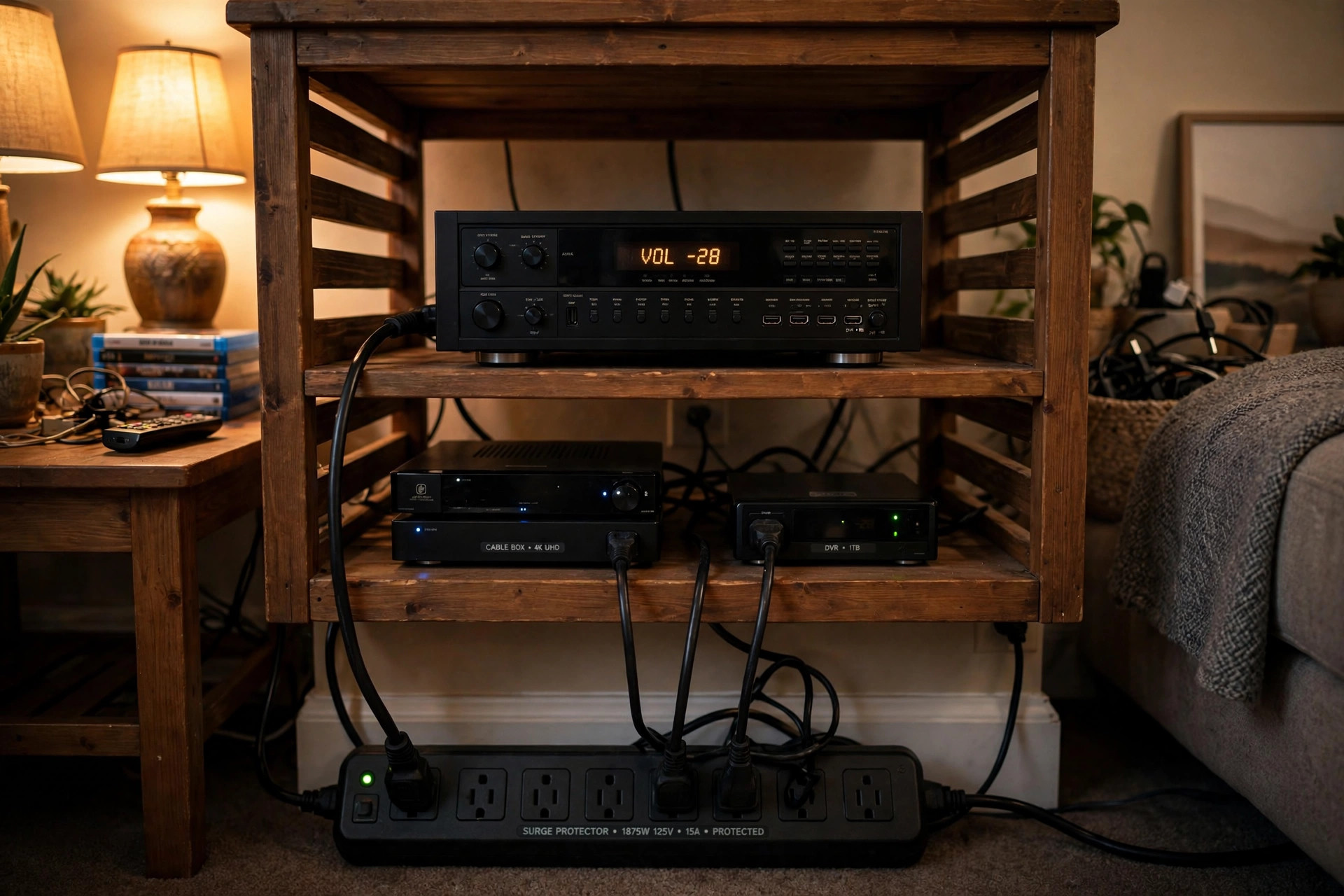

A search for the best surge protector for home theater usa is really a search for peace of mind. You may own a large television, a receiver, a subwoofer, a Blu-ray player, and a game console. Together they can cost several thousand dollars. One bad storm or one fault in the power grid can harm them in a single moment. A surge protector stands between the wall and your gear. It is a small box with a big job.
Many people think any power strip will do. That is a mistake. A plain power strip only gives you more outlets. It does not guard against voltage spikes. A true surge protector does. This guide will show you how they work, what numbers matter, which types fit a home theater, and how much you should pay. It is written for the American home, where wall power runs at about 120 volts and storms are a fact of life.
Why It Matters
Power surges are short bursts of high voltage. Most last only a fraction of a second. They have many causes. Lightning is the most famous one. A strike need not hit your house to cause harm. It can hit a power line far away and send a pulse through the grid. Your home wiring can also make surges. Large motors in air conditioners and refrigerators can push small spikes into your lines when they start and stop.
A home theater is a prime target. It has many boxes plugged into one spot. It has parts that are always partly on, even in standby. Sensitive circuits in televisions and receivers do not forgive a sudden spike. A surge can burn a main board, knock out an HDMI input, or weaken parts so they fail months later. Repair shops see this pattern every summer storm season.
A surge protector absorbs or diverts the extra voltage. Its inner parts, called metal oxide varistors, clamp the voltage down to a safe level. They wear out over time as they take hits. This is normal. It is why a good unit has an indicator light that tells you protection is still active. When the light goes out, the box is just a power strip. It is time to replace it.
The value is simple math. A good unit for a theater costs about fifty to one hundred and fifty dollars. One repair to a high-end receiver can cost far more. For most owners, the best surge protector for home theater usa is the cheapest insurance they will ever buy.
What to Look for When You Choose One: Best Surge Protector for Home Theater Usa
Joule Rating
The joule rating tells you how much surge energy the unit can absorb over its life. A higher number means a longer and stronger guard. For a home theater, look for at least 2,000 joules. Units with 3,000 joules or more are better for areas with frequent storms. Numbers below 1,000 joules are fine for a lamp or a clock, but not for a theater.
Clamping Voltage
This is the voltage level at which the unit starts to work. Standard wall power in America is about 120 volts. A clamping voltage of 330 volts is best for home theater gear. Some cheaper units clamp at 400 or 500 volts. That lets too much through for sensitive electronics. Always check this number on the box.
Response Time
Surges happen fast. The protector must react fast. Most modern units react in less than one nanosecond. This number is less important today than it used to be, since almost all quality units are quick enough. Still, do not buy a unit that does not list it.
Number and Spacing of Outlets
A theater needs many outlets. Count your devices. A television, a receiver, a subwoofer, a disc player, a streaming box, a game console, and a cable box make seven. A twelve-outlet unit gives you room to grow. Look for wide spacing. Power bricks for game consoles and chargers are fat. They cover nearby outlets if the spacing is tight.
Coaxial, Telephone, and Ethernet Protection
Surges do not only come through the power cord. A lightning pulse can ride a cable television line or a phone line into your set-top box. It can travel a network cable into your streaming box. Good theater units have jacks for coaxial cable, phone lines, and Ethernet. Use them. Protection on only the power cord leaves a back door open.
UL 1449 Listing
In the United States, a surge protector should carry a UL 1449 listing. UL is an independent testing body. The 1449 standard covers surge protective devices. This mark is not a luxury. It means the unit passed real safety tests. A guide to wireless outdoor security camera reviews 2026 may help you guard the outside of your home, but inside, the UL mark is your baseline.
Types of Surge Protectors for Home Theater
Basic Power Strip with Surge Guard
These are the slim units sold in big-box stores. They cost fifteen to thirty dollars. They often have 1,000 to 2,000 joules and six to eight outlets. They are better than nothing. For a full theater, they are a weak choice. They lack wide outlet spacing and line protection. They suit a single television in a bedroom, not a rack of gear.
Mid-Range Theater Units
These are the workhorses. They cost about forty to ninety dollars. They offer 2,000 to 4,000 joules, a 330-volt clamp, ten to twelve outlets, and coaxial and Ethernet jacks. Many have a right-angle flat plug that sits close to the wall. Some add USB charging ports for remotes and phones. For most families, this class holds the best surge protector for home theater usa shoppers should shortlist.
Advanced Units with Power Conditioning
These units cost one hundred to two hundred fifty dollars. They add power conditioning, which smooths out small voltage ups and downs. They may cut electrical noise that causes hum in speakers or lines in a picture. They often have a display that shows line voltage. Some can be turned on in stages with a master switch, so one button wakes the whole rack. Serious hobbyists like these. Review sites such as CNET and PCMag often test models in this class.
Whole-House Surge Protection
An electrician can install a surge device at your breaker panel. It guards every circuit in the house. It costs about two hundred to five hundred dollars installed. It is a strong first wall of defense. It does not replace a point-of-use unit at the theater, though. Experts advise both: the panel unit takes the big hit, and the theater unit catches what gets through. If you run a home backup battery, a tesla powerwall vs generac pwrcell comparison can help you plan the rest of your power system.
Cost and Price
Prices in America fall into clear bands. Under thirty dollars buys a basic strip with light protection. Forty to ninety dollars buys a solid theater unit with the right ratings and line jacks. One hundred to two hundred fifty dollars buys conditioning and displays. A panel-level device, installed by an electrician, runs two hundred to five hundred dollars.
Many makers offer a connected equipment warranty. This is a promise to pay for gear damaged while plugged into their unit, up to a stated amount. Read the fine print. These warranties often require registration within days of purchase. They often require that every line, including cable and network, passed through the unit. Keep your receipt and the box. A warranty is a nice extra, but the joule rating and the UL mark matter more.
Do not buy a unit at a yard sale or use one that is ten years old. The parts inside wear out with each surge. You cannot see the wear. A new unit of known age is the only safe bet.
Care and Upkeep
A surge protector needs little care, but it is not a lifetime device. Follow these simple rules.
Check the protection light every few months. It is usually green or red and marked as protection or grounded. If it is off, replace the unit. If your unit has a ground light and it is off, your wall outlet may not be grounded. An ungrounded outlet cuts the protector’s power. Call an electrician.
Replace the unit after a known lightning strike nearby, even if the light is still on. A big hit can use up most of the parts inside. Also plan to replace a unit every three to five years in storm country. In calm areas, five to seven years is a fair rule.
Keep the unit cool and dry. Do not hide it under a pile of blankets or behind a hot amplifier. Heat shortens its life. Keep it where you can reach the master switch. Dust the vents once or twice a year with a dry cloth.
Plug the unit straight into the wall. Do not plug one surge protector into another. This is called daisy chaining. It can trip breakers and void the warranty. If you need more outlets, buy a bigger unit.
Unplug the theater during a severe storm if you can do it safely. No protector can stop a direct lightning strike. The best habit during a bad storm is still the old one: unplug. Smart home owners who also run best mesh wifi for smart home 2026 usa networks should protect their router the same way.
Safety
Safety rules are short and firm. Buy a unit listed to UL 1449. Plug it directly into a grounded wall outlet. Never cut off the ground pin to fit an old two-slot outlet. Never use a unit with a cracked case, a loose plug, or a burned smell. The U.S. Consumer Product Safety Commission recalls unsafe electrical products, and it is worth checking its site before you buy an unknown brand.
Do not run the unit’s cord under a rug or through a wall. Cords can overheat where you cannot see them. Do not overload it. Add up the watts of your gear. A television, a receiver, and a subwoofer can draw several hundred watts. Most units handle 1,800 watts on a 15-amp circuit. Stay under that.
If you have small children, pick a unit with outlet covers or sliding safety shutters. Keep the box behind the stand where small hands cannot reach it. Consumer Reports and The Verge both publish safety notes on home electronics worth a read.
During setup, connect the coaxial cable from the wall to the unit’s in jack, then run a short cable from the out jack to your box. Do the same for the phone or network line if your gear uses one. This closes the back door that surges love.
Frequently Asked Questions
How is a surge protector different from a power strip?
A power strip only adds outlets. A surge protector adds outlets and also blocks voltage spikes. Many strips are sold with the word surge on the box, but only a UL 1449 listing proves it. Check for the mark and a joule rating before you buy.
What joule rating do I need for a home theater?
Aim for at least 2,000 joules. In areas with many storms, 3,000 joules or more is better. Higher is better because the parts wear down with each surge they absorb. A low rating is fine for a lamp, but a theater deserves more.
Does the clamping voltage really matter?
Yes. It is one of the most important numbers. A 330-volt clamp is best for home theater gear. Cheaper units that clamp at 400 or 500 volts let more voltage reach your television and receiver. Always pick the lower number when you have a choice.
Can a surge come through the cable line or the internet cable?
Yes. Lightning can ride a cable television line, a satellite line, a phone line, or a network cable into your equipment. That is why theater units include coaxial, phone, and Ethernet jacks. Route every wire through the unit, not just the power cords.
How do I know when to replace my surge protector?
Watch the protection indicator light. When it goes out, protection is gone. Also replace the unit after a close lightning strike and every three to five years in storm-prone areas. Keep the receipt so you can use the maker’s warranty if gear is ever damaged.
Should I get a whole-house unit too?
If you can, yes. A panel-mounted device guards every circuit in the home and takes the edge off big surges. Pair it with a good point-of-use unit at the theater for the best result. Smart security brands such as Ring, SimpliSafe, and ADT also advise layered protection for the electronics that guard your home, and the Google Store lists many of the smart devices that benefit from the same habit.
A Final Word
The best surge protector for home theater usa shoppers can buy is the one with the right ratings, the right number of outlets, and a UL 1449 mark, bought new and replaced on time. It will not impress your guests. You will never see it work. That is the point. It sits quiet behind the stand while storms pass, so the movie plays on. Buy the right unit, wire every line through it, check the light now and then, and your theater will be ready for whatever the grid sends its way.
References
ADT. (n.d.). Home security and automation. https://www.adt.com CNET. (n.d.). Technology news and reviews. https://www.cnet.com Consumer Reports. (n.d.). Product reviews and ratings. https://www.consumerreports.org Google Store. (n.d.). Smart home devices. https://store.google.com PCMag. (n.d.). Technology product reviews. https://www.pcmag.com Ring. (n.d.). Smart home security devices. https://www.ring.com SimpliSafe. (n.d.). Home security systems. https://www.simplisafe.com The Verge. (n.d.). Technology news and reviews. https://www.theverge.com U.S. Consumer Product Safety Commission. (n.d.). Product safety information. https://www.cpsc.gov
Was this guide helpful?

About Emily Rodriguez
The My Garden US editorial team writes practical, in-depth home and garden guides for American homeowners — tested advice, no fluff.
You May Also Like
Dual Fuel Generator Reviews for Home Use USA
March 4, 2026 0 views
Best Nanny Cam Hidden Camera Reviews USA: A Plain Guide for Parents
July 25, 2026 0 views
Smart Doorbell Chime Extender Reviews USA: What American Buyers Say
September 23, 2026 0 views