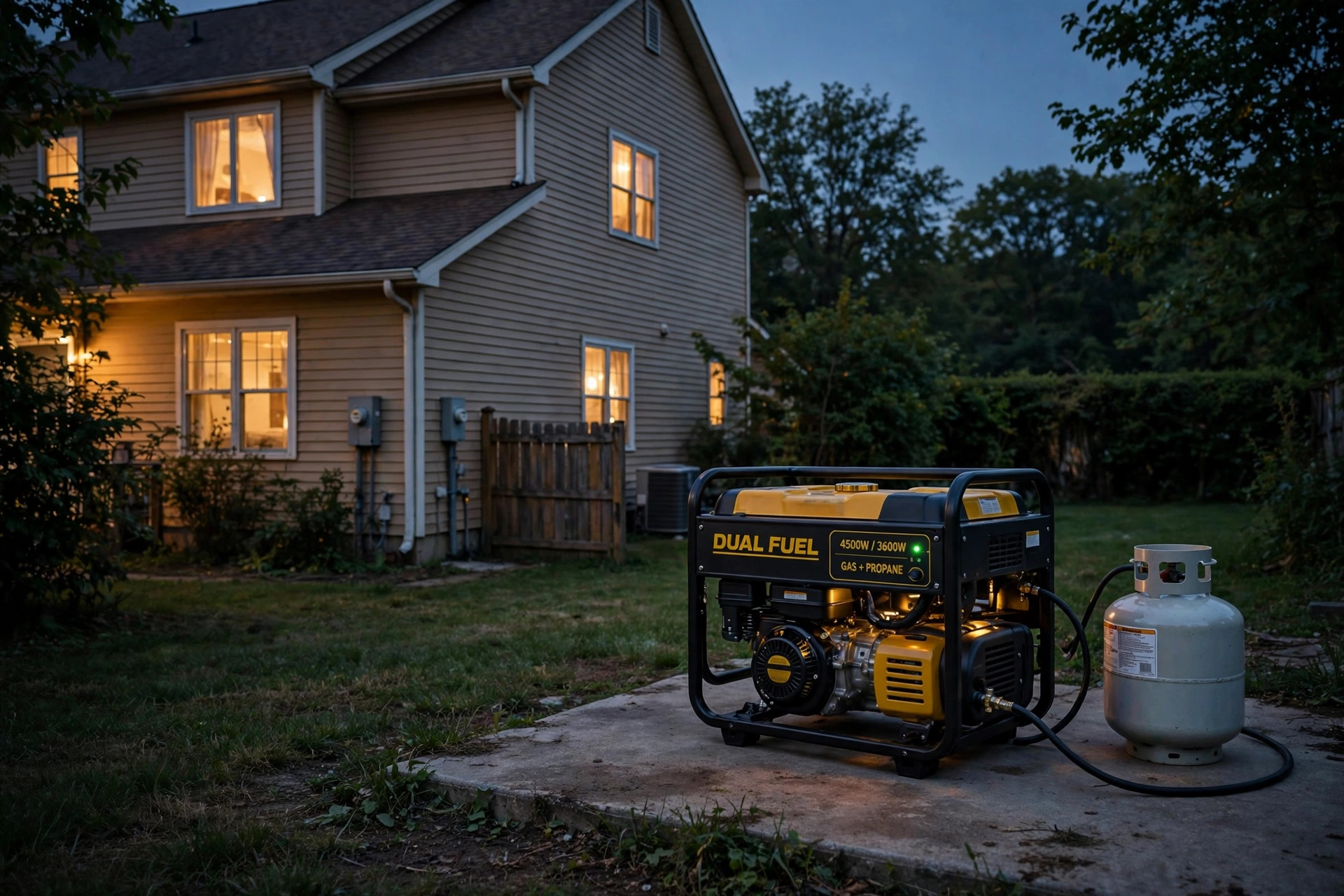

Storms and grid failures have made home backup power a common worry across the country. This guide to dual fuel generator reviews for home use USA looks at machines that run on both gasoline and propane and shows what honest buyers should check before they spend money.
Why a Dual Fuel Generator Matters for an American Home
A blackout does more than turn off the lights. Food in the refrigerator starts to warm. Heating and cooling stop. In winter, pipes can freeze when the furnace dies. In summer, a heat wave without air conditioning can be a real health risk for older people and small children.
A dual fuel generator solves one old problem. A gasoline-only machine is useless when the tank runs out or when local stations lose power and cannot pump fuel. A dual fuel model gives you a second choice. Propane stores well for years and does not go stale like gasoline.
Reviews matter because prices are not small. A good unit can cost from several hundred to several thousand dollars. Real users report how loud the machine is, how easy it is to start, and whether it truly powers what it claims. These details rarely appear on the box.
Backup power also protects your smart home. Doorbell cameras, alarm panels, and Wi-Fi routers all die in a blackout. A generator keeps home security cameras and alarm systems running through the night. If you want a fume-free indoor option for small loads as well, read up on solar generator choices for home backup as a complement.
What to Look For When You Read Reviews: Dual Fuel Generator Reviews for Home Use Usa
Not every review is worth your time. Some are short. Some are paid. The best dual fuel generator reviews for home use USA share certain traits, and you should learn to spot them.
First, look for running wattage and starting wattage. Running watts are the steady power the machine can give. Starting watts are the short burst it gives when a motor kicks on, such as a refrigerator compressor or a well pump. A review should name both numbers on each fuel. Propane usually gives slightly fewer watts than gasoline. A careful reviewer will say so.
Second, check the noise level. A number near 60 to 70 decibels is common for open-frame models. A good review will say how the machine sounds in a real yard.
Third, note the run time. Reviewers often test how long a full tank of gasoline or a standard propane tank lasts at half load. The independent test results from testing labs give you a fair baseline.
Fourth, read about the start system. Pull-start models are simple and cheap. Electric start models need a battery, which is one more part to maintain. Remote start matters in bad weather, when you do not want to walk outside in a storm.
Types and Options on the American Market
Dual fuel generators come in a few broad types. Knowing them helps you sort through dual fuel generator reviews for home use USA without confusion.
Open-frame portable models are the most common. They have an exposed metal frame, wheels, and a strong engine. Sizes range from about 4,000 to 13,000 starting watts. These are workhorses. They power refrigerators, lights, fans, sump pumps, and small window air conditioners. They are loud, so they suit larger lots better than tight suburbs.
Inverter dual fuel models are quieter and gentler on electronics. An inverter makes clean power that is safe for computers, televisions, and phones. These cost more per watt, but they suit homes full of sensitive devices. Reviewers who cover home electronics and backup gear often note the value of clean power.
Large standby-ready portables sit between portable and permanent. They are big wheeled units with high wattage and electric start. Some buyers pair them with a manual transfer switch installed by an electrician, which feeds chosen circuits through a proper panel.
Small dual fuel units under 4,000 watts suit light duty at home. They run a few lights, charge phones, and keep a small fridge cold. Reviews of these machines often focus on weight and fuel use rather than raw power.
When you compare reviews across types, keep your own needs in front of you. A family of five with a well pump and central air needs a far bigger machine than a couple in a small townhouse.
Fuel Choice: Propane vs. Gasoline
The heart of every review in this class is the fuel question. Each fuel has plain strengths and plain limits.
Gasoline gives slightly more power and is easy to buy. But gasoline goes stale in months. It can gum up the carburetor if the machine sits unused. Storing large amounts of gasoline at home also carries fire risk, and local rules may limit how much you can keep.
Propane burns cleaner and stores for years without going bad. A twenty-pound grill tank is easy to swap. Propane engines often need less maintenance because the fuel leaves fewer deposits. The trade-off is a small loss of power, often around ten percent, and the need to keep tanks on hand before a storm.
Many reviewers test both fuels on the same machine and report the difference. This is the most useful part of dual fuel generator reviews for home use USA. A reviewer who only tested gasoline has not really reviewed a dual fuel machine.
If you live where hurricanes or ice storms are common, think about which fuel you could actually get during a week-long outage. Gas stations may close. Your answer decides which fuel you will lean on.
Cost and Price Ranges in 2026
Prices for dual fuel generators in the United States fall into clear bands.
Small dual fuel inverter models, around 2,000 to 3,500 starting watts, often sell for 400 to 800 dollars. These suit light backup duty.
Mid-size open-frame models, around 7,500 to 10,000 starting watts, often sell for 800 to 1,500 dollars. This is the most popular band for family backup. It can run a refrigerator, a freezer, lights, fans, a sump pump, and a window air conditioner at once.
Large models, 11,000 starting watts and above, often sell for 1,500 to 3,000 dollars or more.
Do not forget the extra costs. A transfer switch installed by a licensed electrician can add 500 to 1,500 dollars. Heavy outdoor extension cords, propane tanks, oil, filters, and a weather cover add more. Honest cost guides from home improvement reviewers remind buyers to count these extras.
How to Choose the Right Size for Your House
Choosing size is the step where most buyers go wrong. Too small, and the generator trips when the refrigerator kicks on. Too big, and you burn fuel and money for power you never use.
Start by listing what must run during an outage. A refrigerator draws about 150 to 200 running watts but needs 600 to 1,200 starting watts. A sump pump needs similar starting power. A window air conditioner may need 1,000 to 2,000 watts. Lights, phone chargers, and a Wi-Fi router add only a little.
Add the running watts of everything you plan to run at once. Then add the highest single starting watt figure on top. This gives you a rough target. Buy a generator whose running watts on propane, not just gasoline, meet this target with room to spare.
Reviews help here when they describe real loads. A reviewer who ran a fridge, a freezer, and a furnace blower at once gives you more useful facts than a spec sheet. Buyers of portable backup units often share these load lists in detail, and those lists transfer well to dual fuel shopping.
If you are torn between two sizes, the larger one is usually the safer pick, as long as your budget allows it. A machine running at half load lasts longer and uses fuel more calmly.
Care and Upkeep Through the Years
A generator that sits in a garage for two years and then fails in a storm is a common sad story. Simple care prevents it.
Run the machine every two to three months for fifteen to twenty minutes with a real load, such as a space heater. Change the oil after the first break-in hours and then on the schedule in the manual. Check the air filter once a year.
Propane makes upkeep easier because it does not leave stale fuel behind. Still, if you plan to keep gasoline as your backup fuel, run the machine on it now and then. Stale gasoline is the top cause of dead generators. Many reviews mention adding fuel stabilizer to stored gasoline. This is sound advice.
Store the generator dry and covered. A shed or garage is fine. Do not store it in the house or in an attached garage with fuel in it. Keep propane tanks upright, outdoors, away from heat.
Keep a small kit with the machine: extra oil, a spare air filter, a spare spark plug, and the manual in a sealed bag. In an outage, stores may be closed.
Safety Rules Every Owner Must Follow
Generator safety is not optional reading. Mistakes can kill. The federal product safety agency warns each year about carbon monoxide deaths tied to portable generators.
Never run a generator indoors. Not in the garage with the door open. Not in the basement. Place it at least twenty feet from the house, with the exhaust pointing away from windows and doors. Carbon monoxide is odorless and colorless. You cannot smell danger coming.
Install battery-powered carbon monoxide alarms on every floor of your home. Test them monthly. If an alarm sounds during generator use, turn the machine off, leave the house, and call for help from outside.
Let the engine cool before you refuel. Spilled gasoline on a hot engine can catch fire.
Do not backfeed power into your home wiring by plugging the generator into a wall outlet. This sends power back out to utility lines and can kill line workers. It can also start fires in your walls. The safe path is a proper transfer switch or interlock device installed by a licensed electrician.
Keep children and pets away from the hot, loud machine. Store fuel out of their reach. Teach every adult in the house how to start and stop the generator.
Reading Brand Comparisons With Care
Many shoppers search for brand versus brand generator comparisons before they buy. These can help, but read them with care.
A fair comparison tests machines of similar size and price. It runs the same loads on both. It notes noise, fuel use, and warranty side by side. A weak comparison picks a big machine from one brand and a small one from another, then declares a winner. That tells you nothing.
Warranty terms deserve real attention. Most portable generators carry two to three years of limited coverage. Read what the warranty excludes. Reviews that describe a warranty claim from start to finish are worth more than the warranty page itself.
Customer service quality shows up in reviews again and again. When you read dual fuel generator reviews for home use USA, give extra weight to reviews written a year or more after purchase. Early reviews praise the box and the first start. Late reviews tell you whether the machine still works.
Frequently Asked Questions
How long will a dual fuel generator run on a propane tank? A standard twenty-pound grill tank holds about four and a half gallons of propane. On a mid-size generator at half load, that often gives eight to ten hours. Larger tanks last longer in direct proportion.
Is propane or gasoline better for a home generator? Propane stores longer, burns cleaner, and avoids stale-fuel problems. Gasoline gives slightly more power and is easier to buy in normal times. Most owners keep both on hand and choose by the situation.
Can a dual fuel generator power my whole house? Most portable dual fuel models cannot run a whole house with central air, an electric stove, and an electric water heater all at once. They can power chosen circuits through a transfer switch: fridge, freezer, lights, furnace blower, sump pump, and one air conditioner.
Are dual fuel generators safe for computers and TVs? Inverter dual fuel models make clean power that is safe for sensitive electronics. Standard open-frame models make rougher power. Many owners run electronics through a surge protector or a small uninterruptible power supply as a buffer. Reviews aimed at tech and gadget buyers often test this exact question.
How loud are they really? Open-frame models often rate around 70 decibels at a set distance, about as loud as a vacuum cleaner. Inverter models can be near 60 decibels or lower, closer to normal conversation. Real-yard tests in reviews matter more than lab numbers.
What maintenance does a dual fuel generator need? Change the oil on schedule, check the air filter, inspect the spark plug, and exercise the machine every few months. Check propane hoses for cracks. Keep the battery charged on electric start models. Most of this takes less than an hour a year.
A Short Final Word
A dual fuel generator is a practical tool, not a luxury toy. It keeps food cold, rooms warm or cool, and security systems awake when the grid goes dark. The best way to buy one is to read widely, trust reviews that show real tests and real flaws, and match the machine to your true needs.
Use the checklists in this guide when you read dual fuel generator reviews for home use USA. Compare wattage on both fuels. Note noise and run time. Count the full cost with installation and extras. Follow the safety rules without exception.
For help keeping security gear online during outages, see guides on monitored alarm options and self-monitored alarm kits. Smart speakers and displays from the major smart home store also benefit from steady backup power.
References
ADT. (n.d.). Home security and automation. https://www.adt.com CNET. (n.d.). Technology news and reviews. https://www.cnet.com Consumer Reports. (n.d.). Product reviews and ratings. https://www.consumerreports.org Google Store. (n.d.). Smart home devices. https://store.google.com PCMag. (n.d.). Technology product reviews. https://www.pcmag.com Ring. (n.d.). Smart home security devices. https://www.ring.com SimpliSafe. (n.d.). Home security systems. https://www.simplisafe.com The Verge. (n.d.). Technology news and reviews. https://www.theverge.com U.S. Consumer Product Safety Commission. (n.d.). Product safety information. https://www.cpsc.gov
Was this guide helpful?

About Michael Thompson
The My Garden US editorial team writes practical, in-depth home and garden guides for American homeowners — tested advice, no fluff.
You May Also Like

Residential Solar Cost Per Watt 2026 USA: A Plain Guide for Homeowners
May 20, 2026 0 views
Smart Curtain Rod Reviews for Sliding Doors: A Practical Buying Guide
August 29, 2026 0 views
Fireproof Safe for Home Reviews 2026 USA: What Buyers Should Know
September 16, 2026 0 views