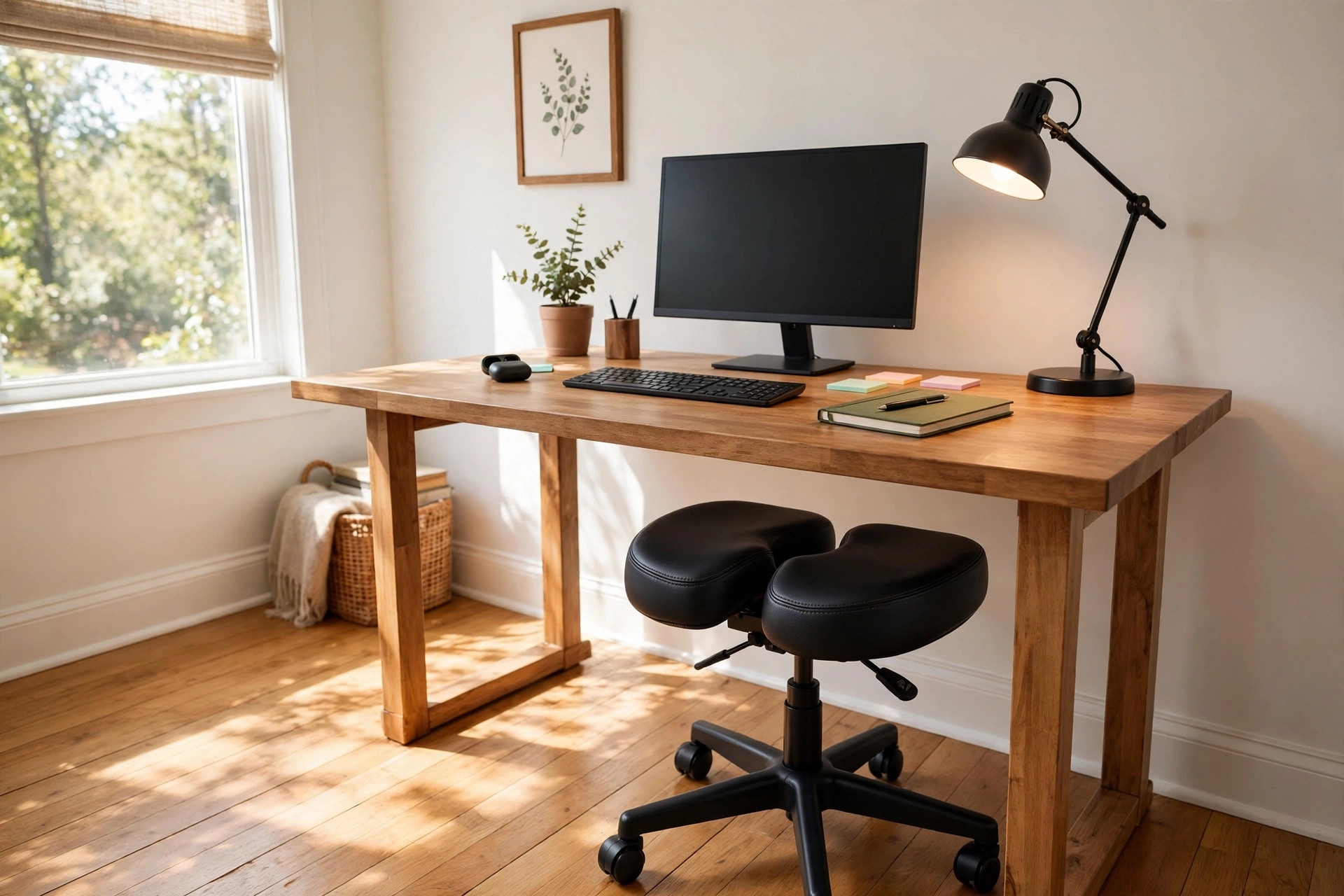

Many people who work at home stand for part of the day. A raised desk feels good at first. The back straightens. The legs move. Then, after an hour or two, the feet ache. The knees complain. The lower back grows tired. An ergonomic saddle stool for standing desk alternative offers a middle path. It is not a chair. It is not quite standing either. It places the body in a perched pose, higher than a chair and lower than full standing. The seat looks like a horse saddle. The legs drop open on each side. The spine holds its natural curve.
This guide explains what a saddle stool is, why it helps, and how to choose one for a home office. It covers types, prices, care, and safety. It answers common questions. By the end, the reader will know if this seating style fits their daily work.
Why It Matters
Sitting all day strains the body. The hips fold tight. The spine rounds forward. The neck bends down toward the screen. Hours pass. The shoulders hunch. Pain creeps in at the neck, the shoulders, and the lower back. Doctors and workplace researchers have noted these patterns for decades. Herman Miller has studied seating posture for many years, and Steelcase has published research on how posture shifts during the workday. Both agree on one point: the body was built to move, not to hold one pose.
Standing desks helped. They let workers rise and stretch. But standing still for hours brings its own problems. Feet swell. Knees stiffen. The lower back tires. Many workers end up sitting right back down.
The saddle stool sits between these two extremes. It keeps the hips open at a wider angle than a chair. This open angle lets the pelvis tilt forward in a natural way, so the spine holds its curve with less effort. The feet stay on the floor and carry some weight, so the legs stay active.
How a Saddle Stool Changes the Way You Sit: Ergonomic Saddle Stool for Standing Desk Alternative
A flat chair seat lets the hips close to about ninety degrees. In that pose, the pelvis often rolls backward. The lower back flattens. The muscles of the trunk work hard to hold the spine up. Over time, the disc pressure in the lower back rises. A saddle stool changes the geometry. The seat slopes down at the front and back, like a saddle. The knees drop below the hips. The hip angle opens to roughly one hundred twenty to one hundred thirty-five degrees.
This wider angle matters. The pelvis can tilt forward with ease, so the lower back keeps its gentle inward curve. The trunk muscles relax. The shoulders fall back without force. Many users report that they breathe more deeply in this pose. The chest opens. Blood flows freely through the legs because the seat edge does not press hard under the thighs.
Movement is easy on a saddle stool. The body pivots and the stool swivels with the turn, so the worker reaches left or right without rising. This small, constant motion feeds the joints and muscles and keeps the mind alert.
What to Look for When You Choose One
Saddle stools vary a great deal. Prices range from budget models to professional-grade seats. The right choice depends on the body, the desk, and the hours of use. The sections below list the points that matter most.
Seat Shape and Size
The seat may be one piece or split into two pads. A one-piece seat feels firm and simple. A split seat has a gap in the middle. The gap relieves pressure under the tailbone and improves airflow on warm days. Wider seats suit larger bodies. Narrow seats suit smaller frames. The padding should be firm, not soft. Soft foam bottoms out and presses on the nerves. A firm seat with a slight give holds the pelvis steady.
The cover material counts. Vinyl and faux leather wipe clean and suit homes with pets or children. Fabric covers breathe better but stain more easily. Some seats use mesh tops for airflow. Check the seams. Sharp seams under the thighs cause irritation after a few hours.
Height Range
Height range is the single most important spec. The stool must reach the right height for the desk. Measure the desk surface height first. A person of average height needs a seat height of roughly twenty-six to thirty-four inches for a raised desk. Shorter users may need less. Taller users may need more. A good pneumatic cylinder adjusts smoothly and holds its height under weight. Cheap cylinders sink slowly through the day. Look for a class-four gas lift, which carries more weight and lasts longer.
The range should also cover a standard desk if the stool will serve double duty. Some stools drop low enough for a normal chair desk. Others stay high and suit only standing-height desks. Match the range to the real setup at home.
Base, Casters, and Stability
A five-star base gives the best stability. The legs should reach wide. Narrow bases tip when the user leans. Casters matter on hard floors and rugs. Soft casters suit wood and tile. Hard casters suit carpet. Braking casters lock the stool in place, which helps users who push away too easily. The base material can be plastic, aluminum, or steel. Metal bases last longer and feel solid. A footrest ring helps on tall stools. It gives the feet a place to rest so they do not dangle.
Weight capacity should exceed the user weight by a safe margin. Most home models hold between two hundred and two hundred fifty pounds. Heavy-duty models hold three hundred or more. IKEA and other large furniture retailers publish clear capacity ratings, which makes comparison simple.
Types and Options
Saddle stools fall into a few broad groups. Each group fits a different need and budget.
Basic saddle stools have a fixed saddle seat, a simple gas cylinder, and a plastic base. They cost the least and suit light use of two to four hours a day. Split-seat stools have two separate pads with a center gap. The gap relieves pressure and improves airflow. They suit long days at the desk but cost more. Drafting-style saddle stools rise higher and include a footrest ring. They suit tall desks and drawing tables. Professional and medical-grade stools use strong cylinders, metal bases, and dense foam. They cost the most and suit full-time use. Some stools add a small backrest for long calls, though many users skip it since the open pose itself supports the spine.
Cost and Price
Prices vary by build and brand. Budget saddle stools sell for roughly sixty to one hundred twenty dollars. They suit trial use and light duty. Mid-range stools cost about one hundred fifty to three hundred dollars. They offer better cylinders, wider seats, and sturdier bases. They suit daily use. Professional models run from three hundred to six hundred dollars or more. They use top-grade parts and carry long warranties.
Price tracks with the cylinder and the base. A strong gas lift and a metal base add cost and years of life. A cheap stool may last a year of daily use. A well-built stool can last five years or more. Buyers should weigh the daily hours against the price. A stool used for seven hours a day earns a bigger budget than one used for one hour.
Shoppers can compare models at large retailers. Wayfair lists many saddle stools with buyer reviews. Staples and Office Depot carry office seating with clear specs. The Spruce offers buying guides for home office furniture. Reviews from real buyers reveal how a stool feels after weeks of use, which matters more than a first impression.
Setting Up the Stool at a Standing Desk
Good setup makes the stool work. Bad setup ruins it. Follow these steps.
First, set the desk to elbow height. Stand tall and let the arms hang. The desk surface should sit at or just below elbow level. This is the same rule used for standing desks, and UPLIFT Desk publishes clear guides on desk height for standing work.
Second, set the stool height. Sit on the saddle with feet flat on the floor. The knees should angle down, lower than the hips. If the knees rise above the hips, the stool is too low. If the feet dangle, it is too high or needs a footrest.
Third, place the screen. The top of the monitor should sit at or just below eye level, about an arm’s length away. A best laptop stand for standing desk posture raises a laptop to the right height and pairs well with a saddle stool.
Fourth, ease into it. Start with one to two hours a day. The inner thighs and sitting bones may feel sore at first. This is normal. The muscles adapt over one to two weeks. Increase the time slowly and alternate with standing and walking.
Fifth, add small supports. An ergonomic footrest for under desk at home gives the feet a change of pose. An anti-fatigue mat softens standing breaks.
Care and Upkeep
A saddle stool needs little care. Wipe the seat weekly with a damp cloth. Mild soap removes most marks. Avoid harsh cleaners on vinyl and faux leather. They dry the surface and cause cracks. Fabric covers need a vacuum now and then.
Check the cylinder every few months. If the seat sinks under weight, the gas lift is failing. Many stools let the owner swap the cylinder at low cost. Tighten the base screws twice a year. Casters pick up hair and dust, so flip the stool and clear the wheels with a small brush. On wood floors, a chair mat under the stool prevents scratches. Store the stool out of direct sun and keep it dry. With simple care, a good stool serves for years.
Safety
Saddle stools are safe for most adults. A few cautions apply.
New users may feel unsteady at first. The high seat and open leg pose feel strange. Mount and dismount slowly. Hold the desk edge for the first days. Place the stool on a flat floor. Sloped or soft floors make the stool rock.
People with hip problems should check with a doctor first. The wide leg pose can strain a bad hip. People with knee injuries should also seek advice. The bent-knee pose loads the joint. Pregnant workers may find the straddle pose awkward late in term. A standard chair may suit them better for a time.
Mind the weight limit. Overloading the cylinder can cause a sudden drop. It can also crack the base. Keep children from spinning the stool at speed or standing on the seat. Locking casters add safety on smooth floors. The U.S. PCMag review labs and Wirecutter test teams both stress stability checks in seating reviews, which shows how much base design matters.
Pair the stool with a proper desk. An adjustable height desk converter for existing table turns a normal table into a standing station that fits a saddle stool. The converter must hold steady at height. A wobbly desk makes the stool feel unsafe even when the stool is fine.
Frequently Asked Questions
Is a saddle stool good for all-day use? Many users sit on one for six to eight hours. The first week feels hard. The thighs and sitting bones need time to adjust. After that, most users report less back pain than with a flat chair. Still, the best habit is to move. Stand, walk, and stretch through the day. No seat replaces motion.
Does a saddle stool help back pain? It can. The open hip angle lets the pelvis tilt forward and the lower back hold its curve. This cuts the slouch that flattens the spine. Many users feel relief within weeks. Results vary. A stool will not fix a slipped disc or severe injury. See a doctor for sharp or lasting pain.
How long does it take to get used to one? Plan for one to two weeks. Start with short sessions of one to two hours. Some soreness in the inner thighs is normal and fades as the muscles learn the pose. If pain grows sharp or spreads, stop and rest. Check the seat height. A wrong height causes most early pain.
Can a saddle stool replace a standing desk? It does not replace the desk. It pairs with it. The desk still rises to elbow height. The stool lets the worker perch instead of standing fully. Many workers switch between standing, perching, and sitting through the day.
What is the right seat height? Feet flat on the floor. Knees below the hips. Thighs slope down toward the knees. Body size sets the number, so measure the desk height and match the stool range to it before buying.
Do saddle stools suit small home offices? Yes. The stool takes less floor space than a full chair and tucks under a raised desk when not in use. The small footprint suits corners and spare rooms.
A Final Word
An ergonomic saddle stool for standing desk alternative is a simple tool with a clear job. It keeps the spine tall. It keeps the hips open. It lets the legs rest while the body stays active. It costs less than a full ergonomic chair. It takes less space. It asks for a week or two of patience at the start.
The choice comes down to hours and habits. Light users can start with a budget model. Daily users should buy a stronger build. Measure the desk. Pick the right height range. Set the screen at eye level. Ease in slowly. The body will thank the effort with easier days at the desk.
References
Herman Miller. (n.d.). Office furniture and ergonomic seating. https://www.hermanmiller.com IKEA. (n.d.). Home furnishings. https://www.ikea.com Office Depot. (n.d.). Office supplies and furniture. https://www.officedepot.com PCMag. (n.d.). Technology product reviews. https://www.pcmag.com Staples. (n.d.). Office supplies and furniture. https://www.staples.com Steelcase. (n.d.). Office furniture and workplace research. https://www.steelcase.com The Spruce. (n.d.). Home and garden advice. https://www.thespruce.com UPLIFT Desk. (n.d.). Standing desks and ergonomic office furniture. https://www.uplift-desk.com Wayfair. (n.d.). Furniture and home goods. https://www.wayfair.com Wirecutter. (n.d.). Product reviews from The New York Times. https://www.nytimes.com/wirecutter
Was this guide helpful?

About David Wilson
The My Garden US editorial team writes practical, in-depth home and garden guides for American homeowners — tested advice, no fluff.
You May Also Like

Quiet Keyboard for Shared Home Office Space: A Complete Guide
June 15, 2026 0 views
Best L Shaped Standing Desk for Corner Office: A Buyer’s Guide
May 30, 2026 0 views
Home Office Desk Chair with Flip Up Arms: What to Know Before You Buy
February 6, 2026 0 views