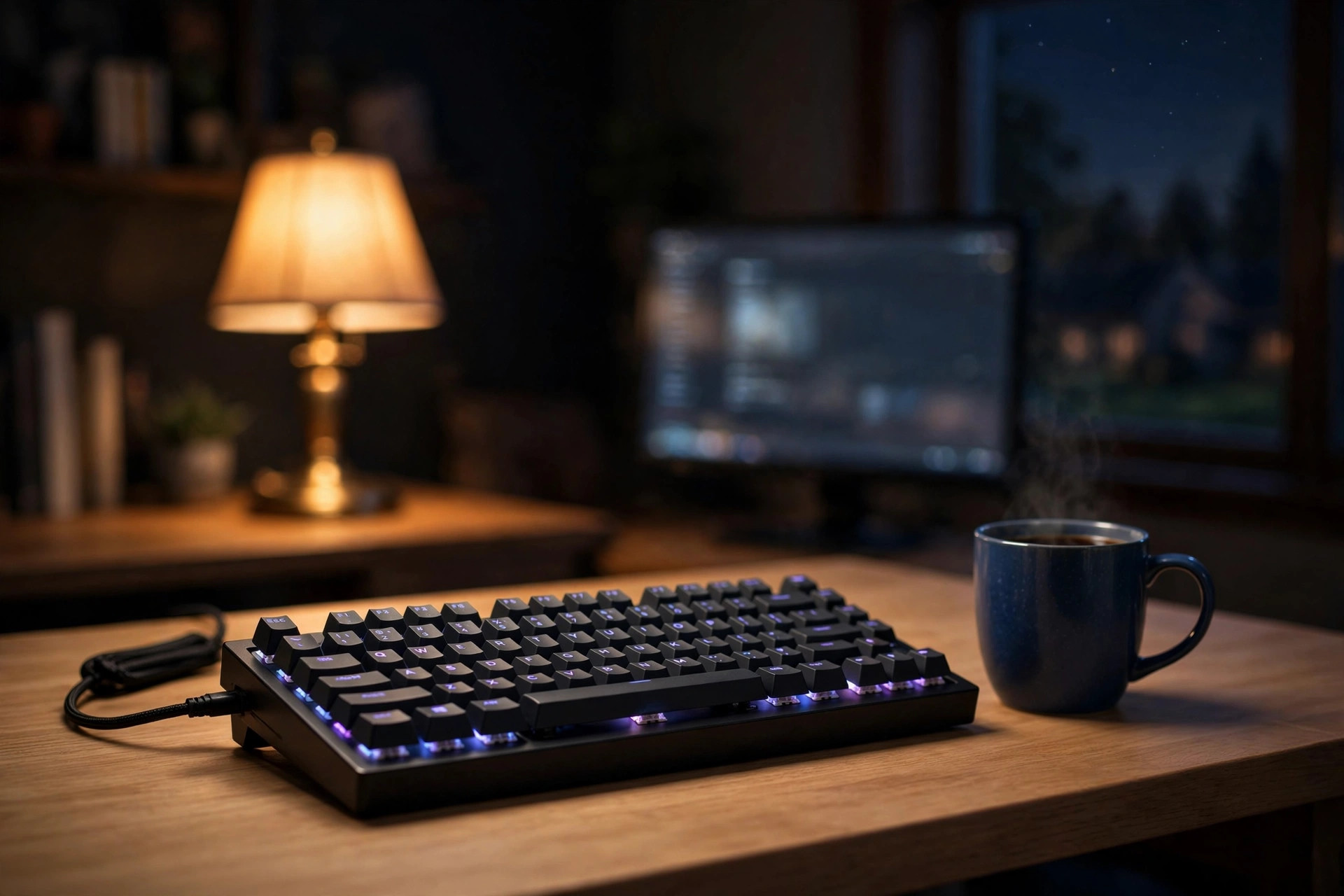

Many people in the United States work from home late at night. Students finish papers after midnight. Remote workers take shifts that run past bedtime. Parents work after the children fall asleep. All of them share one problem. A normal keyboard is loud. Each keystroke sends a sharp click through the house. A quiet mechanical keyboard for home office night solves this problem. It gives you the solid feel of a real keyboard without the noise that wakes the people around you.
Why a Quiet Keyboard Matters for Night Work
Sound travels far in a quiet house. At two in the morning the walls seem thin. A loud keyboard can wake a partner, a baby, or a roommate in the next room. This is more than a small comfort issue. Broken sleep leads to tired mornings and short tempers. It can strain the peace of a home. A silent typing tool protects the rest of the house while you finish your work.
There is also the matter of your own focus. Loud clicks tire the ears over long hours. Many night workers report that a softer sound helps them type longer without fatigue. A calm desk leads to calm work. Your thoughts stay clear when the room stays quiet.
A third reason is the growing trend of shared work spaces. Home offices are often part of a bedroom or a living room. A quiet keyboard for shared home office space makes it possible for two people to use the same room at night. One can sleep. The other can work. Nobody must move to another room.
How a Quiet Mechanical Keyboard Works: Quiet Mechanical Keyboard for Home Office Night
A mechanical keyboard uses a small spring switch under each key. Press the key and the switch makes an electrical contact. This gives a crisp and accurate feel. Standard switches use a plastic stem that strikes the housing with a click. Quiet versions change this design.
Silent switches add soft rubber pads at the top and bottom of the stem. These pads absorb the shock when the key moves down and when it springs back up. The click becomes a soft thud. The feel stays firm and sure. Your fingers still get clear feedback with each press. Only the noise goes away.
Most quiet models also add foam layers inside the case. The foam absorbs echoes before they leave the keyboard body. Some add thick keycaps that lower the pitch of each stroke. Together these features cut noise by half or more compared with a standard mechanical board.
What to Look for When You Choose One
Start with the switch type. Linear switches move straight down with no bump. They are the quietest choice. Tactile switches give a small bump at the moment of contact. Many writers prefer this bump. Silent versions of both types exist. Brands such as Epomaker and Keychron sell quiet switch options that are easy to compare side by side.
Look next at the build of the case. A heavy case with foam inside will sound deeper and softer than a thin hollow one. A board with a metal plate often rings like a bell when you type. Boards without a plate, called gasket mount boards, feel softer and sound quieter. If the product page lists the internal materials, read them with care.
Keycaps matter too. Thick keycaps made of PBT plastic produce a dull low sound. Thin ABS keycaps produce a high thin rattle. The difference is easy to hear in a silent room. Choose thick keycaps for night use.
Consider the layout. Full size boards have a number pad on the right. Compact boards drop the number pad to save desk space. If you type numbers all night, keep the pad. If not, a smaller board gives your mouse more room. Many home office buyers pair a compact keyboard with a well planned desk from a maker such as IKEA, whose small office furniture suits night workers in apartments.
Check the connection type. Wired boards never run out of power. Wireless boards free your desk from cables. Most wireless boards connect through Bluetooth or a small USB receiver. For night work a wired board is one less thing to charge. For a clean look a wireless board is better.
Types and Options on the Market
The market offers several types of quiet mechanical keyboards. Each type suits a different kind of night worker.
Pre built silent keyboards. These arrive ready to use. The maker has already fitted silent switches, foam, and quiet keycaps. Makers like Das Keyboard and Logitech sell finished boards that need no changes. This is the best choice for a buyer who wants a quiet desk at once.
Hot swap keyboards. These boards let you pull out a switch and push in a new one with no tools. You can buy the board with standard switches, then change them to silent switches later. This gives you freedom to test different feels. It is a good path for a hobby buyer who likes to fine tune a desk.
Low profile keyboards. These boards are thin like a laptop keyboard but keep mechanical switches. They take less desk space and look neat. The thin design can make them slightly louder than full size boards. Choose one with silent switches to keep night noise low.
Wireless silent keyboards. These connect through Bluetooth and can switch between a computer, a tablet, and a phone. They suit workers who move between devices at night. Check the battery life before you buy. Some run for months on one charge.
Review sites such as Wirecutter test keyboards in real office rooms and publish careful noise notes. Reading two or three expert reviews before you buy can save you from a costly mistake.
Cost and Price
Prices for a quiet mechanical keyboard for home office night use vary widely. Basic pre built models start around forty dollars. These give you silent switches and a solid case. They are a fine choice for a student or a light night user.
Mid range models cost between eighty and one hundred fifty dollars. This range brings better foam, thicker keycaps, and hot swap sockets. Most serious home workers land in this range. The extra cost buys a board that lasts for years of nightly use.
High end models cost two hundred dollars or more. These use premium materials and custom designs. They are made for buyers who type for a living. Night shift workers who type eight hours a night may find the cost worth it.
Do not forget the small extras. A good ergonomic wrist rest for keyboard and mouse costs fifteen to thirty dollars and eases wrist strain on long nights. A set of replacement silent switches costs about twenty dollars. A desk pad under the keyboard costs ten to twenty dollars and absorbs even more sound. These small buys make a big difference to night comfort.
Set your budget before you shop. Decide what matters most to you. If silence is the top goal, spend more on the switches and the case foam. If comfort is the goal, spend on the layout and the wrist rest.
Care and Upkeep
A quiet keyboard stays quiet only with basic care. Dust is the main enemy. Dust builds up under the keycaps and makes the switches gritty. The grit adds noise. Clean the board once a month.
To clean it, pull off the keycaps with a keycap puller. Brush the dust out with a soft brush. Wipe the surface with a dry cloth. You can wash the keycaps in warm water with a drop of mild soap. Let them dry fully before you put them back. Never use strong cleaners on the switches.
Keep drinks away from the desk at night. A spill at three in the morning is a common way to ruin a keyboard. If a spill happens, unplug the board at once. Dry it upside down. Give it a full day to dry before you test it.
Store the keyboard flat when you travel. Do not stack heavy items on it. The switches can bend under weight. A bent switch clicks louder than a straight one.
Check the cable or the battery once in a while. A loose cable causes missed keystrokes. A weak battery makes a wireless board lag. Fix small problems early so they do not grow into big ones.
Safety
A quiet mechanical keyboard is a safe product when used in a normal way. Still, a few safety points deserve mention for night workers.
Watch your posture. Typing for hours in a dim room tempts you to hunch over the desk. Keep the screen at eye level. Keep your wrists straight. Guides from workspace health leaders such as Steelcase and Herman Miller explain how desk height and chair support protect your back and wrists during long sessions.
Take breaks. Stand up and stretch every hour. Night workers often forget breaks because the house is dark and quiet. Set a timer if you need a reminder. Short walks keep your blood moving and your eyes fresh.
Mind the lighting. Typing in total darkness strains your eyes even with a backlit keyboard. Use a soft desk lamp. The gentle light protects your sight and keeps the room calm for anyone sleeping nearby. Home guides at The Spruce offer simple plans for warm low light in a night office.
Check electrical safety for wired boards. Use a sound power strip. Do not run cables under rugs where they can wear down. Replace a frayed cable at once.
Frequently Asked Questions
How quiet is a quiet mechanical keyboard really?
It is much quieter than a standard mechanical board but not fully silent. Expect a soft thud with each keystroke instead of a sharp click. Most silent switches measure about half the noise of standard ones. In the next room the sound should be barely audible.
Are quiet mechanical keyboards good for fast typing?
Yes. The switches still give clear feedback and fast response. Many fast typists prefer silent linear switches because the smooth motion lets their fingers move quickly. Speed comes from the switch design, not from the noise.
Can I make my current keyboard quieter?
You can lower the noise with simple changes. Add rubber O rings under the keycaps. Place a foam pad under the keyboard. Swap the keycaps for thick PBT ones. These steps help but they will not match a board built with silent switches from the start.
Do quiet mechanical keyboards work with any computer?
Most work with Windows, Mac, and Linux computers. They connect through USB or Bluetooth. Check the product page for the exact systems it supports. Some special key functions, like volume keys, may differ between Windows and Mac.
Should I choose wired or wireless for night work?
A wired board is simpler. It never needs charging and it responds a fraction faster. A wireless board keeps your desk tidy and lets you move the keyboard around. If you type through long night shifts, a wired board removes one worry. If you value a clean desk, wireless is fine as long as you charge it on a schedule.
How long does a quiet mechanical keyboard last?
Most switches are rated for fifty million keystrokes or more. That is many years of nightly use. The keycaps may shine and smooth with age. The board itself should last five to ten years with basic care.
A Final Word
A quiet mechanical keyboard for home office night work is a small change that improves many nights. It lets you earn, study, and create after hours without disturbing the people you love. Choose silent switches, a solid case, and thick keycaps. Add a wrist rest and a desk pad. Keep it clean. Then type in peace while the house sleeps.
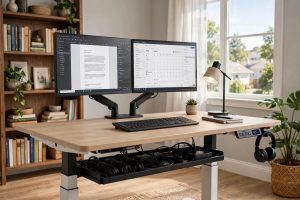
Many night workers pair their quiet board with a larger comfort upgrade, such as an affordable dual monitor setup for remote workers usa or a height adjustable desk from a maker like Uplift Desk. A calm desk, a quiet keyboard, and a clear plan turn the night shift from a struggle into a habit you can keep for years.
References
Das Keyboard. (n.d.). Mechanical keyboards. https://www.daskeyboard.com Epomaker. (n.d.). Mechanical keyboards and switches. https://www.epomaker.com Herman Miller. (n.d.). Office furniture and ergonomic seating. https://www.hermanmiller.com IKEA. (n.d.). Home furnishings. https://www.ikea.com Keychron. (n.d.). Wireless mechanical keyboards. https://www.keychron.com Logitech. (n.d.). Computer accessories and headsets. https://www.logitech.com Steelcase. (n.d.). Office furniture and workplace research. https://www.steelcase.com The Spruce. (n.d.). Home and garden advice. https://www.thespruce.com UPLIFT Desk. (n.d.). Standing desks and ergonomic office furniture. https://www.uplift-desk.com Wirecutter. (n.d.). Product reviews from The New York Times. https://www.nytimes.com/wirecutter
Was this guide helpful?

About Robert Taylor
The My Garden US editorial team writes practical, in-depth home and garden guides for American homeowners — tested advice, no fluff.
You May Also Like

Home Office Curtain Backdrop for Video Calls
May 23, 2026 0 views
Ergonomic Mesh Office Chair Under 200 Dollars: What to Know Before You Buy
August 28, 2026 0 views
Home Office Desk with Keyboard Tray Slide Out: A Full Buyer’s Guide
May 12, 2026 0 views