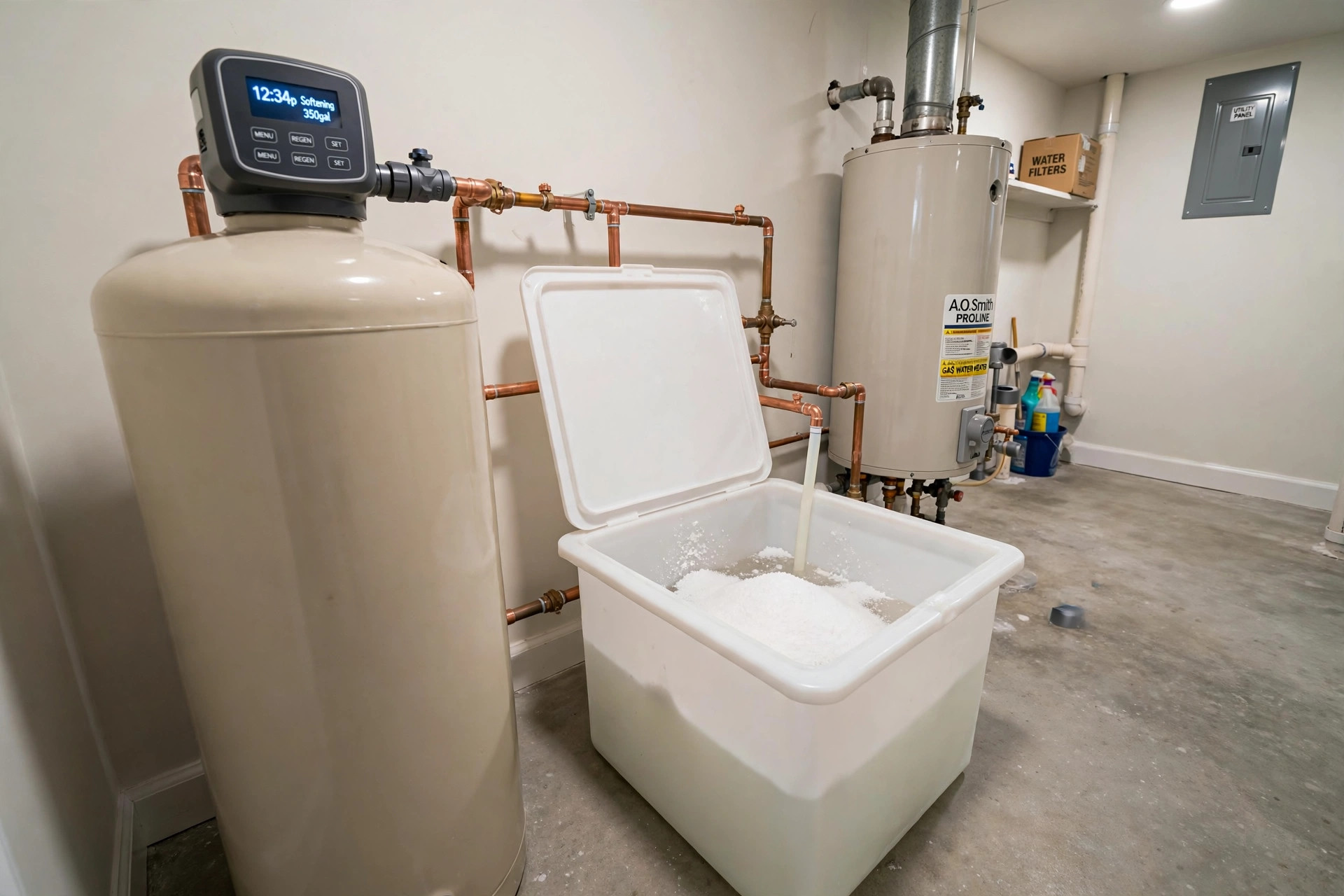

Hard water is common across the United States. It leaves spots on dishes, dulls laundry, and shortens the life of pipes and appliances. A water softener can solve these problems, but only if it fits your home. This guide on how to size a water softener usa guide walks you through the simple math, the key terms, and the choices you will face. By the end, you will know exactly what size unit your home needs.
Why Sizing Matters
A water softener works by trading hard minerals for soft sodium. Inside the tank sits a bed of resin beads. As water flows through, the beads catch calcium and magnesium. Over time the beads fill up. Then the unit must clean itself in a cycle called regeneration. It uses a salt brine to wash the minerals away and start fresh.
If the softener is too small, it will regenerate too often. That wastes salt and water. It also wears out the valve faster. If it is too large, you pay for capacity you never use. The unit may also sit too long between regenerations, which can foul the resin. The right size runs a regeneration about once every seven days. That rhythm keeps salt use low and water soft all week.
Sizing also protects your pipes and appliances. Hard water builds scale inside water heaters, dishwashers, and faucets. A right-sized softener stops that scale from forming. Homeowners who also run a whole house water filter system often pair it with their softener to handle both hardness and sediment in one setup.
What to Look For: The Key Numbers: How to Size a Water Softener Usa Guide
Three numbers decide the size of your softener. They are easy to find, and each one plays a clear role in the math.
First, find your water hardness. Hardness is measured in grains per gallon, often shortened to GPG. One grain equals 17.1 parts per million. You can buy a simple test strip or a drop kit from a hardware store. Some local water departments publish a hardness report each year. The U.S. Environmental Protection Agency also offers guidance on home water quality and testing.
Second, know your daily water use. A common rule in the industry is 75 gallons per person per day. A family of four uses about 300 gallons a day. This is an average. It covers showers, toilets, laundry, and dishes. If your home has a large garden or a pool that fills from the same supply, your use will run higher.
Third, know your iron level. Iron acts like hardness inside a softener. The rule of thumb is that each part per million of iron equals four grains per gallon of hardness. A well-water test will give you the iron number. Many guides to the best water softener for well water usa stress this point, since well water often carries iron that city water does not.
The Simple Sizing Formula
Here is the formula the trade uses:
Grains per day = people × gallons per person × (hardness in GPG + iron adjustment)
Total capacity = grains per day × days between regenerations
Let us walk through an example. A family of four lives in a home with water at 10 GPG. They use 75 gallons per person per day. They want the softener to regenerate once every seven days.
4 people × 75 gallons × 10 GPG = 3,000 grains per day.
3,000 grains × 7 days = 21,000 grains.
So this family needs at least a 21,000-grain unit. Softeners come in standard sizes. The next size up from 21,000 is the common 24,000-grain model. That would be the right pick.
Now try a harder case. A couple on well water has 15 GPG hardness and 2 ppm iron. Their house serves two people.
Iron adjustment: 2 ppm × 4 = 8 GPG. Total hardness = 15 + 8 = 23 GPG.
2 people × 75 gallons × 23 GPG = 3,450 grains per day.
3,450 × 7 days = 24,150 grains. A 32,000-grain unit would fit well here.
Always round up to the next standard size. Running a softener near its full limit forces extra regenerations. A little headroom costs less in the long run.
Types and Sizes of Water Softener
Softeners come in several types, and the size range is wide. Knowing the options helps you shop with confidence.
Salt-based ion exchange. This is the standard type. It uses resin beads and salt brine. Sizes run from 24,000 to 110,000 grains. A 24,000-grain unit suits one or two people with moderate hardness. A 32,000-grain unit is the most popular size for a family of three to five. Homes of five or more, or homes with very hard water, often need 48,000 or 64,000 grains.
Salt-free conditioners. These do not remove hardness. They change the mineral form so scale does not stick. They need no salt and no drain. Sizing for these is based on flow rate, not grain capacity. Reviews of salt-free units are worth reading before you buy, since they solve a different problem than true softening.
Dual-tank systems. Two tanks take turns. One always stays in service while the other regenerates. These give soft water around the clock. They suit large homes and homes with high flow needs. They cost more but regenerate with less water.
Portable exchange tanks. A service company swaps a fresh tank for your used one on a schedule. You never buy salt. Sizing is the company’s job. This option fits renters and people who dislike upkeep.
Flow rate matters as much as grain size. A softener has a service flow rate, measured in gallons per minute. Most homes need 8 to 12 GPM. A big home with several bathrooms may need 15 GPM or more. An undersized unit chokes water pressure during peak use, even if its grain capacity looks right. Retailers like Lowe’s list flow rates in their buying guides, which makes comparison easier.
Cost and Price
Price tracks size. A basic 24,000-grain salt-based unit costs less than a large 64,000-grain model. Expect to pay more for dual-tank designs and for smart controls that meter actual water use. A metered valve tracks gallons and regenerates only when needed. A timer valve regenerates on a fixed schedule and wastes salt on low-use weeks. The metered valve is worth the small extra cost.
Installation adds to the price. A simple swap in an open basement runs lower than a tight crawl-space job. Many owners look up water softener installation cost near me to get a feel for local rates before they call a plumber. A professional job also covers the drain line, the brine tank setup, and a first regeneration test.
Running costs stay modest. Salt is the main expense. A right-sized unit may use one to two bags of salt a month. Water used in regeneration adds a small amount to the water bill. Over the years, a softener often pays for itself by extending the life of the water heater and the dishwasher. Scale shortens appliance life, and replacement costs far more than salt.
Care and Upkeep
A softener asks little, but it asks it on a regular basis. Keep the brine tank at least one-quarter full of salt. Check the level once a month. Use clean pellet or crystal salt. Rock salt carries dirt that can clog the tank.
Clean the brine tank once a year. Scoop out old salt, scrub the tank, and refill with fresh salt. Inspect the drain line for kinks. A blocked drain can flood the area around the unit.
Watch the resin bed. Most resin lasts ten to fifteen years. Signs of worn resin include soft water that turns hard again between cycles and salt use that keeps climbing. Some owners add a resin cleaner once or twice a year, especially with well water that carries iron. Iron fouls resin fast if left untreated.
Set the valve to match your home. Enter the correct hardness number and the correct time of day. Regeneration usually runs at night, around 2 a.m., so it never interrupts your morning routine. If your family grows or your water source changes, retest and update the settings. The best whole house water filter system usa guides remind readers of the same habit: retest your water once a year and adjust your equipment to match.
Safety
Water softeners are safe when installed right, but a few points deserve care.
Drain and overflow. The unit discharges salty water during regeneration. The drain line must run to a proper drain, never to a septic field in areas where salt discharge is restricted. Check local rules before you install.
Drinking water taste. Softened water carries a small amount of sodium. Most people never notice it. People on strict low-sodium diets may want a separate unsoftened tap at the kitchen sink for drinking and cooking. A plumber can add a bypass line for this purpose.
Backflow protection. A check valve stops brine from flowing back into the home supply. Most modern valves include one. Make sure yours does.
Electrical and floor safety. The control valve needs a nearby outlet. Keep cords dry. Place the unit on a level floor where a leak would drain safely. A simple pan under the brine tank catches minor drips.
Hot water lines. Never run hot water through the softener tank. Heat damages resin. The softener belongs on the cold water main, before the water heater splits off.
Manufacturer resources such as Moen and Kohler publish general plumbing safety notes that apply to any whole-house water project. It is good practice to read them before you start.
Frequently Asked Questions
What size water softener do I need for a family of four? Most families of four with average hardness (7 to 12 GPG) need a 32,000-grain unit. That size handles 300 gallons a day and regenerates about once a week. Test your hardness first, since very hard water may push you to 48,000 grains.
Can a water softener be too big? Yes. An oversized unit costs more up front and may go too long between regenerations. Stagnant resin can grow bacteria or foul with iron. Pick the smallest size that meets your seven-day target, then round up one standard size.
How often should a water softener regenerate? About once every seven days is the sweet spot. Metered units do this on their own. Timer units need the day setting adjusted to match your actual use. More frequent regeneration wastes salt and water.
Does a water softener remove iron? A standard softener handles small amounts of iron, up to about 2 or 3 ppm. It treats iron as extra hardness in the sizing math. Higher iron needs a dedicated iron filter ahead of the softener. Well owners should test for iron before they size anything.
What is the difference between grains and GPG? GPG, or grains per gallon, measures how hard your water is. Grains, as in a 32,000-grain softener, measure how much hardness the unit can remove before it must regenerate. Multiply your daily grains by seven days to find the grains your home needs.
Do I need a plumber to install a water softener? A skilled homeowner can install a basic unit in a day. The job needs copper or PEX cutting, a drain connection, and a nearby outlet. Many people still hire a plumber. The work is quick for a pro, and a correct install avoids leaks. Step-by-step overviews from This Old House and the Family Handyman show what the job involves.
A Final Word
Sizing a water softener is simple arithmetic, not guesswork. Test your water. Count your people. Add iron to the hardness number. Multiply by seven days. Round up to the next standard size. Check that the flow rate fits your home. Do those five steps and you will buy a unit that runs once a week, sips salt, and keeps every tap in the house soft. Hard water is stubborn, but a right-sized softener beats it quietly, day after day, for a decade or more.
See The Home Depot for more detail.
References
Family Handyman. (n.d.). DIY home repair and maintenance. https://www.familyhandyman.com Homedepot. (n.d.). Home and garden information. https://www.homedepot.com/c/ai/whole-house-water-filters-vs-water-softeners Kohler. (n.d.). Bathroom and kitchen fixtures. https://www.kohler.com Lowe’s. (n.d.). Home improvement products. https://www.lowes.com Moen. (n.d.). Faucets and plumbing fixtures. https://www.moen.com The Home Depot. (n.d.). Home improvement products. https://www.homedepot.com This Old House. (n.d.). Home renovation guidance. https://www.thisoldhouse.com U.S. Environmental Protection Agency. (n.d.). Protecting human health and the environment. https://www.epa.gov
Was this guide helpful?

About James Carter
The My Garden US editorial team writes practical, in-depth home and garden guides for American homeowners — tested advice, no fluff.
You May Also Like

Sewer Gas Smell in Bathroom: Proven Solutions USA Homeowners Trust
September 23, 2026 0 views
Reverse Osmosis Faucet Air Gap Reviews USA: A Plain Buyer’s Guide
January 12, 2026 0 views
Best Water Softener for City Water USA: A Practical Buying Guide
February 11, 2026 0 views