
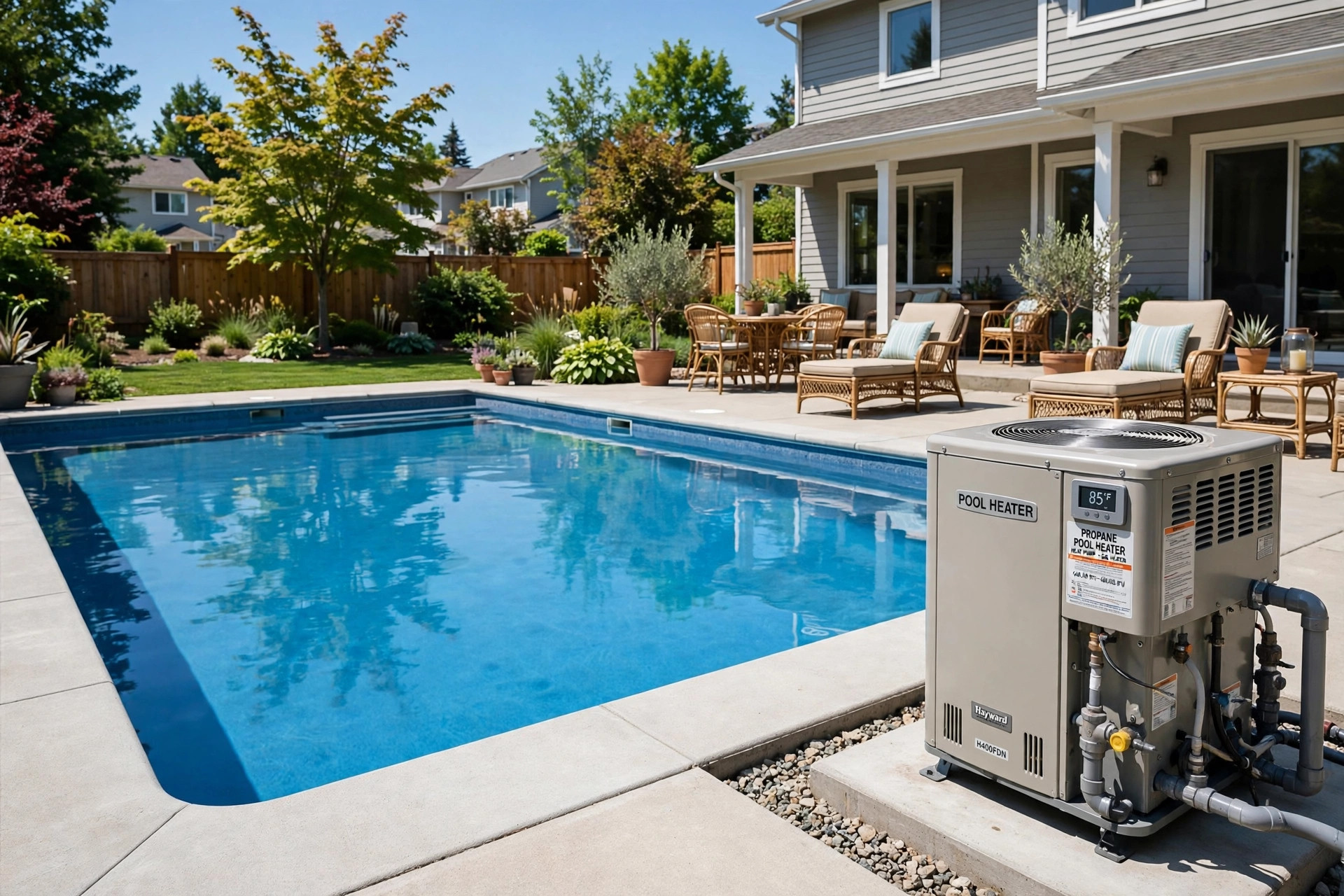

A large pool is a fine thing to own. It gives room to swim laps, to play games, and to cool off on hot days. But a large pool also holds a great deal of water, and water takes a long time to warm up. When you search for the best pool heater for large pools, you are really asking one plain question: how do I keep all that water warm without paying too much to do it? This guide answers that question. It walks through why size matters, how to pick the right type, what each type costs, how to care for it, and how to keep it safe.
Why the Right Heater Matters for a Large Pool
A small pool warms up fast. A large pool does not. A pool of forty thousand gallons holds more than three times the water of a small backyard pool. Heat escapes from the surface every night, and wind pulls more heat away each day. A heater that is too small will run all day and still fail to warm the water. You will pay for the gas or the power and get little in return.
The right heater saves both time and money. It brings the water up to the temperature you want, then holds it there. A heater that fits the pool runs in short, steady bursts instead of grinding all day. Many owners find that a proper heater pays for itself in lower bills and longer swim seasons. You may gain weeks of extra use in the spring and fall, which makes the pool far more useful.
A pool that is cold most of the time also tends to be used less. Children swim less, guests leave early, and the pool becomes more of a chore than a joy. The best pool heater for large pools changes that. It keeps the water at a steady, inviting temperature so the pool earns its keep.
What to Look For When Choosing a Heater: Best Pool Heater for Large Pools
Size and Heating Power
Heaters are rated in British thermal units, or BTUs. One BTU raises one pound of water by one degree. A large pool needs a high BTU rating, often 250,000 BTUs or more. Gas heaters carry the highest ratings and heat fast. Heat pumps carry lower ratings but run far more cheaply in mild weather.
To size a heater, you need your pool’s volume in gallons. The dealer or the store at Home Depot can help you work out the math. As a rule, match the heater to your climate. A colder region needs more power. If your area drops into the fifties at night, do not skimp on BTUs.
Energy Efficiency
Efficiency tells you how much of the fuel becomes heat. Heat pumps are very efficient because they move heat from the air rather than making it from scratch. In warm climates they are the cheapest to run. Gas heaters are less efficient, but they work in cold air when a heat pump slows down. Solar heaters cost almost nothing to run, but they need full sun and many panels to serve a large pool.
Check for guides on efficient models at Energy Star and the pool learning center at Swim University. The U.S. Department of Energy also publishes plain advice on pool heating at energy.gov.
Build Quality and Warranty
A pool heater lives outdoors in sun, rain, and pool chemicals. Look for a rust-proof cabinet and a solid heat exchanger. Copper-nickel exchangers hold up better in salt water pools. A good warranty tells you the maker trusts its product. Most quality heaters carry at least two to three years of coverage.
Types of Pool Heaters for Large Pools
Gas Heaters
Gas heaters burn natural gas or propane. They heat water faster than any other type. That speed matters for a large pool, where a slower heater might need days to raise the temperature. Gas heaters also work in any weather, even cold air that stops a heat pump.
The trade-off is cost. Gas is dear, and a large pool drinks a lot of it. If you heat the pool often, the monthly bill can be steep. Gas heaters also last fewer years than heat pumps, often eight to ten years. Still, for owners who want quick heat on demand, a gas heater is hard to beat. You can read owner reviews and compare models at Leslie’s Pool Supplies.
Heat Pumps
Heat pumps pull warmth from the outside air and pass it to the pool water. They use electricity, but they give back several times more heat than the power they take in. In mild climates they are the cheapest choice to run. A heat pump suits a large pool well because it keeps running at low cost once the water is warm.
Heat pumps are slower than gas heaters. They also lose power when the air turns cold, usually below fifty degrees. If you swim only in mild months, a heat pump may be the best pool heater for large pools in your area. Pair it with a good solar cover to hold in the heat overnight.
Solar Heaters
Solar heaters send pool water through dark panels on the roof or a rack, where the sun warms it. After the panels are bought and set up, the running cost is close to zero. Solar is gentle on the environment and needs little care.
The catch is size. A large pool needs a large collector area, often half to all of the pool’s surface area in panels. Cloudy weeks bring little heat. Many owners use solar as a helper alongside a gas or heat pump unit, cutting fuel bills while keeping a backup for cool days.
Electric Resistance Heaters
Electric resistance heaters are simple and small. They cost little to buy but a great deal to run. They suit hot tubs and tiny pools, not large pools. For a pool of thirty or forty thousand gallons, the power bill would be punishing. Most experts leave these out of the large-pool conversation entirely.
Cost and Price Guide
A heater for a large pool costs more than one for a small pool, because the unit must be bigger. Expect to pay about 1,500 to 4,000 dollars for a good gas heater, and 2,500 to 5,000 dollars for a quality heat pump. Solar systems for large pools run 3,000 to 7,000 dollars installed, depending on how many panels the pool needs.
Installation adds more. A gas heater needs a gas line and proper venting, which a licensed pro must set up. A heat pump needs a strong electrical circuit. Budget 500 to 1,500 dollars for professional installation. Compare prices at Pool Warehouse to get a feel for the market before you talk to a local dealer.
Running costs depend on your fuel prices and how warm you like the water. A gas heater for a large pool can cost 300 to 600 dollars a month in heavy use. A heat pump may cost 100 to 250 dollars a month in a mild climate. Solar costs nearly nothing after setup. Keep in mind that a solar cover cuts heat loss by up to 70 percent and trims every type of running cost. The home project guides at The Spruce explain covers and other money-saving steps in plain terms.
Do not forget upkeep costs. Plan for yearly service, filters, and small parts. Over a ten-year life, a heat pump often costs less in total than a gas heater, even though it costs more at first.
Care and Upkeep
A pool heater works hard, and a little care keeps it working. Check these tasks each season:
– Keep the filter clean. A dirty filter chokes water flow, and low flow can damage the heater. – Watch the chemistry. Low pH eats metal parts. High pH leaves scale. Test the water weekly. – Clear leaves and debris from around the unit. Air must flow freely through a heat pump or gas heater. – In cold regions, winterize the heater. Drain it before the first freeze so pipes do not crack. – Have a pro service the unit once a year. They will check burners, coils, and safety switches.
For a pool heater for above ground pools, the care is much the same, though the units are smaller and often easier to reach. If you are thinking about a salt water pool conversion cost guide, note that salt systems are gentle on swimmers but a bit harder on metal parts, so pick a heater with a salt-rated exchanger.
Safety Tips
Pool heaters use gas, high-voltage power, or both, so safety comes first. These rules are not optional.
Keep the area around the heater clear. Do not store pool chemicals near a gas heater. Fumes and flame do not mix. Let a licensed professional handle gas lines and electrical hookups. Bad wiring or loose gas fittings can be deadly.
Never cover a running heater or block its vents. A gas heater needs fresh air to burn clean. A heat pump needs air flow to work. Read the manual and follow the maker on clearance distances.
Water temperature matters too. The U.S. Consumer Product Safety Commission offers pool safety guidance at cpsc.gov. Most health groups suggest keeping pool water between 78 and 82 degrees for active swimming. Water above 104 degrees is not safe for pools, and hot water raises risks for children, older adults, and pregnant women.
Teach children that the heater is not a toy. Keep the equipment area fenced or locked. If you smell gas near a gas heater, leave the area and call your gas company at once.
Frequently Asked Questions
How long does it take to heat a large pool?
It depends on the heater type, the pool size, and the starting temperature. A strong gas heater can raise a large pool by one to two degrees per hour. A heat pump may need a full day or more to bring a cold pool up to swimming temperature. Solar is slowest of all. Once the pool is warm, keeping it warm takes far less energy than the first warm-up.
What size heater do I need for a 40,000-gallon pool?
Most pools of that size do well with a gas heater of 400,000 BTUs or a heat pump of at least 140,000 BTUs. Your climate shifts the answer. Talk to a dealer who knows your region, or use sizing tools from retailers like Home Depot and spa specialists such as Hot Spring and Bullfrog Spas for equipment guidance.
Gas or heat pump: which is better for a large pool?
Gas heats faster and works in cold weather. Heat pumps cost less to run in mild weather and last longer. If you heat the pool all season in a warm state, a heat pump usually wins on total cost. If you want quick weekend heat in a cool state, gas usually wins. Some owners run both: solar or a heat pump for daily use, and gas for fast top-ups.
Can I install a pool heater myself?
Small electric or plug-in units may suit a handy owner, but gas and heat pump heaters need a professional. Gas work can leak and burn. Electrical work can shock and short. Many warranties demand professional installation. Hire a licensed contractor and keep the paperwork.
Does a pool pump affect heater choice?
Yes. The heater and pump must match. A weak pump cannot push enough water through a big heater, and the heater may overheat. If your pump is old, read our guide to the best pool pump for inground pools before you buy a heater. Pairing the two correctly saves energy and extends both units’ lives.
How can I cut heating costs for a large pool?
Use a solar cover every night. Heat only the days you swim. Keep the water a degree or two cooler; each degree costs real money. Trim the run time with a timer. Clean the filter so water flows freely. Shade and wind raise losses, so a windbreak or fence helps too.
A Short Final Word
The best pool heater for large pools is the one that fits your pool size, your climate, and your budget all at once. Gas gives speed. Heat pumps give low running cost. Solar gives nearly free heat with sun. Whichever you pick, size it right, have a pro install it, and cover the pool at night. Do those three things and your large pool will stay warm, welcoming, and worth every penny from spring to fall.
References
Bullfrog Spas. (n.d.). Hot tubs and spas. https://www.bullfrogspas.com ENERGY STAR. (n.d.). Energy efficient products. https://www.energystar.gov Hot Spring Spas. (n.d.). Hot tubs and spas. https://www.hotspring.com Leslie’s Pool Supplies. (n.d.). Pool supplies and equipment. https://www.lesliespool.com Pool Warehouse. (n.d.). Pool equipment and supplies. https://www.poolwarehouse.com Swim University. (n.d.). Pool and hot tub care guides. https://www.swimuniversity.com The Home Depot. (n.d.). Home improvement products. https://www.homedepot.com The Spruce. (n.d.). Home and garden advice. https://www.thespruce.com U.S. Consumer Product Safety Commission. (n.d.). Product safety information. https://www.cpsc.gov U.S. Department of Energy. (n.d.). Energy efficiency and renewable energy. https://www.energy.gov
Was this guide helpful?

About Michael Thompson
The My Garden US editorial team writes practical, in-depth home and garden guides for American homeowners — tested advice, no fluff.
You May Also Like
Pool Heater for Above Ground Pools: A Plain Guide to Warm Water All Season
June 30, 2026 0 views
The Best Pool Heater for Year Round Use
June 7, 2026 0 views
How to Winterize Pool Equipment Properly: A Step-by-Step Guide
June 1, 2026 0 views