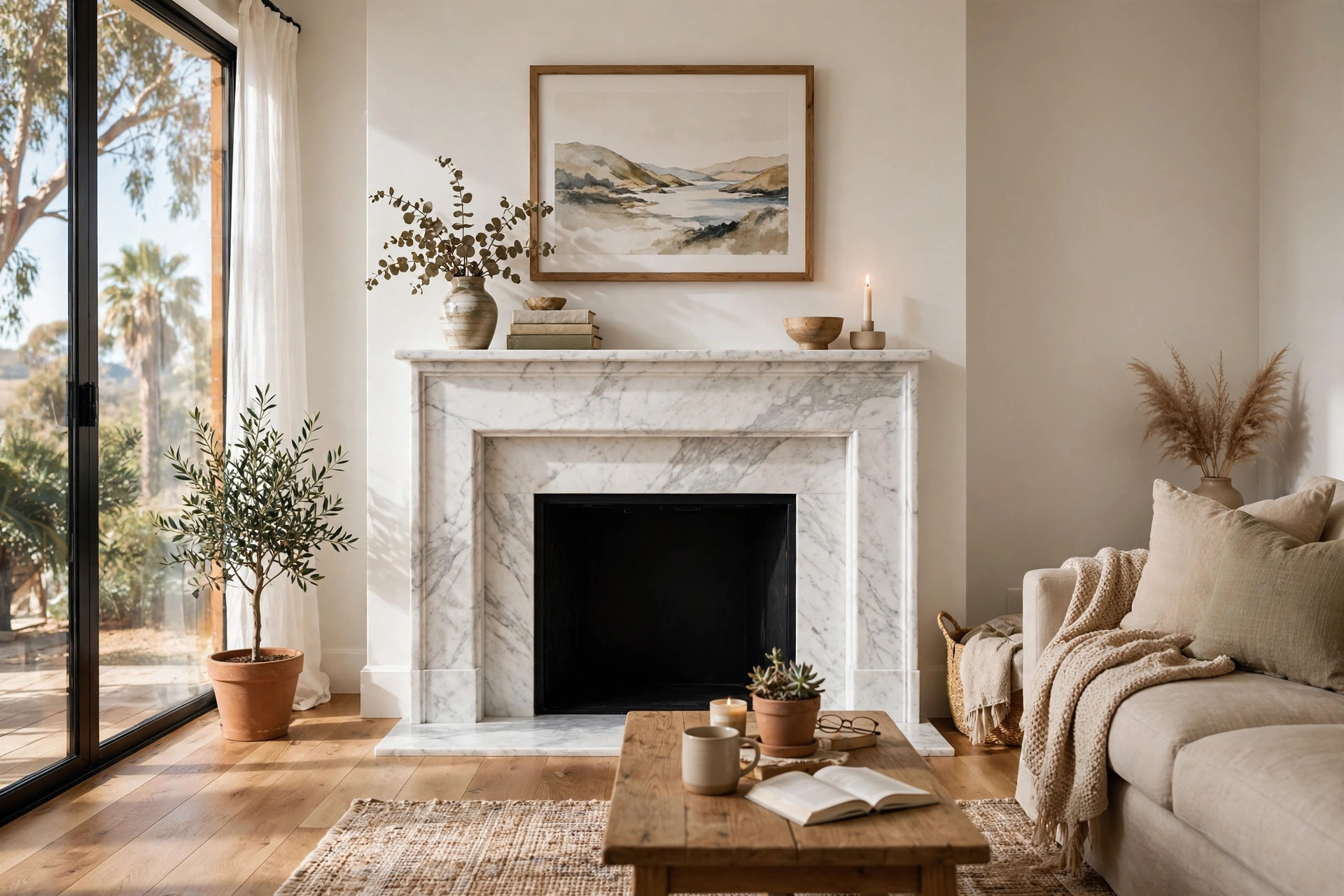

If you are searching for where to buy marble fireplace surrounds in California, you have many good options. Marble is one of the finest materials for a fireplace front. It is cool to the touch, easy to clean, and each slab has its own natural pattern. No two pieces are ever the same. This guide will show you the main places to shop, what to look for, what to pay, and how to care for the stone once it is in place.
Why Marble Is a Popular Choice for Fireplace Surrounds
A fireplace surround is the frame around the firebox opening. It covers the gap between the firebox and the wall. Marble has been used for this purpose for hundreds of years, and there are good reasons for its long record.
First, marble handles heat well. It does not burn, warp, or give off fumes when it gets warm. It absorbs heat slowly and gives it back to the room over time. Second, marble looks rich without being loud. Its soft veining suits almost every style, from Spanish colonial homes in Los Angeles to modern ranch houses in San Diego. Third, marble raises the value of a home. Real estate agents report that buyers notice a stone fireplace at once. A marble surround can make an ordinary room feel finished and permanent.
Natural stone also lasts. A wood mantel may chip or fade. Paint may peel. Marble, once set in place, can serve for a lifetime with only light care. For these reasons, many California homeowners choose marble over tile, brick, or cast stone when they remodel.
Where to Look: The Main Sources in California: Where to Buy Marble Fireplace Surrounds in California
California has more stone sellers than almost any other state. You can shop in person or online. Each type of seller has its own strengths.
Natural Stone Yards and Slab Dealers
Stone yards are the first stop for serious buyers. These are large warehouses where whole slabs of marble stand on racks. You can see the exact slab you will buy, check the veining, and have it cut to your size. Major metro areas like Los Angeles, Orange County, San Francisco, and San Diego each have several stone yards. Many sell both slabs and pre-cut fireplace surrounds.
Buying from a stone yard gives you the best price on real material. You also get help from people who know stone. They can tell you which marble is dense enough for a fireplace and which may crack near heat. Ask for a fabricator who works with fireplaces, since cutting and fitting a surround takes skill. More general background on fireplace parts and terms can be found at This Old House, which keeps clear guides for homeowners.
Fireplace Specialty Showrooms
Fireplace showrooms sell stoves, inserts, and surrounds together. They stock finished marble fireplace surrounds for sale that fit standard openings. This is a good path if you want a ready-made piece with simple delivery. Many showrooms in California also handle the install, which saves you from hiring two trades at once. Manufacturers such as Napoleon list dealers through their sites, and Heatilator offers dealer search tools for factory-built units and surrounds.
Home Improvement Stores
Large stores such as The Home Depot and Lowe’s carry a small range of marble and stone fireplace surrounds. These are usually stock sizes at modest prices. The choice is narrower than at a stone yard, but the prices are easy to compare and returns are simple. This path suits buyers on a budget who want a standard look.
Online Sellers
Online shops give you the widest choice. You can compare dozens of marble mantel surrounds in one evening. The risk is that you cannot touch the stone. Colors on a screen often differ from the real slab. If you buy online, ask the seller for a real sample chip before you pay for the full piece. Check the return policy, the freight terms, and who is responsible if the stone arrives cracked. Useful buying checklists for large home items appear at The Spruce and Family Handyman, and emissions rules for wood-burning units are published by the U.S. Environmental Protection Agency.
How to Choose the Right Marble Surround
A surround must fit your firebox, your wall, and your taste. Work through these points before you buy.
Measure twice. Measure the width and height of the firebox opening. Measure the wall space around it. Note the depth from the wall face to the firebox edge. Bring these numbers to the seller. A surround that is too small looks wrong, and one that is too large may cover vents or trim.
Check local rules. California has strict rules on wood-burning fireplaces in some areas. Gas inserts and electric units are common. Make sure the surround you pick is rated for your fuel type. Clearance rules set how far the stone must sit from the flames. Your city building office can confirm the numbers.
Pick a finish. Polished marble shines and shows the veining well. Honed marble has a soft, flat look that hides small marks. Tumbled marble looks old and rustic. Polished is best for formal rooms; honed suits casual family rooms.
Match the style. White Carrara marble with gray veins fits colonial and traditional homes. Warm beige marble suits Mediterranean and Spanish-style houses. Dark marble, such as Nero Marquina, fits modern rooms. Hold a sample against your wall paint and floor before you decide.
If you are also shopping for matching pieces, you may want to read about where to buy fireplace mantel shelves in California, since the shelf and the surround are often bought as a pair.
Types of Marble Commonly Used for Surrounds
Not all marble behaves the same near a fire. These are the kinds you will meet most often in California shops.
Carrara marble. Mined in Italy, white with soft gray veins. The most popular choice for fireplace fronts. It is fairly priced and widely stocked.
Calacatta marble. Also Italian, but whiter with bolder gold or gray veins. More costly than Carrara. It makes a strong statement piece.
Crema Marfil. A warm beige marble from Spain. It matches well with the warm tones of many California homes.
Statuary marble. Very white with fine veins. Fine to look at but a bit softer, so it needs careful handling during install.
Black marble. Nero Marquina and similar dark stones give a bold, modern look. Soot shows less on dark stone, which some owners like.
Man-made options exist too. Cast marble and engineered stone cost less and weigh less. They do not have the depth of real veining, but they are easier to install. If you are weighing real stone against other materials, a look at top rated stone fireplace surrounds for small apartments can help you compare the choices.
Cost and Price: What to Expect
Prices for marble fireplace surrounds in California vary by size, marble type, and whether the piece is stock or custom.
– Stock surrounds from a home store: about $400 to $1,200. These fit standard openings and come in a box. – Ready-made surrounds from a showroom: about $1,000 to $3,500. Better stone, more sizes, often with delivery. – Custom-cut from a stone yard: about $2,500 to $8,000 or more. You pick the slab, and a fabricator cuts it to fit your wall.
Installation adds to the cost. A simple install on a flat wall may run $500 to $1,000. A full job with a new hearth, demo of an old surround, and tile work can run $2,000 to $5,000. Always get three written quotes. Ask each installer how they handle heat expansion joints, since stone and wall move at different rates.
Shipping is another cost to watch. Marble is heavy. A surround can weigh 200 to 500 pounds. Freight within California is common, but crating and liftgate fees add up. Local pickup from a stone yard avoids most of this cost.
Care and Upkeep of a Marble Surround
Marble is a soft natural stone. It needs gentle care to stay bright.
Seal it. Ask your installer to seal the marble after the job. A good sealer keeps soot and smoke stains from soaking in. Re-seal every one to two years, or when water stops beading on the surface.
Clean gently. Use warm water and a mild, pH-neutral soap. Wipe with a soft cloth. Never use bleach, vinegar, or scouring powder. Acid eats the surface and leaves dull spots that are hard to fix.
Dust often. Soot builds up near a working fireplace. A light dusting each week keeps the stone clean and stops stains from setting.
Fix chips fast. Small chips can be filled by a stone pro. Deep cracks may need a panel replaced. Keep a record of your marble type and seller so a match can be ordered later.
With this light routine, a marble surround will look good for decades. The stone itself does not wear out; only the sealer needs renewal.
Safety Around a Marble Fireplace
Stone does not burn, but safety rules still apply.
Keep clearances. Building codes set the minimum distance from the firebox to wood trim, mantels, and nearby furniture. Marble itself is non-combustible, but the wood shelf above it is not. Follow the insert or firebox manual for exact numbers.
Use a screen or doors. Sparks can land on rugs and floors. A mesh screen or glass doors stop most sparks. This matters most with open wood fires.
Check the chimney. A blocked flue sends smoke and heat where they should not go. Have the chimney swept and checked once a year if you burn wood.
Mind children and pets. Marble stays warm long after the fire dies down. A hot surround can burn small hands. Teach children to keep back, and consider a guard rail for toddlers.
For official guidance on wood smoke and stove rules, see the resources at the U.S. Environmental Protection Agency.
Frequently Asked Questions
Is marble safe to use around a real wood fire? Yes. Marble is non-combustible and handles the heat of a normal fireplace. It should be set with proper clearances and sealed against soot stains. Do not use marble that is cracked or thin near the firebox edge.
Can I install a marble surround myself? A small stock surround can be a do-it-yourself job if you are handy, the wall is flat, and the piece is light. Large or custom slabs are best left to a stone installer. Marble is heavy and breaks if it is lifted wrong.
How long does a marble surround last? With normal care, it lasts as long as the house. The stone does not rot or fade. You may need to re-seal it every year or two and re-grout joints once in a decade.
Does marble stain near a fireplace? It can. Soot and smoke leave marks if the stone is not sealed. A quality sealer and weekly dusting stop most stains. Dark marble shows soot less than white marble.
What is the difference between a surround and a mantel? The surround is the stone frame around the firebox opening. The mantel is the shelf above it. The two are often sold as a set, but they can be bought apart. If you need the shelf alone, see where to buy fireplace mantel shelves in California.
Should I buy the surround before or after the firebox insert? Buy or at least size the firebox first. The surround must match the opening and the required clearances. Many buyers pick both at the same showroom to be sure they fit. If you are also comparing tile looks, buy tile fireplace surrounds online in Texas shows what the tile market offers as a point of comparison.
A Short Final Word
California gives you more choice in marble fireplace surrounds than most states. Stone yards offer the best stone and the best prices on custom work. Showrooms give you a simple one-stop buy with install. Home stores and online sellers suit tight budgets and standard sizes. Measure well, seal the stone, and hire a careful installer. Do that, and your marble surround will be the quiet center of the room for years to come.
References
Family Handyman. (n.d.). DIY home repair and maintenance. https://www.familyhandyman.com Heatilator. (n.d.). Fireplaces and fireplace products. https://www.heatilator.com Lowe’s. (n.d.). Home improvement products. https://www.lowes.com Napoleon. (n.d.). Fireplaces, grills, and heating products. https://www.napoleon.com The Home Depot. (n.d.). Home improvement products. https://www.homedepot.com The Spruce. (n.d.). Home and garden advice. https://www.thespruce.com This Old House. (n.d.). Home renovation guidance. https://www.thisoldhouse.com U.S. Environmental Protection Agency. (n.d.). Protecting human health and the environment. https://www.epa.gov
Was this guide helpful?

About Robert Taylor
The My Garden US editorial team writes practical, in-depth home and garden guides for American homeowners — tested advice, no fluff.
You May Also Like
Top Rated Fireplace Safety Gates for Florida Homes
September 12, 2026 0 views
Smart Electric Fireplaces Reviews and Buying Guide
July 26, 2026 0 views
Premium Fireplace Tool Sets for First-Time Homeowners
February 9, 2026 0 views