
Introduction
A ventless vs vented gas fireplace comparison is the right place to start if you want the warmth and glow of a real flame without a wood pile. Both types burn natural gas or propane. Both look fine in a living room, a den, or a basement. But they work in very different ways, and the one you pick will affect your heat, your air, your budget, and even your building permit. This guide walks through how each one works, what each one costs, and what safety rules apply, so you can make a sound choice for your own home.
How Each Type Works: Ventless vs Vented Gas Fireplace Comparison
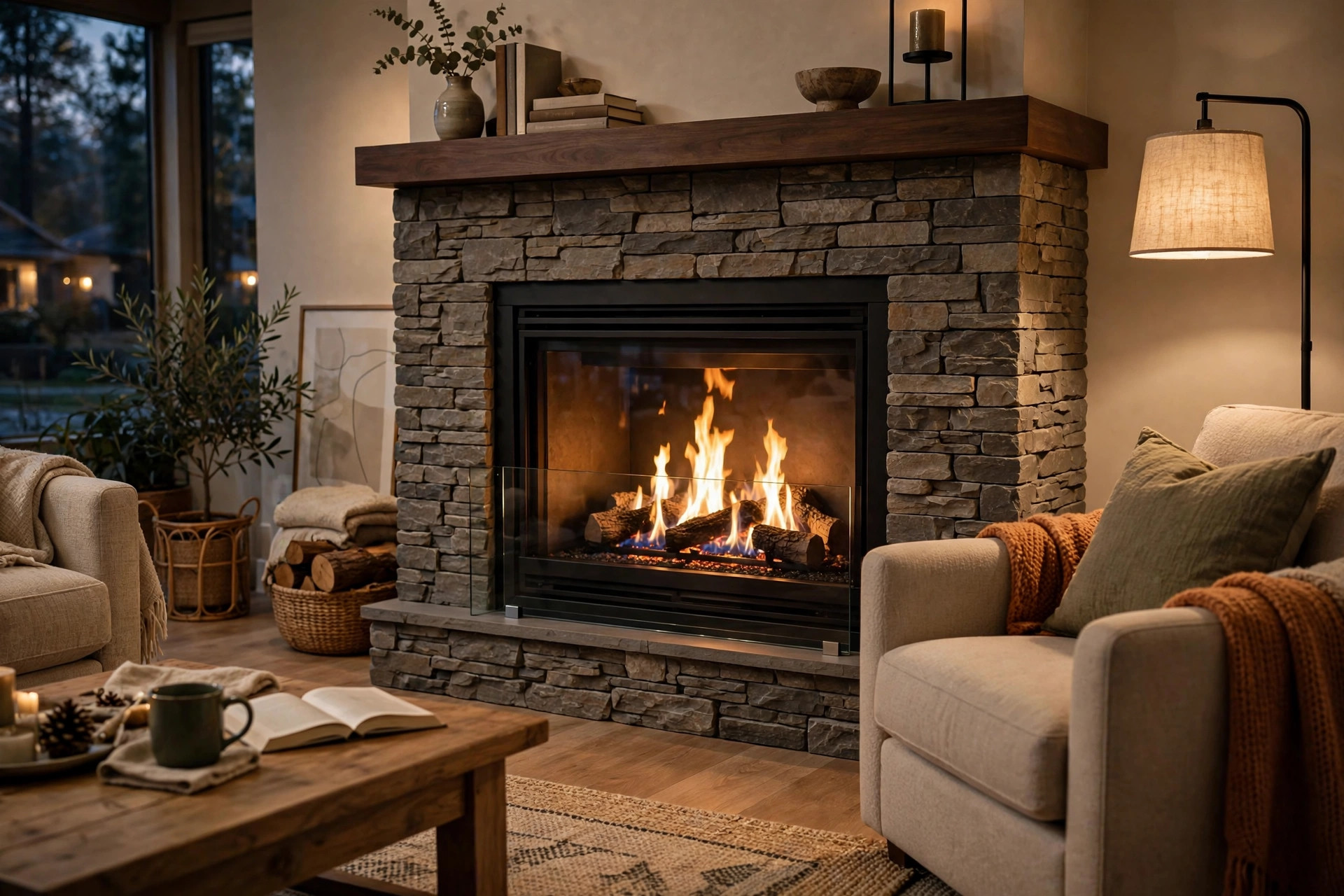
A vented gas fireplace works much like a wood fireplace. It burns gas, and the smoke and combustion gases leave the house through a chimney or a vent pipe. The flame sits behind a fixed glass panel in most new models. The room gets heat from the glass and from the warm air around the unit, but a good share of the heat goes up the chimney. That is the price of moving all exhaust out of the house.
A ventless gas fireplace, also called a vent-free fireplace, has no chimney and no vent pipe. It burns gas so cleanly that the maker says the exhaust is safe to release into the room. A special burner mixes gas and air with care, and an oxygen sensor shuts the unit off if room oxygen drops below a safe level. Almost all the heat stays in the room, which is why these units rate at 99 percent efficiency or better.
The key point in any ventless vs vented gas fireplace comparison is this trade. Vented units send exhaust outside and lose heat. Ventless units keep the heat but leave small amounts of combustion byproducts, such as water vapor and carbon monoxide, in the room.
Why It Matters
The choice touches four big parts of your home life. First is heat. If you want a fireplace to warm a cold room, the ventless unit wins on pure output for the gas it burns. A vented unit looks just as nice but heats less per dollar of gas.
Second is air quality. A vented unit keeps all fumes out of the house by design. A ventless unit is built to burn clean, but it still adds moisture and trace gases to your indoor air. People with asthma, allergies, or small children often lean toward vented for this reason.
Third is law. Some states and cities ban ventless gas fireplaces outright. California, for example, does not allow them in homes. Other places allow them with strict rules on room size and ventilation. Vented units face fewer bans, though they must meet venting and clearance codes. Always check local rules before you buy.
Fourth is cost. The ventless unit is cheaper to buy and far cheaper to install, since no chimney or vent pipe is needed. The vented unit costs more up front but may hold its value better at resale, since buyers and home inspectors know it well.
What to Look for When You Choose
Start with your room. Ventless units are sized by room volume. A unit that is too large for a small room can build up moisture and trip its own oxygen sensor. Makers print the minimum room size on the box. Measure your room and stay within the rating.
Look at the glass. Vented models with sealed glass fronts are safer and cleaner than old open-front models. For ventless models, check that the unit carries an oxygen depletion sensor and that it is listed by a recognized test lab.
Think about fuel. Both types can run on natural gas or propane. If your home already has a gas line to the room, your install cost drops. If not, running a new gas line can add several hundred dollars.
Check your codes early. Call your city building office and ask two questions: are ventless gas fireplaces allowed, and what permit is needed for a gas fireplace install. This five-minute call can save you from buying a unit you cannot legally use. Guidance on safe home heating from Energy.gov can help you weigh efficiency too.
Heat Output
Look at the BTU rating. A 30,000 BTU ventless unit will heat a large living room well. A vented unit of the same size will put less usable heat into the room. If heat is your main goal, the ventless design is the stronger pick. If looks are your main goal, the vented flame often looks more like a real wood fire, with taller, more natural flames.
Types and Options
Vented Gas Fireplaces
Vented units come in three main forms. A built-in vented fireplace fits into a wall or a framed chase and vents through the roof or a side wall. A vented gas insert slides into an old wood fireplace opening and uses the old chimney with a new liner. A vented gas log set sits in an existing fireplace and must keep the chimney damper open at all times.
Direct-vent models are the most common new choice. They pull fresh air from outside for combustion and send exhaust back out through a sealed pipe. The glass front never opens, which keeps room air separate from the flame. Retailers such as Home Depot and Lowes carry a wide range of these models.
Ventless Gas Fireplaces
Ventless units come as wall-mounted fireplaces, freestanding stoves, and log sets that fit into an old fireplace opening. Some look like classic wood stoves. Others are slim modern boxes that hang on the wall like a picture frame.
The makers of these units, including brands you will see at Napoleon and Heatilator, design the burners to run with a short blue flame that makes very little soot. Many owners like that there is no chimney to clean and no cold draft when the unit is off.
A Note on Electric Alternatives
If gas is not an option, electric inserts are worth a look. Our guide to best ventless gas fireplace reviews usa covers top ventless picks, while electric fireplace insert reviews 2026 usa looks at electric models. For install pricing, see gas fireplace insert installation cost usa.
Cost and Price
A ventless gas fireplace unit often costs between 400 and 1,500 dollars. Install is simple. If a gas line is already in the room, a pro can set the unit in a few hours. Total installed cost often lands between 800 and 2,500 dollars.
A vented gas fireplace unit often costs between 1,500 and 4,000 dollars. Install is the big cost. A new vent pipe through a wall runs 1,000 to 2,500 dollars. A full chimney chase for a new build can add far more. Total installed cost often lands between 3,000 and 7,000 dollars, and more for high-end stone surrounds.
Running cost is close. Gas is gas, and both burn it at similar rates per BTU. But since the ventless unit keeps nearly all its heat in the room, it heats the same space with less gas. Over a cold winter, that gap shows up on the gas bill.
Do not forget the yearly service. Both types should be checked once a year by a gas technician. A service visit runs about 100 to 200 dollars. The tech cleans the burner, checks the sensors, and makes sure the gas connections are tight. Advice on finding good help appears in project guides from This Old House and Family Handyman.
Care and Upkeep
Both types are far less work than a wood fireplace. There is no ash, no creosote, and no wood to haul. Still, a gas fireplace is not a set-and-forget box.
Wipe the glass front when it looks hazy. Dust the logs or stones with a soft brush once a season. Keep the area in front of the unit clear of paper, blankets, and toys. For ventless units, watch for extra moisture on windows, which is a sign the unit is adding too much water vapor to the room air. A small dehumidifier or cracked window can fix it.
Have the oxygen sensor on a ventless unit tested each year. If the unit shuts off often for no clear reason, call a technician. Do not bypass the sensor. It is the main guard against low oxygen, and it must work right.
For vented units, have the vent pipe checked for nests, rust, and loose joints. A blocked vent can push exhaust back into the house. The EPA offers plain guidance on indoor air and combustion appliances that every owner should read.
Safety
Safety is where this ventless vs vented gas fireplace comparison matters most. Vented units are safe by design when the vent is clear and the glass is sealed. The main risks are a blocked vent and a cracked heat exchanger, both of which a yearly check will catch.
Ventless units are safe when they are sized right, installed right, and used in a room with enough air. But they do release small amounts of carbon monoxide and nitrogen dioxide into the room. Most healthy adults will not notice. Still, every home with any gas fireplace should have a working carbon monoxide detector on each floor. The CPSC urges this for all fuel-burning appliances.
Never run a ventless unit while you sleep. Never use it as your only heat source in very cold weather for days on end. Keep a window cracked an inch when it runs for long stretches. And never install one in a bedroom, bathroom, or small closed room unless the maker and your local code both allow it.
Children and pets need a guard. The glass front of a vented unit gets very hot. A simple mesh screen or gate keeps small hands away. Ventless units also get hot to the touch. Treat every gas fireplace like a hot stove.
If you smell gas, leave the house and call your gas company from outside. Do not light matches. Do not flip switches. This rule holds for every gas appliance in the home.
Frequently Asked Questions
Are ventless gas fireplaces legal everywhere?
No. Some states ban them, and some cities add their own rules. California is the best-known ban. Always check with your local building office before you buy. A vented unit is allowed in nearly all areas, though it must meet venting codes.
Which one heats better?
The ventless unit heats better for the gas it burns, since nearly all heat stays in the room. A vented unit of the same BTU size will warm the room less. If your goal is real heat in a cold room, ventless wins. If your goal is looks with mild heat, vented is fine.
Do ventless fireplaces make the air damp?
Yes, a little. Burning gas makes water vapor, and a ventless unit keeps it all in the room. In a dry winter house this can be a plus. In a damp house it can fog windows. Good room sizing and some fresh air keep it in check.
Can I put a ventless log set in my old wood fireplace?
Often yes, and it is one of the most common uses. The old chimney damper must be closed or sealed, since no venting is needed. Check that your fireplace opening meets the maker’s size rules, and confirm local code allows it.
Which costs less to install?
Ventless, by a wide margin. No chimney, no vent pipe, and often a shorter labor time. A vented unit needs proper venting through a wall or roof, which is skilled work and costs more.
Do I need a carbon monoxide detector?
Yes. Put one on each floor, near sleeping areas, no matter which type you own. It is cheap, easy to install, and it guards against the one risk you cannot see or smell. Home guides at The Spruce walk through placement in plain terms.
A Short Final Word
A fair ventless vs vented gas fireplace comparison ends with a simple rule. Pick ventless if you want the most heat for the least money, your local code allows it, and your room is sized right. Pick vented if you want the most natural flame, the cleanest indoor air, and the fewest legal questions. Either way, buy a listed unit, have a pro install it, service it once a year, and keep a carbon monoxide detector on the wall. Do those things and your fireplace will give you years of warm, easy evenings.
References
Family Handyman. (n.d.). DIY home repair and maintenance. https://www.familyhandyman.com Heatilator. (n.d.). Fireplaces and fireplace products. https://www.heatilator.com Lowe’s. (n.d.). Home improvement products. https://www.lowes.com Napoleon. (n.d.). Fireplaces, grills, and heating products. https://www.napoleon.com The Home Depot. (n.d.). Home improvement products. https://www.homedepot.com The Spruce. (n.d.). Home and garden advice. https://www.thespruce.com This Old House. (n.d.). Home renovation guidance. https://www.thisoldhouse.com U.S. Consumer Product Safety Commission. (n.d.). Product safety information. https://www.cpsc.gov U.S. Department of Energy. (n.d.). Energy efficiency and renewable energy. https://www.energy.gov U.S. Environmental Protection Agency. (n.d.). Protecting human health and the environment. https://www.epa.gov
Was this guide helpful?

About Jennifer Lee
The My Garden US editorial team writes practical, in-depth home and garden guides for American homeowners — tested advice, no fluff.
You May Also Like
Ridge Vent vs Turbine Vent Comparison USA: Which Roof Vent Fits Your Home
August 21, 2026 0 views
Best Window AC for Large Rooms Reviews USA
September 16, 2026 0 views
Best Space Heater for Large Room USA: A Simple Guide to Buying Right
July 19, 2026 0 views