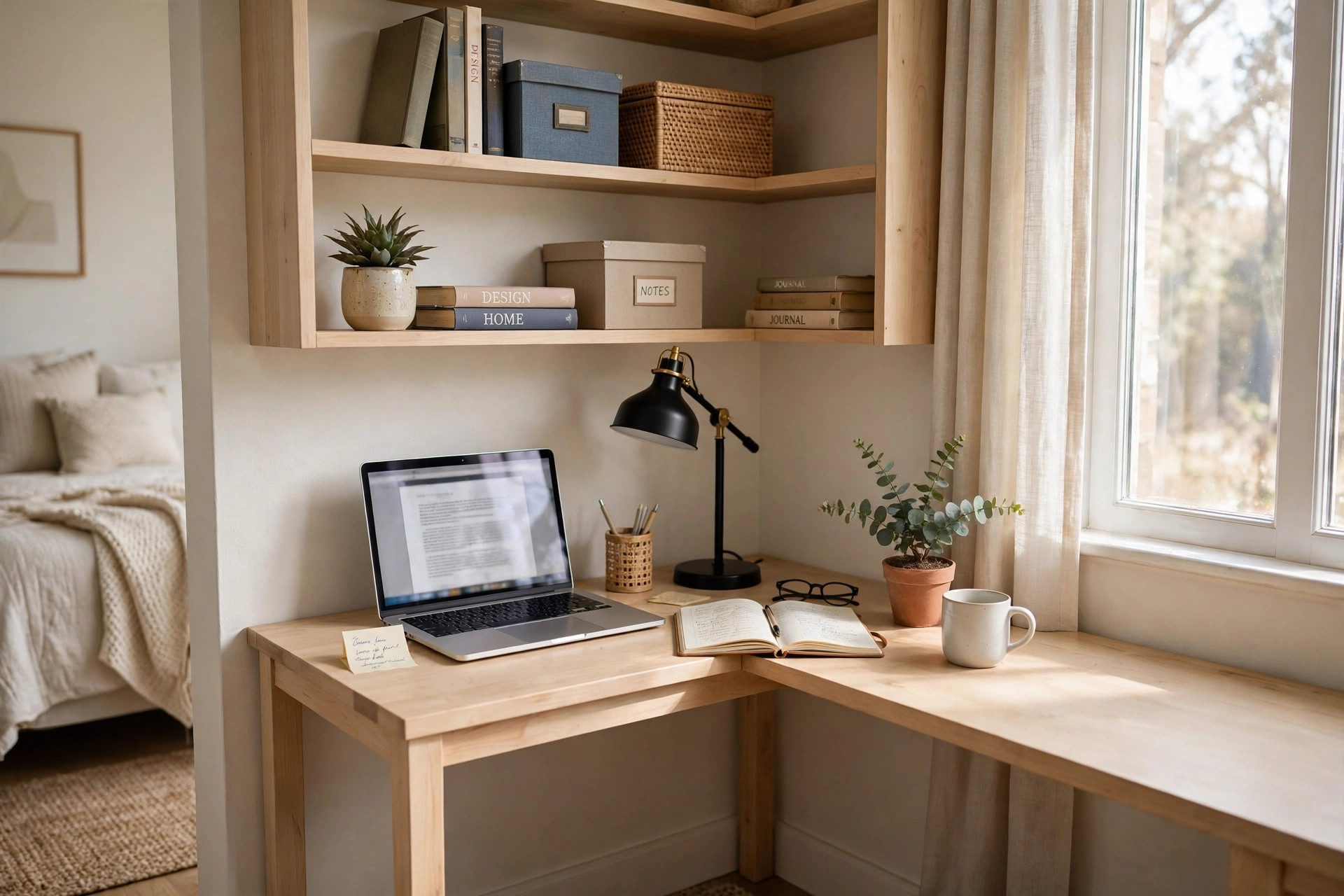

A small desk for bedroom corner with shelves is one of the smartest ways to add a work space to a small room. It uses the corner, a spot that often stays empty, and holds a lamp, a laptop, books, and supplies in one neat place. The shelves above keep papers and boxes off the work top. This guide covers why a corner desk works, what to check before you buy, the main types, fair prices, care, safety, and the questions buyers ask most.
Why a Corner Desk With Shelves Matters
Bedrooms are often short on floor space. A bed, a dresser, and a closet can fill most of the room. A corner desk solves this problem. Corners are hard to use with flat-wall furniture. A desk made for a corner fits there well. It gives you a full work surface without taking over the room.
The shelves are the key part. A desk alone needs more furniture around it: a bookcase, a file box, or a side table. Built-in shelves remove that need. Books, binders, chargers, and office supplies sit above the desk, within arm’s reach. The work top stays clear for writing or typing. When work is done, the whole setup still looks neat, which matters in a bedroom. No one wants to sleep next to a messy office.
A fixed work spot also helps work habits. A corner setup keeps work apart from rest, even in the same room. Reviews at The Spruce note that a defined work zone improves focus in small rooms, and buying guides at Wirecutter make the same point: a small desk beats working from the bed.
A corner desk is small by design. It will not hold two large monitors and a printer at once, and chair space can feel tight near the bed. Still, for one person with a laptop, a notebook, and a lamp, it is usually enough.
What to Look for Before You Buy: Small Desk for Bedroom Corner with Shelves
Measure the Corner First
Write down the width of each wall meeting at the corner, the height from the floor to any window sill, and where the power outlets are. A desk that is one inch too wide will not fit, so measure twice. Allow at least 24 inches in front of the desk to pull the chair out and sit down.
Check the Desk Height
Most desks are 29 to 30 inches high, which fits most adults with a standard chair. For a child or teen, a lower height may feel better. Most small models are fixed, so compare the listed height with a table you already own.
Look at Shelf Depth and Weight Limits
Shelves hold your books and gear, so check what they can carry. Most small desks list a weight limit for each shelf. Thin shelves may hold 10 to 15 pounds. That is fine for paperbacks and small boxes. It is not enough for a stack of textbooks or a heavy monitor. Deeper shelves, around 8 to 12 inches, hold more and keep items from tipping off. Look for shelves with a small raised edge or lip at the front. This edge stops books from sliding forward.
Study the Work Top
The work surface should be at least 32 inches wide for a laptop, a lamp, and a few books; forty inches or more is better for a monitor and keyboard tray. Twenty inches of depth lets a laptop sit open with room for your hands. A sealed wood or laminate top wipes clean and resists coffee rings. Raw wood looks warm but needs coasters and more care.
Cord Management
A desk with a hole or slot for cords keeps wires neat. Without one, chargers and lamp cords drape and tangle. A small gap at the back of the desk works too, and a desk near an outlet keeps the cord run short and hidden.
Sturdiness and Materials
Particle board and MDF are common in budget desks. They are light and cheap. They also chip at the edges and sag under heavy books. Solid wood and plywood cost more but last longer. Metal frames add strength and give a modern look. Check the joinery. Screws and cam locks hold well if tightened right. Plastic joints loosen over time. Sit at the desk and lean on it a little in the store. If it wobbles, pass it up. Assembly tips and product tests at PCMag often show how much build quality varies at the same price.
Pick a Pairing Chair
A desk is only half of the setup. A good chair makes the corner comfortable for long sessions. If you want a full ergonomic option, read about the ergonomic office chair mesh back with lumbar to learn what back support to look for. On a tight budget, the guide to the best budget office chair under 150 dollars lists solid picks that cost less. Some people even use an ergonomic saddle stool for standing desk alternative to save floor space, since a stool tucks fully under the desk.
Types and Options
L-Shaped Corner Desks
The L-shaped desk is the classic corner choice. One side runs along each wall, giving the most work space of any small corner type. Shelves often sit on one or both sides. The trade-off is size: an L-shape needs more floor area than a triangle or wall-mounted unit.
Triangular Corner Desks
A triangular desk fits into the corner with a diagonal front edge. It takes very little floor space. The work top is smaller, but the shelves above often run in an L along both walls. This is a good pick for a tight corner in a child’s room or a guest room. The diagonal edge gives your elbows room while the back of the desk stays deep.
Wall-Mounted Corner Desks
A wall-mounted desk hangs on the wall with no legs. It opens the floor under the desk for a chair or storage bins. Shelves mount on the wall above. This style looks clean and modern but needs strong wall studs. Drywall alone will not hold the weight. If you rent, ask the landlord before drilling into the walls.
Desk With Hutch
A hutch is a shelf unit that sits on top of the desk. It often has small doors or cubbies. A corner desk with a hutch gives the most storage in the smallest footprint. The closed cubbies hide clutter. Hutches add weight to the back of the desk, so the desk must be sturdy. They also block some light from a window behind the desk. Put a small lamp on the work top if the hutch shades the area.
Ladder and Tiered Designs
Ladder desks lean against the wall at a slight angle. The shelves get narrower toward the top, like a ladder. They are light and easy to move. They suit renters and dorm rooms. The work top is small, often just wide enough for a laptop. The lean means the top shelves are shallow. This type works best for light use: writing, reading, and laptop work.
Wood Finishes and Styles
Common finishes include white, light oak, walnut, espresso, and black. White and light wood make a small room feel larger. Dark finishes look rich but can make a corner feel closed in. Match the desk to the room’s other furniture if you can. For a step up in design, Herman Miller and Steelcase focus on office-grade build quality, and UPLIFT Desk is known for sturdy adjustable workstations.
Cost and Price
Prices for a small desk for bedroom corner with shelves fall into three bands.
Budget: 60 to 150 dollars. These desks use particle board or MDF with a laminate top. They are fine for light use: a laptop, a lamp, and some books. Shelves are usually open and thin. Assembly takes one to two hours. Check reviews for wobble complaints before you buy. Stores such as IKEA, Wayfair, Walmart, and Target carry wide ranges of these budget desks.
Mid-range: 150 to 350 dollars. This band gives the best value for most buyers. Desks use thicker panels, better hardware, and stronger shelves. Many include cord holes and a small hutch or side shelves. Solid pine and rubberwood appear at the top of this band. A mid-range desk can last five to ten years with normal use.
Premium: 350 to 800 dollars or more. Premium corner desks use solid wood, hardwood veneer, or steel frames. Shelves hold heavy loads without sagging, and the finish resists scratches. You pay for craft and long life, which makes sense for daily use over many years.
Watch for extra costs. Delivery for a flat-pack box is often free, but white-glove assembly can add 80 to 150 dollars. If you need tools you do not own, a basic screwdriver set and a hex key set cover most builds. Some desks need a wall anchor kit for safety, which costs a few dollars at a hardware store.
Prices move with sales. Back-to-school and holiday sales often cut 20 to 30 percent off mid-range desks. Compare the price per feature, not just the sticker price. A 120-dollar desk with thin shelves that sag in a year costs more over time than a 200-dollar desk that lasts.
Care and Upkeep
A corner desk lasts longer with simple care. Dust the shelves once a week with a dry cloth. Wipe the work top with a damp cloth when it looks dirty. Dry it right away so water does not sit on the surface. Use coasters under cups and a mat under hot items.
Tighten the screws once or twice a year. Wood and particle board shift a little with the seasons. A few turns of the screwdriver stop wobble before it starts. Check wall anchors at the same time. If the desk rocks against the wall, replace the anchor before it pulls loose.
Do not overload the shelves. Respect the weight limit on the label. Spread heavy books across several shelves instead of stacking them on one. Keep the heaviest items on the lowest shelf. This lowers the center of gravity and keeps the unit stable.
Sunlight can fade finishes over time, so use a curtain or blind if the corner gets strong sun. Polish wood tops twice a year; a damp cloth is enough for laminate tops.
Safety
Safety matters most when children use the desk. Anchor any tall desk or hutch to the wall studs. A child who climbs the shelves can tip the whole unit forward. Use anti-tip straps or brackets. They cost little and take minutes to install.
Keep cords short and behind the desk. Use cord clips to run wires along the desk leg or the wall, and keep chargers off the floor where feet can catch them.
Check for sharp corners. Some budget desks have sharp metal or raw board edges. Corner guards or edge tape soften them. This matters for desks at a child’s height or in a narrow walkway.
Place the lamp with care. A hot bulb near paper or curtains can be a fire risk. Use LED bulbs, which run cool. Keep the lamp base stable so it cannot tip onto the work top. Unplug chargers when not in use.
Leave a clear path to the door. A corner desk should not block the exit route from the bed to the door. In an emergency, you need a clear path in the dark. Keep the chair pushed in when you stand up.
Frequently Asked Questions
What size is a small desk for a bedroom corner? Most small corner desks are 32 to 48 inches wide on the longest side and 20 to 24 inches deep. The shelves above are usually 8 to 12 inches deep. Measure your corner before shopping and leave at least 24 inches in front for the chair.
Can a corner desk hold two monitors? A large L-shaped desk can hold two monitors if it is at least 48 inches wide. Check that the work top and shelves support the weight. Small triangular or ladder desks cannot.
Are corner desks with shelves hard to assemble? Most flat-pack corner desks take one to two hours with basic tools. Read the instructions through before you start and sort the screws and parts first. Two people make the job faster, especially when lifting the hutch into place.
What is the best material for a corner desk? Solid wood or plywood lasts the longest and holds the most weight. MDF and particle board with laminate cost less and work fine for light use. A steel frame with wood tops gives strength with a modern look. Pick the material that fits your budget and how hard you will use the desk.
How do I keep a corner desk from wobbling? Tighten all screws fully during assembly. Place the desk on a flat floor; use felt pads under short legs if the floor is uneven. Anchor the desk or hutch to the wall studs. Do not put heavy items on the top shelf only, since top weight adds sway.
Can I use a corner desk in a rental? Yes. Freestanding corner desks need no wall changes. Wall-mounted desks need drilling, so ask the landlord first. A ladder desk or a small L-shape works well in rentals because it moves easily when you leave.
A Short Final Word
A small desk for bedroom corner with shelves turns wasted space into a useful work area. Measure the corner, pick a sturdy build, and match the desk type to how you work. Anchor it to the wall, keep cords neat, and care for the surface. Done right, it serves a student, a remote worker, or a hobbyist for many years.
References
Herman Miller. (n.d.). Office furniture and ergonomic seating. https://www.hermanmiller.com IKEA. (n.d.). Home furnishings. https://www.ikea.com PCMag. (n.d.). Technology product reviews. https://www.pcmag.com Steelcase. (n.d.). Office furniture and workplace research. https://www.steelcase.com Target. (n.d.). Retail store. https://www.target.com The Spruce. (n.d.). Home and garden advice. https://www.thespruce.com UPLIFT Desk. (n.d.). Standing desks and ergonomic office furniture. https://www.uplift-desk.com Walmart. (n.d.). Everyday low prices. https://www.walmart.com Wayfair. (n.d.). Furniture and home goods. https://www.wayfair.com Wirecutter. (n.d.). Product reviews from The New York Times. https://www.nytimes.com/wirecutter
Was this guide helpful?

About David Wilson
The My Garden US editorial team writes practical, in-depth home and garden guides for American homeowners — tested advice, no fluff.
You May Also Like
Ergonomic Saddle Stool for Standing Desk Alternative: A Practical Guide
March 4, 2026 0 views
The Right Home Office Side Table for Printer and Supplies
May 15, 2026 0 views
An Ergonomic Lumbar Support Pillow for Office Chair Comfort That Lasts All Day
May 25, 2026 0 views