
Anyone who plans to lay tile in a bathroom, kitchen, or laundry room will meet two famous names. Schluter DITRA is an orange sheet that goes under tile. RedGard is a red liquid that is rolled on like paint. This schluter ditra vs redgard comparison usa guide puts them side by side so a homeowner can choose with a clear head. Both products help tile stick better and keep water from reaching the wood below. They do the job in different ways, and the difference matters when it comes to cost, labor, and long life.
Why This Choice Matters
Tile is a hard finish. It does not bend, and it does not forgive. A house moves. Wood subfloors swell with damp air and shrink in dry air. Concrete slabs crack as they settle. When a rigid floor is glued straight to a moving base, the stress passes into the tile. Sooner or later, a crack appears in the grout, and then in the tile itself.
That is where an underlayment membrane earns its keep. It sits between the subfloor and the tile. It lets the two layers move a little without fighting each other. It also stops water from soaking down into wood, which is what causes rot and mold under tile. A good membrane adds years to a tile floor. A bad choice or a rushed job can cut those years short. For this reason, the schluter ditra vs redgard comparison is not a small detail. It is one of the main choices in any tile project.
What to Look for When Choosing a Membrane: Schluter Ditra vs Redgard Comparison Usa
Before we compare the two products, it helps to know what a membrane must do. A homeowner should judge any underlayment by these points.
First, uncoupling ability. The membrane should break the hard bond between subfloor and tile so small movements do not reach the tile.
Second, waterproofing. In showers and baths, the membrane should block water from passing through. Some products do this on their own. Others do it only when paired with a second step.
Third, ease of install. Sheet membranes go down in strips and need care at seams. Liquid membranes are painted on and need the right thickness. The skill needed is different.
Fourth, total cost. Sheets cost more per foot than a bucket of liquid. But labor time can flip that math.
Fifth, warranty. Both makers stand behind their products when the rules are followed. The rules are strict, and they matter.
Schluter DITRA: The Sheet Membrane
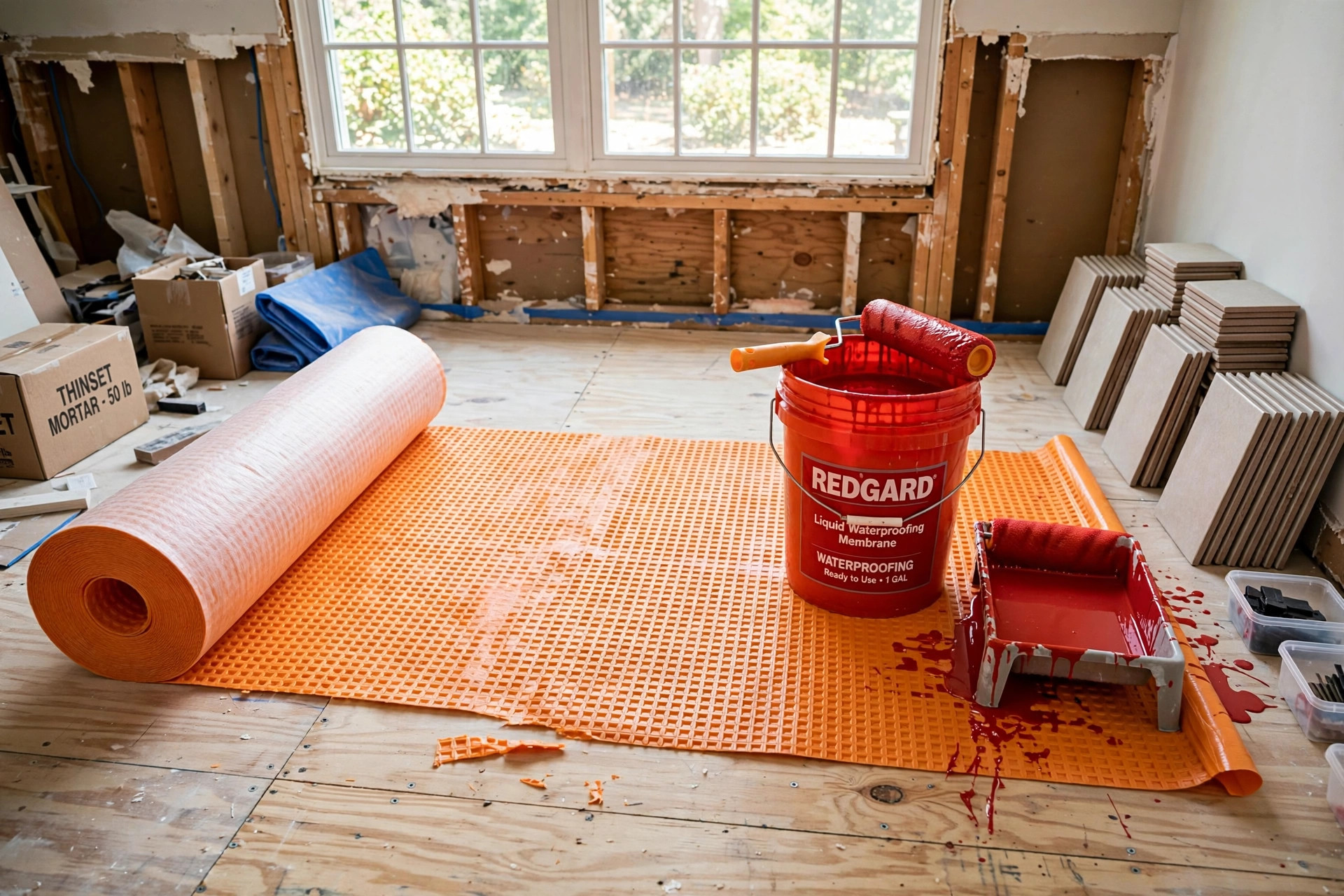
DITRA is made by Schluter Systems, a German company with a long record in tile setting. The sheet is bright orange. One side has a fleece fabric that bonds to the floor. The other side has square pockets that hold mortar. These pockets are the heart of the design. They let the tile layer float free of small shifts in the wood below.
DITRA serves two roles at once. It uncouples the tile from the subfloor, and it blocks water vapor. When seams are sealed with Schluter’s KERDI-BAND, it forms a true waterproof layer. That makes it popular in showers, steam rooms, and wet baths.
The sheet comes in rolls. A standard roll covers about 54 square feet. The installer spreads thin-set mortar on the subfloor, presses the sheet in with a float, and works out the air bubbles. Then tile goes on top with a second layer of mortar. The job needs care. Mortar must reach the right depth. Air pockets left under the sheet weaken the bond. For more on what the labor side of a tile job runs, see the guide to tile installation cost per square foot usa, which breaks down how underlayment work affects the price per square foot.
DITRA has a strong track record in American homes. Tile setters who use it often praise the way it keeps grout lines tight for years. It is also light and easy to carry up stairs, a small point that matters on real jobs. The Home Depot https://www.homedepot.com and Lowe’s https://www.lowes.com both stock the rolls and the banding in most regions.
RedGard: The Liquid Membrane
RedGard is made by Custom Building Products, an American maker well known to tile pros. It is a bright red elastomeric coating. It comes in pails. The installer rolls or trowels it onto the subfloor. Two coats are standard. The finished coat must reach a set thickness, checked with a wet film gauge.
Once cured, RedGard forms a continuous waterproof skin. It bonds to wood, concrete, gypsum, and even old tile. It also cracks up to one eighth of an inch without breaking, which gives it real crack isolation power. That matters over concrete slabs, where hairline cracks are normal.
RedGard is simple to buy and simple to apply. A homeowner with a paint roller can cover a bathroom floor in an afternoon. The work is forgiving. If a spot is thin, a third coat fixes it. Drips wipe up with water before they dry. This ease of use has made RedGard a favorite for do-it-yourself projects across the country. Bob Vila’s guides https://www.bobvila.com often point beginners toward liquid membranes for exactly this reason.
Head to Head: Key Differences
Uncoupling Power
DITRA wins here. Its pocket design is built for one purpose: to let the tile move on its own. It is tested and rated for uncoupling. RedGard offers crack isolation, which is a lesser claim. It handles small cracks well, but it is not rated as a full uncoupling sheet. Over a springy plywood floor, DITRA is the safer bet.
Waterproofing
Both can waterproof a floor. RedGard does it on its own after two proper coats. DITRA needs its seams sealed with KERDI-BAND to reach full waterproofing. If the banding is skipped, water vapor can find the seams. With the banding done right, both systems pass the test. In a shower, many pros prefer the belt-and-suspenders feel of a sheet with sealed seams. In a powder room, either is more than enough.
Vapor Management
DITRA lets moisture in the mortar bed escape through the air channels under the tile. This helps thin-set cure well and lowers the risk of trapped damp. RedGard is a vapor barrier. In most rooms this is fine. But in a shower pan built over a mortar bed, a vapor-tight skin under the tile can trap water in the bed below. Tile setters know this trap and plan around it, yet it is one more thing to get right.
Installation Skill and Time
RedGard is faster for most people. Roll, let dry, roll again, let dry. The drying time between coats is a few hours. DITRA takes more hands-on skill. Spreading thin-set to the right depth, pressing the sheet flat, and sealing seams with banding all take practice. A pro may lay DITRA quickly. A first-timer may spend a full day on what RedGard would finish by lunch.
Cost
RedGard costs less per square foot in material. A three and a half gallon pail covers roughly 350 square feet for two coats and runs a modest price at big box stores. DITRA rolls cost several dollars per square foot, and the KERDI-BAND adds more. On a large floor, the gap adds up. On a small bath, the difference may be under a hundred dollars. Labor can narrow the gap. A pro who lays DITRA fast may charge little more than a RedGard job, while a slow first-timer pays in time either way.
Warranty
Both makers offer warranties when the product is used as directed. Schluter’s warranty is tied to using its full system: DITRA, banding, and approved mortars. Custom Building Products ties RedGard’s warranty to proper coat thickness and cure times. Read the labels. Keep receipts. The warranty is only as good as the install.
Which Is Best for Your Project
The right pick depends on the room and the worker.
Choose DITRA when the subfloor is plywood or OSB and movement is a worry. It is the top pick for showers and steam rooms where full waterproofing with sealed seams matters. It also suits pros who know the system and want the uncoupling rating. The Spruce https://www.thespruce.com notes that uncoupling sheets are the standard answer for tile over wood in older homes.
Choose RedGard when the budget is tight and the installer is a homeowner. It shines over concrete slabs with hairline cracks. It is the easy pick for a laundry room, a powder room, or a kitchen floor where full uncoupling is not a must. For wet bath walls paired with a tile floor, many homeowners like the simple path: RedGard on the walls and a membrane under the floor tile. The related guide to waterproof laminate flooring for bathrooms usa shows how other bath floors handle the same water problem with different trade-offs.
For large stone tiles, DITRA has an edge. Big tiles crack more easily from stress, so uncoupling pays off. For standard ceramic tile in a dry entry, RedGard is plenty. When the tile itself is the star, as with marble bathroom floor tile pros cons usa, the membrane choice guards the investment underneath.
Cost and Price in the USA
Prices shift by region, but the pattern is steady. RedGard pails run roughly two to four dollars per square foot of coverage at retail. DITRA runs roughly four to seven dollars per square foot including the banding. Mortar for the sheet method adds cost too.
Pro labor for membrane work runs about one to three dollars per square foot, on top of the tile setting cost. Some tile setters include the membrane in their per-foot bid. Others price it as a line item. Always ask which product is in the bid. Two bids can look the same until you see that one includes DITRA and the other includes RedGard. LL Flooring https://www.llflooring.com and Shaw Floors https://www.shawfloors.com both carry hard surface lines and offer guidance on matching underlayment to the floor above.
A full bathroom floor of fifty square feet might run 150 dollars in RedGard material and a morning of work. The same floor in DITRA might run 300 dollars in material and a full day for a first-timer. Neither number should scare a homeowner. The tile and labor above them cost far more. The membrane is cheap insurance.
Care and Upkeep
Once tile is down, the membrane is hidden. It needs no care of its own. What it needs is a good install, because a failed membrane is hard to fix. A blister in RedGard or a hollow spot under DITRA will not heal. The tile must come up to fix it.
Upkeep of the finished floor is what protects the system. Keep grout sealed. Clean up standing water. Check caulk lines where the floor meets the tub or wall. If grout cracks, seal it soon. Water that gets past the tile is what the membrane was bought to stop, but a membrane works best when the surface above it is sound too. This Old House https://www.thisoldhouse.com has long advised homeowners to treat tile floors as a system, not as a single surface.
Safety
Both products are safe to handle with normal care. RedGard is water based. Ventilate the room while it dries. Keep it off skin and out of eyes. DITRA is a plastic sheet. It is safe to cut and place. The sharp risk on these jobs comes from the tile itself and the thin-set mortar. Wear gloves. Wear a dust mask when mixing mortar. Lift pails with care. Mohawk Flooring https://www.mohawkflooring.com and other makers remind installers that the dust from mixing setting materials should not be breathed.
Keep both products away from open flame during install. Store pails where children cannot reach them. Read the label before use. It takes five minutes and it covers what each maker asks of you.
FAQ
Can RedGard be used in a shower? Yes. RedGard is rated for shower use when applied at the right thickness. Two coats are standard. Many tile pros use it on shower walls and floors. The seams at corners should get fabric mesh tape set in the coating for strength.
Can DITRA be used in a shower? Yes, with sealed seams. DITRA plus KERDI-BAND at all seams and corners forms a waterproof system. Schluter sells the full system for shower pans and walls. Used alone without banding, DITRA is not a complete waterproof layer.
Is DITRA worth the higher cost? It is worth it over wood subfloors, in showers, and under large format tile. There the uncoupling and the sealed-seam waterproofing pay back in longer grout and tile life. In a small dry room on concrete, RedGard gives fine results for less money.
Can a homeowner install DITRA without a pro? Yes, with care. The steps are clear in Schluter’s guides. The hard parts are spreading thin-set to full coverage and pressing the sheet without air pockets. Practice on a small floor first. Many first-timers start with RedGard and move up to DITRA on the next project.
Do these membranes add height to the floor? A little. DITRA is about one eighth of an inch thick. RedGard adds almost nothing. Door clearances and transitions to other rooms may need a look. Plan the finished height before tile goes down.
Which lasts longer? Both can last as long as the tile when installed right. Failures come from thin spots in RedGard or air pockets under DITRA. The product matters less than the care of the install. A careful job with either one will serve for decades.
A Short Final Word
This schluter ditra vs redgard comparison usa comes down to a plain trade. DITRA gives top uncoupling and a sheet system with sealed seams, at a higher price and a steeper learning curve. RedGard gives simple waterproofing from a roller, at a lower price and an easy install. Match the product to the room, the subfloor, and the skill of the hands doing the work. Get that right, and the tile floor will look good for a long time.
References
Bob Vila. (n.d.). Home improvement advice. https://www.bobvila.com LL Flooring. (n.d.). Hardwood, vinyl, and tile flooring. https://www.llflooring.com Lowe’s. (n.d.). Home improvement products. https://www.lowes.com Mohawk Flooring. (n.d.). Flooring products. https://www.mohawkflooring.com Shaw Floors. (n.d.). Flooring products. https://www.shawfloors.com The Home Depot. (n.d.). Home improvement products. https://www.homedepot.com The Spruce. (n.d.). Home and garden advice. https://www.thespruce.com This Old House. (n.d.). Home renovation guidance. https://www.thisoldhouse.com
Was this guide helpful?

About Emily Rodriguez
The My Garden US editorial team writes practical, in-depth home and garden guides for American homeowners — tested advice, no fluff.
You May Also Like

Curbless Shower Pan Installation Cost in the USA: A Plain Guide
August 26, 2026 0 views
Best Tile for Shower Walls: A 2026 Review Guide for American Homes
May 5, 2026 0 views
Peel and Stick Tile for Bathroom Floor Reviews: What Buyers Learn After Installation
June 26, 2026 0 views