This reliable whole house water filters buying guide starts with a simple fact. Every drop of water in your home comes through one main line. A whole house filter sits on that line. It treats water for every faucet, shower, and appliance. That is the core idea, and the rest of this guide explains how to choose a system that works well and lasts.
Why a Whole House Water Filter Matters
Most people think about drinking water first. They buy a small pitcher filter or a fridge filter. Those help at one tap. A whole house system is different. It cleans water before it spreads through your pipes. That means cleaner showers, cleaner laundry water, and less wear on water heaters and dishwashers.
City water in America is treated to meet legal standards. Even so, it often carries chlorine or chloramine for disinfection. These chemicals keep water safe from germs. They can also give water a bad taste and smell. They can dry out skin and fade laundry. A whole house filter removes most of that chlorine before it reaches your skin.
Well water is a separate case. Private wells are not regulated the same way. A well can carry sediment, iron, sulfur, manganese, or bacteria. A whole house system for a well must match the actual test results. Never buy a system for well water without a lab test first.
Appliances gain too. Scale and sediment shorten the life of water heaters. They clog shower heads and faucet aerators. Clean water flowing through the whole house cuts those problems down. Many owners find they call the plumber less often.
What to Look for When You Buy: Reliable Whole House Water Filters Buying Guide
Start with your water. Order a test from a certified lab. City water customers can also request the annual water quality report from their water utility. The Environmental Protection Agency sets the rules for public water systems, and its site explains what those standards cover. A test tells you the truth about sediment, hardness, chlorine, iron, pH, and other items. Buying a filter without test results is guessing.
Check the flow rate. Flow rate is measured in gallons per minute. A small home may need 8 to 10 gallons per minute. A large home with many bathrooms may need 15 or more. A filter that is too small slows your water to a trickle. Pick a system rated above your peak use. Sizing tools and charts are published by testing groups such as NSF International, which certifies home water treatment products.
Look at port size. The inlet and outlet ports are usually one inch for whole house systems. Match them to your main line. Adapters exist, but each adapter can cost you some flow.
Check the filter media. Media is the material inside the tank that does the work. Activated carbon handles chlorine, taste, and odor. Catalytic carbon handles chloramine. KDF media handles chlorine, iron, and some heavy metals. Sand and sediment media catch rust and dirt. Mixed beds do more than one job. Match the media to your test results.
Look at the housing quality. A good housing is made of reinforced plastic or stainless steel. It should carry a pressure rating. Home water pressure usually runs 40 to 60 psi. The housing should be rated well above that. A burst housing floods a home fast.
Read the maintenance schedule. Some systems need a new cartridge every three months. Others run for years with backwashing. Be honest about how much upkeep you will do. A system you never service becomes worse than no system at all.
Types of Whole House Water Filters
Sediment Pre-Filters
Sediment filters catch sand, rust, silt, and dirt. They are usually the first stage in a system. A 20-micron cartridge catches coarse dirt. A 5-micron cartridge catches finer particles. Many homes use a two-stage setup: coarse first, fine second. Sediment filters protect the finer media behind them. They are cheap and easy to change.
Carbon Filters
Activated carbon is the workhorse of whole house systems. It adsorbs chlorine, bad taste, and odor. Catalytic carbon is a stronger grade. It also breaks down chloramine, which plain carbon handles poorly. Cities increasingly use chloramine instead of chlorine. If your water report lists chloramine, choose catalytic carbon. The Centers for Disease Control and Prevention publishes plain-language background on public water disinfection and its byproducts.
KDF and Specialty Media
KDF is a copper-zinc alloy. It reduces chlorine, iron, hydrogen sulfide, and some heavy metals. It also slows bacterial growth inside the filter. KDF often sits alongside carbon in one tank. Specialty media exists for iron, manganese, arsenic, and nitrate. Each targets one problem. Never use specialty media without a lab test to confirm the problem exists.
Salt-Free Conditioners
These are often sold with whole house systems. They do not remove hardness. They change how minerals behave so scale forms less. True water softeners use salt and ion exchange. Salt-free units are simpler to keep. Reviews at Consumer Reports compare both approaches for real homes.
UV Disinfection Add-Ons
UV lamps kill bacteria and viruses with light. They are common add-ons for well water. UV does not remove chemicals or sediment. It works best when water is already clear. A sediment filter should always come before a UV lamp.
Cost and Price Ranges
A basic single-tank carbon system costs about 300 to 800 dollars. This suits small homes on city water. A two-tank system with sediment pre-filter and carbon costs about 800 to 1,500 dollars. Large systems for big homes or wells run 1,500 to 4,000 dollars. These figures cover the equipment only.
Professional installation adds 300 to 1,000 dollars. A plumber cuts into the main line, mounts the tank, and adds shutoff valves and a bypass. A bypass valve lets water flow around the filter during service. Skilled owners can do it themselves with basic plumbing tools. Local codes vary, so check first.
Running costs matter more than the purchase price. Cartridge systems need new cartridges. A set can cost 50 to 200 dollars and last three to twelve months. Backwashing systems use water and electricity instead. They cost more up front and less each year. Add up five years of costs before you buy. Buying guides at The Spruce and Bob Vila lay out these long-term numbers in plain tables.
Do not forget testing. A basic lab test costs 100 to 300 dollars. It is the cheapest money in the whole project. It keeps you from buying the wrong system.
Installation Basics
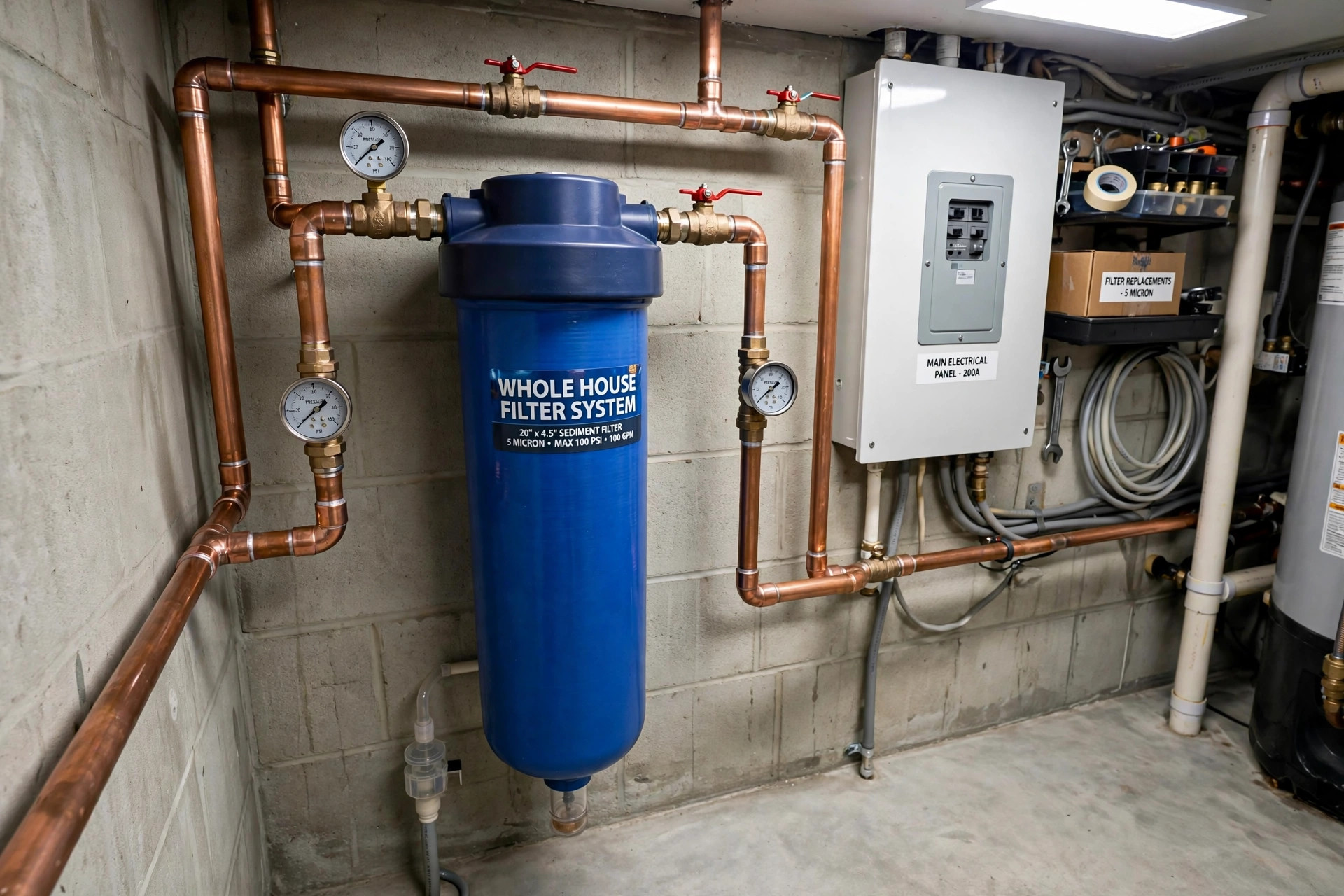
The filter goes on the main water line where it enters the home. It should sit before the water heater and before any branch lines. The space needs room for service. You need clearance to open the housing and change cartridges. Many owners place the system in a garage, basement, or utility room.
A bypass loop is essential. Three valves let you route water around the filter. You use the bypass when you change media or when the system fails. Without it, the whole house loses water during service.
Pressure gauges on both sides of the filter are useful. When the outlet gauge reads much lower than the inlet gauge, the media is clogged. That pressure drop tells you it is time for service. Step-by-step placement advice appears in project guides from Family Handyman and This Old House.
Outdoor installation is possible in mild climates. In freezing zones, the unit must stay indoors or be heavily protected. A frozen housing can crack and flood.
Care and Upkeep
Mark your calendar. The most common failure is simple neglect. Follow the maker schedule for cartridge changes and backwash cycles. Write the date on each new cartridge with a marker. That small habit prevents most problems.
Watch the water. A return of chlorine taste, a drop in pressure, or odd smells means the media is spent. Do not wait for the full schedule if you see these signs. Heavy sediment loads use up filters faster.
Sanitize the system once a year. Housings and tanks can grow bacteria in warm weather. Most makers give a simple bleach flush procedure. Follow it exactly and flush well afterward.
Keep spare parts on hand. One extra cartridge set, spare O-rings, and food-grade silicone grease cover most needs. O-rings dry out and crack. Grease them lightly at each change. Check for leaks after every service. A paper towel under the housing shows drips early.
For well water, retest yearly. Wells change with seasons and rainfall. A system tuned to last year water may miss this year problems. Seasonal checklists from Good Housekeeping help owners build the habit.
Safety Notes
Water filters do not make unsafe water safe by magic. If your water carries bacteria, viruses, or high lead, you need the right certified treatment. Look for NSF or ANSI certification marks on the product. Certification means an independent lab tested the claims.
Lead deserves special care. Whole house carbon filters reduce some lead but are not certified lead removers unless labeled so. If a lab finds lead, address the pipes first. A filter is the second step, not the first.
Do not drink the first water after service. New carbon sheds fine dust. Flush the system for five to ten minutes after a cartridge change. The water may look gray at first. That is normal carbon dust, not dirt.
Keep chemicals away from the unit. Filter housings sit near water heaters, paint, and cleaners in many homes. Store chemicals elsewhere. A cracked housing near stored chemicals is a bad mix.
If you rent your home, ask the owner before cutting into the main line. Most leases forbid plumbing changes. Some owners approve it because the system protects their pipes.
Frequently Asked Questions
How long does a whole house water filter last? The tank or housing often lasts 10 to 20 years. The media inside is the part that wears out. Carbon media lasts three to five years in a backwashing tank. Cartridge systems need new cartridges every three to twelve months. Sediment pre-filters may need monthly changes on dirty well water.
Will a whole house filter soften hard water? No, not by itself. Standard carbon and sediment filters do not remove hardness minerals. You need a salt-based softener or a salt-free conditioner for scale problems. Many homes pair a softener with a whole house carbon filter. Each unit does its own job.
Does it remove fluoride? Standard whole house filters do not remove fluoride. Activated carbon barely touches it. Special alumina media removes some fluoride but needs frequent care. Most owners who want fluoride out use a small reverse osmosis unit at the kitchen sink instead.
How much water pressure will I lose? A clean, well-sized system drops pressure by 2 to 5 psi. That is barely noticeable. An undersized or clogged system can drop 15 psi or more. That feels like a weak shower. Size the system above your peak flow and change media on schedule.
Can I install it myself? Many owners do. You need to cut the main line, solder or press fittings, and mount the unit level. If your main line is old galvanized pipe, hire a plumber. One mistake on the main line floods the house. Check local codes before you start.
Is filtered water safe for babies and pets? Filtered water is fine for both in most cases. For baby formula, follow your doctor advice and your local water guidance. Pets drink what you drink in most homes. If your water needs treatment for safety reasons, fix the source problem first.
Related Reading
If you are weighing filter upkeep against other home services, see our guide to extendable duster sets reviews and buying guide for keeping the rest of the house clean. For seasonal safety checks, our look at reliable chimney sweep services in colorado covers heating-season prep. And if you need hands-on help with the install, read cordless handyman services for homeowners near me.
A Short Final Word
A whole house water filter is one of the most useful upgrades a home can have. It touches every tap. It protects pipes and appliances. It makes water taste better. The reliable choice is not the most expensive one. It is the one matched to a real water test, sized for your home, and kept on schedule. Take the test. Pick honest media. Do the upkeep. Your water will repay you every single day.
References
Bob Vila. (n.d.). Home improvement advice. https://www.bobvila.com Centers for Disease Control and Prevention. (n.d.). Cleaning and disinfecting your home. https://www.cdc.gov Consumer Reports. (n.d.). Product reviews and ratings. https://www.consumerreports.org Family Handyman. (n.d.). DIY home repair and maintenance. https://www.familyhandyman.com Good Housekeeping. (n.d.). Product reviews and home advice. https://www.goodhousekeeping.com NSF International. (n.d.). Product certification standards. https://www.nsf.org The Spruce. (n.d.). Home and garden advice. https://www.thespruce.com This Old House. (n.d.). Home renovation guidance. https://www.thisoldhouse.com U.S. Environmental Protection Agency. (n.d.). Protecting human health and the environment. https://www.epa.gov
Was this guide helpful?

About Robert Taylor
The My Garden US editorial team writes practical, in-depth home and garden guides for American homeowners — tested advice, no fluff.