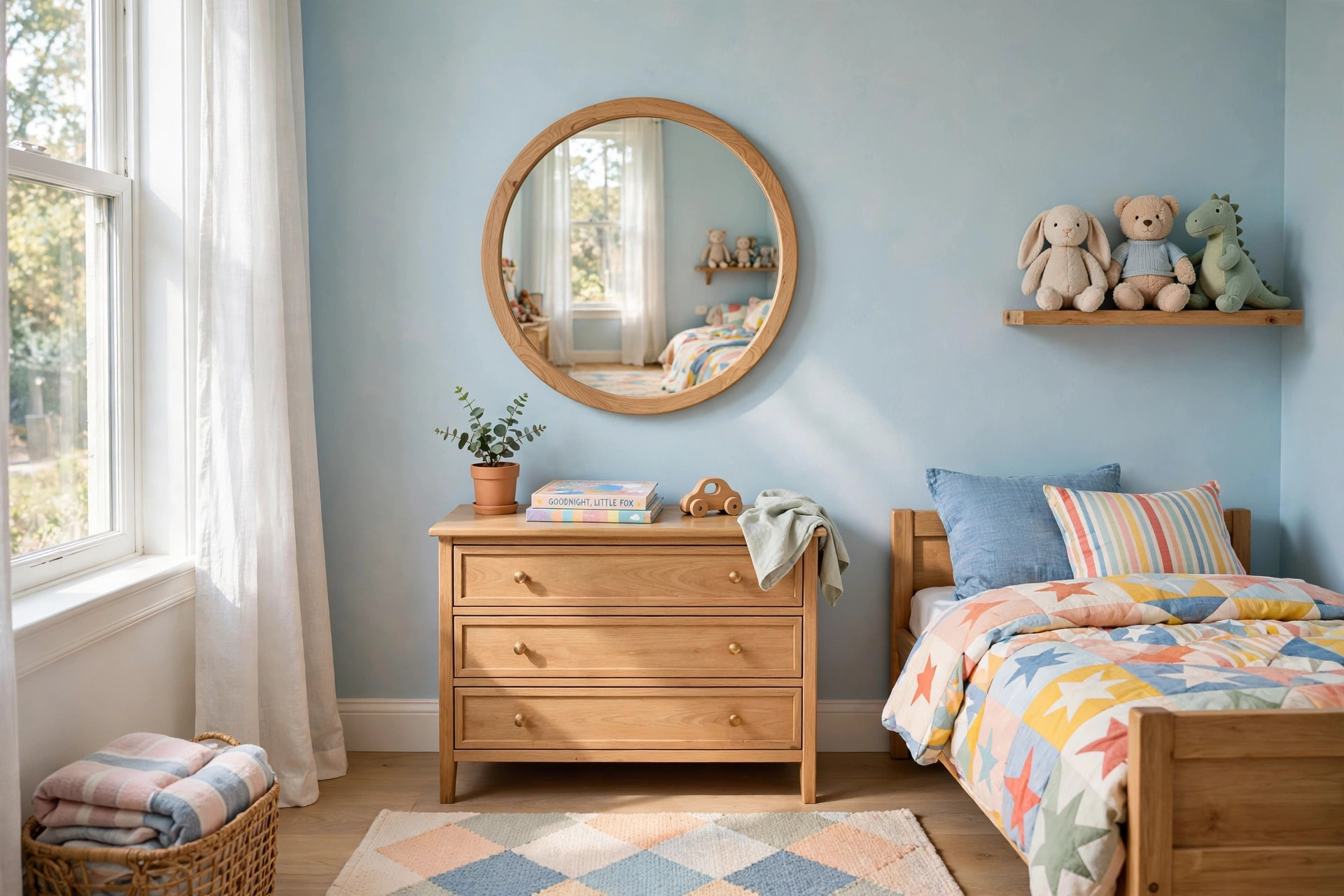

A kids wall mirror for bedroom decor safety is one of the simplest ways to make a child’s room feel bigger, brighter, and more cheerful. It can also be one of the riskiest items on the wall if it is chosen or hung the wrong way. Children climb. They throw toys. They bump into walls at full speed. A mirror that would be fine in an adult bedroom can become a hazard in a room full of rough play.
This guide explains what to look for when you shop for a mirror for a child’s bedroom. It covers the safest materials, the best sizes and shapes, how to mount a mirror so it will not fall, what to expect to pay, and how to keep the mirror clean and safe over time. By the end, you will know how to pick a mirror that looks good and protects your child at the same time.
Why It Matters
A mirror changes a room more than most decor items. It bounces light around. It makes a small bedroom feel twice as big. Children love looking at themselves in mirrors, and many child experts say that mirror play helps toddlers learn about their bodies and their faces.
But glass is glass. A heavy mirror with a weak hook can fall on a child. A thin mirror can break if a ball hits it. The federal safety commission tracks injuries from falling furniture and wall items each year, and mirrors are part of that list. Most of these accidents could have been avoided with better mounting and safer materials.
Safety matters even more in a child’s bedroom than in other rooms. Children spend hours playing there with less supervision than in the living room. They hang from furniture. They turn beds into trampolines. When you plan bedroom decor, safety has to come first and style has to come second.
What to Look For When You Choose One: Kids Wall Mirror for Bedroom Decor Safety
Start with the material. The single most important choice is whether the mirror is made of glass or a shatterproof plastic such as acrylic.
Acrylic mirrors are the safest pick for a child’s room. They are light. If a child hits one with a toy, it will not shatter into sharp pieces. The reflection is a little less sharp than true glass, but in a child’s room that trade-off is worth it. Look for mirrors sold as “shatterproof” or “unbreakable.”
If you want true glass, choose a mirror with a safety film on the back. Safety film holds the glass together if it breaks. The glass will crack but the pieces will stay stuck to the film instead of falling. Many large online furniture sellers list safety film in the product details, so check before you buy.
Next, look at the frame. A frame adds weight, and weight matters. Solid wood and thick plastic frames are fine as long as the mirror is mounted well. Thin metal frames can bend. Sharp corners on any frame are a problem for toddlers, so pick rounded or padded edges.
Check the back of the mirror. A good kids’ mirror has more than one mounting point. Two or more hooks spread the weight across the wall. One lone wire is not enough for a child’s room. Some mirrors come with a French cleat, a two-piece bracket that locks the mirror to the wall. That is one of the safest mounting styles you can buy.
Finally, read the weight. Any mirror over 15 pounds needs a wall anchor or a stud, not just a drywall nail. If the product page does not list the weight, that is a bad sign. Reputable sellers list it clearly.
Types and Options
Acrylic Mirrors
Acrylic mirrors are the top choice for nurseries and young children’s rooms. They come in many shapes: circles, clouds, stars, animals. The light weight means you can hang them with simple screws or even heavy-duty adhesive strips on smooth walls. They are easy to clean with a soft cloth. The main downside is the softer reflection and a surface that can scratch if cleaned with rough paper towels. Many retailers that specialize in children’s rooms carry acrylic mirror lines designed for safety.
Glass Mirrors with Safety Film
These mirrors look like normal mirrors because they are. The back has a clear film that holds broken glass in place. They are heavier than acrylic, so they need stronger mounting. This type works well in a teen’s room, where rough play is less of a concern but safety still counts. Make sure the film is applied by the maker, not added later with a do-it-yourself kit.
Full-Length Mirrors
A full-length mirror is a favorite for older children and teens. It lets them see a full outfit before school. For safety, a full-length mirror should never lean against the wall. Leaning mirrors tip over easily when a child bumps them. Bolt the mirror to the wall with brackets at the top and bottom. Some full-length mirrors come with a stand. If yours does, anchor the stand to the wall with an anti-tip strap. Parenting resource sites remind parents that tip-over accidents are one of the top causes of furniture injuries in children.
Mirror Wall Panels and Sets
Mirror panels are small squares or shapes sold in sets of four or more. You arrange them on the wall in your own pattern. They are light, and each piece is small, so the risk from any single piece is low. They are a good budget choice. The catch is that you must mount each piece well. Four poorly mounted panels are worse than one well-mounted mirror. Take the time to mount every piece on an anchor or a stud.
Decorative Shaped Mirrors
Animal shapes, sun shapes, and cloud shapes turn a mirror into wall art. Most shaped mirrors for children’s rooms are made of acrylic, which keeps them light and safe. They pair well with other wall art. For example, a star-shaped mirror can sit beside removable wall decals for renters without damaging the paint. When you buy a shaped mirror, check that small parts, such as glued-on ears or stars, are fixed firmly. Loose parts can become choking hazards for toddlers.
Cost and Price
Prices for a kids wall mirror for bedroom decor safety range from about 15 dollars to over 200 dollars.
Acrylic mirrors are the cheapest option. Small decorative acrylic mirrors cost 15 to 40 dollars. Larger acrylic panels cost 40 to 80 dollars. At this price, you get good safety for little money.
Glass mirrors with safety film cost more. A medium-size round glass mirror runs 50 to 120 dollars. Full-length glass mirrors run 80 to 200 dollars. The extra cost pays for the clearer reflection and the sturdier frame.
Installation costs extra if you hire help. A handyman charges 50 to 100 dollars to mount a mirror, depending on the size. That is money well spent if you are unsure about finding wall studs. DIY repair guides can show you how to locate studs and use wall anchors if you want to do it yourself.
Remember the full cost. A cheap mirror with weak mounting hardware may need new brackets. It is often cheaper to buy a mirror that comes with strong hardware in the box.
Care and Upkeep
Clean an acrylic mirror with a soft microfiber cloth and a little water. Avoid glass cleaner with ammonia. It can cloud the plastic over time. Wipe gently. Pressing hard can scratch the surface.
Clean a glass mirror with plain glass cleaner and a soft cloth. Spray the cleaner on the cloth, not on the mirror. Liquid that runs down behind the mirror can damage the frame and the wall.
Check the mounting twice a year. Pull gently on the mirror to see if it moves. Tighten any loose screws. Look for cracks in the glass or warping in acrylic. Replace a damaged mirror right away. Do not wait.
Keep the area around the mirror clear. Do not place a dresser or a toy box under a wall mirror. Children climb on furniture, and a climbing child can grab the mirror or knock into it. A clear zone of two feet below the mirror is a good rule.
Teach children not to hang on the mirror. Even a well-mounted mirror is not a toy. A calm rule, repeated often, works better than a loud warning after something breaks.
Safety First
Safety is the heart of this topic. Follow these rules and the mirror will be safe for years.
First, mount into a stud whenever you can. A stud is the wooden beam inside the wall. It holds screws far better than drywall alone. Use a stud finder to locate one. If no stud lines up with your spot, use toggle bolts or other heavy-duty drywall anchors rated for the mirror’s weight.
Second, never rely on adhesive alone for a heavy mirror. Adhesive strips work for very light acrylic pieces on smooth walls. They are not enough for glass. Heat and humidity can weaken the glue over time, and the mirror can fall without warning.
Third, place the mirror at a safe height. For toddlers, mount the mirror low enough to see into but high enough that a crawling baby cannot bang a head against it. For older children, eye level is fine. Keep the bottom edge above furniture that children climb on.
Fourth, round the edges. If the mirror has sharp corners, add corner guards made for children’s furniture. These are cheap and stick on with safe adhesive. Pediatric health experts advise parents to pad or remove sharp edges throughout a child’s room, and mirrors are no exception.
Fifth, think about the whole room. A safe mirror does not make a room safe by itself. Anchor bookcases and dressers to the wall. Cover outlets. Keep cords out of reach. Home safety is a system, and the mirror is one part of it. Home decor guides often include full room safety checklists that are worth reading.
Sixth, buy from sellers that test for children’s use. Look for labels such as “ASTM tested” or “meets CPSC standards.” These labels show the product was tested against known safety rules. When in doubt, check the federal safety commission recall list before you buy.
Finally, trust your eyes. If a mirror looks flimsy in the store, it will not get stronger on your wall. A solid frame, a flat back, and strong hardware are things you can judge in person. Do not buy a mirror you would not feel safe standing under.
FAQ
Is an acrylic mirror as good as a real glass mirror?
For a child’s room, yes. The reflection is slightly less sharp, but acrylic mirrors are far safer because they do not shatter. For a teen who wants a crisp full-length mirror, glass with safety film is the better pick.
At what age is a glass mirror safe in a child’s room?
Most experts say glass mirrors are fine from about age six or seven, when rough indoor play slows down. For children under five, stick with acrylic. For any age, mount the mirror so it cannot fall.
Can I hang a kids’ mirror with adhesive strips?
Only if the mirror is very light and made of acrylic. Glass mirrors should always use screws and anchors. Even for light mirrors, check the strips every few months and replace them once a year.
What size mirror is best for a small bedroom?
A round mirror 24 to 30 inches across works well in a small room. It reflects light and opens up the space without taking much wall area. Hang it opposite a window to double the light. A night light projector for the bedroom nearby can add a soft glow that the mirror will spread around the room.
How do I clean a mirror without scratching it?
Use a clean microfiber cloth. For acrylic, use water only. For glass, use a small amount of glass cleaner on the cloth. Never use paper towels or scrub pads. They scratch both plastic and glass coatings.
Should the mirror match the rest of the room decor?
It helps, but safety comes first. Choose the safest material in a style close to the room’s theme. Many shaped mirrors come in colors and designs that fit common themes, from space to jungle to farm. If you add lighting, a night light with a dimmer for feeding is a practical match for a nursery mirror setup.
A Short Final Word
A kids wall mirror for bedroom decor safety can be both pretty and safe. The formula is simple. Choose a shatterproof material. Pick a frame with soft edges. Mount it into a stud or with strong anchors. Check it twice a year. Follow these steps and the mirror will brighten the room for years without worry.
For more ideas on safe and stylish children’s rooms, browse design show websites for room makeovers, read home improvement advice sites for mounting tips, or look at flat-pack furniture makers that publish child safety guides when you plan the rest of the bedroom.
References
American Academy of Pediatrics. (n.d.). HealthyChildren.org. https://www.healthychildren.org Bob Vila. (n.d.). Home improvement advice. https://www.bobvila.com Family Handyman. (n.d.). DIY home repair and maintenance. https://www.familyhandyman.com HGTV. (n.d.). Home and garden ideas. https://www.hgtv.com IKEA. (n.d.). Home furnishings. https://www.ikea.com Pottery Barn Kids. (n.d.). Kids furniture and decor. https://www.potterybarnkids.com The Spruce. (n.d.). Home and garden advice. https://www.thespruce.com U.S. Consumer Product Safety Commission. (n.d.). Product safety information. https://www.cpsc.gov Wayfair. (n.d.). Furniture and home goods. https://www.wayfair.com What to Expect. (n.d.). Pregnancy and parenting guidance. https://www.whattoexpect.com
Was this guide helpful?

About Michael Thompson
The My Garden US editorial team writes practical, in-depth home and garden guides for American homeowners — tested advice, no fluff.
You May Also Like

Kids Toy Storage Hammock for Stuffed Animals: A Simple Guide
April 23, 2026 0 views
Kids Toy Box with Lid for Living Room: A Practical Buying Guide
January 3, 2026 0 views
Toddler Bed With Tent Canopy for Imagination: A Guide for Parents
August 14, 2026 0 views