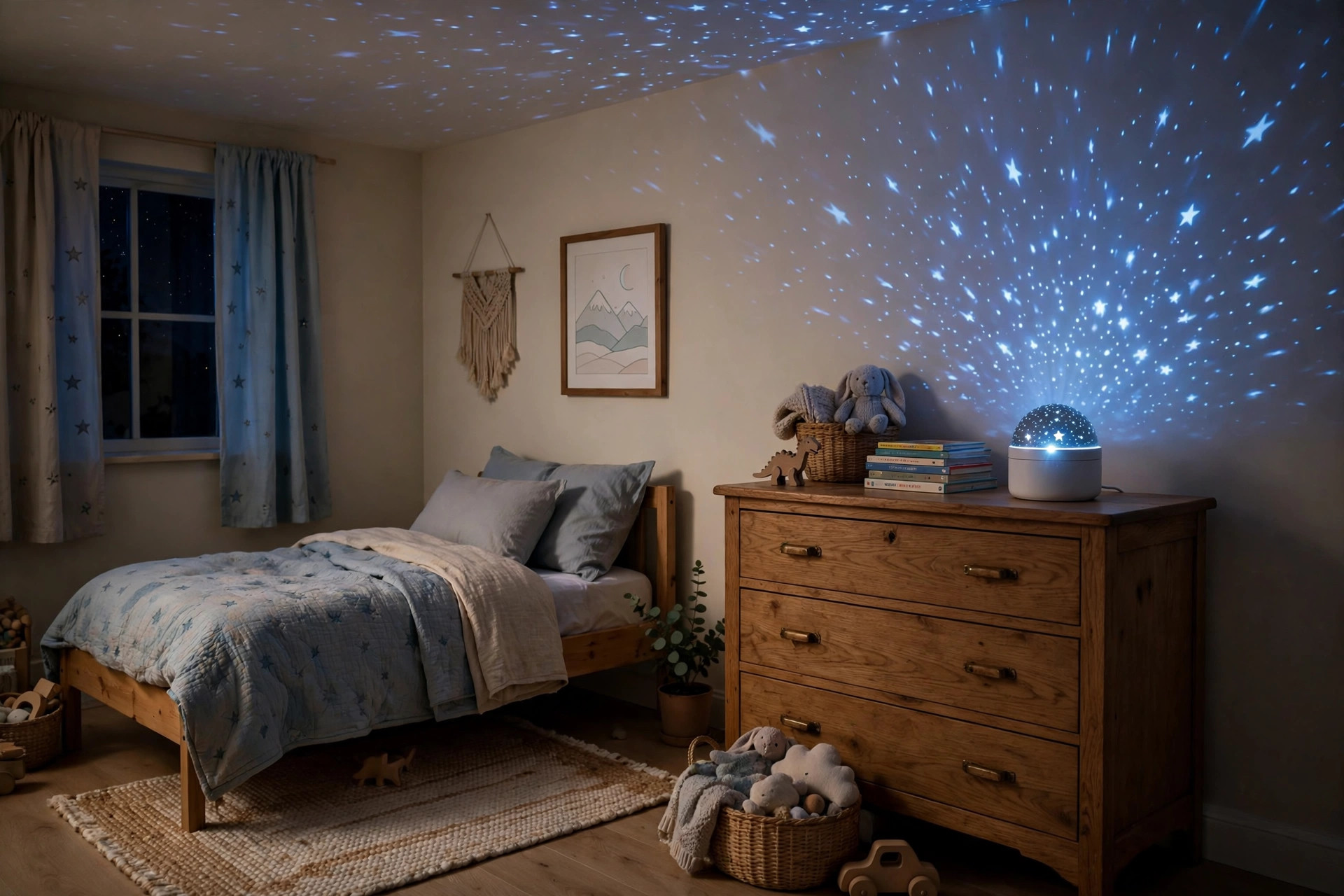

A child who fears the dark often sleeps better with a little light in the room. A night light projector does two jobs at once. It gives a soft glow so the room is never fully dark, and it paints stars, waves, or animals across the ceiling to make bedtime feel calm and pleasant. If you are hunting for the best kids night light projector for bedroom use, this guide will walk you through what matters, what to skip, and how to choose with confidence.
Why a Projector Night Light Matters
A plain night light is just a bulb. A projector turns bedtime into a small ritual. Many children settle faster when they have something gentle to look at. Moving stars or soft clouds on the ceiling give the eyes a resting point. The glow is dim enough that it should not keep a child awake, yet bright enough to take away the fear of total darkness.
Parents like these lights for simple reasons. They work as a nursery night light with dimmer for feeding during late-night feedings. They help toddlers who wake at 2 a.m. find their way back to sleep without a bright lamp being switched on. And unlike a television or tablet, a projector light does not play shows or games. It is light only.
Health guidance from HealthyChildren.org notes that a calm, dark-but-not-pitch-dark sleep space helps children build steady bedtime habits. A projector night light fits well into that routine when it is used at low brightness and turned off, or set to a timer, once the child drifts off.
What to Look for When You Choose: Best Kids Night Light Projector for Bedroom
Brightness and Dimmer Control
The best kids night light projector for bedroom use always offers brightness control. A room that glows too brightly can delay sleep. Look for a model with at least three brightness levels, or a smooth dimmer. You want the stars to be visible but soft. The light should never shine straight into the child’s eyes.
Many parents pair the projector with a nursery lamp with soft warm light for night for feedings and diaper changes, then let the projector take over for the long stretch of sleep. Two small lights, each dim, often beat one strong lamp.
Projection Type and Themes
Projectors come in a few common styles:
– Starry sky projectors cast small stars and dots across the ceiling. These are the most popular and the most calming. – Ocean wave projectors move slow waves of blue and green light. Some play water sounds. – Character projectors show animal shapes or storybook scenes. Young toddlers often love these, but the busy patterns may distract an older child. – Rotating versus still images. A slow rotation adds magic. A fast rotation can be too busy for sleep.
Pick a theme that matches your child’s age and mood. A five-year-old who loves space will treasure a star projector. A toddler may do better with soft waves.
Timer and Auto Shut-Off
A timer is one of the most useful features. It lets the light run for 30, 60, or 90 minutes and then switch itself off. This saves power and keeps the room fully dark for the deep sleep hours. Health experts note that total darkness during deep sleep supports better rest, so a timer is worth seeking out.
Power Source
Most projectors run on USB power or batteries. USB models with a wall adapter are best for a bedroom, since you will not be replacing batteries every few weeks. If you want one for travel, a rechargeable model with a long battery life is a smart pick.
Sound Options
Some projectors include built-in lullabies, white noise, or nature sounds. A gentle sound can help a baby fall asleep, and it may reduce the need for a separate nursery sound machine for baby sleep aid. Check that the sound has volume control and a mute button. Sound that is too loud, or that loops with gaps, can wake a light sleeper.
Types of Projector Night Lights Compared
Plug-in projectors sit on a shelf and draw power from an outlet. They are steady, bright enough, and always ready. The downside is the cord, which must be kept well away from the crib or bed.
Battery and rechargeable projectors are portable. You can move them from the bedroom to the living room or pack them for a trip. The trade-off is charging and slightly dimmer light on some models.
Combination night light projectors do double duty: they glow as a plain night light and also project. These are handy for small rooms where you want only one device.
Clock and projector combos add a soft time display. For older kids, a clock that changes color when it is time to get up can be a nice bonus.
Ideas for room layout and light placement can be found in room inspiration guides at IKEA and Wayfair, which show how small lights fit into a child’s bedroom setup.
Cost and Price: What to Expect
Prices for the best kids night light projector for bedroom models fall into clear bands:
– Under $15. Basic battery models with one or two themes. Fine for a trial, but check the brightness and timer. – $15 to $35. The sweet spot. Rechargeable models with dimmer control, timers, and two or three projection themes live here. Most families find everything they need in this range. – $35 to $60. Premium models with app control, music libraries, voice control, and many themes. Nice extras, but not needed for most children.
Set a budget before you shop. A $25 projector with a timer and dimmer often beats a $50 model with features you never use. Buying guides at Pottery Barn Kids and What to Expect offer parent-tested views on which features are worth the price.
Care and Upkeep
A projector night light needs little care, but a few habits keep it working well:
– Clean the lens. Dust on the lens makes the stars blurry. Wipe it gently with a dry, soft cloth once a month. – Check the cord. If the model is USB-powered, inspect the cable for wear. Replace frayed cables at once. – Keep it out of reach. Place the projector on a high shelf or dresser, away from little hands. Small parts or loose covers can be a hazard. – Store batteries safely. If your model uses replaceable batteries, keep spares in a locked drawer, not in the child’s room.
The care pages at The Spruce have simple checklists for keeping nursery electronics clean and safe.
Safety: What Every Parent Should Know
Safety comes first with anything that sits in a child’s room overnight.
– Buy from trusted brands. Cheap, unbranded projectors may lack proper heat controls. Stick with sellers that follow U.S. safety standards. – Check for recalls. The U.S. Consumer Product Safety Commission lists recalls for children’s lighting and electronics. A quick check before you buy takes two minutes. – Mind the heat. A good projector runs cool. If the unit feels hot after an hour, stop using it and return it. – Keep cords away from cribs. Any cord within reach of a crib is a strangulation risk. Mount the projector high and run the cord along the wall. – Small parts. Models with removable domes or covers can expose small parts. Keep these out of a toddler’s reach. – Use a timer. All-night light may disturb deep sleep. The timer setting lets the room go dark once the child is asleep.
Retailers like Target and Amazon list safety certifications on product pages, which makes it easier to compare models before you order.
How to Introduce the Projector at Bedtime
Buying the best kids night light projector for bedroom use is only half the job. How you introduce it matters too. A new glowing device in a dark room can surprise a small child, so take it step by step.
Start with the lights on. Let your child hold the projector and press the buttons. Show them each theme and each color. Let them pick their favorite stars. When children have a say, they feel ownership, and the light becomes theirs instead of something strange in the room.
On the first night, use the brightest setting and sit with your child while the stars move. Read a short story under the glow. Once they seem relaxed, turn the brightness down one level each night until you reach the softest setting. This slow change helps the child adjust without noticing much difference.
Build the projector into a fixed routine. A warm bath, teeth brushing, one story, projector on, lights out. Children feel safe when the same steps happen in the same order every night. The projector becomes a signal: stars on the ceiling means it is sleep time.
If your child wakes at night and calls out, resist the urge to switch on the main light. Walk in quietly, check that all is well, and let the projector do its job. The dim stars will still be there, and the child will learn that the dark room is safe.
For siblings who share a room, place the projector where both beds can see the ceiling glow. Two children may want two themes. A simple rule helps: one child picks the theme on odd days, the other on even days. Small routines like this stop bedtime arguments before they start.
When travel comes, bring the projector along if it is rechargeable. Hotels feel strange to children, but familiar stars on an unfamiliar ceiling can make a new room feel like home. Charge it fully before the trip and pack the short USB cable in your carry-on bag.
Frequently Asked Questions
At what age can a child use a night light projector?
Most projectors are safe from birth when placed out of the baby’s reach. For newborns, keep the light dim and the sound low. Toddlers from about 18 months up often get the most comfort from the starry images.
Will a projector light keep my child awake?
It should not, if the brightness is low and the theme is calm. Fast-moving or bright patterns can be too exciting. Choose slow stars or waves, use the dimmest setting, and set a timer so the room goes dark during deep sleep.
Is it better than a regular night light?
Both work. A projector adds a calming image, which helps children who fear the dark. A plain night light is simpler and cheaper. Many parents use both: a dim plain light for feedings and a projector for falling asleep.
How far should the projector sit from the bed?
Place it on a shelf or dresser at least six feet from the bed. The stars should cover the ceiling, not shine into the child’s eyes. Test the angle before bedtime and adjust as needed.
Can I leave it on all night?
A timer is better. Most sleep experts favor darkness during the deep sleep hours. Set the timer for 60 to 90 minutes so the light fades out after your child falls asleep.
What if my child is scared of the moving stars?
Some children find moving images unsettling. Try a still projection first, or a plain glow with no images. Let the child choose the theme if they are old enough. Comfort matters more than any feature list.
A Short Final Word
The best kids night light projector for bedroom use is not the one with the most features. It is the one your child loves at bedtime, with a dimmer, a timer, and a safe build. Shop in the $15 to $35 range, check the safety basics, and place it high on a shelf away from the crib. With the right projector, bedtime becomes a calmer part of the day for the whole family.
References
Amazon. (n.d.). Online shopping. https://www.amazon.com American Academy of Pediatrics. (n.d.). HealthyChildren.org. https://www.healthychildren.org IKEA. (n.d.). Home furnishings. https://www.ikea.com Pottery Barn Kids. (n.d.). Kids furniture and decor. https://www.potterybarnkids.com Target. (n.d.). Retail store. https://www.target.com The Spruce. (n.d.). Home and garden advice. https://www.thespruce.com U.S. Consumer Product Safety Commission. (n.d.). Product safety information. https://www.cpsc.gov Wayfair. (n.d.). Furniture and home goods. https://www.wayfair.com What to Expect. (n.d.). Pregnancy and parenting guidance. https://www.whattoexpect.com
Was this guide helpful?

About David Wilson
The My Garden US editorial team writes practical, in-depth home and garden guides for American homeowners — tested advice, no fluff.
You May Also Like

Best Kids Desk with Hutch for Homework: What to Know Before You Buy
June 7, 2026 0 views
Kids Bedroom Rug for Girls Pink Decor: A Parent’s Complete Guide
September 15, 2026 0 views
The Best Kids Desk Lamp for Eye Protection: A Parent’s Guide
July 11, 2026 0 views