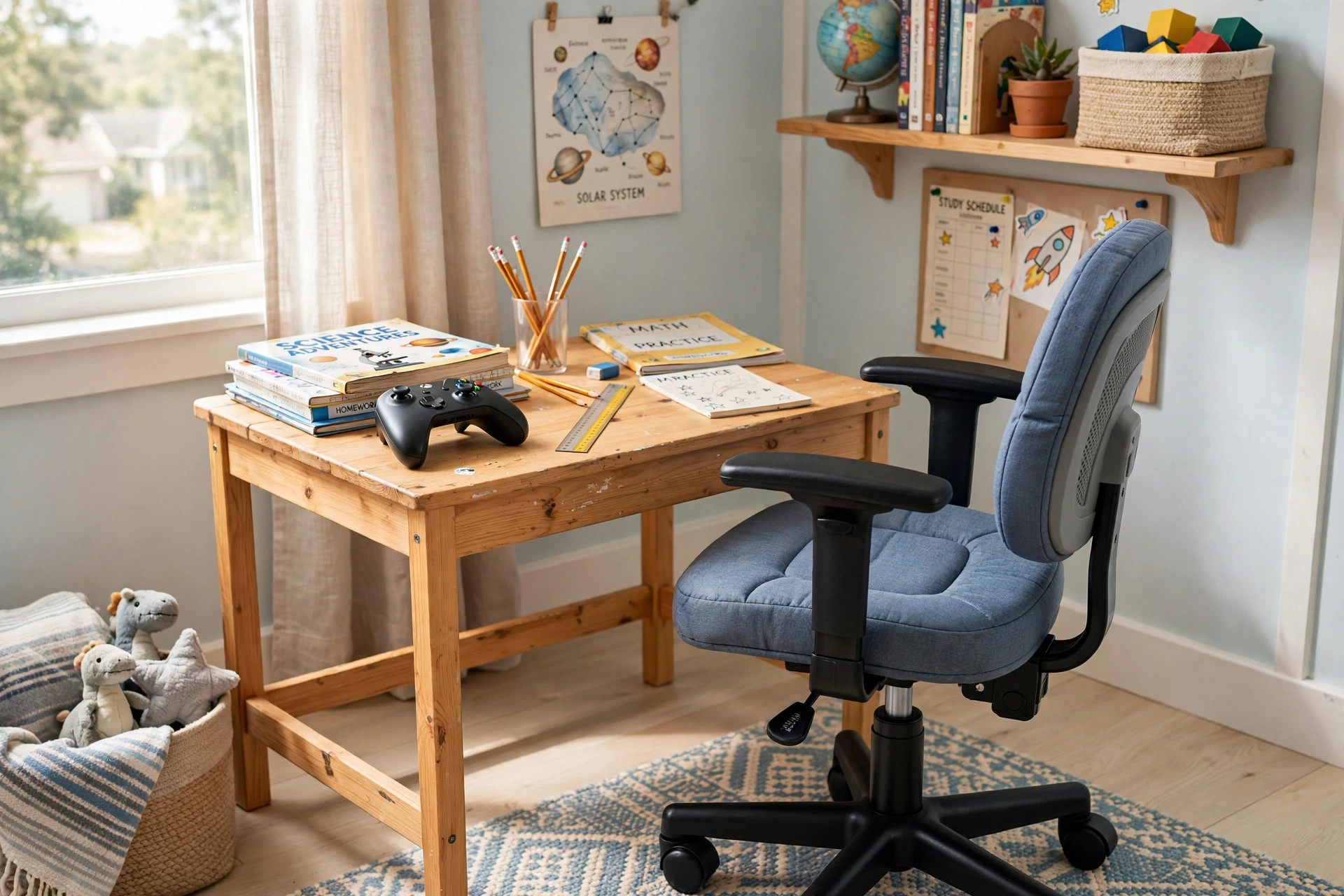

Many children now spend hours each day in one seat. In the morning they may sit down to finish math problems. In the afternoon they may sit in the same spot to play a video game. A regular kitchen chair does not support that kind of use. The best kids chair for gaming and homework is built for both jobs. It holds good posture during study time and gives comfort during play.
This guide explains what makes such a chair work. It covers size, support, materials, price, and safety. It also answers common questions from parents. By the end, you will know how to pick a chair that fits your child, your room, and your budget.
Why the Right Chair Matters
Children grow fast, and their bodies need support while they sit. A chair that is too tall pushes their legs forward. A chair with no back support lets them slouch. Over time, poor seating can lead to back pain, neck strain, and tired eyes. These problems show up in adults, but they start in childhood.
A chair built for both gaming and homework solves two problems at once. During homework, the child needs a firm seat and a straight back. Good posture helps them focus. During gaming, they need a seat that lets them shift and relax a little. A chair with a padded seat and a back that tilts slightly works well for both uses.
Parents also care about money. One chair that handles both activities costs less than two chairs. It also takes up less space. In a small bedroom, one kids desk chair adjustable for growing children can serve the desk corner for years.
There is a health angle too. Doctors who study children say that kids should change position often. A chair that swivels or rocks a little lets a child move without getting up. Small movements keep blood flowing and help attention. The American Academy of Pediatrics notes that posture and activity habits form early, and good habits are easier to build than to fix later (https://www.healthychildren.org).
What to Look for When Choosing: Best Kids Chair for Gaming and Homework
Start with size. The best kids chair for gaming and homework must fit the child who will use it. The child should sit with feet flat on the floor and knees at a right angle. Thighs should rest flat on the seat. The back should touch the backrest without the child pushing back to reach it.
Most chairs for children list a height range or an age range. A chair for a six year old is very different from a chair for a twelve year old. If you are buying for a child between eight and twelve, look for a seat height of about 14 to 17 inches. If the chair has a gas lift, the range may stretch wider. A gas lift lets the seat rise and fall, so the chair can grow with the child.
Next, check the seat. A good seat is firm but padded. Memory foam or thick molded foam works well. The seat should be wide enough that the child does not feel squeezed. A seat depth of 13 to 15 inches fits most school-age children. If the seat is too deep, the front edge will press into the back of the knees. That cuts off blood flow and causes fidgeting.
The backrest matters just as much. Look for a back that supports the lower back. Some chairs have a curved or padded lumbar area. A backrest that tilts back a few degrees helps during gaming. A backrest that locks upright helps during homework. The best chairs let you switch between the two.
Armrests are a point of debate. Fixed armrests can stop a chair from sliding under a desk. That is a problem in a small room. Flip-up armrests solve it. They give support during gaming and move out of the way during homework. If your desk is low, you may want no armrests at all. Many study setups work best with a simple armless chair, and a desk paired with a kids loft bed with desk underneath for teens often needs a chair that tucks in fully.
The base should be stable. Five-star bases with wheels roll smoothly and resist tipping. Four legs are fine for a stationary homework chair but less good for gaming, where the child turns to face a screen at an angle. Check the weight limit. Most kids chairs hold 150 to 200 pounds, which is plenty for children but worth confirming for older teens.
Finally, look at materials. A wipeable surface is a gift for parents. Vinyl and faux leather clean with a damp cloth. Fabric covers breathe better in warm rooms but stain more easily. Mesh backs keep the child cool during long gaming sessions. Wood and plastic seats last a long time but offer less comfort for long sits.
Types and Options
Chairs for this double duty come in a few main types. Each has strengths and weak points.
Adjustable Task Chairs
These are the most popular choice. They look like small office chairs. They have a gas lift for height, a five-star base with wheels, and often a tilt function. They fit a wide age range because the height adjusts. Many models include a lumbar pad. The downside is that cheap models wobble after a year or two. Spend a little more for a strong base and smooth casters. Retailers like IKEA and Wayfair carry many such chairs in child sizes (https://www.ikea.com) (https://www.wayfair.com).
Gaming-Style Chairs in Child Sizes
These chairs copy the look of adult racing-style gaming seats. They have high backs, side bolsters, and bright colors. Children love the look. The high back supports the head and neck during gaming. The weak point is homework. The side bolsters can push the child forward, and the bucket shape is made for leaning back, not sitting straight. If gaming is the main use, these are fine. If homework comes first, a task chair is better.
Rocker and Floor Gaming Chairs
Floor rockers sit low to the ground with no legs. The child sits on the floor and leans back. These are great for console gaming in front of a television. They fold flat for storage. But they are poor for homework. A child cannot reach a desk from a floor rocker. Some families buy both: a floor rocker for the living room and a desk chair for the bedroom.
Simple Wooden or Molded Study Chairs
A plain sturdy chair works for homework and costs little. Molded plastic or wood seats last for years. The weak point is comfort during long gaming sessions. A thin cushion on the seat helps. For younger children, a toddler table and chair set for playroom is the right scale, but school-age kids need a taller seat.
Bean Bags and Soft Seating
Bean bags are fun and cheap. They suit casual gaming. They are terrible for homework posture. Use them as extra seating, not as the main chair.
Cost and Price
Prices for kids chairs vary widely. A simple molded chair may cost 25 to 40 dollars. A basic adjustable task chair runs 60 to 120 dollars. Gaming-style chairs in child sizes run 100 to 200 dollars. High-end ergonomic models can reach 250 dollars or more.
The middle range, about 80 to 150 dollars, is the sweet spot for most families. Chairs in this range usually have a gas lift, a stable base, and decent padding. They last three to five years of daily use.
Do not buy on price alone. A 30-dollar chair that hurts a child’s back is no bargain. A 150-dollar chair that lasts five years costs 30 dollars per year. That is good value. Look for a warranty of at least one year. Read the return policy before you buy, in case the chair does not fit.
Seasonal sales help. Back-to-school sales in late summer often include kids desk furniture. Big retailers such as Target and Walmart run these sales each year (https://www.target.com) (https://www.walmart.com). Holiday sales in November and December are another good window.
Care and Upkeep
A kids chair takes a beating. Crumbs, markers, and spilled drinks are part of daily life. Pick a chair you can clean. For vinyl or faux leather, wipe the seat with a damp cloth each week. For fabric, vacuum the seat and back monthly. For mesh, use a soft brush to clear dust.
Check the moving parts twice a year. Tighten any screws on the base and armrests. Test the gas lift. If the seat sinks on its own, the cylinder may need replacement. Many makers sell replacement cylinders for a small price. Oil the caster wheels if they squeak or stick. Hair wraps around wheel axles often; pull it out with tweezers.
Teach the child a few rules. No standing on the chair. No tipping back on two legs. No spinning at full speed. These habits protect the chair and prevent falls. A chair that is cared for can move from one child to a younger sibling when the older one outgrows it.
If the cover wears out, check whether the maker sells replacement covers. Some brands do. A new cover costs far less than a new chair and makes the chair look fresh.
Safety
Safety comes first with any kids furniture. The U.S. Consumer Product Safety Commission sets rules for children’s products and recalls unsafe items. Before you buy, check their site for recalls on the model you want (https://www.cpsc.gov).
Look for these safety points. The chair should not tip over easily. A five-star base is more stable than a four-leg design for a chair that swivels. There should be no sharp edges or pinch points where small fingers can get caught. The gas lift cylinder should be covered so little fingers cannot reach the moving parts.
Check the materials for safety labels. Look for GREENGUARD or similar marks that show low chemical emissions. Avoid chairs with a strong chemical smell out of the box. Let a new chair air out in a garage or open room for a day before the child uses it.
Weight limits matter. Do not let an older sibling or adult sit in a chair rated for small children. Overloading a chair can break the base and cause a fall. Also keep the chair away from windows with cords and from bunk bed ladders, where climbing games can turn risky. Guides for safe kids rooms from Pottery Barn Kids and The Spruce offer useful checklists (https://www.potterybarnkids.com) (https://www.thespruce.com).
Teach the child to sit fully in the chair, not on the edge. A child who perches on the front edge can slide off. For very young children, a chair with a lower center of gravity is safer than a tall swivel chair. Parenting guides at What to Expect cover age-appropriate furniture choices (https://www.whattoexpect.com).
FAQ
What age is right for a gaming and homework chair?
Most children are ready for a desk-height chair around age six or seven, when homework becomes regular. Adjustable chairs suit ages six to twelve well. Teens may fit adult-sized task chairs. Always check the seat height and weight limit rather than the age label alone.
Should the chair have wheels?
Wheels help on hard floors. They let the child roll between a desk and a gaming setup. On carpet, wheels move poorly and may not be worth it. If you choose wheels, make sure they lock or that the chair is stable enough not to roll away during homework.
Is a gaming chair good for homework posture?
It depends on the model. Racing-style chairs with deep side bolsters push the child to lean back, which is poor for writing. A gaming-style chair with an upright lock and lumbar support works fine. For homework-first use, a plain adjustable task chair is usually the better pick.
How much should I spend?
Plan on 80 to 150 dollars for a chair that lasts. Cheaper chairs often wobble or lose their gas lift within a year. More expensive chairs add comfort and durability but are not required for most children.
Can one chair really work for both gaming and homework?
Yes, if it adjusts. The key features are adjustable height, a backrest that can lock upright or tilt back, and a seat that is firm enough for writing but padded enough for long play. Flip-up armrests add flexibility for tucking the chair under a desk.
How do I know the chair fits my child?
Have the child sit in it. Feet should rest flat on the floor. Knees should bend at about ninety degrees. The lower back should touch the backrest. There should be a small gap, about two fingers wide, between the front edge of the seat and the back of the knees.
A Short Final Word
The best kids chair for gaming and homework is not the most expensive one. It is the one that fits your child today and adjusts as they grow. Measure twice. Check the seat height, the back support, and the base. Pick a surface you can clean. Confirm the safety marks. Then let the child try it if you can.
One good chair in the bedroom can carry a child through years of schoolwork and play. It protects their posture, helps them focus, and gives them a comfortable spot to relax with a game. That is a small price for something they will use every single day.
For more background, see Target.
References
American Academy of Pediatrics. (n.d.). HealthyChildren.org. https://www.healthychildren.org IKEA. (n.d.). Home furnishings. https://www.ikea.com Pottery Barn Kids. (n.d.). Kids furniture and decor. https://www.potterybarnkids.com Target. (n.d.). Retail store. https://www.target.com The Spruce. (n.d.). Home and garden advice. https://www.thespruce.com U.S. Consumer Product Safety Commission. (n.d.). Product safety information. https://www.cpsc.gov Wayfair. (n.d.). Furniture and home goods. https://www.wayfair.com What to Expect. (n.d.). Pregnancy and parenting guidance. https://www.whattoexpect.com
Was this guide helpful?

About Michael Thompson
The My Garden US editorial team writes practical, in-depth home and garden guides for American homeowners — tested advice, no fluff.
You May Also Like

Kids Wall Mirror for Bedroom Decor Safety: A Buyer’s Guide
April 5, 2026 0 views
A Toddler Bedding Set with Curtains Matching: A Calm Room for Your Little One
May 11, 2026 0 views
Best Kids Storage Bench for Entryway Mudroom: A Practical Buying Guide
August 21, 2026 0 views