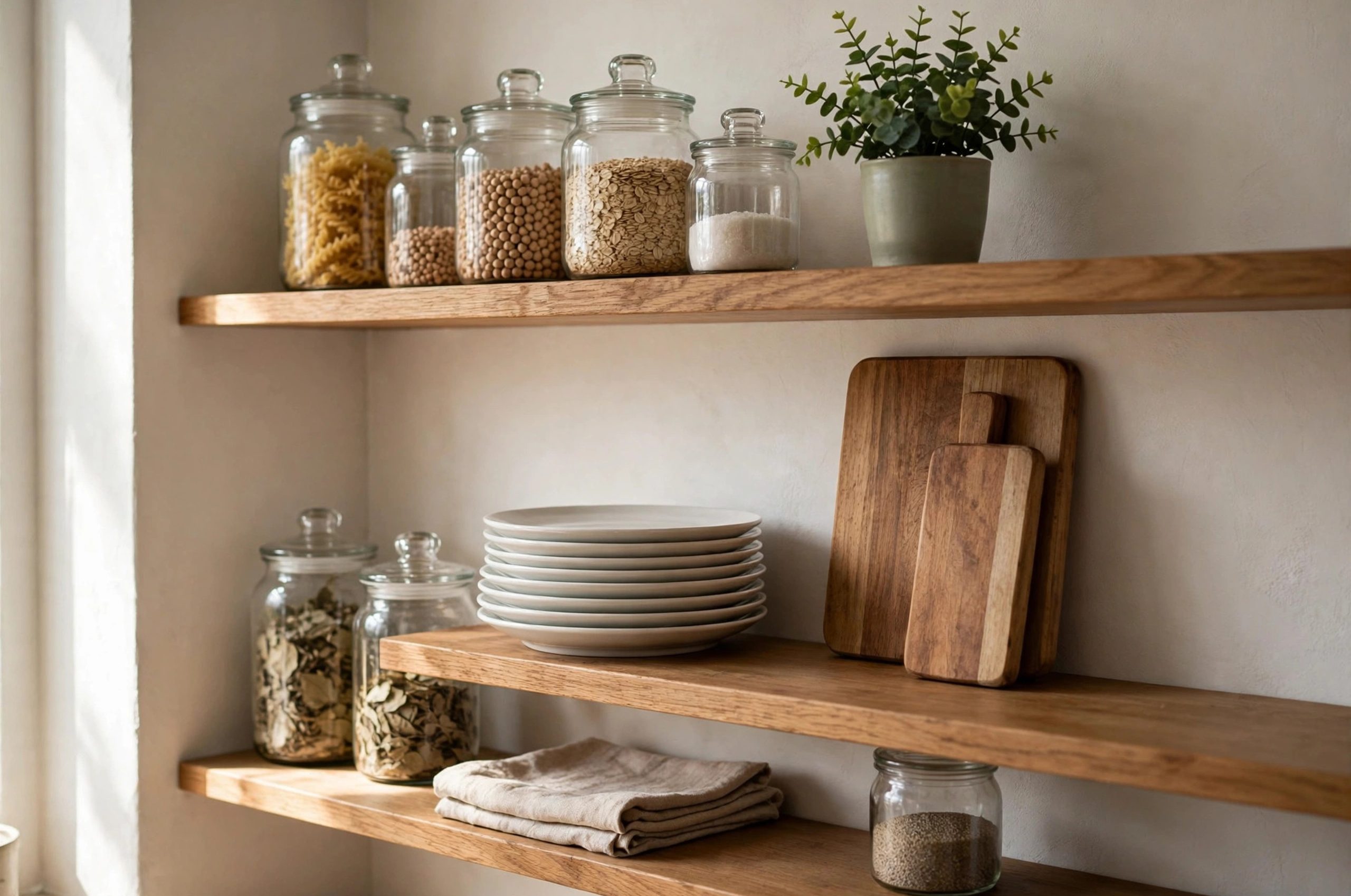
Open shelves can make a kitchen feel bigger, brighter, and more personal. They can also turn into a mess that you stare at every morning with dread. The difference between the two is not a bigger budget or better taste. It is a plan. This guide gives you one.
Table of Contents
Table of Contents
- Open Kitchen Shelving: Start by Emptying Everything
- The Rule of Breathing Room
- Pick a Simple Color Story
- The Stack, Lean, and Anchor Formula
- Group Like With Like
- Put Daily Items Low, Pretty Items High
- Add Life With Wood, Glass, and Green
- The Dust Question
- Edit on a Schedule
- What Belongs and What Does Not
- Making It Work in Small Kitchens
- References
Open Kitchen Shelving: Start by Emptying Everything
When it comes to open kitchen shelving, getting the details right makes all the difference.
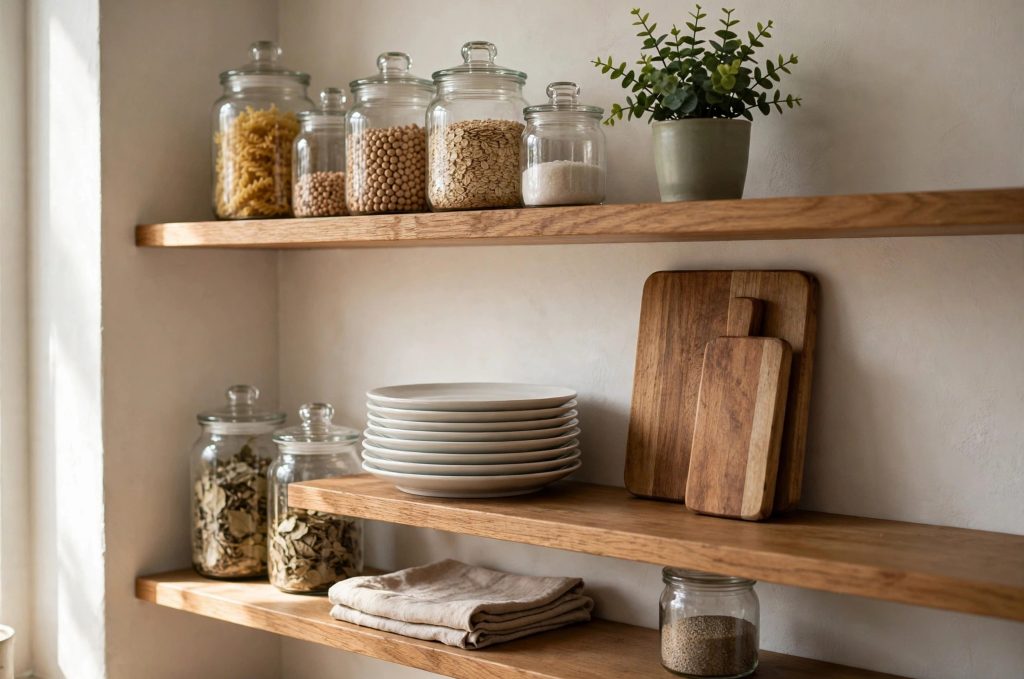
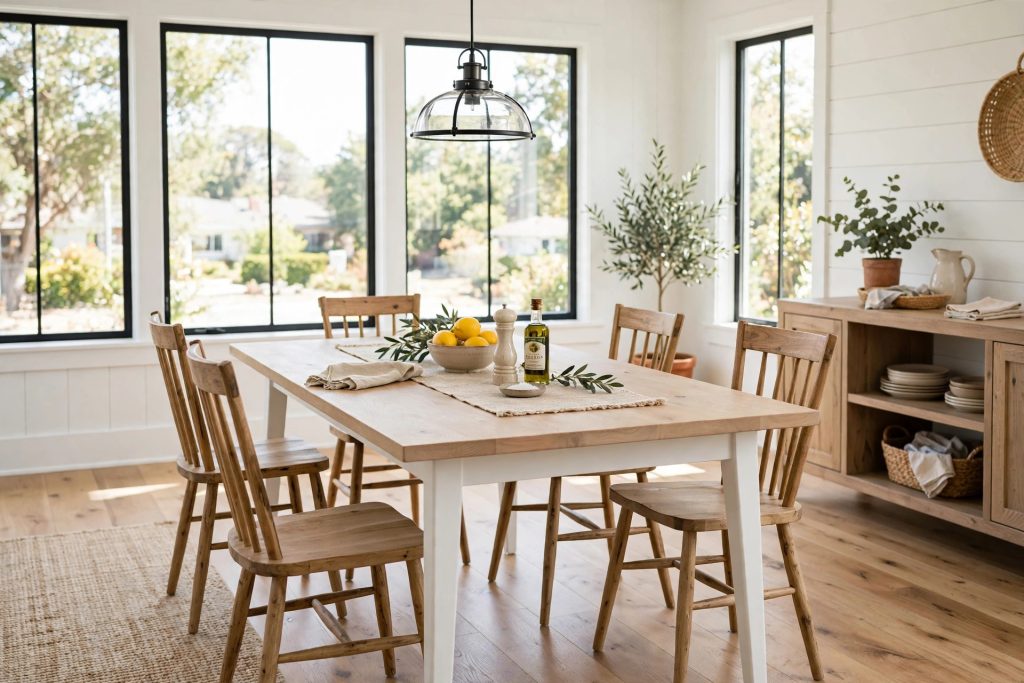
Many homeowners find that open kitchen shelving is easier than they expected once they know the basics.
You cannot fix clutter by shuffling it around. Take every single item off your open kitchen shelving and set it on the counter. Every plate, jar, mug, and stray spoon rest. This step feels like a step backward, but it is the only honest way to see what you own.
Now split the pile into three groups. Group one: things you use at least once a week. Group two: things you use once a month or so. Group three: things you forgot you owned. The first group earns a spot on the shelves. The second group can go behind a cabinet door or into the pantry. The third group needs a new home or a donation bag. Extra Space Storage has a practical version of this sorting method that many organizers swear by.
Be honest here. The chipped mug from a company picnic is not decor. The bread maker box that has lived on your shelf since spring is not styling. Open shelving has no doors to hide behind, so everything on it must earn its place every single day.
The Rule of Breathing Room
Many homeowners find that open kitchen shelving is easier than they expected once they know the basics.
The key to open kitchen shelving is choosing the right approach for your space and budget.
Walk into any kitchen with beautiful open shelves and look for the one thing they all share. It is not expensive dishes. It is empty space. The shelves you admire in magazines have anywhere from a third to a half of their surface left bare. That breathing room is what tells your eye the shelf is styled, not crowded.
A good rule: if you can fit your closed fist between two groups of items, you have enough space. If you cannot, you have too much. Houzz breaks down the same idea with examples of shelves that work because they leave room to rest.
This does not mean you need less storage. It means you need to be pickier about what lives on display. Daily dishes, a stack of bowls, and a few glasses can fill a shelf while still leaving gaps. The trick is resisting the urge to use the last six inches of shelf as overflow. If it does not fit with breathing room, it lives somewhere else.
Pick a Simple Color Story
The key to open kitchen shelving is choosing the right approach for your space and budget.
With a little planning, open kitchen shelving can fit even a busy schedule.
A shelf with ten colors reads as noise. A shelf with two or three reads as a choice. You do not need to buy all new dishes. You need to decide which colors stay and which go behind closed doors.
The easiest color stories for open kitchen shelving are white plus one wood tone, all neutrals with one accent, or glass plus greenery. White dishes on wood shelves with a green plant will never look wrong. If you love color, keep your brightest pieces together in one grouping so they form a single statement instead of scattering spots of color everywhere.
The Kitchn points to a simple approach from Ina Garten: pick a small palette and stick to it. Different heights and shapes next to each other in the same color family look collected. Different heights and shapes in random colors look cluttered.
One honest test: take a photo of your shelf. If it looks busy in the photo, it looks busy in person. Cameras flatten the scene and reveal the chaos your eyes were skipping over.
The Stack, Lean, and Anchor Formula
With a little planning, open kitchen shelving can fit even a busy schedule.
Before you start, it helps to understand how open kitchen shelving works in real homes.
Now the fun part. Almost every styled shelf in America is built from three moves: stack, lean, and anchor.
Stack. Plates and bowls are meant to be stacked. A short stack of four to six plates forms the base of a grouping. Keep stacks of one kind of dish together. Mixed stacks look busy. A guide to kitchen organizers explains how uniform stacks make everyday storage look intentional.
Lean. Tall flat things lean against the back of the shelf: a cutting board, a serving platter, a framed print. This adds height without taking floor space on the shelf. One tall item behind a low stack is the classic combo. As Parkman Woodworks shows in their decorating guide, layering a leaning board in front of taller items adds depth to the whole arrangement.
Anchor. Every shelf needs one larger piece that gives the eye a home base: a big salad bowl, a pitcher, a crock of utensils. Without an anchor, small items scatter and nothing feels grounded. With one, the shelf reads as a composed vignette.
Repeat this trio across your shelves. Stack on the left, lean behind, anchor in the middle. Or mirror it. Symmetry is optional, but balance is not. A heavy stack on one end wants a tall lean on the other.
Group Like With Like
Before you start, it helps to understand how open kitchen shelving works in real homes.
A good plan for open kitchen shelving saves time, money, and frustration.
The quickest way to make shelves look calm is to stop scattering. All the glasses go together. All the mugs go together. The oils and vinegars become one group instead of five soldiers marching across three shelves. Houzz notes that grouping similar items creates rhythm rather than visual noise.
Think of your shelf as a bookshelf. A library does not mix novels with cookbooks and photo albums on every shelf. It gives each type its own home. Do the same with your dishes.
There is one exception: a mixed cluster can work when it is deliberate. A small tray that holds oil, vinegar, salt, and a pepper mill is a group even though the items differ. The tray is the glue. Without the tray, it is four items. With it, it is one vignette.
Put Daily Items Low, Pretty Items High
A good plan for open kitchen shelving saves time, money, and frustration.
For most people, open kitchen shelving comes down to a few smart choices.
Open shelves reward thinking in zones. The bottom shelf is the workhorse zone. It should hold what you reach for daily: breakfast bowls, coffee mugs, water glasses. These items get touched so often they never collect dust, which is a real advantage.
The middle shelf is the everyday-plus zone: plates, salad bowls, the things you use most meals. HGTV shows how kitchens put practical pieces at arm height while keeping the display useful.
The top shelf is the look-but-touch-less shelf. This is where your pretty platter, the serving bowl you use on holidays, and the extra vases live. Because you touch these less, this shelf can hold slightly more delicate items. Keep the top shelf a little emptier than the others. A sparse top shelf acts like a clean horizon line that makes everything below feel tidy.
Add Life With Wood, Glass, and Green
For most people, open kitchen shelving comes down to a few smart choices.
Dishes alone can look cold. Three materials fix that: wood, glass, and something alive.
Wood cutting boards leaned against the backsplash add warmth for almost no money. A big board behind a stack of white plates is one of the most copied shelf looks in the country, and it works because wood softens ceramic.
Glass jars turn food into decor. Rice, pasta, lentils, and oats look like something in a shop window when they sit in clear jars with straight sides. Fill them with things you actually cook. A jar of flour you never use is a dust collector. A jar of the oats you eat each morning is both storage and styling.
Green is the finishing touch. A small potted herb on the shelf is kitchen-appropriate and alive. Pothos and herbs are easy to keep on a shelf near light. The kitchen and bath styling guide notes that greenery softens the hard lines of dishware better than almost anything else.
The Dust Question
If you are new to open kitchen shelving, start with the simplest option and build from there.
Let us address the number one complaint about open shelves: dust. Yes, dishes on open shelves collect dust. But here is the honest truth most people learn after living with shelves: the dishes you use daily never get dusty because you wash them too often. Only the display items suffer.
The fix is simple. Only put daily-use items on the bottom two shelves. Keep the top shelf for things you can wipe with a damp cloth once a week in under five minutes. Or skip the top shelf styling entirely and use it for closed baskets. A set of matching lidded baskets on the top shelf looks neat, hides the rarely used, and never needs dusting.
If you live on a busy street or near construction, dust will be worse. In that case, lean into fewer, larger items. Ten small objects take ten minutes to wipe. Two big bowls take thirty seconds.
Edit on a Schedule
When it comes to open kitchen shelving, getting the details right makes all the difference.
Shelves drift toward clutter the way closets drift toward junk. The defense is a short routine. Once a season, pull everything off and do the three-group sort again. Wipe the shelves. Put back only what earns its spot. It takes about twenty minutes for most kitchens.
Between edits, keep a small basket or tray on the counter for shelf overflow. When something ends up on a shelf that does not belong, it waits in the basket instead of messing up the arrangement. This one habit keeps shelves looking styled between deep edits.
If you are redoing your kitchen backsplash or island seating, restyle your shelves at the same time. The whole wall reads as one composition, and your shelves should match the new work.
What Belongs and What Does Not
Many homeowners find that open kitchen shelving is easier than they expected once they know the basics.
A short cheat sheet from years of watching open shelves succeed and fail:
Belongs: matching dish sets, clear storage jars with daily staples, cutting boards, cookbooks you actually open, one small plant, a tray of oils and salts, pretty glassware in rows.
Does not belong: the junk drawer overflow, plastic containers with mismatched lids, appliances with cords, anything still in its store box, the vitamins and the spare batteries, three half-empty bags of anything.
When in doubt, apply the restaurant test. Imagine your shelf is in a good restaurant. Would the chef be proud of it? Restaurants keep only clean, working tools on open shelves. Your kitchen can do the same.
Making It Work in Small Kitchens
The key to open kitchen shelving is choosing the right approach for your space and budget.
In a small kitchen, open shelves must do real storage work. You may not have cabinets to hide the overflow. The rules still apply, just tighter.
Go vertical. If you have more than one shelf, make the top one your pretty shelf and the lower ones your work shelves. Use wall space beside the shelves for hooks that hold mugs and tools, which frees shelf room for plates and bowls.
Choose one workhorse dish set in a single color. Mixed sets can look charming in a big kitchen with room to spread them out. In a small one, a single matching set is the difference between calm and chaos. Add personality through one accent item per shelf instead of many: a colored bowl, a patterned mug, one green plant.
And never skip the breathing room. In a small kitchen it feels wrong to leave space empty, but that space is doing more work than any extra stack of bowls could.
References
Extra Space Storage. (n.d.). Tips for open kitchen shelving. https://www.extraspace.com/blog/home-organization/diy-kitchen-shelves/
HGTV. (n.d.). Best kitchen open shelving ideas. https://www.hgtv.com/decorating/kitchens/best-kitchen-open-shelving-ideas-pictures?mode=vertical
Houzz. (n.d.). The best things to store on open kitchen shelves. https://www.houzz.com/magazine/the-best-things-to-store-on-open-kitchen-shelves-stsetivw-vs~89847522
Houzz NZ. (n.d.). On display: 10 stylish and tidy ways to arrange open kitchen shelves. https://www.houzz.co.nz/magazine/on-display-10-stylish-and-tidy-ways-to-arrange-open-kitchen-shelves-stsetivw-vs~30470415
Kitchen and Bath Center. (n.d.). Styling tips for open kitchen shelving. https://www.kitchenandbathcenter.net/blog/styling-open-shelving?hs_amp=true
Parkman Woodworks. (n.d.). How to decorate open kitchen shelves. https://www.parkmanwoodworks.com/blogs/news/decorating-open-kitchen-shelves
The Kitchn. (n.d.). Ina Garten's organizing trick for cluttered kitchen shelves. https://www.thekitchn.com/ina-garten-open-shelving-advice-23739561
Velvet Abode. (n.d.). Open kitchen shelving without the clutter. https://velvetabode.com/open-kitchen-shelving-without-the-clutter/
Was this guide helpful?

About My Garden US
The My Garden US editorial team writes practical, in-depth home and garden guides for American homeowners — tested advice, no fluff.
You May Also Like
Modern Farmhouse Tables USA Online Deals: A Plain Guide to Buying Well
June 30, 2026 1 views
Couch Throw Pillows Deals Near Me: How to Find Real Value
March 19, 2026 1 views
Entryway Decorative Mirrors for Florida Homes: A Complete Guide
September 18, 2026 3 views