“How much attic insulation do I need” is one of the most common questions asked by homeowners across the USA. The answer matters. Too little insulation lets heat escape in winter and lets heat in during summer. That raises energy bills and makes rooms feel cold or hot. Too much is rarely a problem, but it can waste money if the attic floor cannot hold the weight or if vents get blocked. This guide gives a plain answer. It explains R-value, shows target depths for each climate zone, and tells you how to check what you already have.
Why Attic Insulation Matters
Heat rises. In a typical American home, the attic is the largest source of heat loss in winter. Studies by government energy offices have long shown that a well-insulated attic can cut heating and cooling bills by a large share. The attic is also the easiest place to add insulation. The space is open. Workers can reach it without tearing walls apart. For many homes, adding attic insulation is the single best energy upgrade per dollar spent.
Insulation also guards comfort. Rooms under a thin attic often feel drafty. Ceilings feel cold in January. In July, upstairs bedrooms stay hot long after sunset. Proper depth fixes much of this. It also slows moisture movement and helps the roof deck last longer.
What Is R-Value and How Much Do You Need: How Much Attic Insulation Do I Need Usa
Insulation is rated by R-value. R-value measures resistance to heat flow. A higher number means better resistance. Building rules in the USA set minimum R-values for attics. The U.S. Department of Energy publishes guidance that most experts follow.
The country is split into climate zones, numbered 1 through 8. Zone 1 covers the hot south, such as southern Florida and southern Texas. Zone 8 covers far northern Alaska. Your zone sets your target.
– Zones 1 to 3 (hot climates): aim for R-30 to R-49 in the attic. – Zones 4 to 8 (mixed and cold climates): aim for R-38 to R-60 in the attic.
Most older homes fall short. Houses built before the 1980s often have only R-11 to R-19 in the attic. That is well below current guidance. The U.S. Department of Energy offers zone maps and insulation advice that can help you find your exact zone.
R-value adds up by layers. If you have R-19 now and your zone calls for R-49, you need about R-30 more. You can add that with batts laid across the old layer or with blown-in material on top.
How to Check What You Have Now
You do not need special tools. A tape measure, a flashlight, and a dust mask are enough. Enter the attic on a cool morning. Step only on joists or on boards laid across them. Never step on the drywall ceiling below. It will not hold your weight.
Measure the depth of insulation in several spots. Push the tape down to the ceiling surface below. Write down each reading. Average them.
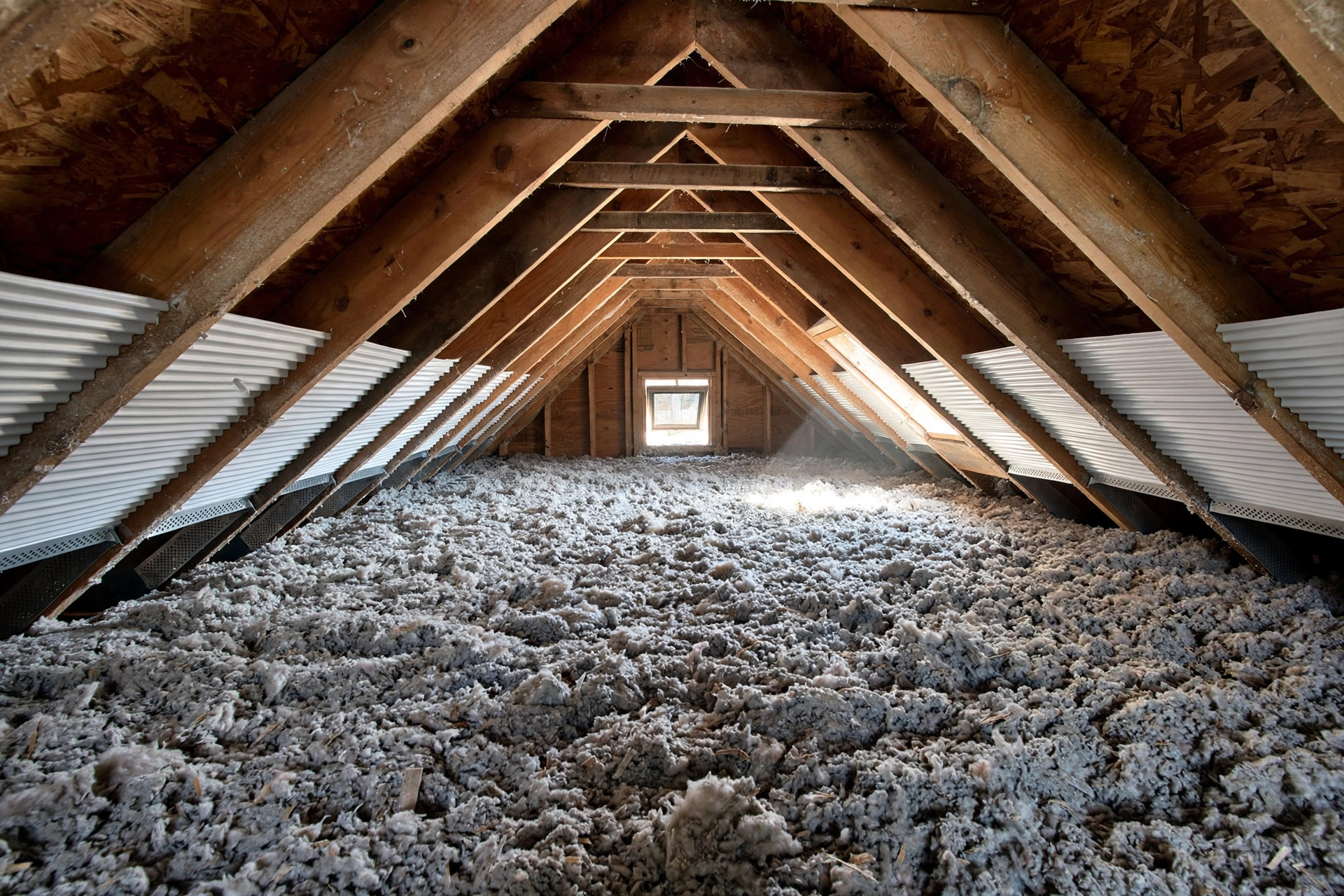
Next, find the type. Fiberglass batts look like pink or yellow blankets. Blown-in fiberglass looks like fluffy white or pink clouds. Blown-in cellulose looks like gray shredded paper. Spray foam looks like a hard crust.
Each type gives a rough R-value per inch:
– Fiberglass batts: about R-3.2 per inch. – Blown-in fiberglass: about R-2.5 per inch. – Blown-in cellulose: about R-3.5 per inch. – Closed-cell spray foam: about R-6.5 per inch. – Open-cell spray foam: about R-3.7 per inch.
Multiply depth by the per-inch value. Six inches of cellulose is about R-21. Ten inches of fiberglass batts is about R-32. This tells you where you stand. If the result is far below your zone target, more insulation is due.
Types of Attic Insulation
Blown-In (Loose-Fill) Insulation
Blown-in insulation is the most common choice for attics in the USA. A machine blows small fibers or shredded material through a hose. It fills gaps around wires, pipes, and odd corners. Cellulose and fiberglass are the two main kinds. Cellulose is made from recycled paper treated to resist fire. Fiberglass is made from fine glass strands.
Blown-in work suits attics with many obstacles. It is fast. A crew can finish most attics in a few hours. Home centers rent blowing machines to do-it-yourself buyers, often free with a large purchase. For a cost breakdown of the two leading methods, see our guide on blown-in versus batt insulation costs.
Batts and Rolls
Batts are pre-cut blankets of fiberglass or mineral wool. Rolls are the same material in long strips. They fit between joists of standard width. They cost less per square foot than blown-in work. They suit attics with clear, open joist bays and few pipes.
Batts must fit snug. Gaps, folds, and crushed spots lower the R-value. A second layer laid across the joists, at right angles to the first, cuts heat flow through the wood. This cross layer adds real value for little extra cost.
Spray Foam Insulation
Spray foam is applied as a liquid that expands and hardens. Closed-cell foam gives the highest R-value per inch. It also blocks air flow. That makes it strong for thin spaces. It costs much more than batts or blown-in material. Most homeowners use it to seal the attic floor or rim areas, then cover the rest with cheaper insulation.
What About Radiant Barriers
Radiant barriers are shiny foil sheets stapled under roof rafters. They reflect heat in hot, sunny climates. They are not insulation. They add almost no R-value. They can help in zones 1 and 2, but they do not replace proper depth.
Cost: What Homeowners Pay in the USA
Prices vary by region, attic size, and material. These ranges cover most American homes in recent years.
– Blown-in fiberglass or cellulose: about $1 to $2.50 per square foot installed. – Fiberglass batts: about $0.80 to $2 per square foot installed. – Spray foam: about $3 to $7 per square foot installed.
A 1,000 square foot attic brought from R-19 to R-49 with blown-in cellulose often costs $1,000 to $2,500 with labor. Do-it-yourself work cuts the labor share but not the material cost. Many utility firms and state programs offer rebates for insulation upgrades. The ENERGY STAR program lists guidance on efficient home upgrades and where to find local incentives.
Heating equipment makers also note that insulation lowers the load on furnaces and air conditioners. Carrier, Trane, Lennox, Goodman, and Rheem all stress that right-sized equipment works best in a well-sealed, well-insulated shell.
Air Sealing and Ventilation Come First
Adding insulation over air leaks wastes money. Warm air slips through gaps around light fixtures, plumbing vents, chimneys, and attic hatches. Seal these with caulk or foam before you add insulation. Keep insulation away from hot surfaces such as recessed lights unless the fixtures are rated for contact.
Ventilation matters too. Soffit vents must stay open. Do not pack insulation tight against the roof edge. Use baffles to hold an air path from the soffit to the ridge. Good air flow keeps the roof deck dry and cool.
Some homeowners pair insulation work with powered ventilation. If you are weighing options, our pieces on whole house fan installation cost and the whole house fan versus attic fan debate can help you decide what fits your home.
Adding More: DIY or Hire a Pro
Small top-ups suit a careful do-it-yourself worker. Laying batts across joists is simple. Blowing cellulose with a rented machine takes two people: one feeds the machine, one guides the hose. Wear a dust mask, goggles, gloves, and long sleeves. Old insulation may hold dust and rodent waste.
Hire a pro when the attic is hard to reach, when wiring looks old, when you see mold, or when you want spray foam. Pros carry the right masks and know code rules for clearances around chimneys and flues. Get three written bids. Ask each bidder for the target R-value, the material type, and the final depth in inches.
Care and Upkeep
Insulation needs little care. Check the attic once a year. Look for these problems.
– Wet or stained spots, which point to roof leaks. – Flat or matted areas, which lose R-value. – Signs of mice or squirrels, such as nests or droppings. – Blocked soffit vents.
Fix leaks before adding more material. Wet insulation must be removed and replaced. It will not dry well in place. Keep storage boxes off the insulation. Boxes crush it and cut its value. If you need attic storage, build a raised platform above the insulation so the full depth stays intact.
Safety
Attic work has real hazards. Heat builds fast in summer. Go early in the day. Bring water. Tell someone you are up there. Wear a proper respirator when handling old material. Some very old insulation may hold vermiculite with traces of asbestos. Do not disturb it. Call a testing lab first if you are unsure.
Keep all insulation at least three inches from metal flues and chimneys unless local code says more. Use metal flashing and high-heat caulk near these hot spots. Turn off power to circuits you will work around. If knob-and-tube wiring is present, stop and call an electrician. Burying that old wiring in insulation is a fire risk.
Step-by-step project guides from This Old House and Family Handyman walk through safe attic practices with clear photos.
Frequently Asked Questions
How many inches of attic insulation do I need? It depends on the material and your climate zone. For R-49 with blown-in cellulose at R-3.5 per inch, you need about 14 inches. With fiberglass batts at R-3.2 per inch, you need about 15 inches. Check your zone target first, then divide by the per-inch value.
Is it possible to have too much attic insulation? It is rare. Extra depth past the zone target adds little savings. Very deep loose-fill can press on a weak ceiling or block soffit vents. Stop at the target and keep vents clear.
Can I add new insulation over old insulation? Yes, in most cases. Old batts or blown-in material can stay if they are dry and clean. Lay new batts across the joists or blow new material on top. Remove any old material that is wet, moldy, or full of pests.
Does attic insulation help in summer? Yes. It slows heat moving down from a hot roof into living rooms. Upstairs rooms stay cooler. Air conditioners run less. The effect is strongest in hot climates with dark roofs.
How long does attic insulation last? Fiberglass and cellulose can last 20 to 30 years or more if kept dry. Settling slowly lowers depth over time. A quick check every few years tells you if a top-up is due.
Do I need to remove old insulation before adding more? Only if it is damaged. Wet, moldy, or pest-soiled material should come out. Clean, dry material can stay and keep working under the new layer.
A Final Word
The plain answer to how much attic insulation do I need in the USA is this: find your climate zone, learn your current R-value, and add enough to reach the target. Most homes need more than they have. A tape measure and an hour of time will tell you where you stand. Seal the air leaks, keep the vents open, pick the right material, and the attic will do its quiet job for decades.
References
Carrier. (n.d.). Heating and cooling systems. https://www.carrier.com ENERGY STAR. (n.d.). Energy efficient products. https://www.energystar.gov Family Handyman. (n.d.). DIY home repair and maintenance. https://www.familyhandyman.com Goodman. (n.d.). Heating and cooling equipment. https://www.goodmanmfg.com Lennox. (n.d.). Heating and cooling systems. https://www.lennox.com Rheem. (n.d.). Heating, cooling, and water heating. https://www.rheem.com This Old House. (n.d.). Home renovation guidance. https://www.thisoldhouse.com Trane. (n.d.). Heating and air conditioning. https://www.trane.com U.S. Department of Energy. (n.d.). Energy efficiency and renewable energy. https://www.energy.gov
Was this guide helpful?

About Michael Thompson
The My Garden US editorial team writes practical, in-depth home and garden guides for American homeowners — tested advice, no fluff.