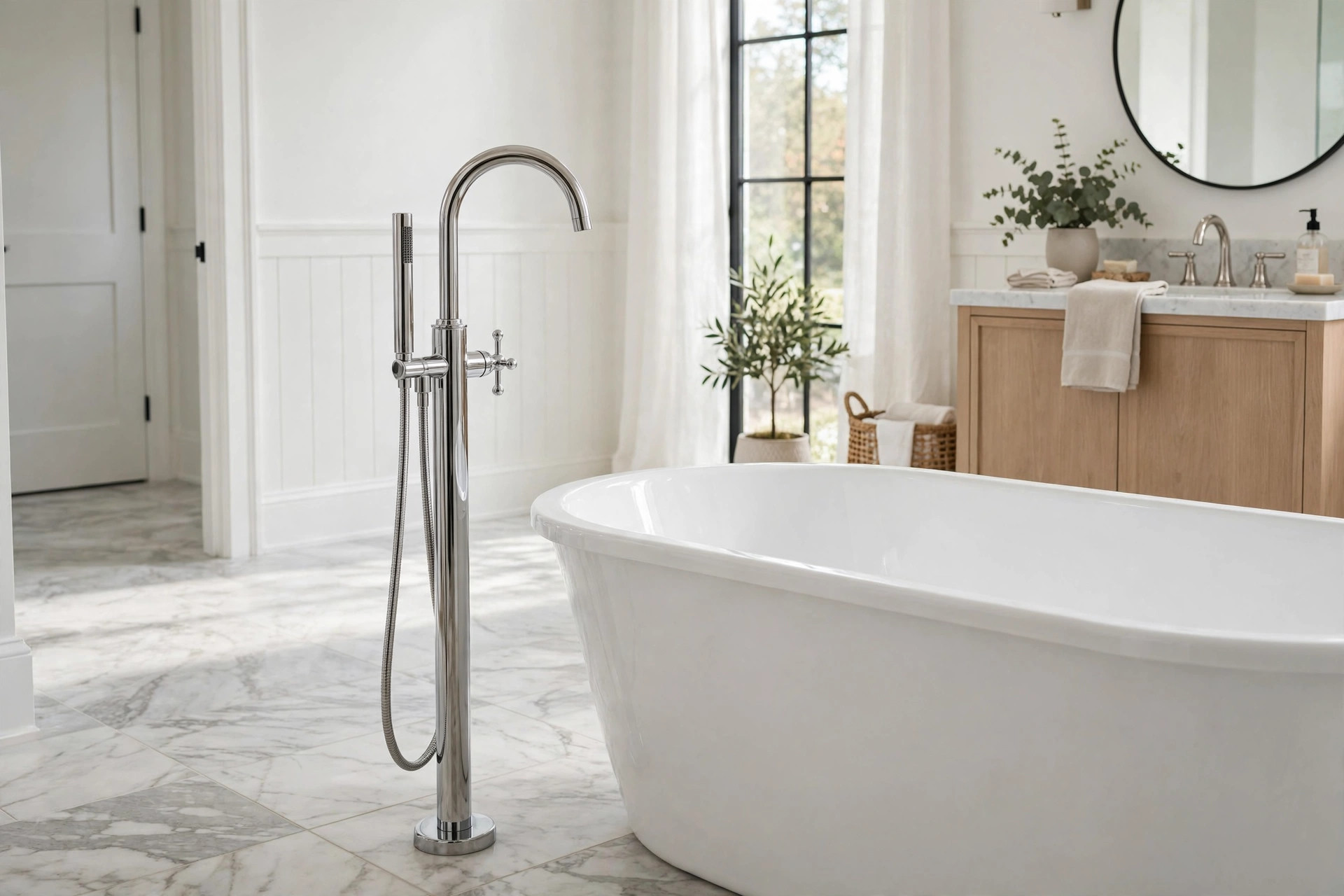

A freestanding tub has become the center piece of many American bathrooms. This guide of freestanding tub faucet floor mount reviews will help you choose the right floor-mount filler for your tub. A floor-mount faucet stands on the floor beside the tub. It rises up and curves over the rim to pour water in. Unlike a wall-mount faucet, it does not need a wall behind the tub. Unlike a deck-mount faucet, it does not need holes cut in the tub rim. That makes it the natural partner for a freestanding soaking tub.
Buyers read reviews before they buy. Reviews tell you how a faucet feels in daily use. They tell you if the finish peels, if the handle drips, or if the water flow is weak. This guide pulls together what owners say about the most common models. It also explains what to look for, what the options cost, and how to keep the faucet working for years.
Why It Matters
A freestanding tub faucet is not a small purchase. The faucet sets the look of the whole bath area. A tall chrome filler gives a modern look. A brushed bronze filler with cross handles gives a classic look. The wrong choice is hard to fix. The water lines run under the floor. Once the floor is closed up, moving the faucet means cutting into the subfloor.
The faucet also sets how fast the tub fills. Freestanding tubs hold a lot of water. A typical model holds 60 to 75 gallons. A weak faucet with a low flow rate will take a long time to fill the tub. Reviews often praise models that deliver a strong, steady stream. That strong stream comes from a high flow rate and a wide spout.
Comfort matters too. The handle should turn with little effort. The spout should reach over the tub without dripping on the floor. The hand shower, which many models include, should have a hose long enough to rinse the tub. These are the details that owners mention again and again in reviews. A faucet that looks fine in a showroom can disappoint at home if the handle is stiff or the hose is short.
Value is another reason to read reviews. Prices range from under two hundred dollars to over a thousand. The most costly model is not always the best. Some mid-price models earn better marks than costly designer models. Reviews help you find the point where quality and price meet.
What to Look for When You Choose: Freestanding Tub Faucet Floor Mount Reviews
Start with the height and the reach. Measure from your finished floor to the top of the tub rim. The spout must clear the rim by several inches. Most floor-mount faucets stand 38 to 44 inches tall. If your tub is very deep, choose a taller model. Check the spout reach too. It should extend over the opening of the tub, not just over the rim edge.
Next, look at the valve and the flow rate. A single-handle faucet mixes hot and cold with one lever. A two-handle faucet has separate hot and cold knobs. Both work well. The flow rate is stated in gallons per minute. Many tub fillers deliver 6 to 9 gallons per minute. A higher rate fills a deep tub faster. Note that the U.S. Environmental Protection Agency runs the WaterSense program, which sets water efficiency standards for bathroom fixtures. A high-flow tub filler may use more water than a WaterSense-labeled model, so weigh speed against use.
The finish is worth study. Chrome is the most common finish. It resists spots and is easy to clean. Brushed nickel hides fingerprints and suits many styles. Matte black makes a strong statement but shows dust and soap marks. Oil-rubbed bronze has a rich look but can wear unevenly with harsh cleaners. Read reviews that mention the finish after a year or more of use. Owners are the best judges of how a finish ages.
Check the rough-in needs. A floor-mount faucet needs hot and cold water lines brought up through the floor. The distance from the tub matters. Most makers state a rough-in depth. Your plumber must know this before the floor is finished. Some kits include a floor plate or a mounting bracket. Reviews often note whether the bracket felt sturdy or flimsy.
Look at the hand shower. Many freestanding fillers include a hand shower on a flexible hose. It is handy for rinsing the tub and for washing hair. Check the hose length. A hose of 59 inches or more gives good reach. Check the hand shower dock too. It should hold the wand firm when not in use.
Finally, check the warranty. Major brands such as Moen, Delta Faucet, and Kohler offer long warranties on their finishes and parts. A lifetime finish warranty is common on top models. Keep your receipt and register the product if the maker asks.
Types and Options
Single-hole floor-mount fillers are the simplest type. One lever controls both temperature and flow. They suit modern baths. Reviews praise them for easy use with wet hands. Some owners note that fine temperature control is harder with a single lever. Still, most rate them well.
Two-handle floor-mount fillers have separate hot and cold handles. They suit classic and farmhouse baths. Owners like the precise control. They also like the look of cross or lever handles. The trade is more parts to clean and, in rare cases, more washers to service.
Waterfall spouts are a popular style. The water pours out in a wide, flat sheet. Owners describe the fill as quiet and calm. The wide stream can splash if the tub is shallow. Reviews are mixed on cleaning. The wide opening can collect mineral film in hard water areas.
High-arc gooseneck fillers have a tall, curved neck. They clear deep tubs with ease. The tall shape makes a strong visual line. Some owners say the tall neck shows water spots more than a low spout. A quick wipe after use solves this.
Some models add a footrest or a temperature display. These extras get little mention in reviews. Owners care more about steady flow, solid handles, and a finish that lasts. When you compare freestanding tub styles, remember that the faucet must match the tub in both height and style.
Cost and Price
Budget models cost 150 to 300 dollars. They are often sold by Lowe’s and The Home Depot. Reviews say they look fine at first. Some owners report loose handles or thin finishes after a year. For a guest bath that sees light use, a budget model can serve.
Mid-range models cost 300 to 700 dollars. This is where most reviews cluster. Owners report solid brass bodies, smooth handles, and finishes that hold up. Many of the best-rated fillers sit in this range. A mid-range model from a known brand is the safe pick for a main bath.
Premium models cost 700 to 1,500 dollars and more. They bring designer styling, heavier brass, and longer warranties. Reviews are warm but often note that the gain over a good mid-range model is mostly in looks. For a master bath where style leads, the premium is easy to defend.
Installation cost is separate. A plumber may charge 200 to 500 dollars to install a floor-mount filler in new work, where the floor is open. In a remodel where the floor must be opened and closed, the cost can reach 500 to 1,000 dollars or more. Get the quote before you buy the faucet. The rough-in parts must match the model you choose.
Care and Upkeep
Daily care is simple. Wipe the faucet with a soft cloth after use. This stops water spots and soap film from building. For brushed and matte finishes, use a dry microfiber cloth. For chrome, a damp cloth works well.
Weekly, clean with mild soap and water. Avoid bleach, ammonia, and abrasive pads. Harsh cleaners dull finishes and void warranties. The Family Handyman site offers plain guides on gentle fixture cleaning that suit these faucets.
Monthly, check the hand shower hose. Run water through it and look for kinks or drips at the joints. Tighten loose connections by hand. Do not use pliers on finished parts. Check the base plate where the faucet meets the floor. Water that pools there can seep into the floor. Dry the base after each bath.
Yearly, inspect the supply lines under the floor if you have access. Look for damp spots on the subfloor or the ceiling below. A slow leak at the rough-in can rot wood over time. Reviews rarely mention this, but plumbers stress it. Catching a leak early saves a costly repair.
In hard water areas, mineral build-up is the main foe. White crust on the spout or the hand shower cuts flow and mars the look. Soak the spout tip in white vinegar for an hour, then rinse. Do not soak plated finishes in vinegar for long. A short soak is safe for chrome and nickel. For bronze or black finishes, use a damp cloth only and test in a hidden spot first.
If the handle stiffens, the cartridge may need service. Most makers sell replacement cartridges. The swap takes a plumber minutes. Keep the model number on file so you can order the right part.
Safety
A freestanding tub faucet brings hot water close to bare feet and small hands. Set the water heater to 120 degrees Fahrenheit. This is the level health groups advise. It cuts the risk of scalds while still giving a hot bath.
Anchor the faucet well. A floor-mount filler is a lever arm. A child who grabs it can put force on the base. The mounting bracket must be bolted to solid blocking, not just to tile. Ask your plumber to show you the blocking before the floor closes.
Keep the floor dry. Water that spills from the spout makes tile slick. Use a bath mat with a rubber back. Wipe splashes after each fill. Reviews of waterfall models sometimes mention more splash than with standard spouts. Aim the stream into the tub and fill at a moderate rate.
Check local code. Some areas require an anti-scald valve on tub fillers. Others require access panels for shutoff valves. Your plumber will know the local rules. The This Old House site has plain notes on bath plumbing codes that can help you ask the right questions.
Frequently Asked Questions
Can I install a floor-mount tub faucet on a concrete slab? Yes, but it is harder. The water lines must run under or through the slab. That means cutting concrete or running lines in a chase. The cost is higher than in a wood floor. Get a plumber to look at the slab before you buy.
How far should the faucet stand from the tub? Most makers advise 4 to 8 inches from the tub edge to the faucet center. Too close and the spout drips on the rim. Too far and water arcs onto the floor. Follow the maker guide for your model. Your plumber will set the exact spot during rough-in.
Do floor-mount faucets work with any freestanding tub? They work with most, but height is the key match. A very tall tub needs a taller filler. A short tub suits a standard filler. When you shop for a small bathroom soaking tub, check the tub height first, then pick a filler that clears it.
Are hand showers worth having on a tub filler? Most owners say yes. The hand shower rinses the tub, washes hair, and cleans the surround. Reviews give higher marks to fillers that include one. Check that the hose is long and the dock is firm.
What finish lasts longest? Chrome has the longest track record. It resists wear and cleans with ease. Brushed nickel is close behind. Dark finishes look sharp but need gentle care. Read long-term reviews for any finish before you commit.
Should I buy the faucet online or in a store? Both work. Online gives more choice and more reviews to read. Stores let you touch the handle and judge the weight. Many buyers research online, then buy from a store with a good return policy. Keep the box until the install is done and tested.
A Short Final Word
These freestanding tub faucet floor mount reviews point to a simple rule. Pick the filler that fits your tub height, delivers strong flow, and comes from a brand with a real warranty. The mid-range models earn the most praise from owners. They cost less than designer pieces and hold up as well in daily use.
Plan the rough-in before the floor goes down. Dry the faucet after each bath. Service the cartridge when the handle stiffens. Do these things and the faucet will serve for many years.
A freestanding tub is a place of rest. The right floor-mount filler fills it fast, looks right, and asks little in return. Read the reviews, measure twice, and buy once. For more bath fixture ideas, see our notes on brushed gold bath faucets and keep an eye on water quality with tips from Aquasana.
References
Aquasana. (n.d.). Water filtration systems. https://www.aquasana.com Delta Faucet. (n.d.). Kitchen and bathroom faucets. https://www.deltafaucet.com Family Handyman. (n.d.). DIY home repair and maintenance. https://www.familyhandyman.com Kohler. (n.d.). Bathroom and kitchen fixtures. https://www.kohler.com Lowe’s. (n.d.). Home improvement products. https://www.lowes.com Moen. (n.d.). Faucets and plumbing fixtures. https://www.moen.com The Home Depot. (n.d.). Home improvement products. https://www.homedepot.com This Old House. (n.d.). Home renovation guidance. https://www.thisoldhouse.com U.S. Environmental Protection Agency. (n.d.). Protecting human health and the environment. https://www.epa.gov
Was this guide helpful?

About Michael Thompson
The My Garden US editorial team writes practical, in-depth home and garden guides for American homeowners — tested advice, no fluff.
You May Also Like

Sewer Gas Smell in Bathroom: Proven Solutions USA Homeowners Trust
September 23, 2026 0 views
Sulfur Smell in Well Water Filter Solution: A Complete Guide
March 14, 2026 0 views
Gas Tankless Water Heater Installation Cost USA: What Homeowners Pay
July 10, 2026 0 views