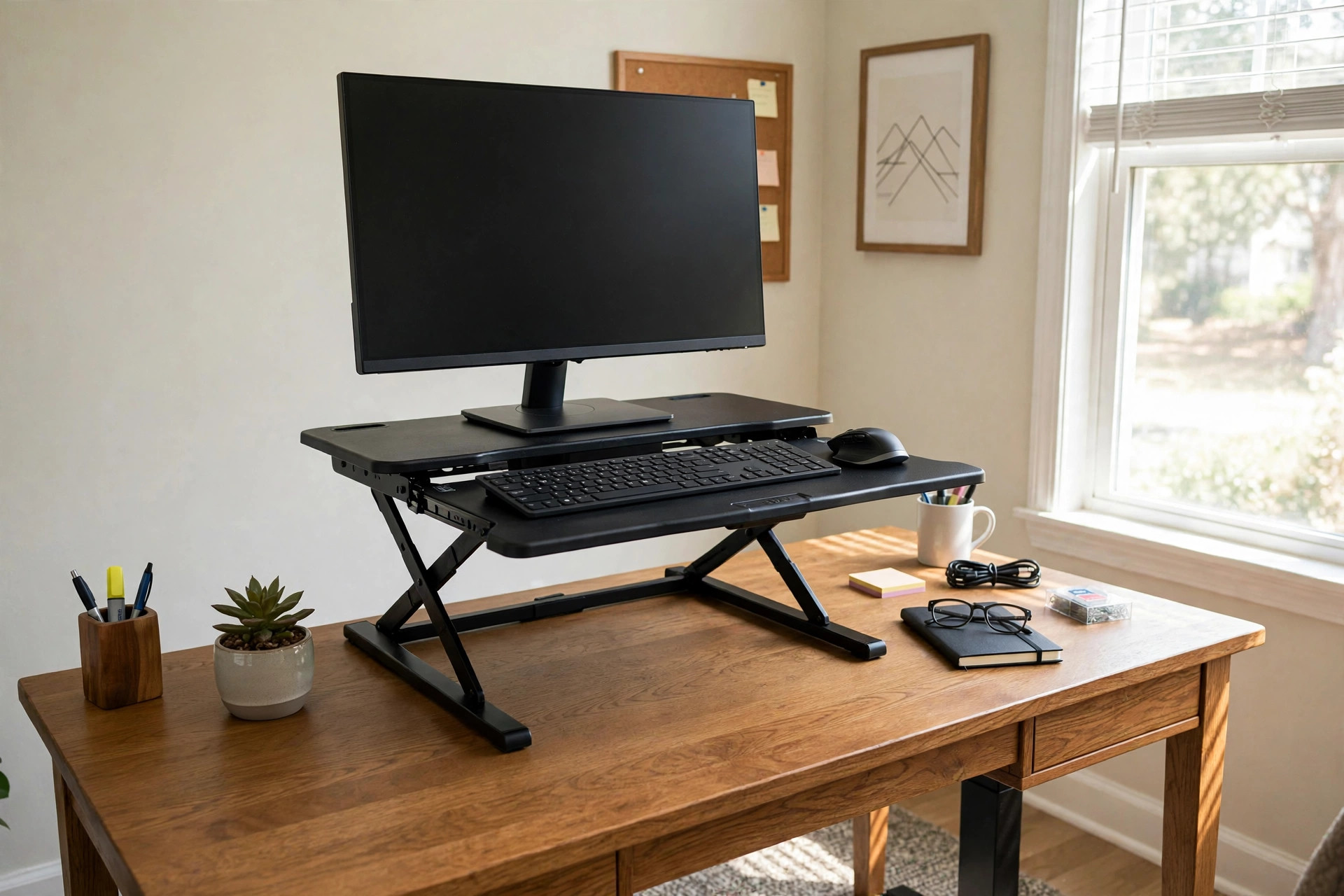

Many people who work from home spend long hours at a plain, fixed desk. By the end of the day their shoulders ache, their necks feel stiff, and their lower backs complain. An ergonomic standing desk converter with keyboard tray offers a simple answer. It sits on top of the desk you already own and lifts your screen, keyboard, and mouse up so you can stand. When you tire of standing, it lowers again in seconds. You do not need to buy a whole new desk. This guide explains why such a unit matters, what features to look for, the main types, the cost, how to care for it, and how to use it in a safe way.
Why It Matters
Sitting all day places steady pressure on the spine and the legs. Medical and workplace studies from the 1980s and 1990s already pointed to long, fixed sitting as a cause of back pain, poor posture, and low energy at work. Little has changed since. The home office worker who sits from nine in the morning to five in the evening faces the same risk as the office clerk of an earlier era.
Standing for part of the day breaks that pattern. Blood moves more freely through the legs. The back can hold its natural curve. Many workers report that their thinking feels clearer after they change posture. A converter makes this easy. You do not need to rebuild your whole room. You place the unit on your present desk and gain the choice between sitting and standing in a few seconds. For people who rent their homes, or who share a small room with a partner, this low-effort change has real value. Many home offices are small rooms rather than open floors. A converter suits such rooms because it uses the desk that is already there and adds no new furniture to the floor.
The keyboard tray is the part that matters most. Without it, a raised monitor alone leaves the hands in a poor position. A tray drops the keyboard a few inches below the main surface and holds it at a comfortable angle. The wrists stay straight. The shoulders can relax.
What to Look for: Ergonomic Standing Desk Converter with Keyboard Tray
Buyers should judge a unit by several plain features before they spend money. The buying guides on PCMag use the same kind of checklist.
First, check the weight limit. A converter must hold the monitor or monitors, a laptop, the keyboard, and the mouse. Some units carry only 25 pounds. That is enough for one screen and a light keyboard. If you use two monitors, look for a rating of 35 pounds or more. Overloading a unit makes it wobble and wears out the lift part.
Second, check the range of height. The main surface should rise high enough to bring the screen to eye level while you stand. Tall people need more range. Measure your elbow height while standing and compare it with the stated lift range before you buy.
Third, study the keyboard tray. It should be wide enough for both the keyboard and the mouse, or it should include a side pad for the mouse. A shallow tray forces the hands to crowd together. Look for a tray that tilts slightly so the wrists stay level. Some trays pull out and slide back, which helps when the desk is small.
Fourth, test the lift action if you can. Good units rise and fall smoothly with one hand. Cheaper units jump or stick. A gas-spring or pneumatic lift tends to move more smoothly than a simple spring.
Fifth, look at the footprint. The base must fit on your present desk with room to spare for papers or a coffee cup. Some units are 32 inches wide. That suits a large desk. Others are 24 inches wide and fit the small desks found in apartments. A guide on the Wirecutter site notes that a unit should never hang over the front edge of the desk, since that tips the weight forward.
Sixth, check for cable management. Loose cables snag when the unit moves up and down. Clips or a rear tray keep cables tidy and protect the plugs.
Types and Options
Several designs are common in stores and in online catalogs.
The X-frame converter is the most common. Two crossed arms fold flat and lift the top surface straight up. It is simple and low in price. Its motion can feel stiff on cheap models.
The Z-frame converter uses a folding arm shaped like the letter Z. It often gives a wider range of height and holds the surface level through the full rise. The UPLIFT Desk line and similar makers sell such models. They cost more but suit taller users.
The corner converter is made for desks set in a corner. Its surface wraps in an L shape and gives room for two screens. It is a good match for workers who run a dual monitor setup for remote work.
The compact converter is small and light. It holds one laptop or one monitor and a slim keyboard. Students and apartment dwellers like it because it fits a small home office desk. Desks of this size are common in the IKEA home office range. An adjustable height desk converter for an existing table remains the classic choice for this group.
Some units add an anti-fatigue mat or a phone stand. These extras are pleasant but not needed. Spend the money on build quality first.
Cost and Price
Prices in the United States range widely. A basic X-frame unit with a small tray costs between 100 and 180 dollars. A mid-range unit with a smooth lift and a wide tray costs between 180 and 320 dollars. A large Z-frame unit with dual-screen capacity costs between 320 and 500 dollars. Specialty brands with long warranties may charge more.
The tray itself adds to the price. A unit with an integrated keyboard tray usually costs 40 to 80 dollars more than the same unit without one. For most buyers the extra cost is fair. Poor wrist posture is one of the main causes of strain in home office work.
Watch for shipping cost and return terms. These units are heavy. Return shipping can be costly if the unit does not fit your desk. A retailer such as Wayfair often lists clear return terms. The Spruce home site also publishes buying advice that compares units by price band.
Care and Upkeep
A converter has moving parts. A little care keeps it smooth for years.
Wipe the surfaces once a week with a soft, damp cloth. Dust settles in the lift joints and can make the motion rough. Do not use harsh cleaners on laminate or painted metal.
Check the bolts every few months. Vibration from daily use can loosen them. A quick pass with the Allen key that came in the box is enough.
Keep the weight balanced. Do not load one side of the surface with a heavy printer while the other side is empty. Uneven weight strains the arms.
Lower the unit fully at night. This rests the lift part and keeps the unit steady if a child or pet bumps the desk.
If the unit has a gas spring, never open the cylinder. The gas inside is under high pressure. If the lift fails, use the maker warranty. Makers such as Steelcase and Herman Miller are known for long service terms, and their support pages explain how to request parts.
Safety
An ergonomic standing desk converter with keyboard tray is safe when it is set up and used in the right way. A few rules cover most risks.
Place the unit on a strong, level desk. A thin folding table is not a sound base. The desk should hold the weight of the converter plus the equipment without bending.
Keep children away from the moving parts. Fingers can be caught where the arms fold. Some units have pinch points marked with labels. Teach children not to touch the unit while it moves.
Do not stand for the whole day at once. Start with 20 to 30 minutes of standing each hour, then sit again. Over time you can raise the standing share. A sudden jump to full-day standing causes sore feet and tired legs.
Wear flat, supportive shoes, or stand on a mat. Hard floors make standing painful after an hour.
Set the screen at eye level and the tray so the elbows rest near a right angle. This is the core of the word ergonomic. A laptop stand for standing desk posture can raise a laptop screen to the right height when the converter surface sits low.
Take the unit down from a truck or car with care. The box is heavy and awkward. Lift with the legs, not the back.
Frequently Asked Questions
Will a converter fit on my present desk?
Most likely yes. Measure the depth and width of your desk top first. The unit needs a flat, stable surface that is at least as deep as the base. A depth of 24 inches or more suits most models. Keep at least two inches of desk behind the unit for cables.
Do I need the keyboard tray, or is the flat surface enough?
The tray is worth having. It drops the keyboard below screen height and lets the wrists stay level. Typing on the main surface while standing often pushes the shoulders up and bends the wrists back. Over months, that strain adds up.
Can I use two monitors on a converter?
Yes, if you choose a wide model with a weight rating that covers both screens. Many dual-monitor units are 35 to 40 inches wide. Check the total weight of both monitors and their stands before you buy.
How long should I stand each day?
There is no single right answer. Most guidance suggests alternating between sitting and standing through the day. A common pattern is 30 minutes standing and 30 minutes sitting. Listen to your body and change position when you feel tired.
Is a converter as good as a full standing desk?
A full standing desk gives more surface room and often moves more smoothly. A converter costs less, needs no assembly of a whole desk, and suits renters. For many home workers, a converter is the practical middle path.
What if the unit wobbles when I type?
A small wobble at full height is normal for X-frame models. If the wobble is strong, check that the weight is balanced and that the bolts are tight. Placing the desk against a wall also helps. If it still shakes badly, the unit may be overloaded.
A Short Final Word
An ergonomic standing desk converter with keyboard tray is a modest buy that can change the feel of a whole workday. It asks for no new desk, no drilling, and no long assembly. It asks only that you measure your desk, choose a unit that fits your body and your screens, and use it with care. Start by standing for short periods. Keep your screen at eye level and your wrists level on the tray. Within a few weeks, the habit of changing posture becomes second nature, and the end-of-day aches grow smaller. The Wirecutter reviews and the buying guides on The Spruce remain useful if you want to compare models side by side before you decide.
References
Herman Miller. (n.d.). Office furniture and ergonomic seating. https://www.hermanmiller.com IKEA. (n.d.). Home furnishings. https://www.ikea.com PCMag. (n.d.). Technology product reviews. https://www.pcmag.com Steelcase. (n.d.). Office furniture and workplace research. https://www.steelcase.com The Spruce. (n.d.). Home and garden advice. https://www.thespruce.com UPLIFT Desk. (n.d.). Standing desks and ergonomic office furniture. https://www.uplift-desk.com Wayfair. (n.d.). Furniture and home goods. https://www.wayfair.com Wirecutter. (n.d.). Product reviews from The New York Times. https://www.nytimes.com/wirecutter
Was this guide helpful?

About Michael Thompson
The My Garden US editorial team writes practical, in-depth home and garden guides for American homeowners — tested advice, no fluff.
You May Also Like

Rolling File Cabinet for Home Office Organization
July 8, 2026 0 views
Compact Desk With Keyboard Tray for Small Room
April 9, 2026 0 views
A Portable Standing Desk for Working from Anywhere: What to Know Before You Buy
March 25, 2026 0 views