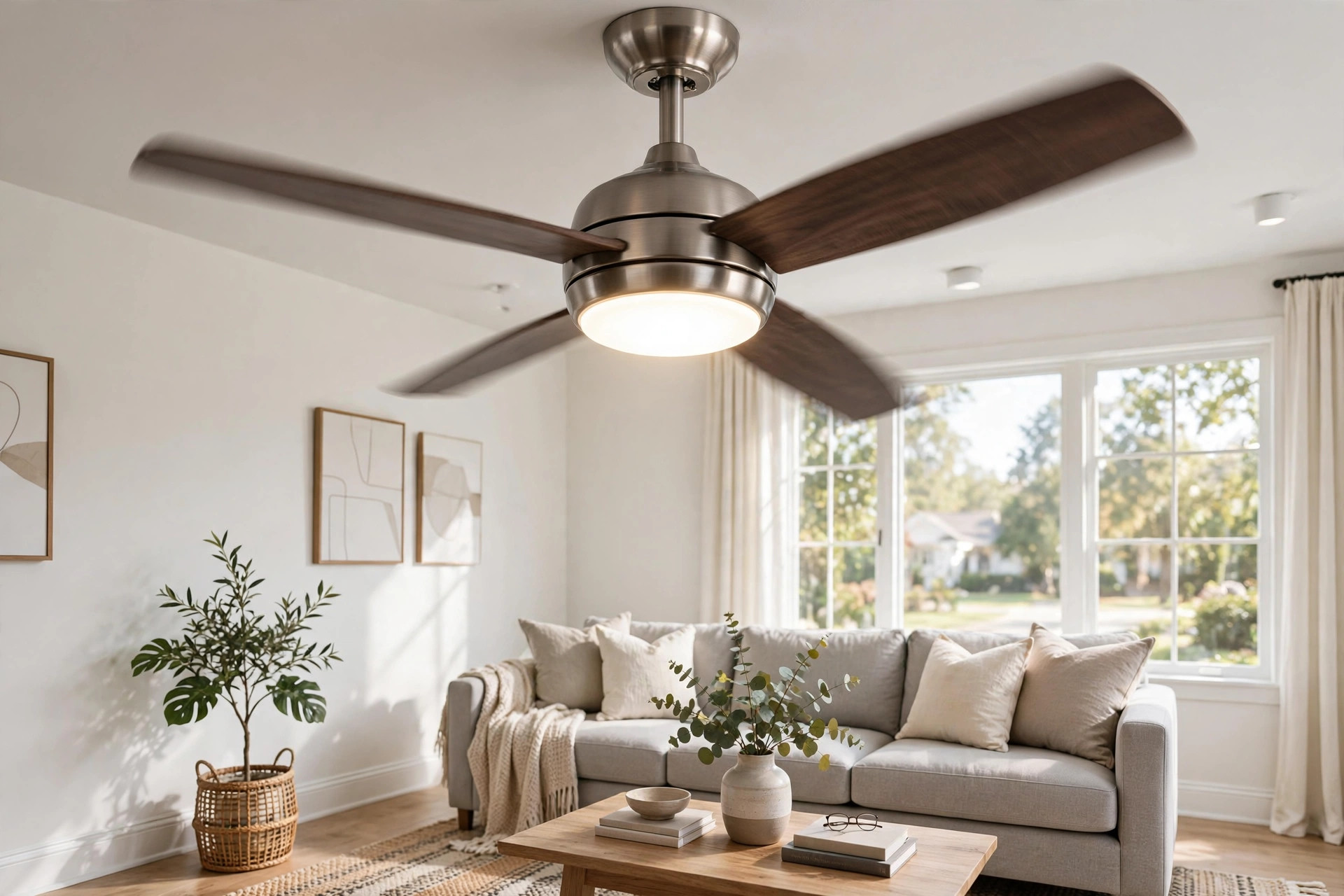

A ceiling fan is one of the simplest machines in an American home. It moves air. That is all. But the newest models do much more. The best smart ceiling fan reviews 2026 USA point to fans that link to your phone, your voice assistant, and your home network. You can change the speed from the couch. You can dim the light from the car. You can set a schedule so the fan runs when the room needs it and rests when it does not.
This guide walks through what matters. It covers motors, controls, size, cost, care, and safety. It also answers common questions from buyers. If you want a plain fan that works with a wall switch, that is fine. If you want a fan that thinks ahead, read on.
Why a Smart Ceiling Fan Matters
A fan does not cool the air. It cools you. Moving air over your skin takes heat away. That is the whole trick. A fan lets you set the air conditioner a few degrees higher and still feel cool. The U.S. Department of Energy notes that a ceiling fan can make a room feel several degrees cooler. That saves power and cuts the electric bill.
A smart fan adds control. Old fans have a pull chain or a wall switch. You walk to the fan or you look for the chain in the dark. A smart fan has no such trouble. You speak to it. You tap your phone. You set rules, such as “run at low speed at night” or “turn off at sunrise.”
Smart fans also fit into wider home plans. Many link to a smart ceiling fan with alexa voice control, to Google Home, or to a phone app. Some work with a home hub. If you already use a smart thermostat installation cost near me in your planning, a smart fan fits the same picture. The two devices can share schedules. The fan can run when the cooling runs and rest when the house is empty.
Energy use is low. A modern fan uses less power than an old one. Energy Star lists fans that meet strict limits for power draw. A fan that uses 25 watts at high speed costs only a few cents per hour to run. Over a summer, that is small change next to an air conditioner.
Comfort is the real prize. A bedroom with a slow fan feels restful. A living room with a wide fan feels open and cool. The 2026 reviews show that buyers care less about raw power and more about quiet running and smooth control. The best fans are felt, not heard.
What to Look For When You Choose: Best Smart Ceiling Fan Reviews 2026 Usa
Motor Type and Energy Use
The motor is the heart of the fan. Old fans use AC motors. New smart fans often use DC motors. DC motors run quiet. They use less power. They offer more speeds, often six or more. An AC motor may give three speeds and a hum. For a bedroom, the DC motor is the better pick.
Check the label for power use. Look for an Energy Star rating. It means the fan passed tests for power and air flow. High air flow with low watts is the mark of good design. Trane and Carrier, well known for heating and cooling equipment, also stress that steady air movement matters more than brute force. The same rule holds for fans.
Air flow is measured in cubic feet per minute, or CFM. A bedroom needs about 3,000 to 5,000 CFM. A large living room needs 6,000 or more. The box should list the number. Do not trust looks alone. A pretty fan with weak flow is a poor buy.
Voice Control and App Control
Smart means connected. Most 2026 models link to Wi-Fi. A few use Bluetooth or a hub. Wi-Fi models link straight to your router. That is simple to set up. Bluetooth models need your phone nearby. A hub model may link to more devices but adds one more box.
Voice control matters to many buyers. A wifi ceiling fan with remote often also answers to voice. Check that the fan works with your system. Some work with Alexa. Some work with Google. Some work with Apple Home. A few work with all three. Do not assume. Read the list on the box.
The app is where you live with the fan. A good app shows speed, light level, and timers. A poor app drops the link or asks for needless sign-ups. Read app reviews before you buy. The fan may be fine, but a bad app ruins the smart part.
Size and Blade Span
Size matters more than most buyers think. A fan that is too small will spin hard and move little air. A fan that is too big will look wrong in a small room.
Here is a simple guide. For rooms up to 75 square feet, a 29 to 36 inch fan works. For rooms up to 175 square feet, use 42 to 48 inches. For rooms up to 350 square feet, use 50 to 54 inches. For great rooms above that, look at 60 inches or more, or use two fans.
Measure the room first. Note the ceiling height too. The blades should sit seven to nine feet above the floor. High ceilings need a downrod, a short pipe that lowers the fan.
Types of Smart Ceiling Fans
Fans With Lights
Many smart fans carry a light kit. The light may be a bowl, a set of bulbs, or a flat LED panel. LED lights last for years. They use little power. Many let you change the color from warm white to daylight white. Warm white suits a bedroom. Daylight white suits a kitchen.
Check the brightness. It is measured in lumens. A bedroom needs 800 to 1,600 lumens. A living room may want 2,000 or more. If the fan light is the only light in the room, go brighter.
Some fans let you dim the light from the app or by voice. That is a true smart feature. A fan with a light that only has on and off is less useful. The 2026 reviews favor fans with smooth dimming and memory. Memory means the light returns to your last setting when you turn it on.
Fans Without Lights
A fan with no light is cleaner. It costs less. It suits rooms that already have lamps or recessed lights. Some buyers pick no-light fans for low ceilings, where a light kit would hang too low.
No-light fans still come in smart form. They link to apps and voice control. They use the same motors. If you need a light later, some models let you add a kit. Check before you buy. Not all fans accept add-ons.
Fans for Outdoor Use
Outdoor fans face rain, heat, and damp air. They need a damp or wet rating. A damp-rated fan suits a covered porch. A wet-rated fan suits open areas that get direct rain. Smart outdoor fans link to Wi-Fi too, but the signal must reach the porch. Test your Wi-Fi there first.
Outdoor fans often have plastic or coated blades. They will not warp in damp air. Wood blades can swell and crack outdoors. The Family Handyman guides on porch work note that outdoor wiring must be rated for the spot.
Cost and Price
Smart ceiling fans cost more than plain fans. A basic fan may cost 60 to 120 dollars. A smart fan with Wi-Fi, a DC motor, and a light often runs 150 to 400 dollars. High-end models with large blades or designer looks can pass 500 dollars.
What do you get for the extra money? A quieter motor. More speeds. App and voice control. A better light. For many buyers, the jump from 100 to 200 dollars is worth it. The jump from 300 to 500 dollars buys looks more than comfort.
Installation cost is separate. If you replace an old fan on a fan-rated box, you can do it yourself in an hour. If you need new wiring or a new box, call an electrician. That may cost 150 to 300 dollars. A whole house fan installation cost usa is a larger job and runs far higher. A ceiling fan is small work by that scale.
Running cost is tiny. A 30-watt fan at high speed costs about four cents per hour at average US rates. At low speed it costs about a penny. The fan pays for itself if it lets you raise the air conditioner by even two degrees. Cooling is the big bill. Lennox and Rheem both note that air conditioning is one of the largest uses of home power. A fan trims that load.
Watch for sales. Spring brings deals as stores stock cooling gear. Fall brings clearance as summer ends.
Care and Upkeep
A ceiling fan needs little care. Dust is the main foe. Dust on blades throws off balance. It also drifts into the room when the fan starts. Wipe the blades every few months with a damp cloth. A pillowcase pulled over each blade catches the dust well.
Check the screws once a year. Vibration can loosen them. Tighten the blade arms and the downrod. If the fan wobbles, stop it and check. A wobble often comes from one loose screw or a blade that bent. Most fans ship with a balance kit, small weights that clip to the blades. Use it.
The motor needs no oil. Modern fans use sealed bearings. They run for years with no care. If the fan clicks or grinds, stop using it. The motor may be worn. Goodman service notes for home equipment stress the same point: strange noise means stop and inspect. That rule fits fans too.
Clean the light cover. Dust dims the light. A soft cloth and mild soap work. Do not soak electrical parts. Turn off the power at the switch before you clean near the motor.
Safety
Fans hang over your head. Treat them with care. Use only a fan-rated electrical box. A normal light box is not strong enough. A fan box holds the weight and the motion. If you are not sure what box you have, ask an electrician.
Turn off power at the breaker before you wire a fan. Test with a voltage tester. The wall switch may not cut all wires. This is the oldest safety rule in home wiring, and it still saves lives.
Keep blades clear. Seven feet above the floor is the minimum. In rooms where tall people walk, nine feet is better. Keep bunk beds and tall shelves away from the fan path.
Children and pets add risk. A fan with a remote or app can start by accident. Lock the app or set a code if children play with phones. Teach children not to throw things at the fan. A toy in the blades can break the toy and the fan.
Outdoor fans need outdoor-rated wire and boxes. Water and power do not mix. If the fan is wet-rated, it can take rain. The wiring behind it must be rated too.
FAQ
Do smart ceiling fans work if the Wi-Fi goes down?
Yes. The fan still works. You lose the app and voice control until the Wi-Fi returns. Most smart fans ship with a remote or work with the wall switch. Speed and light still change by hand. Set the fan to a good speed before a storm, and it will hold that setting.
Can a ceiling fan really cut my cooling bill?
It can. A fan does not cool air, but it cools people. That lets you set the thermostat higher. Each degree higher can cut cooling cost by a few percent. If you pair the fan with an energy efficient mini split for 1500 sq ft, the savings stack. Run the fan only in rooms you use.
What size fan do I need for a 20 by 20 foot room?
That is 400 square feet. A single 52 inch fan is small for it. Use a 60 inch fan or two 52 inch fans. Two fans move air more evenly in a square room. They also look balanced over a large space.
Are DC motor fans worth the extra cost?
For bedrooms, yes. DC motors run much quieter than AC motors. They use less power. They offer more speeds, which helps you find the exact breeze you like. In a living room where noise matters less, an AC motor fan can save money and still please.
Can I install a smart fan myself?
Often, yes. If an old fan hangs on a fan-rated box, swap it in an hour. Match wire to wire and follow the guide. If there is no box, or the box is not fan-rated, or you need new wire run, call an electrician. Bad mounts cause most fan accidents.
Do smart fans work with all voice assistants?
No. Check the box. Some fans work with Alexa only. Some add Google. A few add Apple Home. The term smart ceiling fan with alexa is common in reviews because Alexa support is the most common. If you use a different system, confirm it before you buy.
Final Word
The best smart ceiling fan reviews 2026 USA show a market that has grown up. Fans are quieter. Controls are smoother. Prices are fair. The smart part is no longer a trick. It is the normal way a fan works now.
Pick by motor first. DC for quiet rooms. Pick by size next. Measure the room and the ceiling. Pick control last, and match it to the voice system you already use. A fan that fits these three points will serve you for a decade or more.
References
Carrier. (n.d.). Heating and cooling systems. https://www.carrier.com ENERGY STAR. (n.d.). Energy efficient products. https://www.energystar.gov Family Handyman. (n.d.). DIY home repair and maintenance. https://www.familyhandyman.com Goodman. (n.d.). Heating and cooling equipment. https://www.goodmanmfg.com Lennox. (n.d.). Heating and cooling systems. https://www.lennox.com Rheem. (n.d.). Heating, cooling, and water heating. https://www.rheem.com This Old House. (n.d.). Home renovation guidance. https://www.thisoldhouse.com Trane. (n.d.). Heating and air conditioning. https://www.trane.com U.S. Department of Energy. (n.d.). Energy efficiency and renewable energy. https://www.energy.gov
Was this guide helpful?

About Emily Rodriguez
The My Garden US editorial team writes practical, in-depth home and garden guides for American homeowners — tested advice, no fluff.
You May Also Like

Solo Stove vs Breeo Comparison Reviews USA
June 15, 2026 0 views
Mini Split Line Set Cover Kit Reviews: What American Buyers Need to Know
February 16, 2026 0 views
Ridge Vent vs Turbine Vent Comparison USA: Which Roof Vent Fits Your Home
August 21, 2026 0 views