A baby’s room should feel calm and cool. On warm nights, moving air helps a child sleep. But parents worry about safety first. That is why so many families read the best bladeless fan for nursery reviews USA parents share online. These reviews compare fans that move air without exposed blades. A bladeless fan pushes air through a smooth ring or a narrow slot. Small fingers cannot reach spinning blades because there are none. There is no metal grill to trap dust. Most models run quiet and use little power. This guide sums up what the reviews say. It covers safety, noise, airflow, price, and care. It will help you choose a fan that fits your nursery and your budget.
Why a Bladeless Fan Belongs in the Nursery
Safety is the main reason. A standard fan has fast blades behind a wire guard. A curious toddler can poke a finger through the guard. A bladeless fan has no guard because it needs none. Air flows from a smooth loop. The design removes the most common injury risk of a room fan.
Quiet sound is the second reason. Babies wake at small noises. Reviewers test each model with a meter and with their ears. The best bladeless fan for nursery use stays near 40 to 55 decibels on low speed. That is about the sound of a soft conversation. Some models add a night mode that dims lights and drops the motor to its lowest hum.
Even airflow is the third reason. A nursery can feel stuffy in summer. Warm air rises and collects near the ceiling. A fan breaks up the warm layer and keeps the room temperature even. The child sleeps in air that feels fresh, not stale.
Cleaning is the fourth reason. A grill collects dust fast. Dust then blows back into the room. A bladeless fan has smooth surfaces. A parent wipes it with a damp cloth in one minute. Less dust in the air is better for a baby’s lungs.
If the nursery air feels dry as well as warm, some parents add moisture to the room. Our guide to the best portable humidifier for the bedroom explains that choice in plain terms.
How to Choose the Right Model: Best Bladeless Fan for Nursery Reviews Usa
Reviews test dozens of fans each year. The winners share the same traits. Look for these points before you buy.
Check the Noise Rating
Noise matters more in a nursery than in any other room. Read the decibel rating on the box. Stay under 55 decibels on the low setting. A rating under 45 decibels is best for light sleepers. Independent testing groups such as Consumer Reports measure noise in real rooms. Trust measured numbers over words like “whisper” in ads.
Match Airflow to Room Size
A fan made for a large living room can feel too strong in a small nursery. Check the coverage rating in square feet. Most nurseries run 100 to 200 square feet. A tower fan rated for 150 to 250 square feet suits that space. Too much power wastes money and makes noise. Too little power leaves the room warm.
Look for Real Safety Features
A bladeless design is only the start. Good models add a wide, heavy base that resists tipping. Many add a shut-off switch that kills power if the fan falls over. A cool-touch housing stays safe if a child hugs it. A remote control lets a parent change speed from the door. The parent never needs to lean over the crib in the dark.
Demand Easy Cleaning
Dust builds up fast in a child’s room. Smooth rings wipe clean in seconds. Avoid models with deep slots that trap dirt. Removable filters are a plus. They catch dust before it enters the motor. A clean fan lasts longer and blows cleaner air.
Look at Oscillation and Air Direction
Fixed fans blow in one direction. Oscillating fans turn side to side and cover the whole room. In a nursery, oscillation is worth the extra cost. It keeps air moving past the crib without aiming a steady stream at the child. Some models also tilt up and down. Upward tilt lifts warm air off the ceiling. Wide oscillation, near 90 degrees, suits a square room. Narrow rooms do fine with less swing.
Weigh the Extras
Timers, sleep modes, and oscillation add value. A timer shuts the fan off after the child falls asleep. Oscillation spreads air across the room instead of one spot. ENERGY STAR certified models use less power for the same airflow. The U.S. Department of Energy notes that small cooling choices add up on summer power bills.
Types of Bladeless Fans for Nurseries
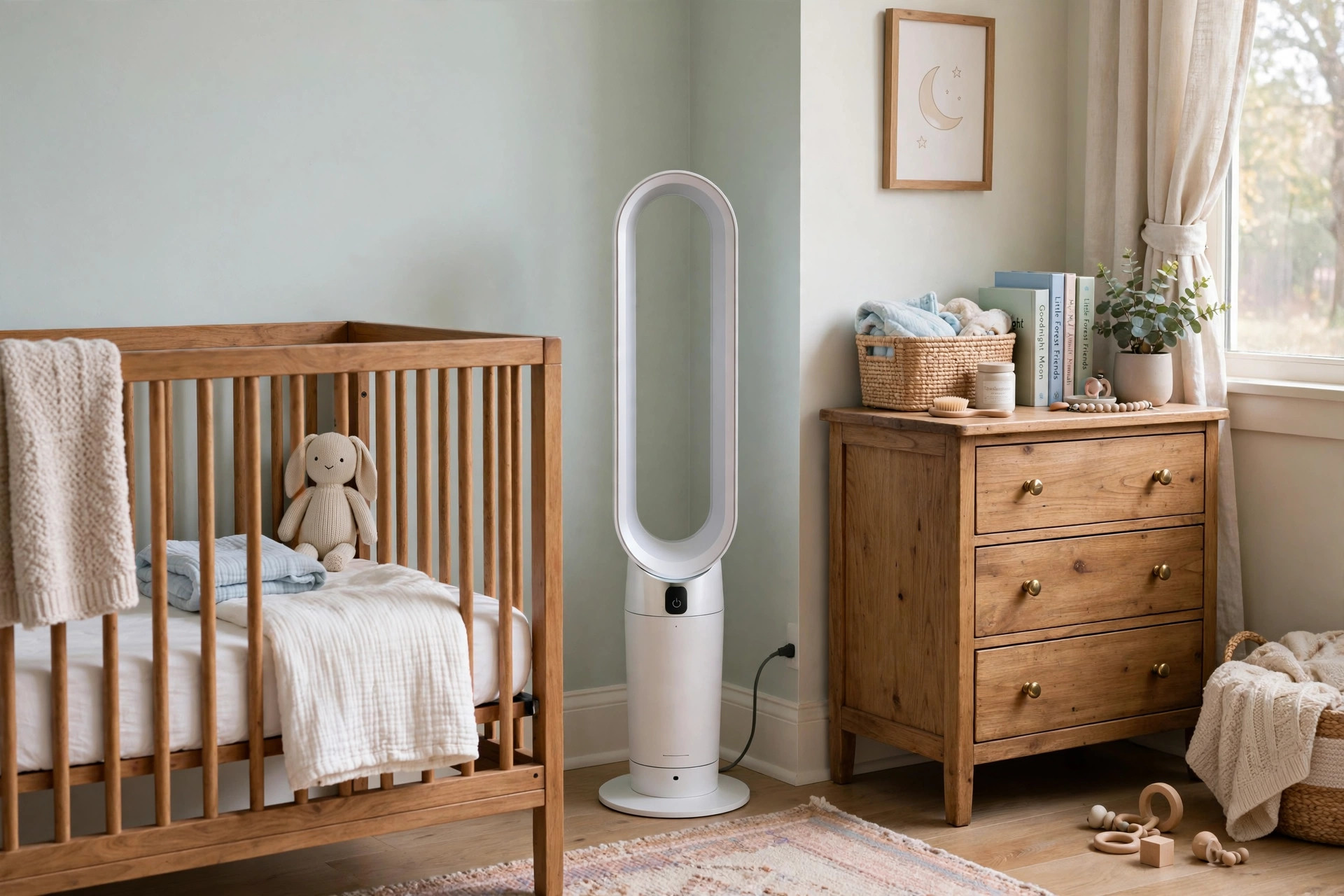
Bladeless tower fans are the most common pick. They stand two to four feet tall. They fit in a corner and push air across the whole room. Most include a remote and a timer. Prices sit in the middle range.
Bladeless pedestal fans look like classic stand fans with no blades. They adjust in height. A parent can aim air above the crib instead of at it. They take more floor space than towers.
Bladeless desk fans are small and light. They suit a changing table or a very small nursery. They cost less. They move less air. They work best as a second fan, not the only one.
Some bladeless fans add heat. A fan-heater combo warms the nursery in winter. This can save the cost of a second device. Check the heater wattage. High wattage raises the power bill. Keep any heater far from the crib and curtains.
Parents who shop for a safe tower fan for a nursery usually start with tower models. They balance noise, airflow, and floor space. Pedestal models win when a parent wants height control.
Parents who search for a quiet fan for a baby room often ask about bladeless fan noise levels for babies in the reviews. Tower fans usually test quietest because their tall shape spreads sound. Desk fans can whine at high speed. Read the low-speed number, since that is the speed you will use at night.
Cost and Price
Prices range wide. Small bladeless desk fans cost 60 to 120 dollars. Mid-range tower models cost 120 to 250 dollars. Premium brands with air purification cost 300 to 500 dollars. The best bladeless fan for nursery reviews USA lists often name a mid-range tower as the best value.
Running cost stays low. Most bladeless fans draw 20 to 60 watts. That is far less than a window air conditioner. An ENERGY STAR label marks the most efficient models. Over one summer of nightly use, the power cost often stays under 20 dollars.
Think about the full home too. A nursery fan is one small part of cooling. Makers of full-home systems such as Carrier, Trane, Lennox, Rheem, and Goodman build the central units that cool the whole house. If the nursery stays hot while other rooms stay cool, the ductwork may need a check. For bigger projects, our article on whole-house fan installation costs gives price ranges.
Also check the warranty before you buy. Most bladeless fans carry a one to two year warranty. Premium brands may offer five years on the motor. A longer warranty matters in a nursery, where the fan runs every night for months. Keep the receipt and register the product online. Some makers replace a failed unit instead of repairing it. That saves weeks of waiting in the middle of summer.
Care and Upkeep
A bladeless fan needs little care. Wipe the ring and base once a week with a damp cloth. Unplug the fan first. Never spray water into the air slot. Check the power cord each month for cracks or loose plugs. A damaged cord should be replaced, not taped.
Keep the base on a flat, stable floor. Do not set the fan on a rug edge where it can rock. If the model has a filter, rinse or replace it on the maker’s schedule. A clogged filter strains the motor and cuts airflow.
Store the fan upright in the off season. Coil the cord loosely. Tight coils crack wire over time. These small habits keep the fan safe for years. Home guides such as This Old House and practical repair advice from Family Handyman both stress that simple upkeep beats costly repair.
If the nursery air runs dry in winter, compare options in our cool mist vs warm mist humidifier comparison before you buy a second device.
Safety
Place the fan where the child cannot reach it. A corner works well. Keep the cord behind furniture and away from the crib. Babies pull cords. Use a cord cover if the cord must cross open floor.
Do not aim strong airflow straight at the baby. Point the fan so air moves across the room. Direct wind on a sleeping infant can dry skin and wake the child. Oscillation helps spread the flow.
Tip-over protection matters. Toddlers push things. A fan that shuts off when it falls cannot keep running on the floor. Check that the feature works when you unbox the fan. Tilt it gently and listen for the click.
Never leave a fan running in a closed room with a newborn without checking the room temperature first. A small thermometer near the crib gives a true reading. Aim for 68 to 72 degrees Fahrenheit, the range most pediatric guides suggest.
A fan is a comfort device, not a safety device. It does not replace safe sleep rules. The U.S. Consumer Product Safety Commission publishes nursery safety guidance that every parent should read. Keep the crib clear, keep the room at a safe temperature, and check on the child through the night.
Frequently Asked Questions
Are bladeless fans really safe for babies?
Yes, they are safer than bladed fans. There are no exposed blades to touch. Still, place the fan out of reach and use the tip-over shutoff. Safety comes from good placement as well as good design.
How loud is a bladeless fan on low?
Most test between 40 and 55 decibels on low. That matches a quiet room or soft talk. Light sleepers do best under 45 decibels. Read the rating before you buy.
Can one fan cool a whole nursery?
Yes, if the size matches. A tower fan rated for 150 to 250 square feet handles most nurseries. Close the door to keep cool air in. In extreme heat, a fan moves air but cannot lower temperature like an air conditioner.
Do bladeless fans help with stuffy air?
Yes. A fan breaks up warm, still air and keeps the room fresh. It does not add or remove moisture. For dry winter air, a humidifier is the better tool.
How much power does it use?
Most models draw 20 to 60 watts. Nightly summer use often costs less than 20 dollars for the season. ENERGY STAR models cost the least to run.
How do I clean a bladeless fan?
Unplug it. Wipe the ring and base with a damp cloth. Clean weekly. Rinse or replace the filter on schedule. Never pour water into the air slot.
A Final Word
The best bladeless fan for a nursery is safe, quiet, and easy to clean. Match the size to the room. Read real reviews with measured noise numbers. Place the fan with care. A good fan brings cool, fresh air to the nursery for many summers. That is comfort a parent can trust.
References
Carrier. (n.d.). Heating and cooling systems. https://www.carrier.com Consumer Reports. (n.d.). Product reviews and ratings. https://www.consumerreports.org ENERGY STAR. (n.d.). Energy efficient products. https://www.energystar.gov Family Handyman. (n.d.). DIY home repair and maintenance. https://www.familyhandyman.com Goodman. (n.d.). Heating and cooling equipment. https://www.goodmanmfg.com Lennox. (n.d.). Heating and cooling systems. https://www.lennox.com Rheem. (n.d.). Heating, cooling, and water heating. https://www.rheem.com This Old House. (n.d.). Home renovation guidance. https://www.thisoldhouse.com Trane. (n.d.). Heating and air conditioning. https://www.trane.com U.S. Consumer Product Safety Commission. (n.d.). Product safety information. https://www.cpsc.gov U.S. Department of Energy. (n.d.). Energy efficiency and renewable energy. https://www.energy.gov
Was this guide helpful?

About Robert Taylor
The My Garden US editorial team writes practical, in-depth home and garden guides for American homeowners — tested advice, no fluff.