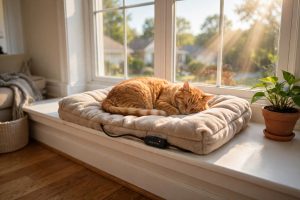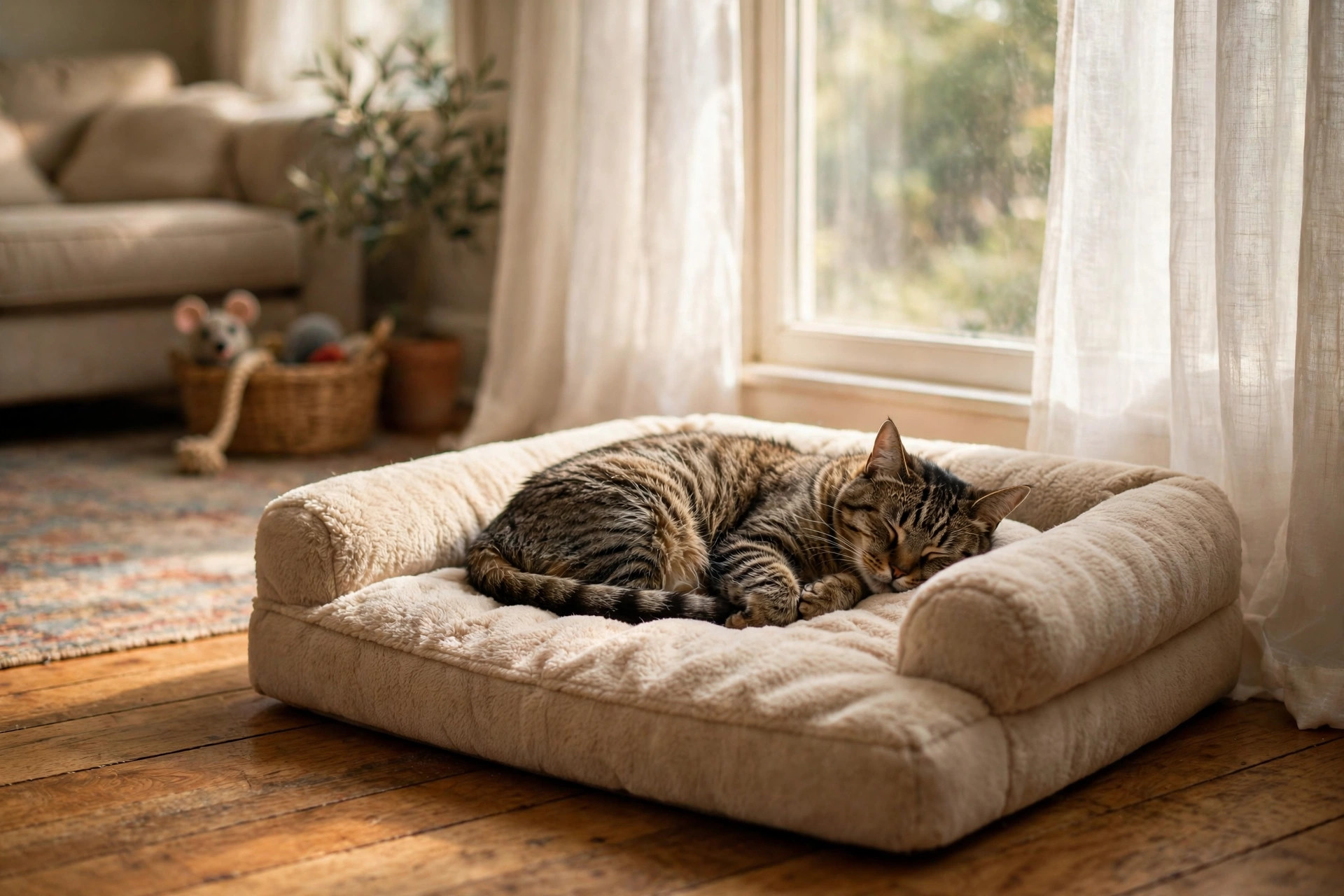

A cat that is ten years old or more sleeps a great deal. Older cats often sleep sixteen to eighteen hours each day. When a cat rests that long, the place where it sleeps matters a great deal. The best orthopedic cat bed for senior cats gives an older animal a soft, steady surface that supports weak joints and tired muscles. It is not the same as an ordinary cushion. It is built to spread the cat’s weight across the bed so that no single joint carries too much load.
Many owners first notice the need for such a bed when their cat starts to hesitate. The cat may pause before a jump that was once easy. It may land hard and walk away stiff. It may avoid the hard floor and seek warm, soft places instead. These small changes are signs of aging joints. A proper bed does not cure arthritis, but it can make rest far more comfortable. This guide explains what to look for, what types are sold, what prices are fair, and how to care for the bed once it is home.
Why a Senior Cat Needs an Orthopedic Bed
Aging joints and arthritis
Cats grow old much as people do. The soft tissue between their bones wears thin. Stiffness sets in, most often in the hips, the spine, and the elbows. Veterinary surveys suggest that a large share of cats over the age of twelve show some sign of joint wear on examination, even when their owners see no limp. The American Veterinary Medical Association notes that weight control and gentle care matter greatly for older animals.
An orthopedic bed helps because it does not let the cat sink into a hollow. A flat pillow or a cheap foam pad can allow the hips to drop lower than the shoulders. That twist is uncomfortable for a stiff animal. A bed with firm, even support keeps the spine level. The cat wakes up less stiff and returns to the bed more willingly.
Warmth and rest
Older cats feel cold more keenly than young ones. Their circulation is slower and their body fat may be lower. A bed that holds a little warmth helps a senior cat sleep deeper. Some beds use self-warming liners that reflect the animal’s own body heat. Others pair well with a low-wattage pet heating pad. The result is the same: the cat uses less energy to stay warm and rests more fully.
Better sleep, better days
Deep rest changes the quality of an older cat’s waking hours. A cat that has slept well on a supportive bed tends to eat better, groom more, and show more interest in its family. Owners often report that their cat becomes more active after a few weeks on a new bed. The bed is a small purchase, but for a cat in its later years it can make a real difference in daily comfort.
What to Look For When You Choose: Best Orthopedic Cat Bed for Senior Cats
Foam density and thickness
The heart of any orthopedic bed is the foam. Look for a solid slab of foam rather than loose fill or thin batting. A slab two to four inches thick gives real support for a full-grown cat. Dense foam, often sold as memory foam or orthopedic foam, springs back to its shape after the cat stands up. Cheap foam stays flat where the cat lay, and after a few weeks it is no better than the floor.
Press the foam with your hand before you buy if you can. It should push back against your palm. If it collapses at once and does not recover, it will not support an older cat for long.
Size and shape
Measure your cat from nose to tail tip while it sleeps stretched out, then add a few inches. Most senior cats like a bed they can stretch across. Some prefer a round nest that hugs their sides. Watch how your cat sleeps now. A cat that curls in a tight ball likes a bolstered round bed. A cat that lies flat on its side likes a rectangular mat with low or open sides, since high walls make entry hard for stiff legs.
Low entry is worth stressing. A senior cat with sore hips should not have to climb a tall wall to reach its rest. Look for a bed with at least one low side, or a flat pad that sits nearly at floor level.
Cover fabric
The cover is what the cat feels against its skin. Choose a soft, washable fabric such as fleece or plush microfiber. The cover should come off for washing, since older cats may shed more and may have the odd accident. A cover with a sturdy zipper lasts longer than one with a simple pull-on fit. Check the seams as well. Strong stitching holds up to years of kneading and washing.
Washability
Everything about a pet bed gets dirty in time. Fur, skin flakes, and the odd hairball are part of cat life. A fully machine-washable bed is easiest. If only the cover washes, the foam core still needs care. Some owners place a washable blanket over the foam to protect it. Read the care label before the first wash so the foam is not ruined in hot water.
Non-slip bottom
A bed that slides across a wood or tile floor frightens a stiff cat. A sudden slip can jar a sore joint. Look for a rubber or textured base that grips the floor. If the bed you like has a smooth bottom, a simple non-slip mat placed beneath it solves the problem for a few dollars.
For more on what veterinarians say about aging pets, the ASPCA publishes plain guidance on senior animal care that any owner can read. General pet health notes from PetMD also explain how arthritis shows itself in cats.
Types of Orthopedic Cat Beds
Shoppers who search for the best orthopedic cat bed for senior cats will find four main styles on store shelves. Each suits a different sleeping habit.
Memory foam beds
Memory foam is the most common orthopedic material. It molds to the cat’s body under warmth and pressure, then returns to shape when the cat rises. This gives even support and eases pressure on sore spots. Most beds sold for the best orthopedic dog bed for senior large dogs use the same material in a larger size, so the technology is well tested. A good memory foam cat bed suits most senior cats and is widely available at fair prices.
Bolstered beds
Bolstered beds have raised walls around some or all sides. The walls serve as a pillow for the head and a guard against drafts. Many older cats like to lean against a wall when they sleep. Choose a bolstered bed only if the entry side is low. A cat that must haul itself over a high wall each time will stop using the bed.
Heated and self-warming beds
Some beds add gentle heat. A heated pet bed for arthritic older dogs works on the same idea: mild warmth loosens stiff joints. Self-warming beds use a thin metallic liner that bounces the cat’s own heat back to it. They need no cord and carry no electric risk. Electric heated beds use a low-wattage pad and should carry proper safety marks. Never use a heating pad made for people, since it can run too hot for an animal.
Flat orthopedic mats
A flat mat is simply a thick foam slab in a washable cover. It has no walls and no tricks. It suits cats that like to stretch out and cats that sleep against a wall or under a table. Mats are also easy to place on a window sill pad or inside a favorite box. For owners who want the support without the bulk, a mat is the honest choice.
Elevated and window beds
Some cats refuse to sleep on the floor. An elevated bed lifts the cat a few inches off the ground, which keeps it away from cold drafts. A cat window perch for sunny window lounging pairs well with a small orthopedic pad for the senior cat that still loves its sunny spot. Make sure any elevated frame is sturdy and does not wobble under the cat’s weight.
Cost and Price
Prices vary widely, and a higher price does not always mean a better bed. As a rough guide, American shoppers in 2026 can expect the following ranges:
– Simple foam mats: fifteen to forty dollars. Good basic support, easy to wash. – Standard memory foam beds: thirty to seventy dollars. The best value for most senior cats. – Bolstered orthopedic beds: forty to ninety dollars. More fabric, more sewing, hence the higher price. – Self-warming orthopedic beds: thirty to sixty dollars. The warming liner adds only a little to the cost. – Electric heated orthopedic beds: fifty to one hundred and twenty dollars. The heating unit and safety testing raise the price.
Retailers such as Chewy carry a wide range of these beds with owner reviews that help separate good value from poor. Home Depot and Wayfair also stock pet beds in their home sections, which is handy when you shop for other household goods at the same time.
What matters more than the price tag is the foam. When you compare any two beds sold as the best orthopedic cat bed for senior cats, foam quality is what separates a good buy from a poor one. Read the listing for foam thickness and density. When the listing hides those numbers, treat that as a warning.
Care and Upkeep
Washing the cover
Wash the removable cover every one to two weeks in normal use. Use warm water and a mild, fragrance-free detergent. Strong scents bother cats and can cause a cat to reject the bed. Dry the cover fully before it goes back on the foam. A damp cover invites mildew and smells.
Caring for the foam core
The foam slab itself should rarely be washed. When it needs freshening, sprinkle it with baking soda, let it sit for an hour, and vacuum it off. For a wet spot, blot at once with a clean towel, then let the foam air-dry flat in a ventilated room. Never put memory foam in a washing machine or a hot dryer. Heat breaks the foam down.
Placing the bed
Put the bed where your cat already likes to rest. A new bed in a new corner may go unused. If the cat naps by a sunny window, place the bed there first. If the cat likes your bedroom, place it beside your own bed. Some owners buy two beds, one for the living room and one for the bedroom, so the cat always has support nearby.
Knowing when to replace
Even good foam tires in time. Check the bed every few months. Press the center where the cat sleeps. If it stays dented and does not spring back, the support is gone. Most beds serve two to three years of daily use before the foam gives out. A senior cat that lives on its bed may need a replacement sooner.
Safety
A safe bed is as important as a supportive one. Keep these points in mind:
– Cords and electricity: Electric heated beds must have a chew-resistant cord and a thermostat. Check the cord for damage now and then. A cat that chews cords should use a self-warming bed instead. – Small parts: Buttons, loose tags, and dangling strings can be chewed off and swallowed. Cut loose tags before the first use. – Fire risk of add-on heaters: Any heating pad should be made for pets and should shut off or hold a low, steady heat. People heating pads are not safe for animals. – Cleaning products: Wash with mild detergent only. Bleach and strong disinfectants leave residues that irritate a cat’s skin and nose. – Placement: Do not place the bed at the top of stairs or on a high shelf where a stiff cat might fall. The floor, or a low, stable surface, is best.
The American Kennel Club and the Cornell veterinary school at Cornell University both publish free safety notes for pet bedding and senior pet care. The Spruce Pets offers plain how-to guides on washing and placing pet beds. Independent test notes from Consumer Reports can help you weigh value before you buy.
FAQ
At what age does a cat count as senior?
Most veterinarians call a cat senior from about eleven years onward, and geriatric from fifteen. But joints do not read calendars. A heavy cat or a cat with an old injury may need orthopedic support at eight or nine. Watch the animal, not the number.
Will an orthopedic bed fix my cat’s arthritis?
No bed cures arthritis. What a good bed does is reduce the daily strain on sore joints and give the cat deeper, more restful sleep. Pair the bed with the care your veterinarian advises, such as weight control and any prescribed treatment.
My cat ignores new beds. What should I do?
Place the new bed where the cat already sleeps. Put a worn shirt of yours on it for a day so it smells like home. Some cats need a week to accept a change. Never force the cat into the bed. Patience works better than pressure.
Memory foam or bolstered bed: which is better?
It depends on the cat. A cat that stretches out does well on flat memory foam. A cat that curls into a ball often prefers a bolstered nest with a low entry. Watch how your cat sleeps now, and match the bed to the habit. The best orthopedic cat bed for senior cats is always the one that fits the animal in front of you.
Are heated beds safe for senior cats?
Self-warming beds are safe for nearly every cat, since they use no electricity. Electric heated beds are safe when they are made for pets, carry proper safety marks, and have a chew-resistant cord. Check the cord and the heat level now and then, and never use a people heating pad for a pet.
How thick should the foam be?
Two to four inches of firm foam suits most adult cats. Thinner pads may feel fine at first but flatten within weeks. When in doubt, choose the thicker slab.
A Short Final Word
The best orthopedic cat bed for senior cats is the one your cat actually uses. Firm foam, a low entry, a washable cover, and a warm quiet spot will serve most older cats well. You do not need the costliest bed on the shelf. You need a bed that supports the joints, keeps the cat warm, and sits where the cat wants to be. Give it a fair trial of two weeks. In many homes, the old cat claims the new bed by the second night and does not look back.
References
American Kennel Club. (n.d.). Dog care and training resources. https://www.akc.org American Veterinary Medical Association. (n.d.). Pet care resources. https://www.avma.org ASPCA. (n.d.). Pet care and animal welfare resources. https://www.aspca.org Chewy. (n.d.). Pet supplies. https://www.chewy.com Consumer Reports. (n.d.). Product reviews and ratings. https://www.consumerreports.org Cornell University College of Veterinary Medicine. (n.d.). Veterinary education and animal health. https://www.vet.cornell.edu PetMD. (n.d.). Pet health information. https://www.petmd.com The Home Depot. (n.d.). Home improvement products. https://www.homedepot.com The Spruce Pets. (n.d.). Pet care guides and product reviews. https://www.thesprucepets.com Wayfair. (n.d.). Furniture and home goods. https://www.wayfair.com
Was this guide helpful?

About Robert Taylor
The My Garden US editorial team writes practical, in-depth home and garden guides for American homeowners — tested advice, no fluff.
You May Also Like
A Self Cleaning Litter Box for Busy Cat Owners
May 20, 2026 0 views
The Best No Pull Dog Harness for Strong Pullers: A Plain Guide
September 9, 2026 0 views
Outdoor Dog Shower for Muddy Paws Cleaning: A Complete Guide
April 1, 2026 0 views