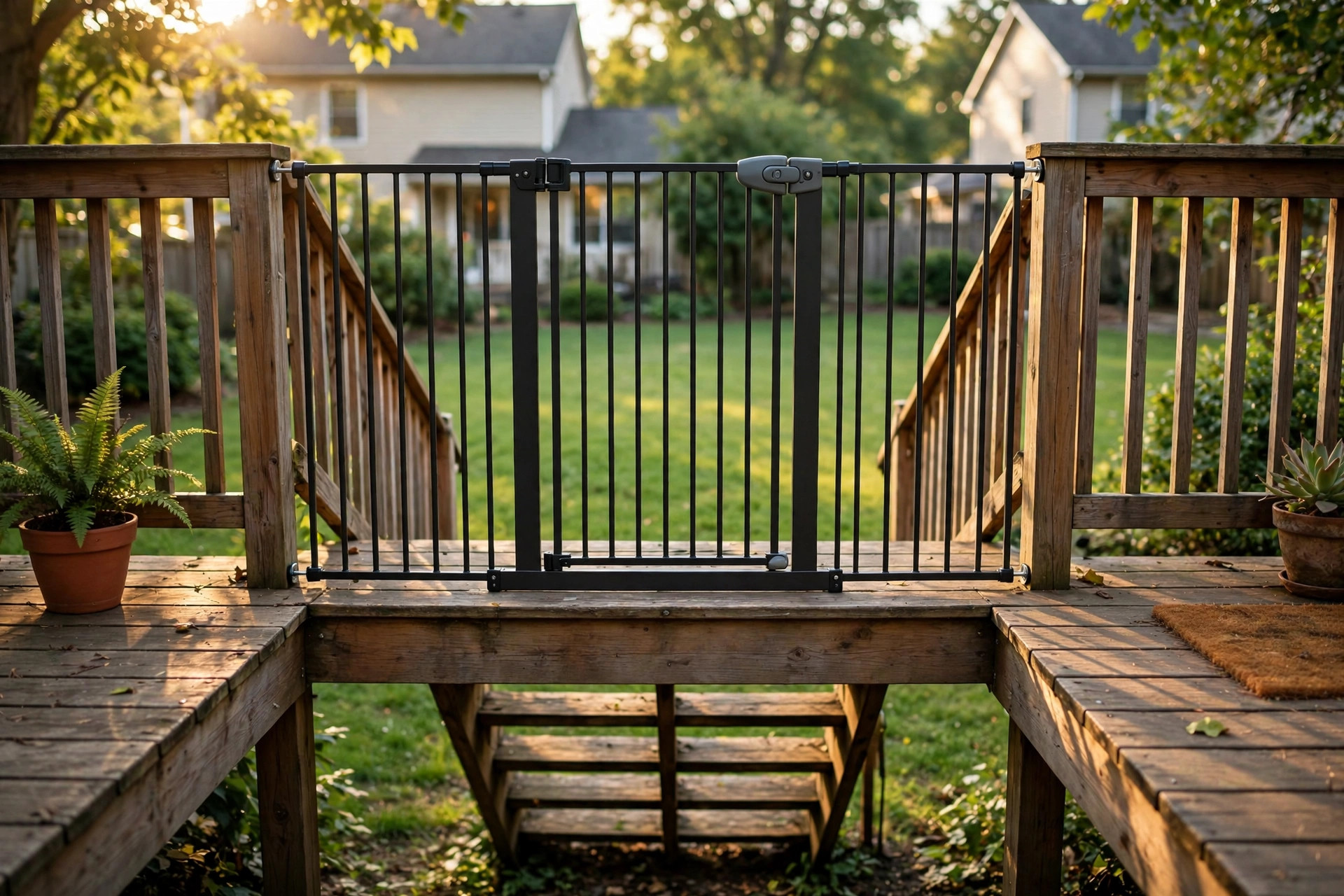

A dog sees an open deck as an open invitation. A cat sees a railing as a path to explore. An outdoor pet gate for deck and patio safety turns that open space into a safe place. It blocks stairs, open edges, and wide gaps while still letting people walk through with ease.
Decks and patios feel like natural extensions of the living room, but raised decks bring real risks. A small dog can slip between wide rails. An older dog can fall down steep stairs. A curious cat can climb a rail and wander far from home. A gate placed in the right spot stops these problems before they start.
This guide explains what an outdoor pet gate does, how to choose one, and how to keep it working year after year. It covers the main types, honest cost ranges, care tips, safety rules, and answers to common questions.
Why a Pet Gate Matters Outdoors
Most people think of pet gates as indoor tools. They place them in doorways and at the top of stairs. But the same idea works outdoors. A deck or patio has edges, stairs, and gaps. An outdoor pet gate for deck and patio safety closes those gaps without closing off the whole yard.
Falls are a common cause of injury for dogs on decks. Stairs with open sides give a small or senior dog little room for error. Wet wood makes the risk worse. A gate at the top of the stairs keeps the dog on the flat surface until you walk down together.
Rails cause their own trouble. Many older decks were built when rail spacing rules were loose. A puppy or a small breed dog can fit through gaps that look narrow to a person. The American Kennel Club notes that pet safety around the home starts with checking barriers and openings from the pet’s point of view.
Patios at ground level have different risks. They often open straight onto streets, driveways, or unfenced yards. A gate at the patio edge keeps a dog from chasing a squirrel into traffic. For cats, a gate can slow an escape long enough for you to react. The ASPCA offers guidance on keeping pets safely contained in outdoor spaces, and barriers are a central part of that advice.
Neighbors and visitors matter too. A dog behind a gate cannot rush the mail carrier or jump on a guest. A gate also keeps other animals out. Stray dogs and wildlife can wander onto an open deck. A closed gate gives your pet a safe zone that stays under your control.
What to Look for Before You Buy: Outdoor Pet Gate for Deck and Patio Safety
Start with measurement. Measure the width of the opening you want to block. Measure the height from the deck floor to the top of the railing. Write both numbers down. Many owners skip this step and guess. Family Handyman reminds readers that careful measuring is the first rule of any home improvement project, large or small.
Next, think about the pet. A gate for a terrier is not the same as a gate for a Labrador. Note your pet’s weight, height at the shoulder, and jumping ability. A gate should stand well above the point your pet can clear. For cats, height matters even more, since a healthy cat can clear most gates. A gate for cats works best as part of a larger enclosure plan, such as an outdoor cat enclosure for safe garden roaming.
Material is the next choice. Metal gates resist chewing and hold up in bad weather. Wooden gates blend with deck rails and look warm and natural. Plastic or mesh gates cost less but wear out faster in sun and rain. For a gate that will stay outside all year, metal or treated wood is the sound choice. The Spruce Pets reviews outdoor pet products and often points out how material choice affects life span in real weather.
Mounting style matters a great deal. Pressure-mounted gates press against two walls or posts. They install in minutes and leave no holes. Hardware-mounted gates attach with screws. They hold stronger and resist pushing from large dogs. Consumer Reports testing methods show that anchored barriers consistently outperform unanchored ones under force.
Check the latch. A good latch opens easily for a person with one hand but defeats a clever dog nose. Self-closing hinges add safety because the gate never stays open by accident. Walk-through doors save your back when you carry groceries or a laundry basket.
Look at bar spacing. Bars set close together stop small heads from getting stuck. The U.S. Consumer Product Safety Commission sets spacing standards for children’s gates, and the same logic applies to pets. Narrow spacing is safer for every animal.
Think about the finish. Outdoor gates need weather-resistant coating. Powder-coated steel resists rust. Cedar and treated pine resist rot. Chewy carries a wide range of outdoor pet gates, and product listings there show how coatings and materials vary across price levels.
Finally, check the warranty and the return policy. A gate is a safety device. If it arrives warped or the latch fails, you should be able to send it back. Home Depot and Lowe’s both carry outdoor pet gates in many stores, which makes it easy to see the product in person before you buy.
Types of Outdoor Pet Gates
Freestanding gates are the simplest type. They have a frame or a set of panels that stands on its own. Some fold like an accordion. You can move them from the deck to the patio as needed. Their weakness is stability. A large dog can push a freestanding gate over. They work best for small or calm pets.
Pressure-mounted gates fit between two posts or walls. Rubber pads on each side grip the surface. They install without tools and remove without a mark.
Hardware-mounted gates screw into posts or walls. They are the strongest option. Once installed, they do not shift or tip. They suit large dogs, strong breeds, and homes where the gate will stay in place for years. For owners who plan a permanent outdoor dog run with roof for backyard, a hardware-mounted gate at the entry point is a natural fit.
Retractable mesh gates roll up like a window shade when open. They look neat and modern. They suit wide openings where a swinging gate would be awkward. But the mesh can tear under claws, and most models are not rated for large dogs.
Wooden picket gates match traditional decks and can be built to fit odd openings.
Metal panel gates use steel or aluminum frames with vertical bars. They are the workhorses of outdoor pet safety. They resist weather, chewing, and pushing. They cost more up front but last the longest.
Expandable gates adjust to fit openings of different widths. They use sliding panels that lock in place. They are useful when you have two openings of different sizes and one gate to cover them.
For larger properties, a best dog fence for large yard no digging system can secure an entire yard without trenching, and a deck gate then becomes the entry point between the house zone and the fenced zone.
Cost and Price Guide
Prices for an outdoor pet gate for deck and patio safety vary widely. A simple freestanding or expandable gate costs between 25 and 60 dollars. These suit small pets and temporary needs. They install in minutes and store flat.
Mid-range gates run from 60 to 150 dollars. This range covers most pressure-mounted and retractable mesh models. Quality improves noticeably here. Latches work more smoothly. Frames feel sturdier. Coatings resist rust better. Most pet owners find what they need in this range.
Premium gates cost 150 to 350 dollars or more. These are usually hardware-mounted metal gates or wide custom-fit models. They use thicker steel, better hinges, and stronger latches.
Custom wooden gates built by a carpenter can cost 300 to 600 dollars installed. The price depends on the wood, the size, and local labor rates. A custom gate fits odd openings perfectly and matches the deck exactly.
Do not forget installation costs. A pressure-mounted gate costs nothing to install. A hardware-mounted gate may need a drill, screws, and an hour of your time. If you hire a handyman, expect 50 to 100 dollars for a simple installation.
Buying two gates often makes sense. One guards the stairs. One guards the yard-side edge. Two mid-range gates usually cost less than one emergency vet visit. PetMD notes that fall injuries in dogs can lead to expensive surgery, which puts the price of a gate in clear perspective.
Care and Upkeep
An outdoor gate faces sun, rain, snow, and temperature swings. Regular care keeps it safe and extends its life. Inspect the gate at the start of each season. Look for rust, loose screws, cracked wood, and worn latches. Small problems are easy to fix early.
Clean the gate a few times a year. Wash metal gates with mild soap and water. Rinse well and dry. Scrub wooden gates with a deck brush to remove mildew.
Treat wood once a year. Apply a water-sealing stain or a clear outdoor sealant. Let the gate dry fully before letting pets near it. Some sealants have fumes that bother animals.
Oil metal hinges twice a year. A drop of outdoor-grade lubricant keeps hinges swinging freely. Check the latch at the same time.
Tighten all bolts and screws each spring. Freeze and thaw cycles loosen hardware. A gate that wobbles is a gate a dog can defeat.
Check pressure-mounted gates monthly. Rubber pads wear and lose grip. If the gate slides in its opening, reposition or replace the pads.
Store retractable mesh gates carefully in winter if your climate is harsh. Roll them up fully and cover them.
Watch for chewing. Some dogs chew gate bars out of boredom or anxiety. Chewing can expose sharp metal edges or splinter wood. If your dog chews the gate, address the behavior and inspect the damage.
Safety Rules That Come First
A gate is a tool, not a replacement for watching your pet. Never leave a young puppy or an anxious dog alone on a deck for long periods. Gates reduce risk. They do not remove it.
Make sure the gate is tall enough. A gate a dog can jump is decoration, not protection. Watch your pet around the new gate for the first few days. If your dog defeats the gate, upgrade to a taller or stronger model.
Keep the area behind the gate clear. Do not place chairs, planters, or storage boxes near the gate. A clever dog will use them as steps.
Check rail spacing across the whole deck, not just at the gate. A gate at the stairs means little if a puppy can slip between rails three feet away. Measure every gap. Block wide gaps with lattice or mesh panels.
Mind the heat. Dark metal gates get hot in direct sun. A dog that leans on a hot gate can burn its nose or paws. Choose lighter finishes for sunny spots, or add shade.
Secure the gate when storms approach. High winds can slam an unlatched gate. Latch every gate before a storm. Bring lightweight freestanding gates inside.
Teach children how the gate works. Show them how to open and close it. Make closing the gate a habit, like closing the front door.
For multi-pet homes, plan for the smallest and the most agile animal. A gate that holds a Labrador may not stop a cat. Homes with both dogs and cats may need layered barriers.
Finally, register the product if the maker offers it. The U.S. Consumer Product Safety Commission tracks recalls for pet gates and barriers, and a registered product means the maker can reach you if a safety issue comes to light.
Frequently Asked Questions
Can a pet gate really keep a cat on a deck? A standard gate alone will not stop most cats. Cats climb and jump well. A gate helps as part of a bigger plan. Pair it with tall railings, angled top extensions, or a full enclosure.
What height should an outdoor pet gate be? For small dogs, 24 to 30 inches is often enough. For medium dogs, choose 30 to 36 inches. For large or athletic dogs, look for 36 inches or taller. When in doubt, go taller.
Will a pressure-mounted gate damage my deck posts? Pressure-mounted gates use rubber pads. They rarely damage posts. They may leave light marks on soft wood. For valuable or new posts, hardware mounting with sealed screw holes often causes less visible wear over time.
Can I leave an outdoor pet gate up all winter? Most metal gates handle winter well. Wooden gates need a good sealant before the cold arrives. Retractable mesh gates do better stored indoors in harsh climates.
How do I stop my dog from chewing the gate? Chewing often signals boredom or stress. Give the dog toys and exercise. Bitter-tasting sprays made for pets can discourage chewing on bars. Metal gates resist chewing better than wood.
Do I need a permit to install a pet gate? In almost all cases, no. A pet gate is not a structural change. Homeowner associations sometimes have rules about visible additions. Check your association rules before installing.
A Short Final Word
An outdoor pet gate for deck and patio safety is a small purchase with a large payoff. It protects dogs from falls and escapes. It gives cats a safer boundary. It brings peace of mind every time you open the back door. Measure your space, match the gate to your pet, and install it with care. Then enjoy the deck together, knowing the boundary is doing its job.
References
American Kennel Club. (n.d.). Dog care and training resources. https://www.akc.org ASPCA. (n.d.). Pet care and animal welfare resources. https://www.aspca.org Chewy. (n.d.). Pet supplies. https://www.chewy.com Consumer Reports. (n.d.). Product reviews and ratings. https://www.consumerreports.org Family Handyman. (n.d.). DIY home repair and maintenance. https://www.familyhandyman.com Lowe’s. (n.d.). Home improvement products. https://www.lowes.com PetMD. (n.d.). Pet health information. https://www.petmd.com The Home Depot. (n.d.). Home improvement products. https://www.homedepot.com The Spruce Pets. (n.d.). Pet care guides and product reviews. https://www.thesprucepets.com U.S. Consumer Product Safety Commission. (n.d.). Product safety information. https://www.cpsc.gov
Was this guide helpful?

About James Carter
The My Garden US editorial team writes practical, in-depth home and garden guides for American homeowners — tested advice, no fluff.
You May Also Like

A Practical Guide to the Cat Tunnel Collapsible for Play and Hiding
January 31, 2026 0 views
Best Automatic Feeder for Two Cats Portion Control
June 26, 2026 0 views
Choosing a Pet Carrier Backpack for Small Dogs Hiking
March 20, 2026 0 views