
A pet gate with cat door for stairway safety solves a problem many two-pet homes know well. The dog must stay off the stairs, but the cat needs to pass. A gate with a small built-in door gives each animal what it needs. This guide covers why these gates matter, the types you can buy, what to pay, and how to install one with care.
Why Stairway Safety Matters for Pets
Stairs can be a danger for both dogs and cats. Small dogs can lose their footing and tumble. Old dogs with stiff joints can fall on hard steps. Puppies may try to climb stairs before their bones are ready. Even sure-footed cats can be caught off guard when a large dog chases them down a stairway. A pet gate with cat door for stairway safety places a clear barrier between the dog and the stairs, while the little door lets the cat move through at will.
A gate also gives the cat a safe retreat. Many homes keep the litter box or the cat food upstairs. Without a gate, a food-guarding dog can block the stairs and frighten the cat away from its own bowl. The ASPCA notes that cats need places where they can rest and eat without fear of other animals in the home (https://www.aspca.org). A cat door built into the gate keeps that path open at all times.
Peace of Mind When You Leave the House
Pet owners also worry when they are away at work. A gate at the top of the stairs means you do not come home to find the dog sleeping on your bed upstairs. It also means a small dog cannot fall down the steps while no one is watching. Many owners report that a good gate lowers their daily stress more than almost any other pet product they buy (https://www.chewy.com).
How a Pet Gate with a Cat Door Works: Pet Gate with Cat Door for Stairway Safety
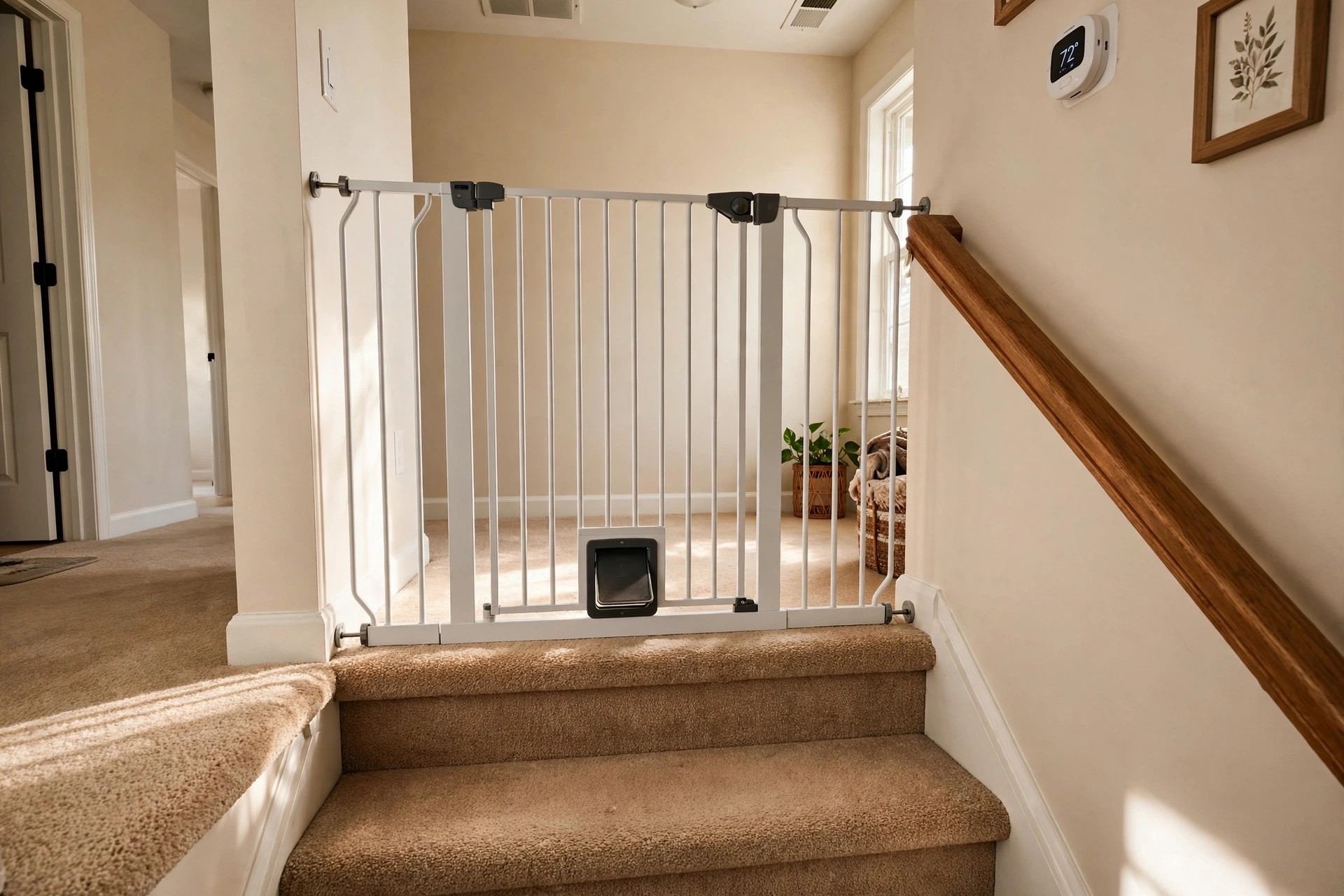
The design is simple. A standard pet gate stands in a doorway or across the stairs. Near the bottom, a small square or round opening is cut into the gate panel. A light swinging flap covers the opening, or the opening is left plain. The hole is big enough for most cats, usually eight to ten inches across. It is too small for a medium or large dog to push through.
Some gates use a two-way flap that swings both directions. Others use a simple rigid pass-through with smooth edges. Both types work. The flap style keeps the dog from sticking its nose through. The open style makes it easier for shy cats to learn to use it.
What to Look for When You Choose One
Buying a pet gate with cat door for stairway safety calls for a few careful checks. Measure first, then compare models.
The Right Size and Fit
Measure the width of your stairway opening at the top of the stairs. Write down the number in inches. Gates adjust to fit a range, such as 28 to 42 inches. Buy a gate whose range covers your opening. Also measure the height of the banister or the wall where the gate will mount. The gate must be tall enough that your dog cannot jump over it.
Check the size of the cat door too. A full-grown cat needs an opening at least seven inches square. Very large cats may need a wider pass. If you own a Maine Coon or another big breed, look for a gate with a larger cat door. The Spruce Pets offers guidance on how big cats move through small spaces (https://www.thesprucepets.com).
Pressure-Mount or Hardware-Mount
At the top of stairs, experts strongly advise a hardware-mount gate. This type screws into the wall or the banister. It cannot tip over when a dog pushes against it. A pressure-mount gate only holds by friction. At the top of stairs, a friction gate can slip and create the very danger you wanted to prevent. Use pressure-mount gates only at the bottom of stairs or in flat doorways.
The U.S. Consumer Product Safety Commission warns that gates at the top of stairs must be securely fixed to the wall (https://www.cpsc.gov). Always follow this rule. A child gate can double as a pet gate, but check that the bars are narrow enough that a small dog cannot squeeze through.
Materials and Build Quality
Gates come in metal, wood, and plastic. Metal gates last longest and resist chewing. Wood gates look nice in homes with wood trim. Plastic gates are light and cheap but may crack if a big dog leans on them. For stairway use, choose steel or hardwood. Check that the welds and joints are smooth, with no sharp edges that could cut a paw.
The Latch and Lock
You will open and close this gate many times a day. The latch should work with one hand. Walk-through gates with a small door for people are easier to live with than gates you must climb over. Some models lock at the top and swing both ways. A self-closing hinge is a useful extra, so the gate never sits open by accident.
Types of Pet Gates with Cat Doors
Several styles are on the market. Each suits a different home.
Freestanding Gates with Cat Doors
A freestanding gate stands on its own with wide feet on each side. It needs no screws and no pressure. It works best at the bottom of stairs or in a hallway. Do not use a freestanding gate at the top of stairs, where a push from a dog could knock it over.
Pressure-Mount Gates with Cat Doors
These gates press against the walls on either side with rubber pads. They leave no holes in the wall. They install in minutes. They suit renters and anyone who wants no marks on the walls. As noted above, keep them away from the top of the stairs.
Hardware-Mount Gates with Cat Doors
These gates bolt to the wall or banister. They are the strongest option. They are the right choice for the top of a stairway. Installation takes a drill and about thirty minutes. Many models include a template so you can place the screws in the right spots.
Extra-Tall and Extra-Wide Models
Large dogs may need a gate 36 inches or taller. Wide stairways may need extension panels. Many makers sell add-on panels that fit their gates. Buy the gate and the extension from the same maker so the parts match. Home improvement stores carry these gates in several widths (https://www.homedepot.com).
Cost and Price
A basic pressure-mount pet gate with a cat door costs between 40 and 70 dollars. A hardware-mount gate of good quality costs between 70 and 130 dollars. Extra-tall models and wide gates with extensions can reach 150 dollars or more. Wood gates often cost more than metal ones.
Online stores often run sales. Big retailers like Amazon, Walmart, and Target carry a wide range of gates (https://www.amazon.com, https://www.walmart.com, https://www.target.com). Pet specialty stores also stock them and can answer questions about sizing (https://www.chewy.com). Prices change with sales, so compare before you buy.
Installation Tips
Good installation matters as much as the gate itself.
1. Measure the opening twice. Buy the gate that fits. 2. At the top of stairs, always use a hardware-mount gate. Never use a pressure-mount or freestanding gate there. 3. Mount into a wall stud or a solid banister post when you can. If you must mount into drywall, use the wall anchors that come with the gate. 4. Leave no gap wider than three inches between the gate and the wall. A small dog can push through a wider gap. 5. Check that the gate swings freely and the latch locks with a click. 6. Show the cat the little door. Hold it open and let the cat walk through with a treat on the other side. Most cats learn in a day or two.
PetMD has articles on how pets adjust to new barriers in the home (https://www.petmd.com). A calm, patient approach works best. Never push an animal through the door. Let it learn at its own pace.
Care and Upkeep
A pet gate needs little care, but a few habits keep it working well. Wipe the gate with a damp cloth once a month. Check the screws and hinges every few months and tighten what is loose. If the gate has a flap on the cat door, check that it still swings freely and has not warped.
Metal gates may rust if they get wet often. Keep them dry. Wood gates can be wiped down with a mild cleaner. Avoid harsh chemicals that could harm a pet that licks the bars.
Safety Notes
Even the best gate has limits. Check these points often.
– Never leave a very small puppy alone at a gate with wide bars. The pup could get its head stuck. – Keep the walk-through door latched when you are not passing through. – Watch large, strong dogs. A determined dog can damage a light gate. Buy a gate rated for your dog’s weight. – Check the cat door edges for cracks or rough spots that could scratch a cat. – If the gate came with a recall notice, stop using it at once and follow the maker’s steps. The American Kennel Club keeps general safety guidance for multi-pet homes (https://www.akc.org).
Training Your Pets to Use the Gate
Most dogs learn quickly that the gate is a boundary. Walk the dog to the gate, say “stay,” and reward calm behavior. In a few days, the dog will stop testing it. For anxious dogs that push or chew at barriers, extra training may be needed. A guide on escape-proof crates for anxious dogs covers related training ideas for dogs that do not settle.
Cats usually take to the cat door at once, but some need help. Put a favorite treat just beyond the door. Leave the flap propped open for the first day. Once the cat walks through on its own, let the flap swing. A tall cat tree for large cats near the gate can give the cat a high perch from which to study the new door before trying it.
Make sure the cat always has water on its side of the gate. A pet water fountain for multiple cats placed near the litter area keeps the cat well supplied when the dog side of the house is closed off.
Frequently Asked Questions
Will my dog fit through the cat door?
Almost certainly not. Cat doors in pet gates are about eight inches across. That is wide enough for a cat but too small for any dog larger than a tiny toy breed. Very small dogs under ten pounds may fit, so measure your dog against the opening before you buy.
Can I use this gate for a baby as well as pets?
Many pet gates meet the same standards as child safety gates. If you want one gate for both, choose a hardware-mount model and check the product label for child safety approval. Always supervise babies near stairs, gate or no gate.
What if my cat refuses to use the door?
Try removing the flap for a few days so the cat sees a plain hole. Place food on the other side. Most cats cross within a day. If the cat still refuses, the door may be too small, or the gate may sit in a spot the cat finds scary. Move the food bowl closer and try again.
Do I need tools to install a hardware-mount gate?
Yes. You need a drill, a screwdriver, and a level. The gate should come with screws and a mounting template. If you are not handy with tools, many handymen will install a gate for a small fee.
How do I clean the gate?
Wipe it with a damp cloth and mild soap. Rinse and dry it well. Do not use bleach or strong cleaners, since pets may lick the bars. A quick wipe once a month is enough in most homes.
Will the gate damage my walls?
Pressure-mount gates can leave small marks on walls where the pads press. Hardware-mount gates leave screw holes. You can fill small holes with putty when you move out. Wall cups, sold with many gates, spread the pressure and reduce marks.
A Short Final Word
A pet gate with cat door for stairway safety is one of the simplest ways to keep a mixed pet home calm and safe. It costs little, installs in an afternoon, and pays for itself in peace of mind. Measure your stairs, choose a hardware-mount gate for the top step, and give your cat a day to learn the little door. Your dog will learn the new rule fast, and your cat will thank you with many quiet trips up and down the stairs.
References
Amazon. (n.d.). Online shopping. https://www.amazon.com American Kennel Club. (n.d.). Dog care and training resources. https://www.akc.org ASPCA. (n.d.). Pet care and animal welfare resources. https://www.aspca.org Chewy. (n.d.). Pet supplies. https://www.chewy.com PetMD. (n.d.). Pet health information. https://www.petmd.com Target. (n.d.). Retail store. https://www.target.com The Home Depot. (n.d.). Home improvement products. https://www.homedepot.com The Spruce Pets. (n.d.). Pet care guides and product reviews. https://www.thesprucepets.com U.S. Consumer Product Safety Commission. (n.d.). Product safety information. https://www.cpsc.gov Walmart. (n.d.). Everyday low prices. https://www.walmart.com
Was this guide helpful?

About Sarah Mitchell
The My Garden US editorial team writes practical, in-depth home and garden guides for American homeowners — tested advice, no fluff.
You May Also Like
Dog Agility Set for Backyard Training Fun: A Complete Guide
June 29, 2026 0 views
How to Choose a Pet Hair Remover Brush for Couch and Car
January 26, 2026 0 views
A Dog Life Jacket for Swimming and Boating: How to Choose the Right One
April 9, 2026 0 views