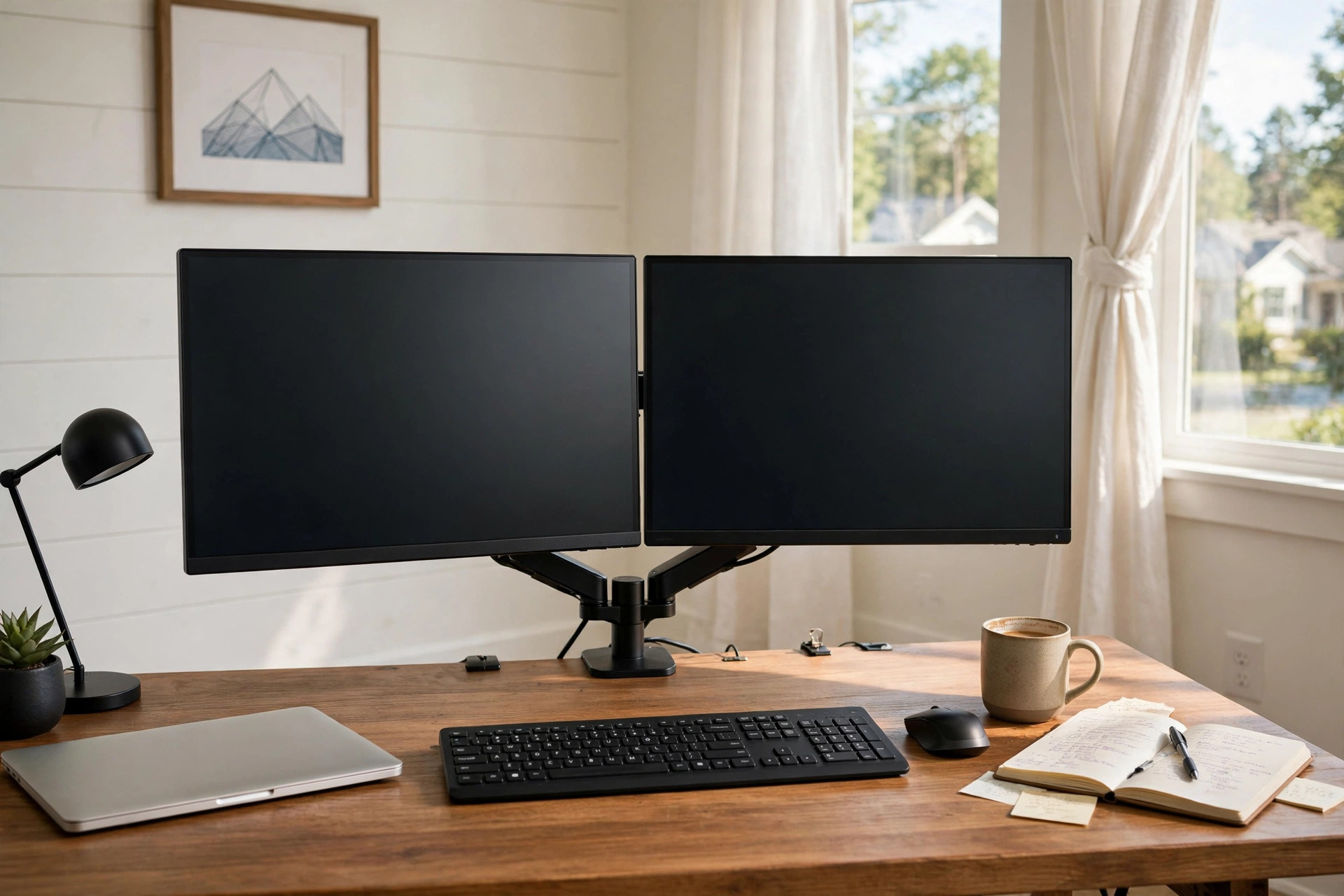

Millions of Americans now work from home full time. Many of them work on one small laptop screen all day. An affordable dual monitor setup for remote workers USA shoppers can find today changes that in a big way. Two screens let you keep your video call on one side and your work on the other. You stop clicking between windows. You stop losing your place. This guide shows how to build a clean, low-cost two-screen home office. It covers what to buy, how to set it up, what it costs, and how to keep it safe.
Why Two Screens Matter for Remote Work
Work from home demands more screen space than ever. Email, chat, video calls, spreadsheets, and documents all fight for room. On one screen, you stack them on top of each other. You alt-tab all day. That slows you down and breaks your focus.
Two screens solve the problem in a simple way. Put the main task on one screen. Put reference material on the other. A remote worker can read notes while writing a report. A customer service agent can see the caller profile and the ticket at the same time. A student can watch a lecture and take notes side by side.
Research on office productivity has long shown that extra screen space helps people finish tasks faster. You do not need expensive gear to get the benefit. Two plain 24-inch monitors can lift your whole workday. The change feels large on day one. After a week, you will wonder how you worked on one screen before.
What to Look For When You Buy: Affordable Dual Monitor Setup for Remote Workers Usa
Screen Size and Resolution
For a budget setup, 24-inch monitors with 1080p resolution are the sweet spot. They are wide enough to read documents with ease. They cost much less than larger or sharper screens. Text stays clear at normal desk distance.
A 27-inch monitor gives more room but costs more. It may also need a bigger desk. Two 24-inch screens fit most home desks well. Stay away from very cheap screens with poor color. They tire your eyes by the end of the day.
Ports and Cables
Check the back of your computer before you buy anything. Most modern laptops have HDMI, USB-C, or both. Older desktop computers may use DisplayPort or DVI. Your monitor must have a port that matches your computer, or you will need an adapter.
HDMI cables are cheap and common. DisplayPort is also fine. USB-C can carry video and charge a laptop through one cable. That keeps the desk clean. Buy cables that are at least six feet long. Short cables pull tight and look messy.
The Stand or Mount
Every monitor comes with a factory stand. Those stands work, but they take up a lot of desk space. A dual monitor arm costs little and lifts both screens off the desk. It clamps to the back edge of the desk. You gain room for a keyboard, a notebook, and a coffee mug.
A good arm also lets you tilt and swivel each screen. That helps you find the right angle. Make sure the arm supports the weight and size of your monitors. Most budget arms hold two screens up to 32 inches.
Types and Options on a Budget
Two Matching 24-Inch Monitors
This is the most popular choice. Buy two of the same model. The colors will match. The heights will match. Your eyes move between screens with no shock. Refurbished office monitors from big brands often cost under one hundred dollars each and still look sharp.
One Laptop Plus One External Monitor
If you cannot fit two large screens, pair your laptop with one monitor. Set the laptop to the side or below. Use the big screen for main work and the laptop screen for chat or email. This costs even less and needs less desk space.
One Ultrawide Versus Two Screens
An ultrawide monitor gives one big curved screen. It feels like two screens with no gap in the middle. Ultrawides cost more than two budget monitors, so they are less common in an affordable setup. Two screens still win on price.
Refurbished and Open-Box Deals
Certified refurbished monitors can cut your cost in half. Big retailers sell open-box returns at a discount. Check the return policy before you buy. Look for a warranty of at least 90 days. Avoid screens with dead pixels or deep scratches.
How to Set Up Two Monitors Step by Step
Check Your Computer First
Start with your computer. Count the video ports on the back or side. If you have only one video port, you may need a USB docking station or a USB-to-HDMI adapter. Most desktops and many laptops can drive two external screens with no extra parts.
Connect the Cables
Plug one cable into each monitor. Connect the other ends to your computer. Power on the screens. Do not force a cable into a port. Each connector only fits one way. A gentle push is enough.
Mount the Screens
If you bought a monitor arm, clamp it to the desk. Attach each monitor to the arm with the VESA bolts on the back. Tighten every bolt by hand first, then with a screwdriver. Ask someone to help hold a screen while you bolt it on. A dropped monitor is an expensive mistake.
Adjust the Position
Set the top of each screen at or just below eye level. Sit about 20 to 28 inches from the screens. Angle the screens slightly toward you. The inner edges can sit a little closer than the outer edges. This follows the natural curve of your vision.
Fix the Display Settings
Open display settings on your computer. Windows and Mac both let you arrange the screens left and right. Drag the boxes on screen so they match your real desk layout. Set the same resolution on both screens. Turn on extended display, not mirror. Mirror mode shows the same picture twice and wastes the second screen.
Cost and Price in the USA
A full affordable dual monitor setup for remote workers USA wide can cost less than many people think. Here is a typical budget breakdown.
Two 24-inch 1080p monitors: $90 to $150 each, so $180 to $300 for the pair. A dual monitor arm: $30 to $70. Two cables or adapters: $10 to $25. A USB docking station, if your laptop needs one: $40 to $80.
That puts a complete setup between $250 and $450. With refurbished monitors, you can go even lower. Many workers build a fine setup for about $200. Start with the screens and add the arm later if money is tight.
Watch for seasonal sales. Back-to-school and holiday sales often cut monitor prices by 20 percent or more. Price tracking tools can alert you when a model drops. Buying both monitors from the same store at the same time keeps the panels matched.
Care and Upkeep
Monitors last a long time with simple care. Wipe the screen with a dry microfiber cloth. Do not spray cleaner right on the screen. Spray a small amount on the cloth instead. Harsh chemicals can damage the coating.
Keep vents on the back clear of dust. Use a can of compressed air once a month if dust builds up. Do not block the vents with books or boxes. Heat shortens the life of electronics.
Check cables now and then. A loose cable causes flicker or a black screen. Push each connector in firm. Replace a frayed cable before it fails. Label your cables behind the desk so you know what goes where. Good cable management ideas can keep the back of the desk tidy and safe.
Turn the monitors off at night or use sleep mode. That saves power and extends the life of the backlight. A simple power strip with a switch makes this easy. Keep drinks away from the screens and the keyboard. One spill can ruin a whole setup.
Safety
Electrical Safety
Plug monitors into a surge protector, not a bare wall outlet. Power spikes can kill electronics. Do not overload one outlet with a strip on a strip. If a cable feels hot, unplug it and replace it. Check cords for cuts or frays each year.
Ergonomic Safety
Bad screen position causes neck and eye pain. Keep the top of the screen at eye level. Do not crane your neck up or down for hours. Sit with your feet flat and your back supported. A good chair matters as much as good screens. Reviews of office chairs at Herman Miller and Wayfair can help you compare options.
Follow the 20-20-20 rule for your eyes. Every 20 minutes, look at something 20 feet away for 20 seconds. Keep room light soft and even. Close blinds if the sun glares on the screen. Many workers also add a good webcam for Zoom meetings and a ring light for video calls so calls look clear without harsh light on the screens.
Desk and Mount Safety
A dual arm puts real weight on the edge of your desk. Make sure the desk is solid. Thin or wobbly desks can tip or crack. Tighten the clamp well. Do not let children hang on the screens. If you use a standing desk from makers like UPLIFT Desk, keep cables loose enough to move with the desk. Some workers pair the setup with an adjustable height stool for standing desk breaks to rest their legs during the day.
Helpful Places to Shop and Learn
Budget monitors are easy to find at big retailers. Dell sells reliable office monitors in many sizes. Amazon lists hundreds of budget models with buyer reviews. Price and review roundups from PCMag and Wirecutter can help you pick a model that tests well. For desk furniture that fits two screens, IKEA offers plain, sturdy desks at low prices.
Frequently Asked Questions
Can any laptop run two monitors?
Most laptops made in the last ten years can run at least one external screen. Many can run two. Check your laptop specs for the number of video outputs. If you have only one port, a USB docking station can add a second output. Business laptops often support two or three screens with ease.
Do I need a special stand?
No, but a dual monitor arm helps a lot. The factory stands that come in the box work fine on a big desk. An arm frees desk space and lets you set the perfect height. Budget arms cost less than a dinner out. They are one of the best upgrades for the money.
Is a dual monitor setup bad for the eyes?
Two screens are not worse for your eyes than one. Eye strain comes from glare, small text, and long hours with no breaks. Set the brightness to match the room. Make text big enough to read with ease. Take short breaks. If your eyes hurt, check your screen distance first. It is often too close or too far.
How much desk space do I need?
Two 24-inch monitors on a dual arm need a desk about 48 inches wide and 24 inches deep. That is a standard medium desk. On factory stands, you may want a 55-inch desk for comfort. Measure your space before you order. Leave room for the keyboard in front.
Can I mix two different monitor brands?
Yes. It works fine. The colors and brightness may differ a bit between brands. You can adjust the settings to bring them close. Matching monitors look nicer, but mixed brands save money. Many workers start with one new screen and one old screen from a past job.
What is the cheapest way to start?
Use the gear you already own. Add one budget monitor to your laptop. That gives you two screens for the price of one. Later, buy a second monitor and a dual arm. Build the setup in steps as your budget allows.
A Final Word
An affordable dual monitor setup for remote workers USA wide is within reach for almost any budget. Two plain screens, a few cables, and a simple arm can change how your workday feels. You will switch windows less. You will find files faster. Your calls will run smoother while your work stays open beside them. Start small, buy smart, and set the screens at the right height. Your back, your eyes, and your to-do list will thank you.
References
Amazon. (n.d.). Online shopping. https://www.amazon.com Dell. (n.d.). Computers and monitors. https://www.dell.com Herman Miller. (n.d.). Office furniture and ergonomic seating. https://www.hermanmiller.com IKEA. (n.d.). Home furnishings. https://www.ikea.com PCMag. (n.d.). Technology product reviews. https://www.pcmag.com The Spruce. (n.d.). Home and garden advice. https://www.thespruce.com UPLIFT Desk. (n.d.). Standing desks and ergonomic office furniture. https://www.uplift-desk.com Wayfair. (n.d.). Furniture and home goods. https://www.wayfair.com Wirecutter. (n.d.). Product reviews from The New York Times. https://www.nytimes.com/wirecutter
Was this guide helpful?

About David Wilson
The My Garden US editorial team writes practical, in-depth home and garden guides for American homeowners — tested advice, no fluff.
You May Also Like

Best Home Office Chair for Bad Posture Correction
August 1, 2026 0 views
Home Office Desk Organizer for Mail and Bills: A Simple Guide
June 7, 2026 0 views
Adjustable Desk Divider for Shared Home Office: A Practical Guide
January 1, 2026 0 views