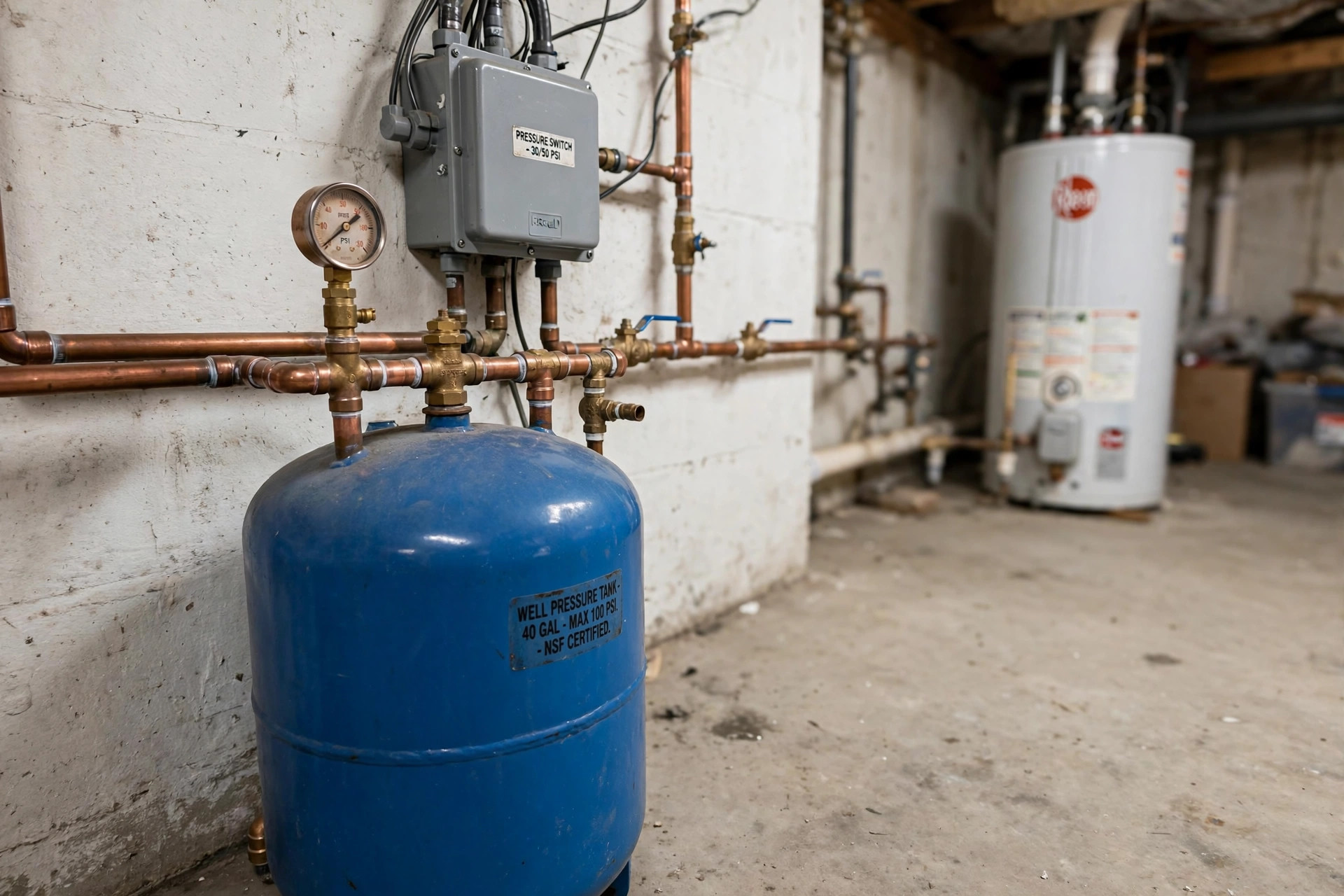

If your well pump runs every time you turn on a faucet, or the water pressure jumps up and down, your pressure tank may be failing. Understanding the well pressure tank replacement cost USA homeowners face helps you budget before the call. In the United States, a full replacement most often runs between $800 and $2,500. The final number depends on the tank size, the type of tank, local labor rates, and the condition of the pipes and fittings around it.
Why the Pressure Tank Matters
A pressure tank stores water under pressure so the pump does not have to run for every small draw. When you open a tap, water comes from the tank first. The pump starts only after the tank pressure drops to a set point. A failing tank makes the pump cycle far too often. This short cycling wears out the pump, and pumps cost far more than tanks to replace.
A sound tank also keeps water pressure steady. Without one, showers would pulse and toilets would fill in bursts. For the millions of rural American homes on private wells, this small steel tank is a key part of daily comfort.
How Much Does a Well Pressure Tank Replacement Cost in the USA?: Well Pressure Tank Replacement Cost Usa
The well pressure tank replacement cost USA plumbers quote usually breaks down into two parts: the tank itself and the labor to install it.
Tank price: $150 to $1,200. A small 20-gallon bladder tank may cost $150 to $300. A mid-size 44 to 86-gallon tank often runs $350 to $700. Large 120-gallon tanks can pass $1,000.
Labor price: $300 to $1,200. Most plumbers or well contractors charge 2 to 4 hours of labor. Rural service calls may add a trip fee of $50 to $150.
Extras: New fittings, a pressure switch, a pressure gauge, and a check valve can add $100 to $300. If the tank stand or the concrete pad must be rebuilt, the cost rises further.
For a common job — a 44-gallon bladder tank in a basement or crawl space — most homeowners report paying between $900 and $1,400. Prices vary by state. Expect higher bills in the Northeast and West, where labor rates run high, and lower bills in the South and Midwest.
A sediment filter for well water is often replaced at the same service visit, since grit in the water can shorten a tank’s life.
Signs Your Pressure Tank Needs Replacing
Watch for these warning signs:
– The pump clicks on and off every few seconds. – Water pressure surges and then fades. – The water looks cloudy or has a metallic taste. – You can hear water sloshing inside the tank when you knock on it. – The tank feels waterlogged, meaning the air cushion inside is gone. – The tank is over 10 to 15 years old.
A simple test is to tap the tank. The top half should sound hollow. If the whole tank sounds solid, it is likely waterlogged. The best water test kit for well water can help rule out water quality issues before you pay for a new tank.
Types of Well Pressure Tanks
Bladder Tanks
A rubber bladder holds the water inside the steel shell. The air around the bladder never touches the water. These are the most common tanks sold today. They need little upkeep and hold air charge well.
Diaphragm Tanks
Much like bladder tanks, but the diaphragm is fixed in place instead of a full bag. They work the same way for most homes and are priced about the same.
Galvanized Steel Tanks (Air-Over-Water)
Older homes often have these plain steel tanks. Air sits on top of the water with no barrier between them. Air slowly dissolves into the water, so the tank needs regular air recharging. Most pros advise swapping these for a bladder tank at replacement time.
What to Look for When Choosing a Tank
Size Matters
Size your tank to your pump and your home. A tank that is too small lets the pump short cycle. Many pros suggest a tank that holds enough drawdown to let the pump run at least one minute. A family of four with a 1-horsepower pump often does well with a 44 to 86-gallon tank. Ask your contractor to match the tank to your pump’s flow rate.
Build Quality
Look for a thick steel shell with a corrosion-resistant finish. Stainless steel or epoxy-coated tanks last longer in damp basements. A good bladder material resists splitting for many years.
Pressure Rating
Most home systems run a 40/60 pressure switch setting. Make sure the tank’s pre-charge and maximum rating fit your system. Your installer can set the air pre-charge, usually 2 psi below the cut-in pressure.
Warranty
Quality tanks carry 5 to 7-year warranties. A strong warranty is a good sign of a tank built to last.
Cost Breakdown by Tank Size
| Tank size | Typical tank price | Installed cost range | | — | — | — | | 20 gallon | $150–$300 | $500–$900 | | 32 gallon | $250–$450 | $700–$1,100 | | 44 gallon | $350–$600 | $900–$1,400 | | 86 gallon | $500–$800 | $1,200–$1,900 | | 120 gallon | $700–$1,200 | $1,600–$2,500 |
These are broad USA ranges. Always get two or three written quotes for your area.
What Drives the Price Up or Down
Several factors move the well pressure tank replacement cost USA contractors charge:
– Tank location. A basement tank with clear access is quick to swap. A tank in a tight crawl space or a remote well house adds time and labor. – Old plumbing condition. Rusted or corroded pipes often must be cut back to solid metal. That adds parts and hours. – Electrical work. A failing pressure switch may share the service call. If the wiring or breaker needs work, the bill rises. – Travel distance. Well contractors in rural areas may add a trip fee. Ask about it up front. – Permits. Some counties require a permit for well system work. The fee is small, usually $25 to $100, but it should appear on the quote. – Emergency timing. A failed tank with no water is urgent. After-hours or weekend calls can cost 50 to 100 percent more.
Knowing these factors helps you read a quote and spot padding.
Questions to Ask Your Contractor
Before you sign, ask:
1. Is the quoted tank a bladder tank, and what is its gallon size? 2. Does the price include the pressure switch, gauge, and fittings? 3. What is the tank’s warranty, and who honors it? 4. Will you set the air pre-charge to match my pressure switch? 5. Is there a trip fee or emergency surcharge on this quote? 6. How long will the water be off during the work?
A good contractor answers these plainly. Vague answers are a sign to get another quote.
Labor: What the Contractor Actually Does
Replacing a well pressure tank is more than unbolting the old one. The pro will:
1. Shut off power to the pump and drain the system. 2. Cut out and remove the old tank. 3. Fit new nipples, elbows, and a drain valve. 4. Set and level the new tank. 5. Reconnect the pressure switch and gauge. 6. Set the air pre-charge and test the system.
Many well service firms list tank work on their well water filtration pages as well, since the two systems sit side by side.
DIY vs. Hiring a Pro
Some handy homeowners do this job themselves. The tank itself may cost only $300 to $600. But there are real risks. Wiring a pressure switch wrong can burn out the pump motor. A leak at a soldered joint can flood a basement. And heavy tanks are hard to move alone.
Most experts say to hire a licensed plumber or well contractor. The labor charge is modest next to the risk of a flooded basement or a dead pump. If you do it yourself, shut off the breaker, drain the system fully, and use Teflon tape and pipe dope on every threaded joint.
Ways to Save Money
– Get multiple quotes. Prices for the same job can differ by hundreds of dollars. – Bundle work. If you also need a new expansion tank for your water heater, ask for a combined price. – Keep access clear. Clear the path to the tank before the tech arrives to cut billable time. – Check the simple parts first. A bad pressure switch or a stuck gauge can mimic a dead tank and cost far less to fix. – Ask about off-season rates. Some contractors are cheaper in slow months.
You can find parts and price ranges at large retailers such as Home Depot, Lowe’s, and Family Handyman for planning purposes.
Care and Upkeep
A little care extends tank life:
– Check the air pre-charge once a year with a tire gauge. – Keep the area dry and the tank free of rust. – Replace the pressure switch if contacts look burned. – Install a sediment filter ahead of the tank if your well water carries grit. – Keep records of the install date for warranty claims.
Guidance on safe drinking water from EPA and maintenance tips from This Old House can help you care for the whole well system.
Safety
Turn off the pump breaker before any work on the tank. A pressurized tank holds stored energy. Never cut into a tank that still has pressure. Bleed the system fully first. If wiring looks frayed or scorched, call an electrician. Plumbing product makers such as Moen, Delta Faucet, Kohler, and filter makers like Aquasana also publish safety notes for water system parts.
FAQ
How long does a well pressure tank last?
Most bladder tanks last 10 to 15 years. Galvanized air-over-water tanks may last 15 to 25 years but need regular air recharging.
Can I replace just the bladder?
Some tanks allow bladder swaps, but most pros recommend replacing the whole tank. A new tank comes with fresh fittings, a new finish, and a full warranty.
Why does my pump keep turning on and off?
Short cycling is the classic sign of a waterlogged tank. The air cushion is gone, so pressure drops fast and the pump starts with every small use.
Does homeowner’s insurance cover pressure tank replacement?
Usually not. Wear and tear is a maintenance cost. Sudden damage from a covered event, like a burst pipe, may be covered in part.
What size tank do I need?
It depends on pump flow and household use. As a rule, a 44-gallon tank suits most families of three to four. Larger homes or high-flow pumps need 86 gallons or more.
Is it normal for the tank to sweat?
Light condensation on the tank in humid weather is normal. Heavy rust or puddles at the base are not. Those point to a leak or a failing tank.
Can a bad tank raise my electric bill?
Yes. A waterlogged tank makes the pump run far more often. That extra run time shows up on the power bill. It also shortens pump life, so a new tank can pay for itself by saving the pump.
A Short Final Word
The well pressure tank replacement cost USA homeowners pay is fair for the work involved. A new tank protects your pump, steadies your water pressure, and brings peace of mind for a decade or more. Get written quotes, choose a tank sized to your pump, and hire a pro for the install. Your well system will thank you with years of quiet, steady service.
References
Aquasana. (n.d.). Water filtration systems. https://www.aquasana.com Delta Faucet. (n.d.). Kitchen and bathroom faucets. https://www.deltafaucet.com Family Handyman. (n.d.). DIY home repair and maintenance. https://www.familyhandyman.com Kohler. (n.d.). Bathroom and kitchen fixtures. https://www.kohler.com Lowe’s. (n.d.). Home improvement products. https://www.lowes.com Moen. (n.d.). Faucets and plumbing fixtures. https://www.moen.com The Home Depot. (n.d.). Home improvement products. https://www.homedepot.com This Old House. (n.d.). Home renovation guidance. https://www.thisoldhouse.com U.S. Environmental Protection Agency. (n.d.). Protecting human health and the environment. https://www.epa.gov
Was this guide helpful?

About Emily Rodriguez
The My Garden US editorial team writes practical, in-depth home and garden guides for American homeowners — tested advice, no fluff.
You May Also Like
UV Water Purifier for Well Water Reviews: What Rural Homeowners Should Know
September 6, 2026 0 views
Electric Tankless Water Heater Reviews USA: What Buyers Should Know
January 21, 2026 0 views
How Often Should You Pump Your Septic Tank? A Plain Guide for American Homes
July 2, 2026 0 views