
A private well puts clean water in your hands. It also puts the care of that water in your hands. No city office tests it for you. If the pump runs and the water looks clear, many owners rest easy. Yet clear water can carry things you cannot see, smell, or taste.
That is why finding the best water test kit for well water usa is one of the most practical steps a well owner can take. A good kit tells you what sits in your water today. It points to the right fix, if one is needed. It also gives you a record to compare against next year.
This guide walks through the whole task: what a well water test should cover, the kinds of kits you can buy, how to run a test without spoiling the sample, how to read the results, and how to pick the best water test kit for well water usa for your own home.
Why Well Water Testing Matters
A city water system must test its water on a strict plan. The rules set by the federal government say how often, for what, and how to report it. Private wells have no such guard. The EPA still says well owners should test their water at least once a year for the common signs of trouble, and more often if something changes.
Wells sit at the mercy of their land. A field uphill may send fertilizer down after a hard rain. An old septic tank may leak. Rock below can add iron, manganese, sulfur, arsenic, or radon. None of these show on the surface.
Testing matters most when the well is new, after a flood, when a baby joins the house, when taste or color shifts, or when a neighbor reports a problem in the same ground.
A kit is not a cure. It is a map. It shows where the trouble lies, so money goes to the right fix.
What a Good Well Water Test Should Cover: Best Water Test Kit for Well Water Usa
Before you shop, know what you are measuring. The most useful home kits test a mix of the following.
Bacteria: coliform and E. coli
Coliform bacteria live in soil and in animal waste. Their presence says the well may be open to the outside. E. coli is the danger flag. If it shows up, do not drink the water until the well is disinfected and retested. Bacteria tests often come as small vials where the sample changes color in 24 to 48 hours.
Hardness and pH
Hardness comes from calcium and magnesium. It crusts on fixtures, spots dishes, and wears out water softeners faster. Low pH, meaning acidic water, eats into copper pipes and can add lead and copper to the water. High pH tastes bitter and clouds glass. Test strips handle both in under a minute.
Nitrates and nitrites
Nitrates come from fertilizer, septic systems, and animal waste. They are the main risk for babies. High nitrate water can cause a blood condition in infants that starves the body of oxygen. The federal limit for drinking water is 10 parts per million. If your well sits near farm fields, this test matters every year.
Iron, manganese, and sulfur
These are the stain makers. Iron turns sinks orange and laundry rusty. Manganese leaves black marks. Sulfur brings the rotten-egg smell. They are seldom a health risk at home levels, but they ruin the look and feel of the water.
Lead and copper
Lead harms growing brains. It seldom comes from the ground. It comes from old solder and fixtures inside the house. If your home was built before 1986, a lead test is worth the cost.
TDS, chlorine, and other readings
Total dissolved solids, or TDS, is a rough measure of all the minerals in the water. Chlorine tests check whether a shock treatment is still active. Some kits add fluoride, copper, pesticides, or radon readings. The wider the panel, the better the picture.
Types of Water Test Kits for Well Water
Kits fall into three broad groups. Each suits a different need.
1. Test strip kits
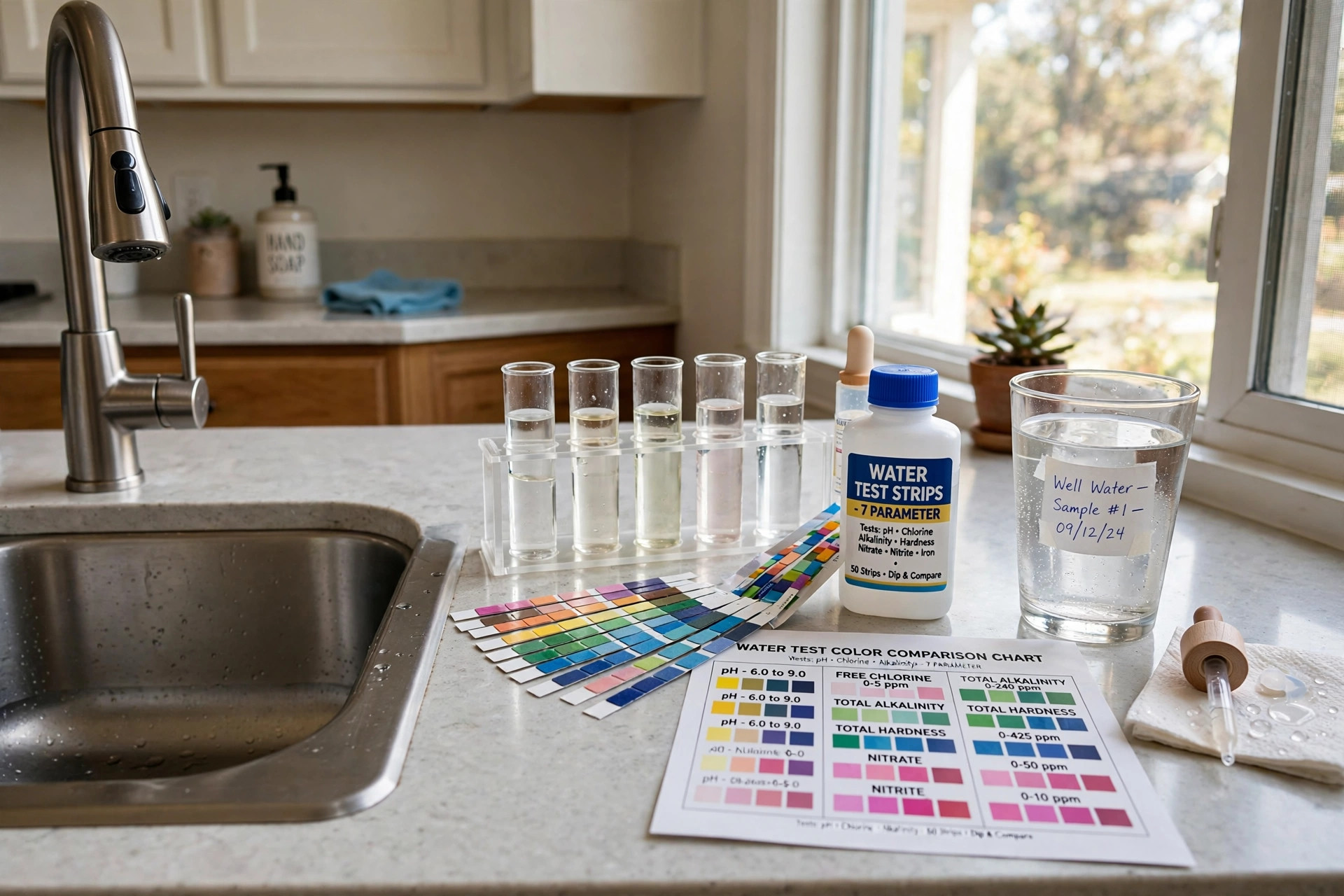
These are the quick checks. You dip a paper strip into the water, wait the stated seconds, and match the colors to a chart. A full strip can read ten or more items at once: pH, hardness, chlorine, nitrates, iron, copper, lead, and more. They cost little, often under twenty dollars, and give results in minutes.
Their weakness is precision. The color steps are wide. A strip may read “between 10 and 25” when you need an exact number. For a yearly screening, that is fine. For deciding on a filter purchase, it is thin.
2. Liquid and vial kits
These kits mix the sample with small vials of reagent and compare the color to a chart. They read more exactly than strips and stay stable longer on the shelf. A vial kit for bacteria gives a clear yes-or-no on coliform and E. coli. A full mineral kit can run through a dozen steps in under an hour.
They need more care. You must follow the timing, keep the vials clean, and read the colors in good light. The price sits in the middle, usually thirty to eighty dollars.
3. Mail-in lab kits
A mail-in kit sends your sample to a real laboratory. You fill the bottles as directed, pack them, and mail them back. The lab uses machines that read far finer than any home test. Results arrive in one to three weeks, often with a written report that flags each reading against federal limits.
This is the most exact choice and the most costly, commonly one hundred dollars or more. For a new well, a house sale, or a worry about arsenic or lead, it is the right move. If you wonder what a professional check costs locally, read our piece on home water quality test cost near me.
Many owners use two kinds at once: strips for quick yearly checks and a lab kit every few years, or when something looks wrong.
How to Choose the Best Water Test Kit for Well Water
Not every kit suits every well. Weigh these points before you buy.
Match the kit to your known risks. A farm-country well needs nitrate and bacteria tests. An old house needs lead. A well with rust stains needs iron and manganese. Buy the panel that fits your ground, not the biggest box on the shelf.
Check what each reading measures. Look at the back of the box or the maker’s page. A kit that lists “lead” should say at what level it can see it. Cheap strips sometimes claim more than they can read. The Family Handyman and This Old House guides remind owners to compare the kit’s range to the federal limits.
Look for clear color charts. Testing fails when you cannot tell two close shades apart. Pick kits with large, plain charts and strong reviews from home users, not just pros.
Note the shelf life. Strips and reagents age. Check the date on the box and buy from a store that turns its stock, such as Home Depot or Lowes.
Think about follow-up. The best water test kit for well water usa is the one whose maker also explains what to do next. Some brands, such as Aquasana, pair test results with treatment advice. Delta and Kohler publish plain guides on fixtures and filtration that help you act on what the test finds.
Count the cost per test. A lab kit may seem steep, but its per-reading cost is often lower than buying three strip kits across the year.
How to Run a Home Well Water Test Without Spoiling the Sample
A test is only as good as the sample. Follow these steps and your results will mean something.
1. Use a clean glass or the kit’s own bottle. Do not use a soapy jar from the dish rack. Rinse it three times with the water you will test. 2. Run the tap first. Let cold water run for two to five minutes. This pulls fresh water from the well itself, not water that sat in the pipes overnight. 3. Test the cold side only. Hot water from the tank can skew mineral readings. 4. Read at the right time. Strips change fast. Hold the strip level, start a timer, and read each square at its stated second. 5. Use good light. Daylight by a window beats a yellow kitchen bulb. Color charts lie under warm light. 6. Do not touch the strip pads. Skin oil spoils the chemistry. 7. For bacteria vials, be extra clean. Wash your hands, do not let the bottle mouth touch the tap, and start the wait time at once. 8. For mail-in kits, follow the clock. Some samples must reach the lab within 30 hours. Mail early in the week so the box does not sit over a weekend.
Write the date, the weather, and any recent rain on the report. That note tells you whether a change came from the season or the ground.
Reading Your Results
A chart full of numbers helps no one unless you know the lines that matter. These are the common federal limits for drinking water, in parts per million unless noted.
– E. coli: none allowed. Any find is a fail. – Total coliform: none allowed under current rules. – Nitrate: 10 ppm or less. – Lead: action level at 15 parts per billion, but no amount is truly safe. – Copper: action level at 1.3 ppm. – pH: between 6.5 and 8.5. – Iron: secondary limit of 0.3 ppm, for taste and staining. – Manganese: health advisory at 0.3 ppm. – TDS: secondary limit of 500 ppm.
One odd reading may be a fluke. Retest before you spend big money. Two matching readings tell a true story.
What to Do After the Test
If the water tests clean
Keep the report with your house papers. Test again next year. Note anything that changes in the meantime: floods, nearby construction, a new septic field, a change in taste.
If bacteria show up
Do not drink the water. Shock-chlorinate the well, wait, flush the lines, and retest. If bacteria return, call a well driller. The casing may be cracked or the cap may sit below grade.
If minerals are high
Hardness, iron, and sulfur are fixable. A softener handles hardness. An iron filter handles iron, and our guide to the best sediment filter for well water usa covers those systems in full. If you are weighing whole systems, our review of uv water purifier for well water reviews covers one common next step for wells with bacteria worries.
If lead or nitrates are high
These need stronger answers: a certified point-of-use filter, and bottled water for drinking and cooking until the source is fixed.
Cost and Price: What a Water Test Kit for Well Water Costs
Prices run a wide range. Simple strip kits start around ten to twenty dollars. Vial-based kits run thirty to eighty dollars. Mail-in lab tests run from about one hundred to two hundred dollars, depending on how many readings they cover.
A yearly strip kit plus a lab test every three to five years is a sound budget for most owners. That plan costs less per year than a single service call from a water company, and it keeps your records steady.
Care and Upkeep of Your Test Kit
Store strips and reagents in a cool, dry place. Heat and damp kill them fast. A bathroom cabinet is a poor home; a bedroom drawer is better. Check the date before each use. Do not mix old and new strips in one test.
Keep the color charts flat and dry. A stained chart reads wrong forever.
After each test, file the results. A simple folder with the date, the season, and the readings becomes your well’s health record.
Safety Notes for Well Owners
Test kits use small amounts of chemistry. Keep them away from children and pets. Read the safety sheet that comes in the box. Do not pour used reagents down a sink that feeds your septic system in large amounts; most home amounts are fine, but follow the label.
When handling a bacteria vial, treat the sample as if it could be unsafe. Wash up after. If you shock-chlorinate the well, keep the strong chlorine water away from gardens and pets until it is flushed clear.
Never mix test chemicals from different brands. And never drink from a sample vial, even if it looks like plain water.
Frequently Asked Questions
How often should I test my well water? At least once a year for bacteria, nitrates, and pH. Test more often after floods, repairs, or any change in taste, smell, or color. A full mineral panel every three to five years is a good habit.
Are home test strips accurate enough? For screening, yes. They catch big problems fast. They are not exact enough to size a filter or to prove the water meets legal limits.
What is the single most important test for well water? Bacteria. Coliform and E. coli tests guard against the one risk that can make a family sick overnight. Run that test every year without fail.
Can I test for radon in well water with a home kit? Radon in water needs special handling. Some mail-in lab kits include a water-radon bottle. If your area is known for radon in rock, ask your state health office for the right test.
Do I need to test if my water tastes fine? Yes. Taste is a weak guard. Nitrates, lead, and bacteria have no taste at the levels that matter.
How long do test kits last on the shelf? Strips usually last one to two years if kept dry and cool. Check the printed date and throw out old kits. A stale strip that reads “fine” is worse than no test at all.
A Final Word
A well is a quiet asset. It asks little and gives much. The price it asks is one yearly test and a small bit of care. The best water test kit for well water usa is simply the one you will use: a strip kit on the kitchen counter each spring, a lab kit in the mail every few years, and the habit of writing the numbers down.
Do that, and your water stops being a guess. It becomes a record, the best tool a well owner can hold.
References
Aquasana. (n.d.). Water filtration systems. https://www.aquasana.com Delta Faucet. (n.d.). Kitchen and bathroom faucets. https://www.deltafaucet.com Family Handyman. (n.d.). DIY home repair and maintenance. https://www.familyhandyman.com Kohler. (n.d.). Bathroom and kitchen fixtures. https://www.kohler.com Lowe’s. (n.d.). Home improvement products. https://www.lowes.com Moen. (n.d.). Faucets and plumbing fixtures. https://www.moen.com The Home Depot. (n.d.). Home improvement products. https://www.homedepot.com This Old House. (n.d.). Home renovation guidance. https://www.thisoldhouse.com U.S. Environmental Protection Agency. (n.d.). Protecting human health and the environment. https://www.epa.gov
Was this guide helpful?

About Emily Rodriguez
The My Garden US editorial team writes practical, in-depth home and garden guides for American homeowners — tested advice, no fluff.
You May Also Like
Drain Cleaning Cost Per Line Near Me: What Homeowners Pay in 2026
March 1, 2026 0 views
Brushed Gold Bathroom Faucet Reviews USA: A Practical Buying Guide
April 2, 2026 0 views
Sulfur Smell in Well Water Filter Solution: A Complete Guide
March 14, 2026 0 views