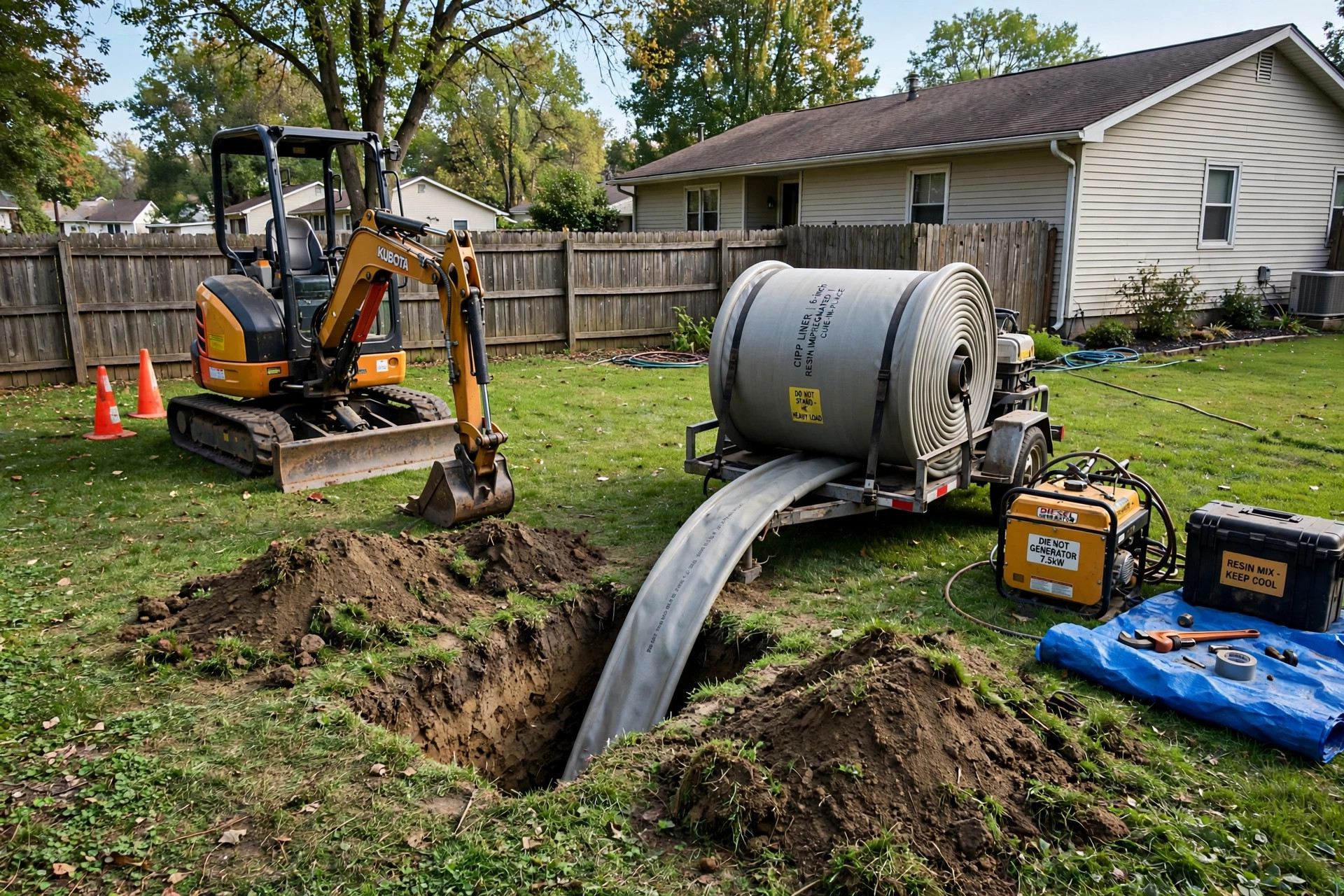

When a sewer line breaks, most homeowners picture the same scene. A backhoe tears up the yard. The driveway cracks. The lawn dies. The trenchless sewer line repair pros cons usa debate starts with this fear, and with a real question. Is there a way to fix the pipe without digging up the whole property? For many houses, the answer is yes. Trenchless methods have repaired buried pipes in the United States for more than four decades, and they have become a common option offered by plumbing contractors across the country.
A sewer lateral is the pipe that carries waste water from your house to the city main or to a septic tank. When it cracks, shifts, or fills with roots, the damage stays hidden underground. The old repair method was simple and brutal. Dig a long trench from the house to the street. Pull out the old pipe. Lay new pipe. Cover everything up. Trenchless repair does most of the work through small holes at one or two ends of the run. The pipe gets fixed or replaced from the inside, while the yard above it stays mostly intact.
This article weighs the real advantages and the real drawbacks. It covers the two main methods, what they cost, when they work, and when they do not. Every house is different, so the goal is to give you a plain base of facts before you call a contractor.
Why It Matters
A failing sewer line is not a small problem. Waste water has to leave the house every day. When the line clogs or breaks, sinks drain slow, toilets gurgle, and sewage can back up into the lowest floor. Left alone, a broken line can pollute soil and ground water around the home. In some towns, the homeowner must fix the lateral at their own cost even when the broken section lies under the street.
The method of repair matters because it sets the final bill. A traditional dig can be cheap in labor for the pipe itself but ruin a new driveway or a mature tree in the process. Restoring the yard often costs as much as the plumbing work. Trenchless repair flips that picture. The pipe work may cost more per foot, but the yard stays whole. This is one reason the sewer line replacement cost per foot usa question so often leads to a trenchless quote.
The Pros of Trenchless Repair: Trenchless Sewer Line Repair Pros Cons Usa
Your Yard Stays Mostly Intact
The clearest benefit is the smallest hole. Trenchless work usually needs one or two access pits, each a few feet across. The digging happens at the start or end of the pipe run, often where damage is cheap to fix. The lawn, flower beds, walkways, and fences above the pipe stay in place.
The Job Finishes Faster
A traditional dig can take three to seven days, and yard repair takes longer still. Most trenchless jobs finish in one to two days. Pipe lining can cure in hours. Short time lines matter when the drains serve the only bathroom in the house.
Long Service Life
The materials used in trenchless repair are tough. A cured-in-place liner is a resin-soaked tube that hardens inside the old pipe. It resists roots, chemicals, and ground movement. Pipe bursting installs a new high-density plastic pipe that can last fifty years or more. Many contractors give warranties of ten to fifty years on the new work. When the job is done right, the repaired line can outlast the homeowner.
Fewer Permits and Less Street Work
Where the sewer lateral runs under the sidewalk or street, an open trench can block traffic and need road work permits. Trenchless methods often avoid cutting the road at all. This cuts paperwork, city fees, and paving costs.
Stronger Joints Against Roots
Old clay and cast iron lines fail most often at their joints. Roots find the tiny gaps and grow into the pipe. Lined and burst pipes have few or no joints along their length. That seamless run defends against root trouble, the most common cause of sewer failure in older suburbs.
The Cons of Trenchless Repair
Higher Cost Per Foot
Trenchless repair often costs more for each foot of pipe than a simple open dig. Typical prices in the United States run from about eighty to two hundred fifty dollars per foot, depending on method, depth, and region. A plain trench replacement can be cheaper per foot in easy soil with nothing above the line. When the pipe run is long and the ground is open, the trench method can win on price alone. The math only turns in favor of trenchless when you add the cost of fixing the yard back up.
It Cannot Fix Every Pipe
This is the hardest limit. Trenchless methods need an existing pipe that still holds its basic shape. If the old line has collapsed flat, or if it has large missing sections, there may be nothing for a liner to press against and nothing for a bursting head to follow. Severe bellies, where the pipe sags and holds standing water, can also rule trenchless out. A sewer camera inspection cost near me search will show that most plumbers charge a few hundred dollars for this step, and it is the step that decides whether trenchless is even possible.
Pipe Diameter Shrinks Slightly
Pipe lining adds a new tube inside the old one. The inside opening gets a little smaller, often by a quarter inch or less on each side. For most homes this change does not matter. In a small line that was already undersized, it can lower flow a bit. Pipe bursting avoids this problem because it pulls a full-size new pipe into place.
Access Is Still Needed
Trenchless is not dig-free. Workers still dig pits to reach the pipe ends. If the line has sharp bends, a new pit may be needed at each bend. Short pipe sections between a house and a main that runs under a road can still need street cuts. The yard is saved, but expect some digging and some mess around the access points.
New Technology Demands Skilled Crews
The equipment is specialized and the work is less forgiving than a simple dig. A liner that is mixed or cured wrong can wrinkle or fail to bond. Pipe bursting in the wrong soil can damage nearby utilities. The method is only as good as the crew.
The Two Main Methods
Pipe Lining (Cured-in-Place)
In this method, a flexible tube soaked in resin is pulled or blown into the old pipe. It is then pressed against the old pipe walls and cured with hot water, steam, or light until it hardens. The result is a smooth new pipe inside the old one. Lining works best on pipes with cracks, root holes, and minor shifts. It needs little equipment at the surface and can bend around gentle curves.
Pipe Bursting
Pipe bursting pulls a cone-shaped head through the old pipe. The head breaks the old pipe outward and drags a new plastic pipe in behind it. The new pipe is full size and brand new from end to end. Bursting handles worse damage than lining and even allows a slight increase in pipe size. It needs stronger pulling equipment and a straight enough path. A full pipe bursting vs pipe lining cost comparison helps here, because bursting often costs more per foot but can solve problems lining cannot.
What to Look For When Choosing a Contractor
Start with the camera inspection. A good contractor will show you the video and point out exactly what is wrong: roots, cracks, offsets, or a collapse. Get the video file if you can. It is your proof and your second opinion tool.
Ask for both options in writing. A fair bid shows the trenchless price and the traditional dig price, each with the restoration work spelled out. Make sure the trenchless bid names the method, lining or bursting, and the pipe material.
Check the warranty in plain terms. Does it cover parts and labor? Does it cover root regrowth? How long does it last, and is it transferable if you sell the house? Strong warranties on trenchless work often run twenty five to fifty years.
Verify licenses and insurance, and confirm who will do the work, not just who sells it. Finally, call the city. Some towns require a permit and a final inspection no matter the method. A contractor who knows the local rules saves you a failed inspection later. The Environmental Protection Agency offers plain guidance on home sewage and waste water rules that help explain why these local codes exist.
Cost and Price
No national price list fits every job. Still, a pattern holds across the country. For a typical home line of forty to eighty feet, trenchless repair often lands between four thousand and fifteen thousand dollars. Lining sits at the lower end. Bursting sits higher. Deep lines, rocky soil, and long runs push costs up. Prices in large coastal cities often run above the national middle.
Compare the full project, not just the pipe. A cheap dig quote can double once you add a new driveway section, a new sidewalk, and fresh sod. Trenchless quotes should state the surface repair included: backfill of the pits, patch of the lawn, and cleanup. Ask about extras like permits and street cuts, and get each in writing. Cost guides from Home Depot and Lowe’s help you sanity check a bid, and pipe and fixture makers Kohler, Moen, and Delta Faucet publish specs showing what modern drain and supply parts are rated to handle.
Care and Upkeep After the Repair
A new liner or new burst pipe needs little care, but a few habits protect it for decades. Keep large trees away from the line. Do not pour grease down the drains. Fix running toilets and dripping faucets, because constant water flow hides the early signs of a slow drain.
Have the line camera-checked every five to ten years if your yard has large trees nearby. Keep the access point covers visible and marked so a future plumber can find them fast. Water treatment guides from Aquasana explain what home filtration systems do and do not cover.
Safety
Trenchless work has its own safety notes. The resins used in lining release fumes during the cure. A good crew vents the work area and keeps the house drains sealed during the process. Stay out of the work pit area and keep children and pets well back from the equipment. Underground utility lines are a real risk in any digging. The crew must call the national dig line before breaking ground, in every state, with no exceptions. If a crew plans to dig without utility marks, stop the job.
Sewage itself is a health hazard. Never open a sewer cleanout and lean in. Never try to clear a main line with household chemicals before a camera check; if the pipe is broken, the chemicals can leak into the soil. Let the licensed crew handle the line once the trouble is confirmed.
Frequently Asked Questions
How long does a trenchless repair take from start to finish?
Most residential jobs take one to two working days. Lining can be finished in a single day, with the liner curing in a few hours. Add a day for the camera inspection and any permit waiting time before work begins. Practical walkthroughs from This Old House and Family Handyman show the day-by-day rhythm of these jobs in real homes.
Will trenchless repair work on cast iron, clay, or Orangeburg pipe?
It depends on the damage, not just the material. Clay and cast iron with cracks and root entry are good candidates for lining. Pipe bursting can replace clay, cast iron, and even Orangeburg, the fiber pipe used in mid-century homes, as long as the run still has a clear path. Fully collapsed sections rule out both methods. The camera video tells the truth.
Does the new pipe meet code?
In most towns, yes. Cured-in-place liners and new burst pipes are accepted under modern plumbing codes when installed by a licensed contractor with a permit. The final inspection usually includes a camera pass to confirm the line is open and sealed. Always confirm with your local building department before work starts, since a few towns have special rules on liner thickness or pipe size.
Can I use my drains during the repair?
During lining, drains must stay unused while the resin cures, often for several hours. During bursting, the old line is out of service until the new pipe is connected. Plan for a day with limited drain use and ask the contractor for the exact window so you can plan around it.
What signs mean my sewer line needs attention?
Slow drains in several fixtures at once, gurgling toilets, sewage smells in the yard, wet spots over the line, and backups in the lowest drain are the classic signs. Learn the clogged main sewer line signs for homeowners by heart, because catching trouble early keeps a small fix from becoming a full replacement.
Is trenchless repair really worth the higher price?
Often, yes, when the pipe runs under things you value. Add the restoration cost to any open-dig quote before you compare. If the line runs through open lawn with nothing above it, the traditional dig may be the cheaper honest choice. The right answer comes from two written bids on the same house, not from a rule of thumb.
A Short Final Word
Trenchless sewer line repair is not magic. It is a set of proven tools that fix many buried pipes with far less digging. The pros are real: a saved yard, a fast job, and a long-lasting result. The cons are real too: higher cost per foot and limits on badly collapsed pipes. The deciding step is always the camera inspection and two honest written bids. With those in hand, most homeowners can see clearly which method fits their house, their yard, and their budget.
References
Aquasana. (n.d.). Water filtration systems. https://www.aquasana.com Delta Faucet. (n.d.). Kitchen and bathroom faucets. https://www.deltafaucet.com Family Handyman. (n.d.). DIY home repair and maintenance. https://www.familyhandyman.com Kohler. (n.d.). Bathroom and kitchen fixtures. https://www.kohler.com Lowe’s. (n.d.). Home improvement products. https://www.lowes.com Moen. (n.d.). Faucets and plumbing fixtures. https://www.moen.com The Home Depot. (n.d.). Home improvement products. https://www.homedepot.com This Old House. (n.d.). Home renovation guidance. https://www.thisoldhouse.com U.S. Environmental Protection Agency. (n.d.). Protecting human health and the environment. https://www.epa.gov
Was this guide helpful?

About Sarah Mitchell
The My Garden US editorial team writes practical, in-depth home and garden guides for American homeowners — tested advice, no fluff.
You May Also Like

Berkey vs Alexapure Water Filter Comparison
May 1, 2026 0 views
Whole House Sediment Filter Installation Cost: What You Pay and Why
February 13, 2026 0 views
Best Plunger for Toilets Reviews 2026 USA: What Clears a Clog Best
February 5, 2026 0 views