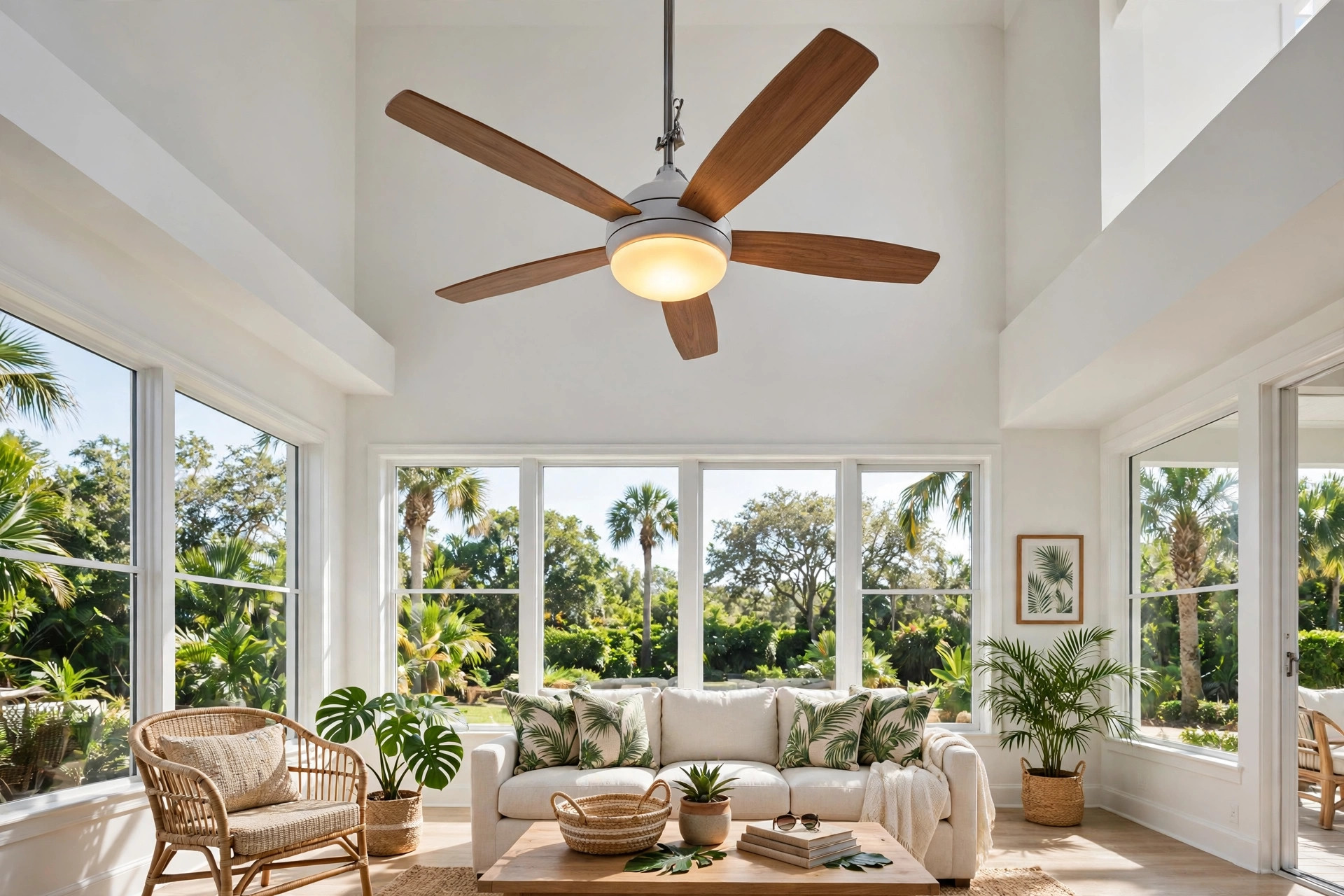

Florida homes have special needs. Heat lasts most of the year. Humid air sits heavy in summer. Air conditioning runs for long hours and electric bills grow fast. A ceiling fan with a light kit is one of the most practical tools for this climate. It moves air so a room feels cooler, and it lights the room at the same time. One fixture does two jobs. Fewer fixtures mean a cleaner ceiling and lower cost.
This guide covers ceiling fans lights florida homes usa in plain terms. It explains why these combos suit Florida, how to choose the right size, which motor types hold up in humidity, what light kits work best, and how much money they save. It also covers upkeep and safety, plus answers to common questions. By the end, any Florida homeowner should know how to pick, place, and care for a ceiling fan with lights.
Why Ceiling Fans With Lights Matter in Florida
Florida is hot. From April through October, daytime highs often reach the upper 80s and 90s. Night brings little relief. Homes rely on air conditioning, and the U.S. Department of Energy notes that cooling is one of the largest energy costs in warm-climate homes. A ceiling fan does not lower the air temperature. It moves air across the skin, which speeds up the cooling effect. A room with a fan running can feel four degrees cooler than the same room without one. That means the thermostat can be set four degrees higher with no loss of comfort.
Each degree the thermostat rises cuts cooling costs by a few percent. Over a long Florida cooling season, the savings add up to real money. A fan itself uses little power, often less than a 100-watt bulb, while an air conditioner uses thousands of watts. Running the fan and easing the air conditioner is a simple swap that pays for itself.
A light kit adds value. Florida homes often have high ceilings, especially in great rooms and open living areas. A ceiling fan placed at the center of such a room is in the ideal spot for a main light. Adding a kit avoids cutting another hole in the ceiling for a separate fixture. One mount point, one wire run, one control. Many kits now use built-in LED modules that draw very little power and last for years.
Florida also has the humidity problem. Indoors, moisture can reach 60 percent or more in summer. Standard fan motors and metal parts can corrode in damp air. Fans made for humid or outdoor-rated use have sealed motors and corrosion-resistant finishes. For enclosed porches and lanais, which are common in Florida, a damp-rated fan is the right choice. For truly open outdoor areas, a wet-rated model is needed. The difference matters for safety and for long life.
What to Look for When Choosing: Ceiling Fans Lights Florida Homes Usa
Size and Blade Span
Fan size must match room size. This is the most common mistake. A fan too small for a room leaves still air in the corners. A fan too large crowds a small room and moves too much air.
– Rooms up to 75 square feet: a 29 to 36 inch span works well. – Rooms from 76 to 144 square feet: choose 36 to 44 inches. – Rooms from 145 to 225 square feet: choose 44 to 52 inches. – Rooms above 225 square feet: choose 52 inches or more.
Most Florida living rooms, family rooms, and master bedrooms fall in the larger groups. When in doubt, measure the room and pick from the middle of the range.
Motor Type
Two motor types dominate. AC motors are the old standard. They are simple, cheap, and reliable. DC motors are newer. They run quieter, use less power, and offer more speed settings. DC fans cost more up front but use up to 70 percent less energy than AC fans at the same speed. In a home where fans run twelve hours a day, the savings pay back the higher price in a year or two. DC fans also reverse with a remote instead of a switch on the motor housing, which is handy on high ceilings.
Downrod Length and Ceiling Height
Fan blades should hang 7 to 9 feet above the floor for best airflow and safety. In a room with a standard 8-foot ceiling, a flush mount or short downrod works. In rooms with 10 to 12-foot ceilings, common in Florida great rooms, a longer downrod is needed. Longer downrods also put the light closer to eye level, which improves the quality of the light in the room.
Light Kit Basics
Light kits come in several forms. Some are bowl kits with frosted glass that spread soft light. Some are exposed-bulb kits in a modern style. Integrated LED kits have the light source built in and cannot take a replacement bulb, but they last a very long time. Kits that take standard bulbs offer more choice and can be fitted with Philips LED bulbs in warm or cool tones.
Color temperature matters. Warm white (2700K) suits bedrooms and living rooms. Cool white (4000K) suits kitchens and work areas. Dimmable kits let one fixture serve both evening rest and bright tasks. Check that the wall control or remote supports dimming before buying.
Damp and Wet Ratings
For enclosed Florida porches and covered lanais, choose a damp-rated fan. Damp-rated models have motors and finishes sealed against moisture in the air. For open decks or areas that rain can reach, choose wet-rated. Installing a dry-rated fan in a humid porch can void the warranty and shorten the fan’s life. Big-box retailers such as Home Depot and Lowe’s list these ratings clearly on each product page.
Types and Options
Traditional five-blade fans. The classic look. Wide blades move a lot of air. Many come with a matching light kit. They suit ranch and Mediterranean style homes, which are common across Florida.
Sleek low-profile fans. Made for 8-foot ceilings. The motor hugs the ceiling. Airflow is weaker than on a downrod model, so they suit smaller rooms.
Tropical and rattan styles. Blades of palm leaf or rattan match Florida’s coastal look. Many are damp-rated for porches. They add strong style to a lanai.
Modern minimal fans. Three blades, clean lines, often with a slim LED ring light. They pair well with updated interiors. DC motors are common in this group.
Smart fans. Wi-Fi connected fans link to apps and voice assistants. They can be set on schedules or tied to room temperature. Some dim and change light color by time of day. A smart fan in a Florida bedroom can turn itself off at night and back on before sunrise.
Dual-motor and statement fans. Large multi-blade or dual-motor designs suit very large open rooms. They cost more but move air evenly across big spaces.
If the main goal is outdoor light without a fan, options like landscape spot lights or patio string lights may serve the yard while the fan handles the porch. For a deeper look at selection in general, a broad ceiling fans lights buying guide covers the full range of models.
Cost and Price
Prices vary by size, motor, and finish. As a rough guide for the U.S. market:
– Basic AC fan with light kit, 42 to 52 inches: 80 to 200 dollars. – Mid-range fan with remote and better finish: 150 to 350 dollars. – DC motor fan with dimmable LED kit: 250 to 600 dollars. – Large or designer fans: 400 to 900 dollars or more.
Installation adds cost. A simple swap of an old fan takes an hour and may cost 100 to 200 dollars from an electrician. A new install where no box exists costs more, since wiring must be run. Homeowners with basic skills can install a fan themselves, but any new wiring should be left to a licensed electrician.
The savings side is strong. An ENERGY STAR rated fan uses far less power than a standard model. Combined with a thermostat set four degrees higher, many Florida homes save 10 to 20 percent on summer cooling bills. Over one long cooling season, a good fan can pay for itself. Specialty lighting shops such as Lumens and Lamps Plus carry efficient models with full spec sheets for comparison.
Care and Upkeep
Florida homes put extra stress on fans. Humid air and salt air near the coast can wear finishes. A little care keeps a fan running for ten years or more.
Dust the blades every month or two. Dust buildup makes blades heavier and less balanced, which adds wobble and noise. A damp cloth or a pillowcase slipped over each blade works well. Never spray water directly on the motor.
Check the screws once a year. Vibration can loosen blade screws and mounting hardware. Tighten what is loose. Check that the light kit glass is seated well.
Clean the light kit glass with a mild cleaner. Avoid harsh chemicals that can damage frosted finishes. Replace LED modules only with the maker’s part if the kit is integrated.
Run the fan in reverse in winter. Florida winters are mild, but a fan on low in reverse pushes warm air down from high ceilings. This evens out heat on cool nights.
For coastal homes, rinse outdoor-rated fans with fresh water now and then to remove salt film. Wipe dry after. This simple step adds years to the finish.
Safety
Fan safety starts with the mount. A fan must hang from a box rated for fan support, not a plain light box. Fan-rated boxes are marked and built to hold the weight and motion. If the old fixture box is not fan-rated, it must be changed before the fan goes up.
Keep blades at least 7 feet above the floor. In rooms where people walk under the fan, this is a firm rule, not a suggestion. Use the right downrod length for the ceiling height.
Turn off power at the breaker before wiring. Test with a voltage tester. Match wire colors and secure wire nuts tight. A loose wire nut is a fire risk.
Damp and wet ratings are safety ratings, not just marketing. A dry-rated fan in a humid porch can corrode inside, and corroded wiring is dangerous. Match the rating to the location. General how-to sources such as The Spruce offer clear guides on matching ratings to rooms.
Children’s rooms need care. Keep pull chains short or use a remote so children do not grab them. Bunk beds under a fan are a bad mix. Fans and roughhousing do not mix either.
FAQ
Do ceiling fans really lower cooling bills in Florida? Yes. A fan makes a room feel about four degrees cooler through moving air. That lets the thermostat be set higher, which cuts air conditioning run time. In a Florida home with a long cooling season, savings are easy to see on the bill.
Should the fan run when no one is in the room? No. Fans cool people, not rooms. An empty room gains nothing from a running fan. Turn it off when leaving. A smart fan with motion or schedule control handles this on its own.
LED kit or bulb kit — which is better? Integrated LED kits last very long and use little power. Bulb kits take standard LED bulbs, so they can be changed for brightness or color. For most Florida homes, either works. Pick integrated for set-and-forget use, bulb kits for flexibility.
What size fan fits a 12 by 16 foot Florida bedroom? That room is 192 square feet. A 52-inch fan fits the range for that size. Use a downrod long enough to put blades 8 feet above the floor on a 9 or 10-foot ceiling.
Can a ceiling fan with lights go on a Florida lanai? Yes, if it is rated for the spot. Enclosed lanais with a roof need a damp-rated fan. Open areas exposed to rain need a wet-rated fan. A dry-rated indoor fan should not go outside.
How long does a good ceiling fan last? A well-made fan with a sealed motor lasts ten to fifteen years or more. Cheap fans with thin motors may fail in three to five years, especially in humid Florida air. Spending a bit more on a solid motor is worth it.
A Short Final Word
Ceiling fans with light kits fit Florida homes well. They cool people without cooling empty air. They light rooms from the best spot in the ceiling. They handle long cooling seasons and pay back their cost. The key steps are simple: size the fan to the room, pick the right motor, match the rating to the location, and keep the blades clean. Do those four things and a fan will serve a Florida home for many quiet, cool years.
References
ENERGY STAR. (n.d.). Energy efficient products. https://www.energystar.gov Lamps Plus. (n.d.). Lighting and home decor. https://www.lampsplus.com Lowe’s. (n.d.). Home improvement products. https://www.lowes.com Lumens. (n.d.). Lighting and ceiling fans. https://www.lumens.com Philips. (n.d.). Lighting products. https://www.philips.com The Home Depot. (n.d.). Home improvement products. https://www.homedepot.com The Spruce. (n.d.). Home and garden advice. https://www.thespruce.com U.S. Department of Energy. (n.d.). Energy efficiency and renewable energy. https://www.energy.gov
Was this guide helpful?

About Sarah Mitchell
The My Garden US editorial team writes practical, in-depth home and garden guides for American homeowners — tested advice, no fluff.
You May Also Like

Dining Room Chandeliers California Homes USA: A Guide to Choosing Well
July 17, 2026 0 views
Kitchen Island Pendants for Florida Homes: A Plain Buyer’s Guide
July 3, 2026 0 views
Reading Floor Lamps: A Guide for American Homes
October 2, 2026 0 views