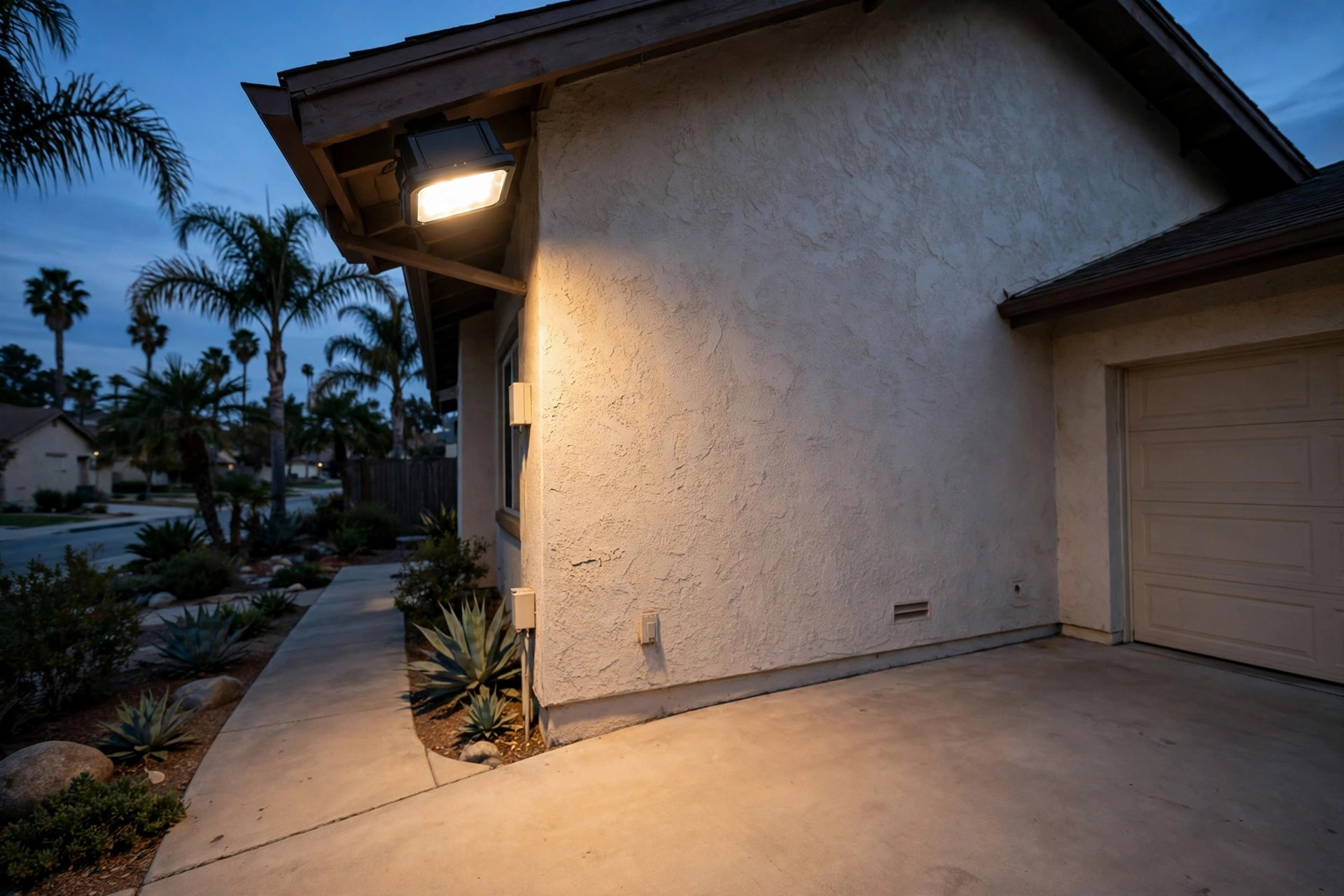
Homeowners in the Golden State want light that works only when it is needed. A motion flood light stays dark through the night and wakes up the instant it senses a person or a car. This guide to motion flood lights california homes usa explains how these lights work, what to buy, where to mount them, and how to keep them running for years.
Why Motion Lights Matter for California Homes
California homes come in many styles. There are ranch houses in the valleys, condos near the coast, and cabins in the hills. Each one has dark corners after sunset. A motion flood light turns those corners into safe, bright space the moment someone steps near.
Deterring Break-Ins
Most break-ins happen under cover of dark. Thieves look for homes where they can move unseen. A sudden burst of light removes that cover. Many burglars simply move on to an easier target when a flood light snaps on. The Spruce notes that good outdoor lighting is one of the simplest and least costly ways to make a home less inviting to intruders.
Police departments across California give the same advice year after year. Light your doors, your garage, and your side yards. A motion sensor flood light does this job without wasting power all night long.
Safer Walkways and Yards
Security is not the only gain. Think of a guest walking to your door on a dark evening. Think of a child playing in the yard after dinner. A motion activated flood light greets them with light when they arrive. It helps older residents too. A bright path means fewer trips and falls on steps and driveways.
How Motion Flood Lights Work: Motion Flood Lights California Homes Usa
The design is simple. A small sensor watches a zone in front of the light. When the sensor sees movement, it switches the lamp on. After a set time with no more motion, the lamp switches off again.
The Sensor
Most units use a passive infrared sensor. This sensor reads heat. A warm body, such as a person, a dog, or a car engine, moves across its field of view. The change in heat tells the sensor to wake the light. The field of view is often 180 degrees wide and reaches 40 to 70 feet.
Rain, small animals, and swaying plants can set off a cheap sensor. Better units let you change the sensitivity. Some also have a dual sensor that reads both heat and motion. These give fewer false alarms.
The Light
The lamp head holds one, two, or three bulbs. Most modern motion sensor flood lights for home use now carry LED lamps. LEDs turn on at full brightness the instant the sensor fires. Old halogen lamps needed a few seconds to warm up. LEDs also run cool and use far less power, which matters in California, where electricity rates are high.
Types and Options
Shoppers in the United States can choose from several types of outdoor motion detector flood light models. Each type suits a different home and a different budget.
Wired and Solar Models
Wired models connect to the house wiring. They run on 120 volts and give the most light. An electrician can mount one in about an hour. Solar models carry their own panel and battery. They need no wiring at all. They suit sheds, fences, and gates far from the house. Their light is weaker, and they fade on cloudy weeks.
There are also plug-in models. These plug into an outdoor outlet and sit between solar and wired units in brightness. For a side yard or a covered patio, a plug-in unit can be enough.
LED and Halogen
LED is the clear choice for almost every buyer today. An LED motion flood light can throw 2,000 to 4,000 lumens while drawing only 20 to 40 watts. A halogen lamp of the same brightness draws 150 to 300 watts. That gap shows up on the power bill. ENERGY STAR lists LED fixtures as the top pick for outdoor use because they last years longer than older lamps.
Halogen lamps still sell, and they cost less up front. But they burn out sooner, run hot, and cost more to run. For the best motion flood lights for house exterior use, LED is the sound buy.
Smart and Standard Models
Smart models join the home network. They send a phone alert when motion is found. They let the owner change the timer and the brightness from an app. Some pair with a doorbell camera or a voice helper. Standard models use small dials on the unit itself. They are cheaper and simpler. Many California homeowners start with a standard model and move to smart later.
What to Look for When You Buy
A little study before shopping saves money and regret. These are the points that matter most.
Range and Angle
Range tells you how far the sensor can see. Angle tells you how wide it sees. A big front yard needs a long range, perhaps 70 feet. A small back porch needs far less. Too much range on a small lot is a problem. The light will fire when cars pass on the street. It will wake neighbors and annoy you. Match the range to the lot.
Brightness
Brightness is rated in lumens. A small porch needs about 1,500 lumens. A driveway or a garage needs 2,500 to 4,000 lumens. More is not always better. A light that is too bright can blind the homeowner and wash out camera footage. Philips and other lamp makers note that well-aimed moderate light works better than one blinding blast.
Sensitivity and Timers
Look for dials or app controls for sensitivity and for the on-time. Sensitivity lets you tune out small animals. The timer sets how long the lamp stays lit after motion stops. One minute is a common choice for doors. Five minutes suits a garage or a back yard where people linger.
Some units have a dusk-to-dawn mode. In this mode the sensor only works after dark. This keeps the lamp off during the day when it is not needed.
Weather Ratings
Outdoor lamps need a weather rating. Look for an IP rating such as IP44 or IP65. The first digit guards against dust. The second guards against water. An IP65 unit can take direct rain. California weather is mild, but coastal fog and valley dust still wear down cheap housings. Metal housings last longer than plastic in the sun.
Cost and Price
Prices in the United States cover a wide span. A basic solar motion flood light costs about 20 to 40 dollars. A good LED wired unit costs 40 to 120 dollars. High-end smart units with cameras cost 120 to 250 dollars.
Wiring costs extra. If there is no junction box at the mounting spot, an electrician may charge 150 to 400 dollars to run one. Many homes already have a porch light or a garage light that can be swapped for a motion unit in minutes. The Home Depot and Lowe’s both sell easy-swap kits for this purpose.
Running costs are low for LEDs. A 30-watt LED that fires for a few minutes each night costs only a few dollars per year to run. A 250-watt halogen that runs the same hours can cost ten times as much. Over five years, the LED pays for itself many times over.
Installing Motion Flood Lights in California Homes
Good placement matters as much as good hardware. A well-placed cheap light beats a badly placed costly one.
Where to Mount Them
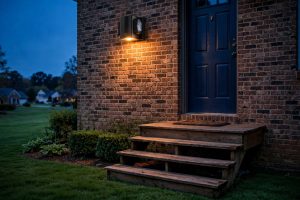
Mount the unit eight to ten feet above the ground. This height puts it out of easy reach but keeps the sensor in its working range. Aim the sensor heads at the approach path, not at the street. Common spots include:
– Above the garage door, aimed down the driveway – Beside the front door, aimed at the walkway – At the side gate, aimed down the side yard – Above the back patio door, aimed at the yard
Keep the sensor away from heat sources. Dryer vents, pool heaters, and barbecue grills can trigger false alarms. Aim the lamp so it lights the yard, not the windows of the house next door.
California Rules and Neighbors
California has rules about light trespass. Many cities ask residents to shield outdoor lights so they do not spill onto nearby homes. Full cut-off fixtures aim all light downward. Some cities in the desert and the mountains have dark-sky rules to protect the night sky. Check the city code before you mount a large unit.
The U.S. Department of Energy advises using only as much light as the task needs. Aim lights down. Use motion sensors so lights run only when needed. These steps save power and keep neighbors happy.
Care and Upkeep
A motion flood light needs little care, but a small yearly routine keeps it working well.
Clean the sensor lens and the lamp lens twice a year. Dust and spider webs cut the range and dim the light. A soft cloth and plain water are enough. Check the mounting screws once a year. Sun and wind loosen cheap mounts over time.
For solar units, wipe the solar panel each month during the dry season. Dust on the panel cuts charging. If the battery fades after two or three years, replace it rather than the whole unit. Most solar units take standard rechargeable cells.
For wired units, watch for water inside the housing. A cracked gasket lets rain reach the wiring. Replace worn gaskets before the rainy season. If the lamp starts to flicker, the driver or the bulb is failing. LEDs rarely burn out, but their drivers do age.
Safety
Outdoor electricity needs respect. Turn off the breaker before you touch any wiring. Use a voltage tester to be sure the power is off. If the old box is worn or the wires look damaged, call an electrician. Do not mount a wired unit on a wet day.
Choose units listed by a testing lab such as UL or ETL. The listing mark means the unit passed safety tests. Bargain units without a mark can be a fire risk. Lumens.com and Lamps Plus both filter their catalogs to listed fixtures, which makes safe shopping easier.
Aim lights so they do not blind drivers on the street. A light that shines into a driver’s eyes is a hazard. Test the aim at night and adjust as needed.
Frequently Asked Questions
How long do motion flood lights stay on?
Most units let you set the time from about one minute to ten minutes. After the set time passes with no new motion, the lamp shuts off. One to three minutes suits most doors and paths. A garage or work area may call for five minutes.
Do motion lights work in the daytime?
Most units have a photocell that keeps them off during the day. You can usually set the unit to work only after dusk. Some models allow daytime use too, which helps in a dark garage or under a covered patio.
Will small animals set them off?
Cats, raccoons, and opossums can trigger a sensitive unit. Turn the sensitivity dial down until small animals no longer set it off. Aim the sensor head slightly upward so the ground zone near fences is out of view. Dual-sensor units give the fewest false alarms.
Are solar motion flood lights bright enough?
Solar units suit small zones such as a shed door or a garden gate. They give about 500 to 1,200 lumens. For a driveway or a large yard, a wired LED unit is the better pick. It can give three to four times the light.
How many motion lights does a home need?
Most California homes do well with two to four units. One covers the front, one covers the garage or driveway, and one or two cover the back and side yards. Start with the front door and the darkest corner, then add more where gaps remain.
Do they raise the power bill much?
LED motion lights add very little to the bill. They run only a few minutes per night. Most homes will not notice the change. Old halogen units cost much more to run and are best replaced with LED.
A Short Final Word
Motion flood lights give California homeowners a simple win. They add safety, comfort, and curb appeal with a small cost and almost no daily effort. Buy a listed LED unit, mount it at the right height, aim it with care, and tune the sensitivity. The light will do the rest, night after night.
If you are still shopping for parts of the project, these related guides can help: landscape spot lights deals near me, sensor porch lights deals near me, and kitchen track lighting for sale usa.
References
ENERGY STAR. (n.d.). Energy efficient products. https://www.energystar.gov Lamps Plus. (n.d.). Lighting and home decor. https://www.lampsplus.com Lowe’s. (n.d.). Home improvement products. https://www.lowes.com Lumens. (n.d.). Lighting and ceiling fans. https://www.lumens.com Philips. (n.d.). Lighting products. https://www.philips.com The Home Depot. (n.d.). Home improvement products. https://www.homedepot.com The Spruce. (n.d.). Home and garden advice. https://www.thespruce.com U.S. Department of Energy. (n.d.). Energy efficiency and renewable energy. https://www.energy.gov
Was this guide helpful?

About Michael Thompson
The My Garden US editorial team writes practical, in-depth home and garden guides for American homeowners — tested advice, no fluff.