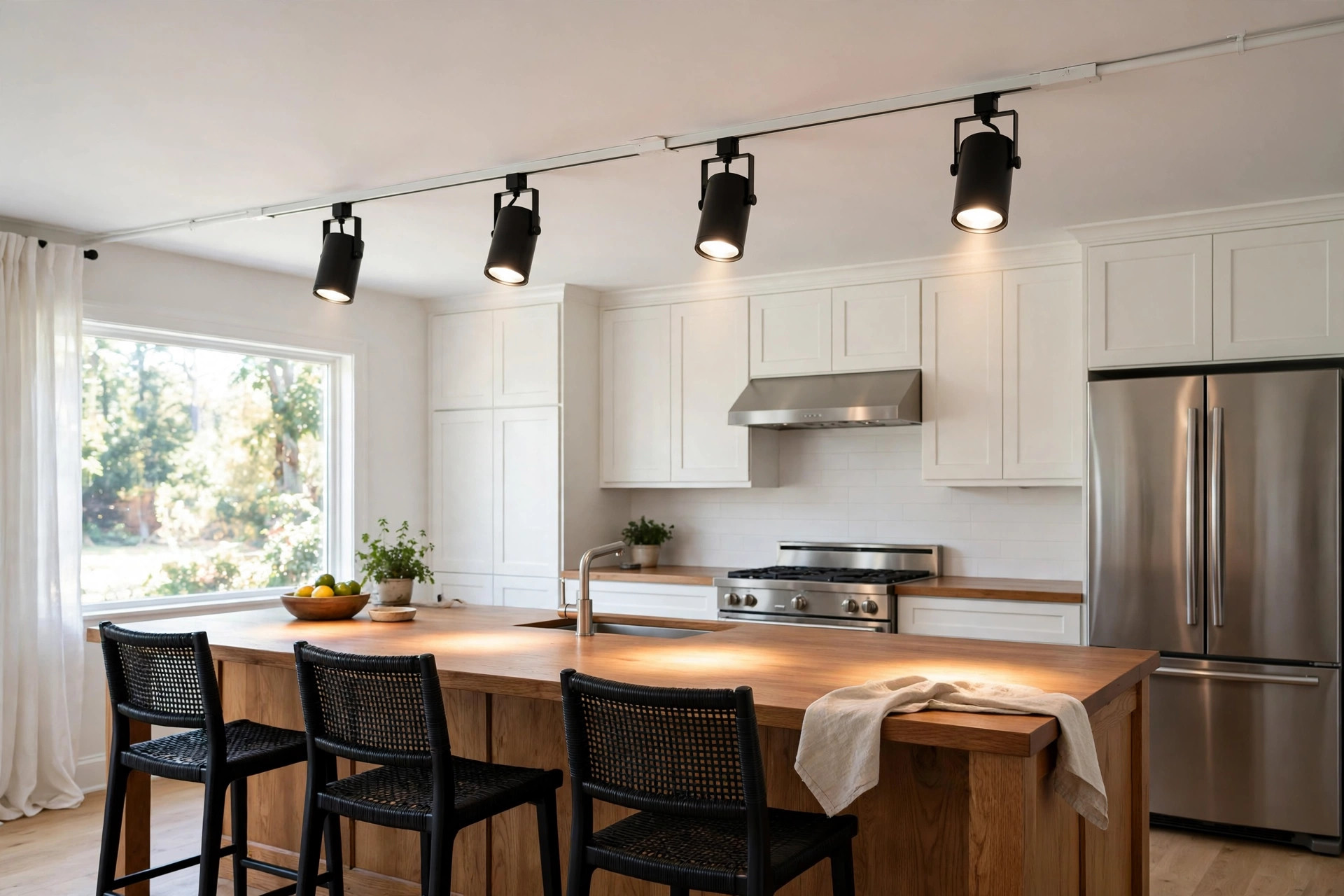

When you shop for kitchen track lighting for sale USA, you will find more choice than you may expect. Rails come in many lengths. Heads come in many shapes. Prices range from modest to steep. This guide explains the basics in plain words. It will help you read listings with care. It will help you pick a set that suits your kitchen and your budget. By the end, you will know what the parts are, what prices are fair, and how to keep the fixture working for years.
Why Track Lighting Suits a Kitchen
A kitchen needs light in many spots. The counter needs light for chopping and mixing. The sink needs light for washing. The stove needs light for cooking. One ceiling lamp in the middle of the room cannot cover all these places. Shadows fall where you work.
Track lighting solves this problem in a simple way. A metal rail fixes to the ceiling. Lamp heads clip onto the rail. Each head turns and tilts. You point each lamp at the spot that needs it. One head aims at the counter. Another aims at the stove. A third washes a wall or lights a corner. The result is even light with few dark spots.
Kitchens change over time. You may move the table. You may add a cart or an island. With track lighting, you can add a head or aim an old one in a new direction. You do not need to wire a new fixture. This flexibility is the main reason many owners choose track lights for their kitchens.
Track lights also suit low ceilings. A rail sits close to the ceiling and takes little head room. In a small galley kitchen, this matters. A hanging fixture can feel heavy in a tight space. A track rail looks slim and neat.
What to Look for Before You Buy: Kitchen Track Lighting for Sale Usa
When you read a listing for kitchen track lighting for sale USA, check these points first.
Track Length and Shape
Rails come in fixed lengths, often two, four, six, or eight feet. Some rails join end to end for longer runs. Measure your kitchen first. A rail should cover the work area but should not crowd the ceiling. In a long galley kitchen, a straight eight-foot rail works well. In an L-shaped kitchen, look for corner pieces or two short rails.
Number and Type of Heads
A kit usually ships with three to five heads. Some sets let you buy extra heads later. Check that the track system and the heads share the same standard. The common standards are H, J, and L. An H-type head does not fit a J-type track. If you buy heads later, match the type.
Heads come in a few styles. Cylinder heads give a clean modern look. Step heads look more classic. Gimbal heads let the lamp turn inside a ring. Pick the style that matches your kitchen.
Bulb Type and Base
Most new track lights use LED lamps. LED lamps use little power and last for many years. Check the bulb base, such as GU10 or MR16. Make sure new bulbs are easy to find at stores. Fixed LED heads last a long time but cannot be swapped when they fail. Removable bulbs are easier to replace.
Color Temperature
Light color is measured in kelvin. Warm white, near 2700K, feels like old incandescent bulbs. It suits dining areas. Neutral white, near 3500K, works well over counters. Cool white, near 5000K, looks bright and crisp but can feel harsh in a home. Many owners pick 3000K to 3500K for kitchens. It is bright enough to work by and warm enough to feel pleasant.
Brightness
Brightness is measured in lumens. A kitchen needs more lumens per head than a hallway does. Each head on a kitchen track often gives 400 to 800 lumens. Add the total of all heads. Compare it with the size of your kitchen. A small kitchen of one hundred square feet may need about three thousand lumens in total. Guidance from the U.S. Department of Energy can help you judge how much light a task area needs.
Types and Options
Track lighting for the kitchen comes in several forms. Each form has its strengths.
Standard Line-Voltage Track
This is the classic form. The rail connects straight to the house wiring at full voltage. It is simple and strong. It supports many head types. Most of the sets you will see for sale in the United States are line-voltage systems. They are a safe choice for a first purchase.
Low-Voltage Track
Low-voltage systems use a transformer to lower the voltage. The heads run cooler and the beams can be very tight and sharp. They cost more. They also need a transformer, which takes space. They suit owners who want a high-end look and precise beams.
Monorail and Cable Systems
Monorail systems use a bendable rail that curves around corners and shapes. Cable systems use two thin wires that stretch across the room. Both look modern and light. They cost more than standard track. They work well in open kitchens where the rail is part of the decor.
Smart and Dimmable Sets
Some new kits work with dimmers or smart controls. You can lower the light for dinner and raise it for cooking. If you want dimming, check the listing with care. The heads, the bulbs, and the dimmer must all support dimming. A mismatch can cause flicker. Reading a full kitchen track lighting buying guide can help you avoid this common mistake.
Many owners mix track lights with other fixtures. A common plan pairs a track rail over the counters with pendants over an island. If you like that look, read a kitchen island pendants buying guide before you buy either piece.
Cost and Price
Prices for kitchen track lighting for sale USA vary with length, head count, brand, and finish.
A basic three-head kit from a big-box store often costs between forty and ninety dollars. A mid-range five-head kit with a better finish costs between one hundred and two hundred dollars. Designer systems and low-voltage sets can cost three hundred dollars or more for the rail and heads. Extra heads usually cost fifteen to forty dollars each.
Finish affects price. White and black are the most common and the least costly. Brushed nickel and bronze cost a little more. Polished or specialty finishes cost the most.
Where you buy matters too. Home Depot and Lowe’s carry many kits at fair prices. Specialty shops like Lamps Plus and Lumens carry wider choices, including designer brands. Online marketplaces may show lower prices, but check the seller rating and the return policy before you order.
Set a budget before you shop. Add the cost of the rail, the heads, the bulbs if they are not included, and any extra heads you may want. If you hire an electrician, add the cost of the work. A simple swap of an old fixture for a new track may cost little in labor. A brand-new run of wire to a new spot costs more.
Watch for sales. Lighting stores often cut prices near holidays. If your project can wait a few weeks, you may save real money.
Care and Upkeep
Track lighting needs little care, but a few habits will keep it bright for years.
Dust the heads and the rail once every few months. Grease from cooking can film over the lamps. Wipe the heads with a soft dry cloth. Turn the power off first. Do not spray cleaner straight onto the lamps. Spray it on the cloth instead.
Check that each head still points where you want it. Heads can drift a little over time. A quick twist puts them back. When a bulb burns out, replace it with the same type and wattage. Using a stronger bulb than the head allows can overheat the fixture.
If a head flickers, first try a new bulb. If the flicker stays, check that the head sits tight on the track. The metal contacts must grip the rail. Turn the power off at the breaker before you touch the contacts. If the problem stays after these steps, the head may be worn out. Replacement heads for the same track standard are easy to order.
LED heads last a long time, often fifteen thousand hours or more. Even so, they do dim slowly with age. If your kitchen feels dimmer than it once did, the lamps may simply be old. Fresh bulbs often restore the room.
Safety
Track lighting is safe when it is installed well and used as the maker intended.
Turn off power at the breaker before you install, move, or clean the fixture. Do not trust the wall switch alone. A switch can be wired in a way that leaves power in the box.
Keep the rated wattage in mind. Each head and each rail has a maximum wattage. Never fit a bulb stronger than the rating. Overloading can melt parts and start a fire.
Keep the track clear of curtains, paper, and other things that can burn. Leave space around each head so heat can escape. LED heads run cool, but halogen heads run very hot. If your old set uses halogen, treat it with extra care.
If your ceiling is damp, such as in a kitchen with poor ventilation, choose a fixture rated for damp spots. Steam from cooking can corrode cheap metal parts over time.
If you are not sure about the wiring, hire a licensed electrician. The cost is small next to the risk of a bad connection. A pro can also tell you if your ceiling box can carry the weight of a long rail.
FAQ
How many track heads does a kitchen need?
Count the work spots. A small kitchen often needs three heads. A medium kitchen often needs four or five. A large kitchen may need six or more. It is better to have one head too many than one too few. You can always aim an extra head at a wall or a corner.
Can I install track lighting myself?
Many owners install a track where a fixture already hangs. The steps are simple: turn off the breaker, remove the old fixture, mount the rail bracket, connect the wires, and clip on the heads. If no box exists where you want the rail, or if the wiring looks old, hire an electrician.
Do track lights work with dimmers?
Many do, but all parts must match. The dimmer, the bulbs, and the heads must each support dimming. LED systems are picky. Buy a dimmer made for LED loads. Test the set before the return window closes. Flicker at low settings means something in the chain does not match.
Are track lights costly to run?
No. A set of LED heads uses little power. Five heads at ten watts each draw fifty watts in total. That is less than one old incandescent ceiling lamp. Your power bill will hardly notice. Ratings from ENERGY STAR mark the most efficient models.
What is the difference between H, J, and L track types?
They are three standards for how heads grip the rail. The shapes and contact points differ. A head made for one type will not fit another. Check the type before you buy extra heads. The type is printed in the manual and often on the rail itself.
Should I choose track lighting or pendants over the island?
Both can work. Track lights aim light at tasks and suit a busy cook. Pendants hang lower and look decorative over an island or table. Many kitchens use both: a rail over the counters and pendants over the island. Compare prices with a look at kitchen island pendants for sale before you decide.
A Short Final Word
Kitchen track lighting is a plain, honest fixture. It does not try to be art. It puts light where you work, and it adapts when your kitchen changes. Take your time with the listings. Match the track type, count the heads, check the lumens, and stay inside your budget. Good advice from makers like Philips and from guides at The Spruce can fill any gaps. With a careful pick, your kitchen will stay bright and easy to work in for many years.
Related guides on this site include led recessed lights installation guide usa, dining room chandeliers buying guide usa, and kitchen island pendants buying guide usa.
References
ENERGY STAR. (n.d.). Energy efficient products. https://www.energystar.gov Lamps Plus. (n.d.). Lighting and home decor. https://www.lampsplus.com Lowe’s. (n.d.). Home improvement products. https://www.lowes.com Lumens. (n.d.). Lighting and ceiling fans. https://www.lumens.com Philips. (n.d.). Lighting products. https://www.philips.com The Home Depot. (n.d.). Home improvement products. https://www.homedepot.com The Spruce. (n.d.). Home and garden advice. https://www.thespruce.com U.S. Department of Energy. (n.d.). Energy efficiency and renewable energy. https://www.energy.gov
Was this guide helpful?

About Jennifer Lee
The My Garden US editorial team writes practical, in-depth home and garden guides for American homeowners — tested advice, no fluff.
You May Also Like
Garage Shop Lights: A Guide for American Homes
May 19, 2026 0 views
Reading Floor Lamps Where to Buy USA: A Complete Home Guide
September 4, 2026 0 views
Sensor Porch Lights Buying Guide USA: A Plain Homeowner’s Handbook
June 9, 2026 0 views