---
Table of Contents
Table of Contents
- Store Cleaning Supplies: Why Cleaning Supplies Need Special Storage
- Step 1: Pick One Locked Home for All Cleaners
- Step 2: Keep Products in Original Containers
- Step 3: Lock It, Latch It, Check It
- Step 4: Build Safe-Use Habits
- Step 5: Choose Safer Products Where You Can
- Step 6: Teach Kids as They Grow
- What to Do If a Child Gets Into Something
- A Quick Room-by-Room Checklist
- The Bottom Line
- References
Kids are curious, fast, and drawn to bright bottles. Cleaning supplies are colorful, interesting, and in many cases dangerous if swallowed, splashed, or breathed in. Every home with small children needs a storage plan that keeps cleaners out of reach, out of sight, and locked away from exploring hands. This article explains how to store cleaning supplies in simple terms.
This is not about fear. It is about a few solid habits and one good locked cabinet. Here is how to store cleaning supplies with kids around, what the poison experts recommend, and what to do if something goes wrong.
Store Cleaning Supplies: Why Cleaning Supplies Need Special Storage
When it comes to store cleaning supplies, getting the details right makes all the difference.
Many homeowners find that store cleaning supplies is easier than they expected once they know the basics.
Many household cleaners can poison a child who swallows even a small amount. Bleach, drain cleaner, toilet bowl cleaner, laundry pods, and disinfectants are the usual culprits. The Head Start poisoning prevention guide warns that swallowing even tiny amounts of cleaning products can poison young children, causing symptoms from vomiting to trouble breathing (Head Start, n.d.).
Kids under five are the most at risk. They explore by tasting, they can open more than you think, and they climb. A cabinet that seems high enough today may be reachable next month. Stanford Children's Hospital advises not relying on a single safety measure: store harmful products out of sight and reach, keep them in original containers, and layer several precautions at once (Stanford Children's Hospital, n.d.).
The rule from every poison expert is the same: high and locked is best.
Step 1: Pick One Locked Home for All Cleaners
Many homeowners find that store cleaning supplies is easier than they expected once they know the basics.
The key to store cleaning supplies is choosing the right approach for your space and budget.
Gather every cleaning product in the house: kitchen cleaners, bathroom cleaners, laundry supplies, dishwasher pods, mops-and-bucket chemicals, garage chemicals. Decide on one primary storage spot that can be locked.
The best options:
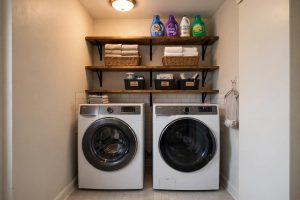
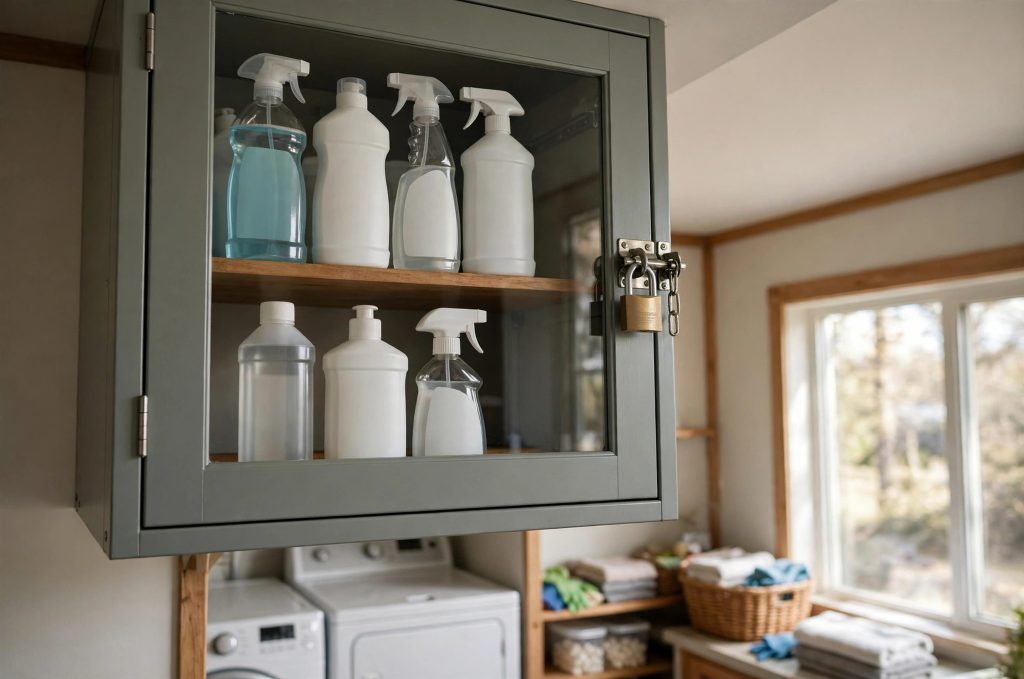
- A high cabinet with a child-resistant latch. Above the washer and dryer, or a high kitchen cabinet. Latches made for childproofing install with screws or strong adhesive.
- A locked closet or utility room. If you have a laundry room or utility closet, a simple hook-and-eye latch mounted high on the door works.
- A locking cabinet in the garage. For the heavy-duty stuff: pesticides, paint, automotive fluids.
UH Hospitals' childproofing guide recommends storing cleaners, detergent pods, toiletries, paints, and pesticides in a locked cabinet in their original labeled containers, with safety latches on drawers and cabinet doors (UH Hospitals, n.d.). One locked home beats five half-secured spots.
What does not count as safe storage: under the kitchen sink with no latch, on the laundry room floor, on a low shelf "they can't reach yet," or in a cabinet whose latch you never relatch. Kids watch and learn. If they see you open it, they will try.
Step 2: Keep Products in Original Containers
The key to store cleaning supplies is choosing the right approach for your space and budget.
With a little planning, store cleaning supplies can fit even a busy schedule.
This rule matters more than most parents realize. Every household product should stay in the container it came in, with the label intact. Consumer Reports' safety guidance stresses this: in a poisoning emergency, you need the exact product information on the label to tell the poison center what was swallowed (via poison prevention reporting, n.d.).
Never pour cleaners into food containers, drink bottles, or unmarked spray bottles. A clear liquid in a sports bottle looks like water to a child. AboutKidsHealth's poison prevention guide notes that products moved out of original containers lose their ingredient information, warning symbols, and first aid instructions, which are exactly what you need in an emergency (AboutKidsHealth, n.d.).
If you mix your own cleaners from simple ingredients, label the bottle clearly with the contents and the word "cleaner," and store it with the rest of the locked supplies.
Step 3: Lock It, Latch It, Check It
With a little planning, store cleaning supplies can fit even a busy schedule.
Before you start, it helps to understand how store cleaning supplies works in real homes.
Child-resistant caps and latches are helpers, not guarantees. AboutKidsHealth reminds parents that there is no such thing as a child-proof container: child-resistant packaging only slows a child down, buying you time to intervene (AboutKidsHealth, n.d.).
Layer your defenses:
- Cabinet latches on every cabinet holding cleaners. Magnetic locks are the most discreet and the hardest for toddlers to figure out.
- A high shelf inside the locked cabinet for the most dangerous items: drain cleaner, oven cleaner, concentrated products.
- A monthly check that latches still work and bottles are closed tightly. Latches loosen. Caps get left off. Check.
When you buy new products, look for child-resistant packaging and buy the smallest size that meets your needs. Smaller bottles are easier to store high and leave less around if one spills.
Step 4: Build Safe-Use Habits
Before you start, it helps to understand how store cleaning supplies works in real homes.
A good plan for store cleaning supplies saves time, money, and frustration.
Storage is half the battle. The other half is how you handle products while cleaning:
- Never leave products unattended. If the phone rings mid-clean, take the bottle with you or put it back in the locked cabinet. A bucket of mop water is a drowning and poisoning hazard for a toddler.
- Never mix products. Bleach plus ammonia or acids creates dangerous fumes. Use one product at a time and rinse between different cleaners.
- Ventilate. Open a window or run a fan when using strong cleaners. Keep kids out of the room until the smell clears.
- Put products away immediately after use. Not "in a minute." Now. The most dangerous moment is the distracted minute after cleaning, when bottles sit on the counter at child height.
- Keep the number posted. Save the Poison Help number, 1-800-222-1222, in your phone and post it on the fridge. Poison Control answers around the clock, and the call is free.
NewsWise's safety reporting quotes pediatric experts advising parents to keep a list of emergency numbers with their first aid kit, keep products in original packaging with labels intact, and never leave a bottle open and unattended (NewsWise, n.d.).
Step 5: Choose Safer Products Where You Can
A good plan for store cleaning supplies saves time, money, and frustration.
For most people, store cleaning supplies comes down to a few smart choices.
You cannot eliminate every hazardous product, but you can shrink the collection. The EPA's Safer Choice program certifies cleaning products that meet strict standards for human health and environmental safety. Looking for the Safer Choice label when you shop is an easy way to reduce risk (U.S. EPA, n.d.).
Simple swaps that lower the stakes:
- Use microfiber cloths and water for most dusting and wiping. Our guide to microfiber cleaning cloth sets covers what to look for.
- A vacuum with a sealed HEPA filter handles dust without chemicals. See our eco-friendly HEPA vacuum cleaners guide.
- Baking soda and vinegar handle many light-duty jobs, though never mix them with bleach or ammonia.
- Buy concentrates in small amounts rather than giant jugs of ready-to-use harsh chemicals.
Fewer harsh products in the house means fewer chances for trouble. The EPA's household hazardous waste page also explains how to dispose of old chemicals properly instead of letting them pile up (U.S. EPA, n.d.).
Step 6: Teach Kids as They Grow
For most people, store cleaning supplies comes down to a few smart choices.
If you are new to store cleaning supplies, start with the simplest option and build from there.
Locks handle toddlers. Teaching handles older kids. In age-appropriate terms:
- Teach that cleaning bottles are never for touching, tasting, or playing.
- Never tell a child that medicine or cleaners "taste like candy" to get them to cooperate. Kids take that literally.
- Explain that the same rules apply at friends' houses and grandparents' houses.
- As kids get older, teach them to read warning labels and to ask an adult before using any cleaning product.
KidsHealth's poisoning prevention guide for parents adds practical points: store medicines with safety latches too, keep purses and bags that might hold medicines out of reach, and know what products are in homes your kids visit often (KidsHealth, n.d.).
What to Do If a Child Gets Into Something
If you are new to store cleaning supplies, start with the simplest option and build from there.
Act fast and stay calm:
1. Call Poison Control immediately: 1-800-222-1222. Do this before anything else. They will tell you exactly what to do for that specific product and that specific child. 2. Have the product label handy. Read the product name and ingredients to the poison expert. 3. Do not make the child vomit unless Poison Control tells you to. Vomiting can cause more damage with some chemicals. 4. For eye splashes, rinse the eye gently with lukewarm water and call Poison Control. 5. Call 911 if the child collapses, is not breathing, or is having a seizure.
Poison.org, the national poison control resource, offers an online triage tool and emphasizes acting fast: use their web tool or call immediately if you suspect any exposure (National Capital Poison Center, n.d.). Save the number now, before you need it.
A Quick Room-by-Room Checklist
When it comes to store cleaning supplies, getting the details right makes all the difference.
Walk your home with this list and fix what you find:
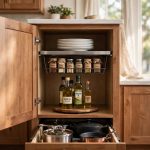
- Kitchen: cleaners out from under the sink into the locked spot. Dishwasher pods in a latched high cabinet, never in a low drawer.
- Bathrooms: toilet cleaner, tub cleaner, and air fresheners locked away. Medicines in a latched cabinet, not on the counter.
- Laundry room: detergent, bleach, and pods on a high shelf or in a locked cabinet. Never on top of the washer where a climber can reach.
- Garage and shed: pesticides, paint, automotive fluids locked up. These are the most dangerous products in most homes.
- Everywhere: check for old products you no longer use and dispose of them properly.
If deep cleaning feels overwhelming with little ones underfoot, a professional deep cleaning service can handle the big jobs while you focus on the safety setup.
The Bottom Line
Many homeowners find that store cleaning supplies is easier than they expected once they know the basics.
Storing cleaning supplies with kids around comes down to four habits: one locked home for all cleaners, original containers with labels intact, latches you actually check, and products put away the moment you finish. Add safer product choices and age-appropriate teaching as kids grow, and keep the Poison Help number posted where you can find it fast. It takes an afternoon to set up and protects your family every day after. That is all it takes to store cleaning supplies with confidence.
References
AboutKidsHealth. (n.d.). Poison prevention: A guide to keeping your family safe from poisons. https://www.aboutkidshealth.ca/healthaz/prevention/poison-prevention-a-guide-to-keeping-your-family-safe-from-poisons/?hub=poisonprevention
Head Start. (n.d.). Poisoning prevention home safety tip sheet. https://headstart.gov/publication/poisoning-prevention-home-safety-tip-sheet?redirect=eclkc
KidsHealth. (n.d.). Preventing poisoning (for parents). https://kidshealth.org/AetnaBetterHealthKentucky/en/parents/safety-poisoning.html
National Capital Poison Center. (n.d.). Poison prevention week. https://www.poison.org/articles/poison-prevention-week
NewsWise. (n.d.). Keep your child safe from household cleaners and chemicals. https://www.newswise.com/articles/keep-your-child-safe-from-household-cleaners-and-chemicals/?sc=rsmn
Stanford Children's Hospital. (n.d.). Preventing household poisonings. https://www.stanfordchildrens.org/en/topic/default?id=preventing-household-poisonings-1-1610
UH Hospitals. (n.d.). Childproof your home for poisons. https://www.uhhospitals.org/rainbow/services/pediatric-psychology-psychiatry/conditions-and-treatments/article/pediatric-diseases-and-conditions-v0/childproof-your-home-for-poisons
U.S. Environmental Protection Agency. (n.d.). Find safer choices to use in your community. https://www.epa.gov/saferchoice/find-safer-choices-use-your-community
U.S. Environmental Protection Agency. (n.d.). Household hazardous waste (HHW). https://www.epa.gov/hw/household-hazardous-waste-hhw
Was this guide helpful?

About My Garden US
The My Garden US editorial team writes practical, in-depth home and garden guides for American homeowners — tested advice, no fluff.
You May Also Like
Buy Under Sink Organizers Online in Colorado: A Simple Guide
May 30, 2026 1 views
How to Buy Sports Equipment Organizers Online in California
August 13, 2026 1 views
Top Rated Craft Room Storage Cabinets: A Buying Guide
May 29, 2026 4 views