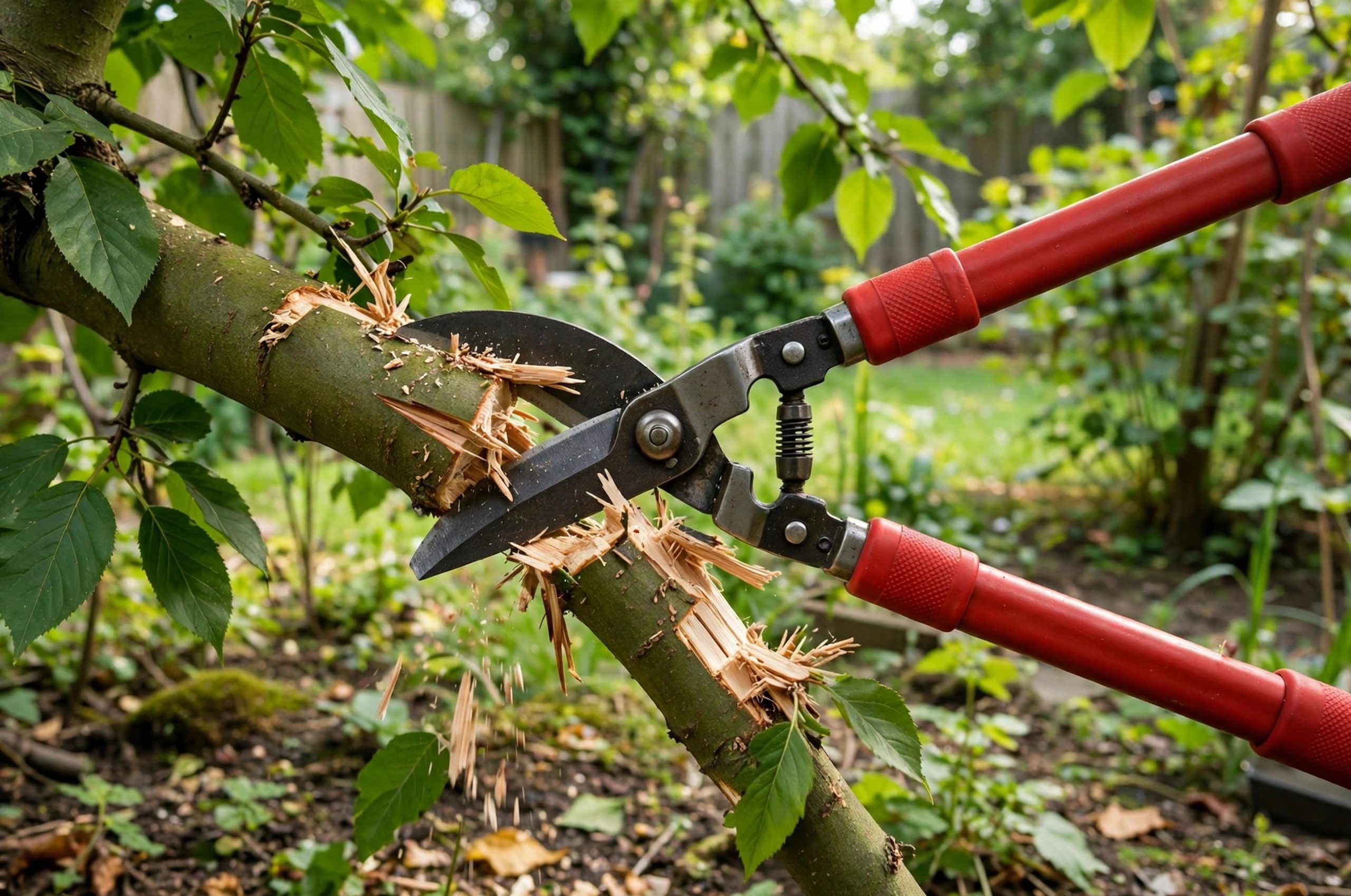
Loppers sit in the sweet spot of pruning tools. They handle wood too thick for hand pruners and too small to drag out the saw. But that middle ground is where most pruning mistakes happen. People force cuts through branches that are too thick. They stretch too far. They stand in the wrong place. A little knowledge fixes all of that. Here is how to cut thick branches with loppers without fuss.
Table of Contents
Table of Contents
- Cut Thick Branches with Loppers: Know Your Tool's Limits First
- Gear Up Before You Cut
- Set Your Stance and Position
- Find the Branch Collar
- The Cutting Motion
- Bypass or Anvil: Which Lopper for Thick Branches?
- Dealing With Spring and Tension
- Overhead Cuts Need Extra Care
- After the Cut: Clean Up Right
- When to Call a Professional
- A Safe Pruning Checklist
- References
This guide covers the safe way to cut thick branches with loppers: how to judge branch size, how to stand, where to cut, and what gear keeps you safe. Follow these steps and you will get clean cuts without the strain and the risk.
Cut Thick Branches with Loppers: Know Your Tool's Limits First
When it comes to cut thick branches with loppers, getting the details right makes all the difference.
Many homeowners find that cut thick branches with loppers is easier than they expected once they know the basics.
Not every branch belongs in a pair of loppers. Most standard loppers cut branches up to about one and a half to two inches thick. Heavy-duty and geared models stretch a bit further, but two inches is a sensible working limit for most home gardeners.
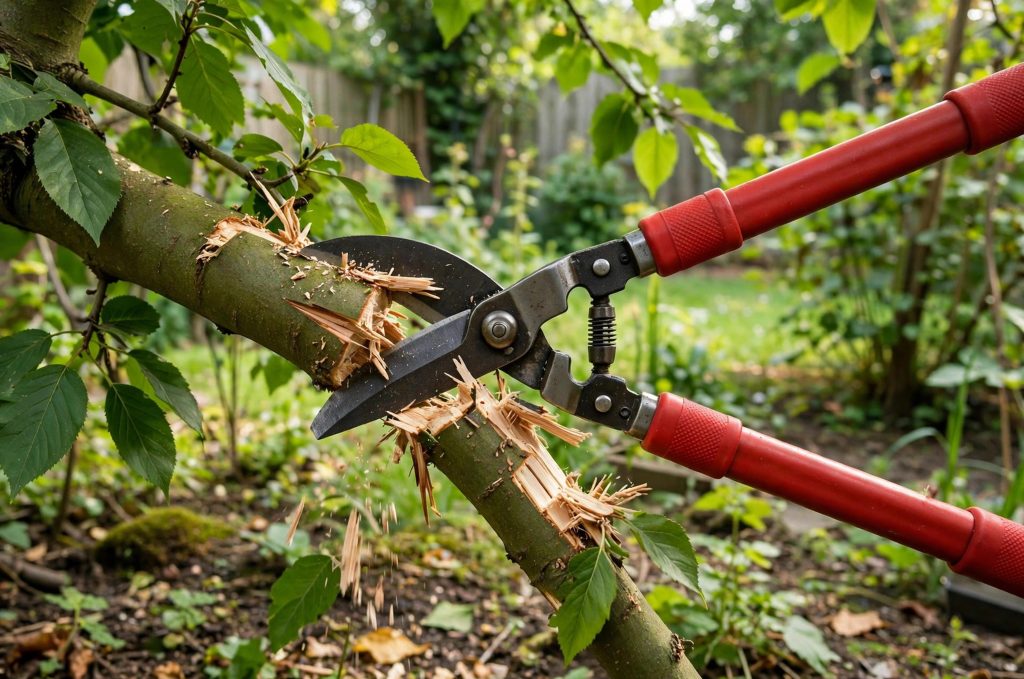
Here is the quick test. Look at the branch and compare it to your wrist. If it is thicker than your wrist, reach for a saw instead. If the lopper blades cannot open wide enough to close around the branch, do not force them. Forcing a cut damages the blades, strains the pivot, and can send the tool kicking back at you.
Dead wood counts double. A dead branch of a given thickness is much harder than a living one of the same size. If you are cutting dead limbs, drop your size limit by a third. What goes through green wood easily may stall halfway through dead wood and jam the blades.
When a branch is clearly beyond lopper range, a pruning saw for thick branches is the right tool. There is no shame in switching. The right tool is always safer than the wrong one pushed past its limit.
Gear Up Before You Cut
Many homeowners find that cut thick branches with loppers is easier than they expected once they know the basics.
The key to cut thick branches with loppers is choosing the right approach for your space and budget.
Thick branches fight back. Splinters fly, sawdust drifts, and branches spring when they let go. A few simple items keep you safe:
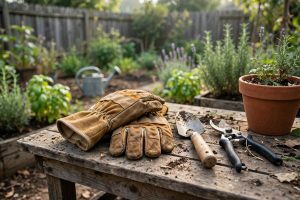
- Work gloves. Thick leather or heavy canvas gloves protect against splinters and blisters. They also improve your grip on the handles.
- Safety glasses. Always. Debris flies at face level when cutting branches at chest height or above. Ordinary sunglasses are better than nothing, but proper safety glasses fit closer and protect from the sides. For more on protective hand wear, see our guide to garden gloves for pruning thorns.
- Sturdy shoes. Closed boots with good soles keep you steady and protect your feet from falling limbs.
- Long sleeves. They shield your arms from scratches and flying chips.
Keep a first-aid kit within easy reach when you prune. It is basic common sense, and most gardeners never think of it until they need it.
Set Your Stance and Position
The key to cut thick branches with loppers is choosing the right approach for your space and budget.
With a little planning, cut thick branches with loppers can fit even a busy schedule.
Where you stand matters as much as how you squeeze. Plant your feet shoulder-width apart with one foot slightly forward. Keep your knees soft, not locked. This gives you balance if the branch springs or the cut lets go suddenly.
Position yourself to the side of the branch, never directly underneath it. Branches fall straight down or swing toward the cut. Standing off to the side keeps you clear of both. This is doubly important for overhead work. If a branch is above your head, think hard about whether you should be cutting it with loppers at all. A pole pruner lets you work from the ground and keeps falling wood away from your face.
Never overreach. If you have to lean, stretch, or stand on tiptoe to reach the branch, you are out of position. Move the ladder, move the branch, or pick a different tool. Overreaching wrecks your balance and puts your hands in the blade's path. A quick overview of safe lopper practice at Garden Botany lists stable footing and clear surroundings among the top safety rules.
Clear the area around you before the first cut. Move pots, toys, and garden ornaments out of the drop zone. Make sure no person or pet is standing in the line where the branch will fall. A quick look around takes five seconds and prevents real trouble.
Find the Branch Collar
With a little planning, cut thick branches with loppers can fit even a busy schedule.
Before you start, it helps to understand how cut thick branches with loppers works in real homes.
Before every cut on a live branch, find the branch collar. That is the slightly swollen ring of bark where the branch meets the trunk or a larger limb. The tree seals wounds best when the cut sits just outside this collar. Cut too far out and you leave a stub that rots. Cut into the collar and you open a wound the tree cannot close well.
For thick branches, use the three-cut method instead of one big squeeze:
1. The undercut. About a foot out from the collar, cut upward through the bottom third of the branch. This stops the bark from tearing down the trunk when the branch drops. 2. The top cut. A few inches farther out, cut down through the top until the branch breaks away and falls. The weight of the branch does most of this work. 3. The final cut. Now remove the remaining stub with a clean cut just outside the branch collar. With loppers, this last cut is the one that matters most. Keep it smooth and close.
The three-cut method feels slow the first time. It is much faster than dealing with a torn trunk that takes years to heal. The branch-cutting best practices at Farmstand walk through collar placement and the three-cut sequence in detail.
The Cutting Motion
Before you start, it helps to understand how cut thick branches with loppers works in real homes.
A good plan for cut thick branches with loppers saves time, money, and frustration.
With the branch positioned between the blades, get both hands on the handles near the ends. This gives you the most leverage. Long handles multiply your grip strength, so use all of that length.
Squeeze with steady, even pressure. Do not jerk or bounce on the handles. A smooth squeeze lets the curved blades draw through the wood. If the cut stalls halfway, stop. Open the blades, reposition the branch deeper in the jaws, and squeeze again. Sometimes shifting the angle a few degrees is all it takes.
For extra-thick branches near the top of your lopper's range, try ratcheting. Open and close the handles in short pumps rather than one long squeeze. Each pump bites a little deeper. Many modern loppers include a ratchet or gear mechanism for exactly this. The heavy-duty lopper guide at Home Cleaning Stuff explains how geared heads turn short handle strokes into real cutting power.
Listen to the tool. A sharp, well-fitted lopper makes a clean snick. Grinding, groaning, or flexing means something is wrong. Stop, inspect, and adjust. If the blades are dull, sharpen them first before continuing. A step-by-step sharpening guide shows the one-direction filing method that restores an edge in minutes. Forcing a dull tool through thick wood is the fastest route to a hand injury.
Bypass or Anvil: Which Lopper for Thick Branches?
A good plan for cut thick branches with loppers saves time, money, and frustration.
For most people, cut thick branches with loppers comes down to a few smart choices.
Two blade styles exist, and the choice matters for thick work.
Bypass loppers work like scissors. Two curved blades slide past each other. They make the cleanest cuts on living wood and are the best choice for most branch work. Keep them sharp and they slice smoothly.
Anvil loppers have one straight blade that closes down onto a flat plate. They handle dead, dry wood well because the crushing action powers through hard material. But they are rougher on living tissue, so save them for deadwood.
For cutting thick living branches, bypass is almost always the better pick. Match the tool to the wood and the job gets easier and safer at once.
Dealing With Spring and Tension
For most people, cut thick branches with loppers comes down to a few smart choices.
If you are new to cut thick branches with loppers, start with the simplest option and build from there.
Thick branches under tension are dangerous. A branch bent under its own weight or pinned by another limb can whip when cut. Before you cut, study the branch. Which way does it want to move? Where will the free end go when it releases?
Cut from the compression side first when you can, and stand clear of the release path. If a branch is badly tangled or under heavy load, do not cut it with loppers from a ladder. Call it a two-person job or bring in a saw where you can control the release with a rope. The safety section of the Stihl lopper guide stresses keeping the safety lock engaged when repositioning and staying aware of everyone near the work zone.
Branches near power lines are a hard stop. Do not touch them with any tool. Call your utility company. No branch is worth an electrical injury.
Overhead Cuts Need Extra Care
If you are new to cut thick branches with loppers, start with the simplest option and build from there.
When it comes to cut thick branches with loppers, getting the details right makes all the difference.
Cutting above your head with loppers is the riskiest common pruning task. The branch falls toward you. Chips rain into your face. Your arms tire fast, and tired arms make sloppy cuts.
If you must cut overhead, keep these rules:
- Wear safety glasses and a hat or hard hat.
- Cut small pieces. Remove the branch in short sections so no single piece is heavy.
- Support the branch with your free hand when possible, then cut with both hands on the handles. If the branch is too heavy to hold, cut it in smaller sections first.
- Step back as the cut finishes. Let the piece drop, then move in to grab it.
- Never cut overhead while standing on a ladder with loppers. The tool needs two hands, and you need at least one hand on the ladder. Use a pole pruner instead, which is designed for exactly this.
Gardeners with weak grips or joint trouble should look at garden pruners for arthritis hands. The same ergonomic thinking applies to loppers: lighter models with geared heads cut thick wood with far less hand force.
After the Cut: Clean Up Right
When it comes to cut thick branches with loppers, getting the details right makes all the difference.
Many homeowners find that cut thick branches with loppers is easier than they expected once they know the basics.
Each cut leaves a wound. You do not need to paint or seal it. Trees heal on their own when the cut is clean and placed right. What you should do is remove the debris. Pile branches where they cannot trip anyone. Chip or bundle the waste according to your local yard-waste rules.
Wipe the lopper blades with a rag when you finish. Sap hardens fast and dulls the edge. A quick wipe now saves a full cleaning later. If you cut any diseased wood, disinfect the blades before moving to a healthy plant. Extension guidance recommends rubbing alcohol for routine disinfection and a bleach-water soak, rinsed well afterward, for serious disease (University of Arizona Extension).
Store loppers with the blades closed and locked, hung on a hook or laid flat where the edge cannot strike other tools. Good garden tool storage ideas for the shed keep edges sharp and hands safe at the same time.
When to Call a Professional
Many homeowners find that cut thick branches with loppers is easier than they expected once they know the basics.
Some jobs are beyond home tools and home skills. Call a certified arborist when:
- The branch is thicker than four or five inches.
- The branch hangs over a roof, a fence, a power line, or a neighbor's yard.
- The tree is tall enough that you would need to climb or use a tall ladder.
- The branch is cracked, hanging, or storm-damaged and its behavior is unpredictable.
- You feel unsure. Trust that feeling. It is usually right.
A professional has the ropes, saws, and training to take down heavy wood safely. Paying for an hour of expert work beats paying for an emergency room visit.
A Safe Pruning Checklist
The key to cut thick branches with loppers is choosing the right approach for your space and budget.
Tape this to your shed door if it helps:
1. Check branch thickness. If it is too thick, switch to a saw. 2. Put on gloves, glasses, and boots. 3. Clear the drop zone of people, pets, and breakables. 4. Stand to the side with solid footing. Never overreach. 5. Find the branch collar. Plan the three cuts. 6. Squeeze smoothly. Stop if the tool strains. 7. Step clear as the branch falls. 8. Clean the blades. Lock and store the tool.
Follow that list and loppers become what they should be: the easiest, safest tool for the middle-size wood in your yard. Once you try it, you can cut thick branches with loppers with ease.
References
With a little planning, cut thick branches with loppers can fit even a busy schedule.
Farmmod. (n.d.). How to sharpen loppers: A beginner's guide. https://farmmod.com/how-to-sharpen-loppers-pu805/
Farmstand. (n.d.). 3 best loppers for 2-inch branches. https://www.farmstandapp.com/116395/3-best-loppers-for-cutting-branches-up-to-two-inches/
Garden Botany. (n.d.). Choosing the right loppers for pruning. https://gardenbotany.com/choosing-right-loppers-pruning
Home Cleaning Stuff. (n.d.). The ultimate guide to finding the best heavy duty garden loppers. https://homecleaningstuff.com/best-heavy-duty-garden-loppers/
My Garden US. (n.d.). Garden tool storage ideas for shed: A practical guide. https://mygardenus.com/garden-tool-storage-ideas-for-shed/
Texas Real Food. (n.d.). Mastering branch cutting: The top Stihl loppers for effortless precision. https://discover.texasrealfood.com/homesteaders-toolbox/the-best-stihl-loppers-for-effortlessly-cutting-thick-branches
University of Arizona Extension. (n.d.). Sanitizing pruning tools. https://extension.arizona.edu/sites/extension.arizona.edu/files/attachment/SanitizingTools.pdf
Yardique. (n.d.). How to sharpen garden loppers for clean, precise cuts. https://yardique.com/how-to-sharpen-garden-loppers/
Garden UK. (n.d.). How to sharpen garden tools. https://gardenuk.co.uk/how-to/how-to-sharpen-garden-tools/
Was this guide helpful?

About My Garden US
The My Garden US editorial team writes practical, in-depth home and garden guides for American homeowners — tested advice, no fluff.
You May Also Like

Drip Irrigation for Hanging Baskets: A Plain Guide for Home Gardeners
June 12, 2026 15 views
Best Garden Kneeler With Handles Reviews: A Complete Buying Guide
January 15, 2026 16 views
Best Garden Hose Splitter Two Way: A Complete Guide
May 27, 2026 15 views