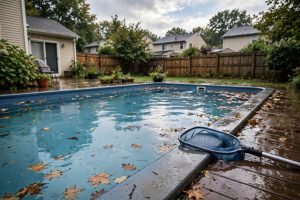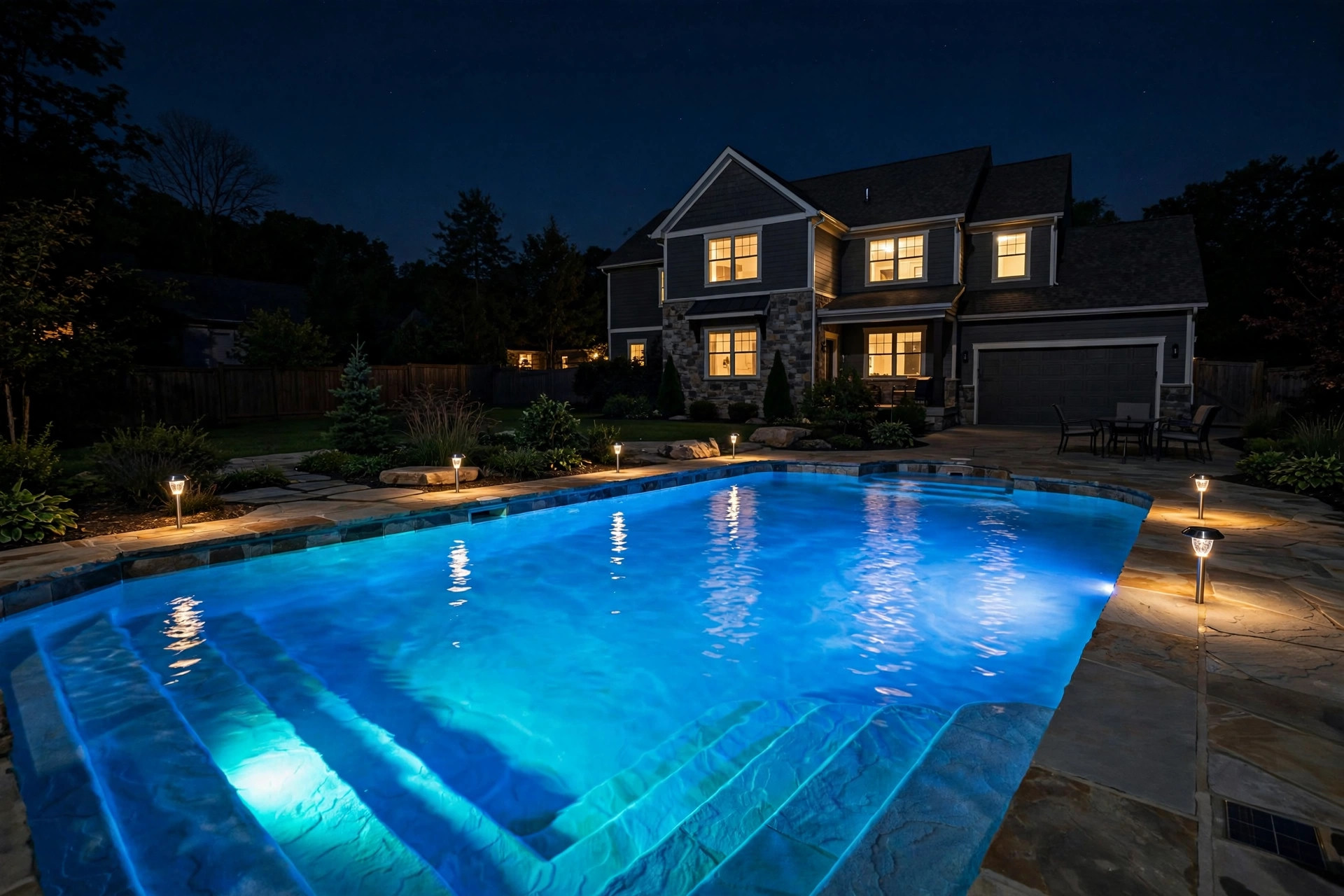

A backyard pool does not close when the sun goes down. Many owners enjoy a swim after dinner or sit near the water late in the evening. For those hours, good light matters. Inground pool lighting options for night turn a dark pool into a safe and pleasant place.
Why Night Lighting Matters for Your Pool
Light makes a pool safe after dark. Water is hard to see in the dark. A swimmer may not see the steps, the shallow end, or the deep end. A guest may walk too close to the edge and slip. Good underwater and deck lights mark the pool clearly. They show where the edge is, where the steps are, and where the water begins.
Light also makes a pool more useful. Without light, the pool season feels shorter. You swim only in daylight. With light, you can swim on warm evenings and hot nights. The pool becomes part of your outdoor living space, not just a daytime feature.
Light adds beauty too. Colored lights can turn the water blue, green, or red. White lights give the water a clean, bright look. A lit pool becomes the center of the yard at night. It adds value to the home and to family time outdoors.
There are legal and insurance reasons to light a pool as well. Many local codes ask for a lighted pool area. A dark pool is a hazard. A child or a pet may fall in and no one would see. A pool alarm for child safety helps, but light is the first line of defense. You can learn more in our guide to best pool alarm for child safety.
How to Choose the Right Pool Lights: Inground Pool Lighting Options for Night
Brightness and Color
Pool lights are measured in lumens. A small pool needs less light than a large pool. Most inground pools need two or three lights for full coverage. A good rule is one light for every 30 to 40 feet of pool surface. Too little light leaves dark spots. Too much light can glare and waste power.
Color is a matter of taste. White lights show the water clearly. They are best for safety. Colored lights are best for mood. Many LED lights can change color at the push of a button. You can set blue for a calm evening or red and green for a party. Think about how you use the pool at night. If you swim laps or play games, choose white. If you host parties, choose color changing lights.
Power and Wiring
Most pool lights run on 12 volt power. This low voltage is safer near water. A transformer changes house current to 12 volts. Some older pools use 120 volt lights. These can be safe if they are installed well, but low voltage is the modern standard.
Check your pool before you buy. Note the type of niche, which is the box in the pool wall that holds the light. Nicheless lights mount on the surface. Niche lights sit inside the wall. Buy lights that fit your pool. If you are not sure, ask a pool professional. The staff at Leslie’s can help you match a light to your pool.
Think about control. Simple lights have one switch. Better lights have a remote control or a phone app. With a remote, you can dim the lights or change colors from a chair. Some systems tie into a full pool automation panel. These panels can run the lights, the pump, and the heater together. For more on pumps, see our article on best pool pump for inground pools.
Types of Inground Pool Lights
LED Pool Lights
LED lights are the most popular choice today. They use far less power than older bulbs. They last many years, often 30,000 to 50,000 hours. They run cool and they come in white or color changing models.
LED lights cost more up front. A good LED pool light can cost two or three times more than a halogen bulb. But they pay for themselves in power savings and long life. You will change bulbs less often and pay less on your power bill. The U.S. Department of Energy notes that LED lighting uses far less energy than older lamps, and pool lights are no exception. You can read more about efficient lighting at energy.gov.
LED lights are easy to install in most pools. Many models fit standard niches. Some are retrofit kits that replace an old halogen bulb in the same fixture. This makes an upgrade simple and fast.
Fiber Optic Pool Lights
Fiber optic lights move light through thin cables. The light source sits far from the water. Only the cable tip glows in the pool. This makes fiber optic lights very safe. No power runs near the water at all.
These lights give a soft, even glow. They can change color and they can light the pool edge, the steps, and the deck with small points of light. They look like stars set in the pool wall. They are a good pick for a luxury look.
The weak point is cost and upkeep. Fiber optic systems cost more to install. The cable ends can dim over time. The light box needs a dry place near the pool. Still, for a high end pool, they are hard to beat for style.
Halogen Pool Lights
Halogen lights are the old standard. They give bright white light. They cost less to buy than LED lights. Many older pools still use them.
But halogen has clear drawbacks. The bulbs burn out fast, often in one to two seasons. They use a lot of power. They run hot. Most pool owners now replace halogen bulbs with LED retrofit kits. If your pool still has halogen lights, an LED retrofit is one of the best upgrades you can make. Pool Warehouse carries many retrofit kits for common niches.
Solar and Floating Lights
Solar lights and floating lights are not wired to the pool. They charge by day and glow by night. Floating lights drift on the surface and add color to the water. Solar deck lights line the pool edge.
These lights are cheap and easy to add. You can buy them at Home Depot and place them the same day. They are not as bright as wired underwater lights. They should not be your only light source for night swimming. But they are a fine add on. They dress up the deck and mark the edge for walkers.
You can also mix types. Many owners use LED underwater lights for swimming and solar lights for the deck. This mix gives safety and style at a fair cost.
Cost and Price of Pool Lighting
Prices vary by type and by who does the work. Here are rough ranges for a standard inground pool in the United States.
A single LED pool light bulb or fixture costs 100 to 500 dollars. A full LED fixture with color changing can cost 300 to 800 dollars. A halogen bulb costs 30 to 80 dollars but burns out fast.
Fiber optic systems are the most costly. A full system can cost 1,500 to 5,000 dollars for parts and labor. Solar and floating lights are the least costly, often 20 to 60 dollars each.
Labor adds to the cost. If your pool already has a niche and wiring, a pro can swap a light in an hour or two. Expect 150 to 400 dollars for labor. If new wiring is needed, the cost rises. Trenching for wire and adding a transformer can add 500 to 1,500 dollars.
Do not forget the power bill. LED lights use about 40 to 60 watts each. Halogen lights use 300 to 500 watts each. Over a season, the difference is large. Consumer Reports often notes that long life and low power use make LED the better buy over time.
Plan the full layout first so later lights fit the plan.
If you heat your pool for night swims, plan the light work at the same time. You can read about heaters in our guide to best pool heater for inground pools.
Care and Upkeep
Pool lights need little care, but they do need some. Check the lights each month. Look for dim bulbs, dead colors, or water inside the lens. A foggy lens means the seal is bad. Fix it soon to protect the fixture.
Clean the lens face twice a season. Algae and mineral film can coat the lens and dim the light. Use a soft cloth and a mild pool cleaner. Do not use harsh acids on the lens. Turn the light off and let it cool before you clean it.
Check the gasket each year. The gasket is the rubber ring that keeps water out of the fixture. It wears with time. A new gasket is cheap and easy to fit. A bad gasket can let water reach the wires, which is a real hazard.
For color changing LED lights, check the remote or app once a season. Replace remote batteries. Update the app. Test all colors. If a color fails, the LED board may need service.
Winter care matters in cold states. If you close the pool for winter, leave the lights in place. Do not remove them unless the maker says to. Keep the water level at the mark the maker sets. Ice can press on fixtures if the water is too high or too low. Swim University has clear guides on winter care for pool equipment.
Keep the transformer dry. It should sit in a dry box above flood level. Check it for rust and for loose wires. A humming transformer that gets very hot may need a pro to look at it.
Safety Rules for Pool Lights
Safety comes first with any pool wiring. Follow these rules.
Use a licensed electrician for all new wiring. Pool wiring has strict codes. A handyman or a do it yourself job can miss a key rule. The U.S. Consumer Product Safety Commission warns that bad pool wiring can cause shock. A pro knows the code.
Make sure the lights are on a GFCI breaker. A GFCI cuts power fast if there is a fault. This is one of the most vital safety devices at a pool. Test the GFCI each month with the test button.
Never swim when a light is broken. A cracked lens or a loose fixture is a danger sign. Turn off the breaker and call a pro. Do not touch the fixture while the power is on.
Keep cords and plugs away from the water. Landscape lights near the pool should be low voltage and set back from the edge. Do not drape string lights over the pool. If a cord falls in the water, shock is possible.
Teach children the rules. No night swimming alone. No diving in shallow water, day or night. An adult should watch every swim. Light helps, but it does not replace watchful eyes.
If you own a spa or hot tub near the pool, light it too. Spas have their own lights and rules. Hot Spring and Bullfrog Spas both offer spa lighting guides for their models.
For more pool safety tips, The Spruce keeps a good library of home pool articles.
Frequently Asked Questions
How many lights does an inground pool need?
Most pools need two to three lights. A small pool under 20 by 40 feet often needs two. A large or L shaped pool may need three or four. Place lights to avoid dark spots. A pro can plan the layout.
Can I replace halogen pool lights with LED?
Yes, in most cases. Many makers sell LED retrofit bulbs that fit halogen niches. You swap the bulb, keep the fixture, and save power. Check the niche size and voltage first. A 12 volt halogen can take a 12 volt LED retrofit.
Are color changing pool lights worth it?
They are worth it if you enjoy evening parties or a stylish yard. They cost more than plain white lights. But they add mood and fun. If you swim laps at night, plain white is more useful. Many owners pick one white light and one color light for the best of both.
Do pool lights attract bugs?
Yes, some do. Bugs like bright white light. To cut the problem, use warm white or amber lights near seating areas. Turn deck lights down when you are not using them. Keep the pool clean, since bugs fall in the water.
How long do LED pool lights last?
A good LED pool light lasts 30,000 to 50,000 hours. At four hours a night, that is 20 to 30 years of evenings. Real life is often less because of heat and water. But LED still lasts far longer than halogen.
Can I install pool lights myself?
You can swap a bulb yourself if the wiring is already in place and the power is off at the breaker. New wiring, new niches, or new transformers need a licensed electrician. Pool wiring codes are strict. A mistake can cause shock or fire.
A Final Word
Inground pool lighting options for night are wide and getting better each year. LED lights lead the field for most owners. They save power, last long, and change color. Fiber optic lights suit luxury pools. Solar and floating lights are fine extras. Pick lights that fit your pool, your budget, and your night habits. Keep safety first, care for the fixtures, and your pool will shine for many seasons.
References
Bullfrog Spas. (n.d.). Hot tubs and spas. https://www.bullfrogspas.com Consumer Reports. (n.d.). Product reviews and ratings. https://www.consumerreports.org Hot Spring Spas. (n.d.). Hot tubs and spas. https://www.hotspring.com Leslie’s Pool Supplies. (n.d.). Pool supplies and equipment. https://www.lesliespool.com Pool Warehouse. (n.d.). Pool equipment and supplies. https://www.poolwarehouse.com Swim University. (n.d.). Pool and hot tub care guides. https://www.swimuniversity.com The Home Depot. (n.d.). Home improvement products. https://www.homedepot.com The Spruce. (n.d.). Home and garden advice. https://www.thespruce.com U.S. Consumer Product Safety Commission. (n.d.). Product safety information. https://www.cpsc.gov U.S. Department of Energy. (n.d.). Energy efficiency and renewable energy. https://www.energy.gov
Was this guide helpful?

About Jennifer Lee
The My Garden US editorial team writes practical, in-depth home and garden guides for American homeowners — tested advice, no fluff.
You May Also Like
How to Install a Pool Heat Pump the Right Way
October 4, 2026 1 views
Best Inflatable Hot Tub for Couples: A Practical Buying Guide
July 17, 2026 0 views
Hot Tub Electrical Requirements for Installation: A Plain Guide
July 19, 2026 1 views