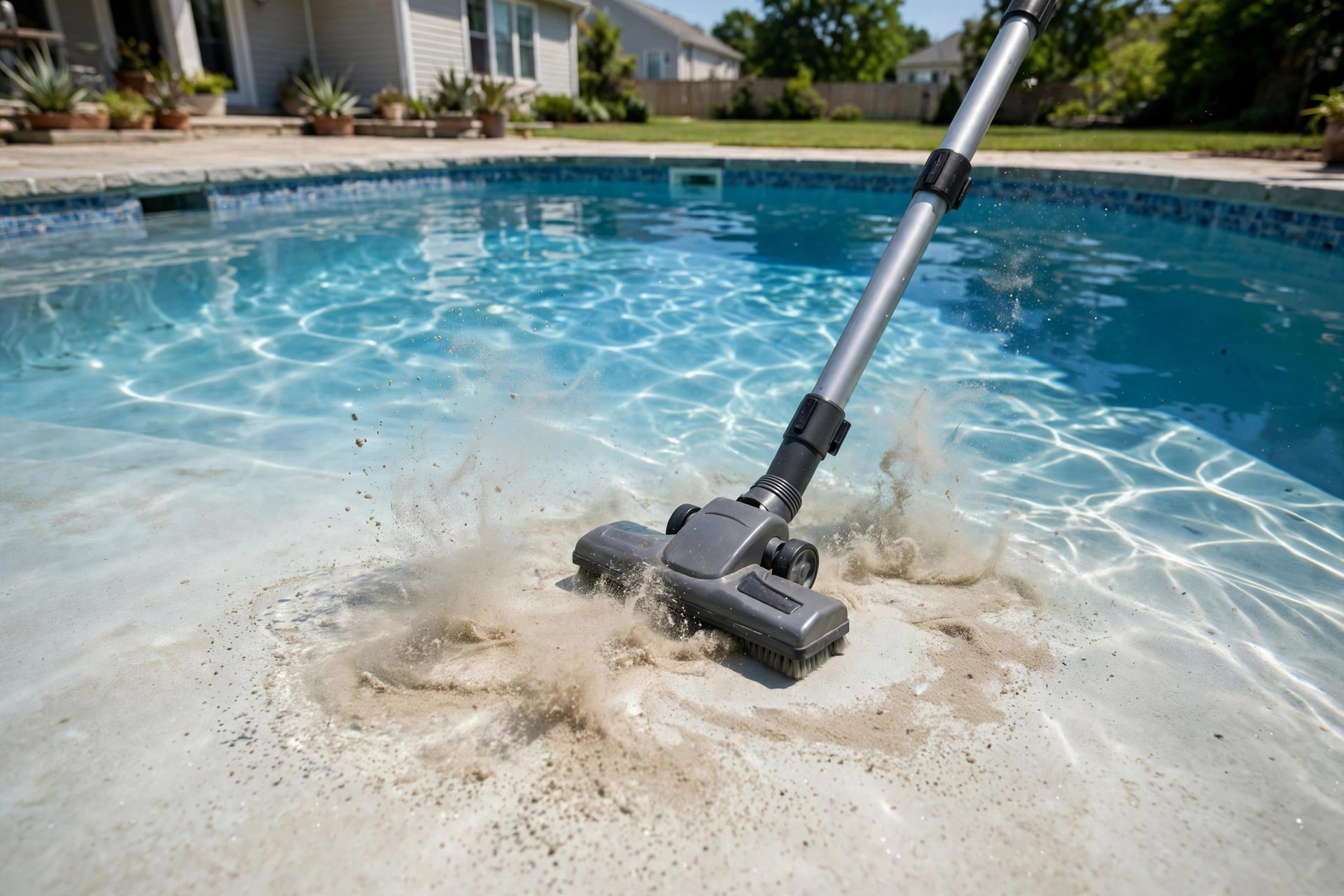

Finding the best pool vacuum for sand bottom pools starts with a simple fact. Sand and dirt settle deep into the floor of the pool. A regular skimmer net cannot lift it. A weak cleaner will stir the dust and cloud the water. The right vacuum lifts the sand and traps it, so the water stays clear and the floor stays clean.
Many owners of above ground pools have a sand or dirt floor under the liner. Others have sand-bottom areas where wind blows fine grit into the water. The best pool vacuum for sand bottom duty must pick up fine particles without wasting water or clogging the filter. This guide explains what to look for, the main types, what they cost, and how to care for them.
Why Sand Bottom Pools Need the Right Vacuum
Sand is heavier than it looks. It sinks fast and sits in a thin layer on the pool floor. Wind, bathers, and nearby landscaping add more every week. If the sand stays, it feels gritty under bare feet. It can also wear the liner and give algae a place to grow.
A standard pool brush only moves sand around. It does not remove it. A garden hose siphon works, but it is slow and wastes water. The best pool vacuum for sand bottom pools uses steady suction and a fine filter or waste line to take the sand out of the pool for good.
Pool owners at Leslie’s Pool supply stores often hear the same complaint. The pool looks clean from above, but the floor feels like a beach. A proper vacuum ends that problem in one pass.
Common Problems a Good Vacuum Solves
Fine sand passes through coarse baskets and returns through the jets. It clogs cartridge filters. It leaves a dull film on vinyl liners. A vacuum built for fine debris fixes each of these problems. It collects the sand in its own bag or sends it straight to waste, so the main filter stays clean.
What to Look For When You Choose: Best Pool Vacuum for Sand Bottom
Fine Filtration
The most important feature is filtration down to fine particles. Sand grains are small. A cleaner with a coarse mesh bag will let them slip back into the water. Look for a fine mesh bag, a micron-rated filter, or a vacuum head that works with a sand filter set to waste. Product pages at Pool Warehouse often list the micron rating, and lower numbers mean finer capture.
Strong, Steady Suction
Sand needs firm suction to lift it off the floor. Manual vacuums use the suction of the pool pump. Robotic cleaners use their own motors. Either way, the suction must be steady. A vacuum that surges and stops will leave lines of sand behind.
Wheels and Brushes That Suit the Surface
For a sand bottom under a vinyl liner, the vacuum head should glide softly. Stiff brushes can scratch the liner. Smooth wheels and soft bristles are best. Reviews at The Spruce often note which heads are safe for vinyl.
Hose Quality
Manual vacuums need a flexible hose that does not kink. A kinked hose breaks suction and makes the job take twice as long. Look for a crushproof hose with swivel cuffs that turn as you move.
Ease of Emptying
Sand is heavy. A cleaner with a small bag will fill in minutes and need frequent emptying. A larger debris chamber or a top-loading bag saves time on big pools.
Types of Pool Vacuums for Sand Bottoms
Manual Vacuum Heads
A manual vacuum head attaches to a telescopic pole and the skimmer hose. You walk it slowly across the pool floor. This is the most common tool for sand. It gives you full control, and you can move slowly over sandy patches. It is also the least expensive option. The drawback is time. A large pool can take an hour of steady work.
Many guides at Swim University teach the slow technique for sand. Move the head at a walking pace. Pause over sandy spots. Let the suction do the work. Rushing the pass leaves half the sand behind. Overlap each pass by a few inches, the way you would mow a lawn, so no strip of floor is missed.
Another point in favor of manual heads is control near steps and corners. Sand gathers where water moves slowly. A manual head reaches those spots with ease. Robots can miss tight corners, and suction-side cleaners may not climb steps. For an older pool with an uneven floor, the human hand still does the finest work.
Suction-Side Cleaners
A suction-side cleaner plugs into the skimmer or a dedicated suction line. It moves around the pool on its own, driven by the pump. These cleaners are good for daily upkeep. They keep light sand from building up. They struggle with heavy sand layers, and they can clog if the sand load is large. They also put extra wear on the pool pump.
Pressure-Side Cleaners
A pressure-side cleaner connects to a return jet and uses a booster pump or the main pump to move. It sweeps debris into its own bag. It works well for medium sand loads and does not strain the filter. It needs a pressure line, which some above ground pools do not have.
Robotic Pool Cleaners
Robotic cleaners are self-contained. They plug into a power outlet and scrub and vacuum on their own. Many have fine filter baskets that catch sand well. They are the easiest option for a sand bottom pool. The owner drops the robot in, presses a button, and lifts it out when the cycle ends. They cost more, but they save hours of labor over a season. For a pool that collects sand every week, the time saved often pays for the machine within two summers. When comparing models, owners often weigh a robot against a robotic cleaner made for vinyl pools, since the brush type matters for liners.
Battery and Handheld Vacuums
Small battery vacuums work for spot cleaning. They are handy for sand in corners and steps. They cannot clean a whole pool floor in one charge. Keep one as a helper, not as the main tool.
Cost and Price: What to Expect
Manual vacuum heads cost little. A good head, pole, and hose set often runs from thirty to one hundred dollars. This is the cheapest way to find the best pool vacuum for sand bottom needs on a tight budget.
Suction-side and pressure-side cleaners usually cost between one hundred fifty and six hundred dollars. The price depends on the brand, the hose length, and extra features. Remember that some need parts or fittings to match your pool.
Robotic cleaners cost the most. Entry models start near three hundred dollars. Mid-range models with fine filters run from five hundred to nine hundred dollars. Top models can pass one thousand dollars. The cost is high, but so is the time saved. Big retailers such as Home Depot carry models at each price level, so shoppers can compare side by side.
Running costs matter too. Manual vacuuming costs nothing extra if you already own a pump. Robots add a small amount to the electric bill. Cleaners that send sand to waste also cost water. Backwash the filter after heavy sand cleanups to keep flow strong.
Care and Upkeep of Your Pool Vacuum
A vacuum that is cared for lasts many seasons. Rinse the head, hose, and bags with clean water after each use. Sand is rough, and it wears parts that are left dirty.
Empty filter bags before they are full. A packed bag cuts suction and lets fine sand escape. Check bags for small tears. Even a small hole will release sand back into the pool.
Store hoses in straight coils, out of the sun. Sunlight weakens plastic and makes hoses crack. Keep the vacuum head in a dry place. Replace worn brushes and wheels before they scratch the liner.
Check the pool filter after sand vacuuming. Sand can pack into a cartridge or add load to a sand filter. A quick backwash or rinse keeps the system ready. Articles on fixing cloudy pool water often trace the problem to a dirty filter, so this step pays off.
Safety Tips for Vacuuming a Sand Bottom Pool
Pool safety rules apply during vacuuming as they do during swimming. Never leave the equipment in the water with swimmers. Unplug robotic cleaners before anyone enters. Keep cords and hoses away from walkways where people may trip.
Electrical parts must stay dry except where the maker says they can get wet. Use a ground fault protected outlet for any electric cleaner. The Consumer Product Safety Commission offers plain guidance on safe use of electric products around water, and it is worth a read before the first use.
Chemical safety matters as well. Test the water after vacuuming a sandy pool. Stirred-up sand can change the balance. Keep chemicals stored high and locked, away from children and pets.
If the pool has a vinyl liner over a sand base, work gently. Do not press the vacuum head hard into the floor. Slow and light passes protect the liner and still pick up the sand.
FAQ
How often should I vacuum a sand bottom pool?
Most pools need vacuuming once a week during the swim season. Pools near sand, dirt, or construction may need it twice a week. Watch the floor. If you see a gritty layer, it is time.
Can I vacuum sand straight to waste?
Yes, and for heavy sand it is often the best method. Set a multiport valve to waste, attach the manual vacuum, and move slowly. The sand leaves the pool instead of loading the filter. Refill the water you lose afterward.
Will a robotic cleaner pick up fine sand?
Many will. Choose a model with a fine filter basket or fine filter panels. Standard coarse filters let fine sand pass through. Check the listed micron rating before you buy.
Why does sand keep coming back after I vacuum?
Three causes are common. First, the filter bag or basket is too coarse. Second, you moved too fast and stirred the sand instead of lifting it. Third, new sand keeps blowing in from the yard. Fix the filter, slow down, and consider windbreaks or a pool cover. A pool vacuum made for leaves can help with the larger debris that blows in with the sand.
Is sand bad for my pool filter?
Small amounts are fine. Large amounts can clog cartridges and wear pump parts. After a heavy sand cleanup, backwash a sand filter or rinse a cartridge. This keeps the system in good shape.
Do I need a different vacuum for a vinyl liner over sand?
Not a different machine, but a gentler head. Use soft brushes and smooth wheels. Avoid metal parts that can tear the liner. Many spa and pool makers, such as Bullfrog Spas for hot tubs and pool brands for liners, warn against abrasive tools on soft surfaces.
A Short Final Word
The best pool vacuum for sand bottom pools is the one that traps fine sand, glides gently over the surface, and fits your budget and your time. A manual head suits careful owners who do not mind the work. A robot suits busy owners who want the job done on its own. Either way, slow passes, fine filtration, and regular care will keep the floor clean and the water clear all season long. A sand bottom pool rewards steady habits, and the right vacuum makes those habits easy. For year-round comfort beyond the pool, owners also look at makers like Hot Spring when they plan the whole backyard.
References
Bullfrog Spas. (n.d.). Hot tubs and spas. https://www.bullfrogspas.com Hot Spring Spas. (n.d.). Hot tubs and spas. https://www.hotspring.com Leslie’s Pool Supplies. (n.d.). Pool supplies and equipment. https://www.lesliespool.com Pool Warehouse. (n.d.). Pool equipment and supplies. https://www.poolwarehouse.com Swim University. (n.d.). Pool and hot tub care guides. https://www.swimuniversity.com The Home Depot. (n.d.). Home improvement products. https://www.homedepot.com The Spruce. (n.d.). Home and garden advice. https://www.thespruce.com U.S. Consumer Product Safety Commission. (n.d.). Product safety information. https://www.cpsc.gov
Was this guide helpful?

About Lisa Anderson
The My Garden US editorial team writes practical, in-depth home and garden guides for American homeowners — tested advice, no fluff.
You May Also Like
The Best Pool Chemical Feeder for Chlorine: How to Choose the Right One
June 4, 2026 0 views
Salt Water Pool Test Kit Reviews: What Works and What Does Not
August 10, 2026 0 views
Best Pool Vacuum for Leaves Reviews: A Plain Guide for Pool Owners
January 18, 2026 0 views