Solar landscape lights that actually work are harder to find than they should be. Many homeowners buy a box of cheap solar stakes, place them along the front walk, and enjoy a pleasant glow for a few weeks. Then the light grows dim. Then it dies. By the second season, half the set is dark, and the rest give off a weak flicker that lasts an hour or two after dark. The problem is not the idea. The idea is sound. The problem is that most low-cost units are built with small solar cells, weak batteries, and thin plastic parts that cannot stand up to weather. This guide explains what separates dependable solar landscape lights from the ones that fail, so you can spend your money once and enjoy steady light for years.
Why It Matters
A well-lit yard does more than look pleasant. Light along a walkway keeps visitors from tripping after dark. Light near the driveway shows drivers the edge of the pavement. Light around the back door gives the family a sense of safety when they step out at night. Studies of home crime have long shown that a lit yard is less inviting to intruders than a dark one. The point is not to flood the yard with light. A few steady points of light do the job.
Solar lights offer a simple way to get that light without wiring. No trench must be dug for cables. No electrician is needed. No monthly cost appears on the power bill. The sun does the charging. That is why solar lights appeal to so many owners of small and mid-size yards. The appeal is real. But only if the lights truly work.
There is also a quieter reason to care. When cheap units fail, most of them go straight into the trash. Batteries, plastic shells, and circuit boards pile up in landfills. A set of strong, long-lasting solar path lights that keeps working for five years produces far less waste than a cheap set replaced every spring. Buying well once is both kinder to the wallet and kinder to the land.
What to Look For: Solar Landscape Lights That Actually Work
The Solar Panel
The panel is the heart of the light. It turns sun into stored power. Cheap lights use tiny panels, often smaller than a playing card, made from low-grade cells. Such panels charge slowly and cannot fill even a small battery on a short winter day. Look for lights with panels of honest size, made of monocrystalline cells. Monocrystalline cells convert a larger share of sunlight than the cheaper polycrystalline kind. The maker should state the panel size and type. If the box says nothing about the panel, treat that as a warning.
The Battery
Most failed solar lights die because of the battery. Many use small nickel-metal-hydride cells that lose capacity fast and suffer in heat. Better lights use lithium-ion or lithium iron phosphate cells with higher capacity, often 1,500 milliamp-hours or more. A larger battery stores more daylight and keeps the light on for eight to ten hours. Check the rated hours of light per full charge. Trust lights that claim six to ten hours. Distrust lights that claim fifteen hours from a battery the size of a thumb. Good makers also make the battery replaceable. A standard AA or 18650 cell that the owner can swap extends the life of the unit by years.
Brightness and Light Color
Brightness is measured in lumens. A path light needs only 10 to 50 lumens to mark a walkway. A spotlight aimed at a tree or a flag needs 100 to 300 lumens. Match the lumen rating to the task. More is not always better. A row of very bright stakes along a path can blind the eye and spoil the mood. Warm white light, around 3,000 Kelvin, looks natural in a garden. Cool white, near 6,000 Kelvin, suits driveways and security spots. Many dependable models offer a switch between warm and cool. That small switch is a good sign of thoughtful design.
Build and Weather Rating
Outdoor lights face rain, heat, frost, lawn mowers, and the occasional stray football. Look for a stated weather rating such as IP65 or IP67. IP65 means the unit resists dust and jets of water. IP67 means it can stand brief flooding. Metal stakes hold up better than thin plastic. Glass lenses outlast plastic ones, which turn yellow and cloudy. Screws should be stainless, not plain steel that rusts. Pick up the light in the store if you can. A solid, heavy feel usually means thicker materials.
Types and Options
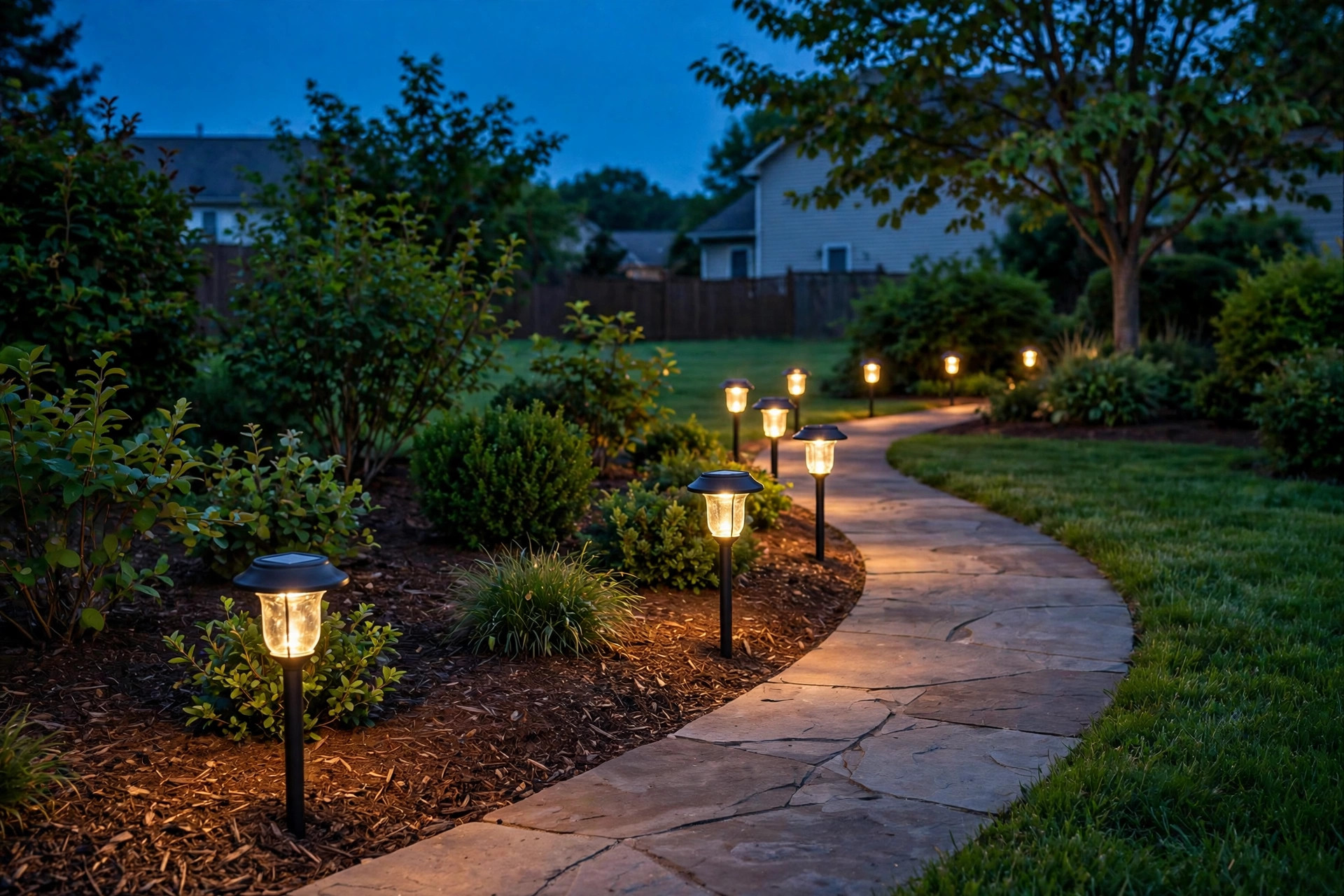
Path Lights
Path lights are the classic choice. They stand one to two feet tall, spread a soft circle of light, and mark edges of walks and beds. For a thirty-foot walk, five to seven lights spaced four to six feet apart give an even line. Buy lights with a wide light cap so the glow points down, where feet are. Cheap path lights shine in all directions and waste power lighting the sky.
Spotlights
Spotlights throw a beam at one point: a tree, a fountain, a fence post, a front step. Good solar spotlights for trees often carry a separate solar panel on a cord, so the panel can sit in full sun while the light sits in shade. Look for adjustable heads and ground stakes that anchor firmly. Some models also mount on a wall with a bracket.
Flood and Security Lights
Flood lights add motion sensors. They sleep at low power and jump to full brightness when someone passes. They work best over a garage door, a gate, or a side yard. Because the light is not on all night, a modest battery lasts well. Make sure the sensor can be aimed and that its range, often fifteen to thirty feet, fits the space.
String and Lantern Lights
String lights and solar lanterns serve mood more than task. They suit porches, pergolas, and small patios. They draw little power, so even modest panels can keep them going. They are a fine addition to a yard that already has path and spot lighting for safety.
How to Choose, Step by Step
Start by walking your yard at dusk with a notebook. Mark the places that feel too dark: the steps, the curve in the path, the mailbox, the back corner by the fence. Count the spots. That number tells you how many lights you need.
Next, note the sun. Each panel needs direct sun for most of the day, ideally six hours. South-facing spots charge best in the northern hemisphere. If a spot sits in shade, choose a light with a remote panel on a cord, and place the panel in the sunny spot.
Then set a budget per light, not per set. A dependable single path light often costs twelve to thirty dollars. Sets that promise ten lights for twenty dollars are promising failure. It is better to buy six good lights than twenty weak ones. You can add more each year as the budget allows.
Read reviews with care. Look for reviews written after six months or a year of use, not just after the box arrived. A light that works on day one and fails in month four is the common story. Search review text for words like “second winter” and “still going.” Those reviews tell the truth.
Finally, check the return policy. A maker that offers a one-year or two-year warranty stands behind the product. Cheap no-name sets carry no warranty and no phone number. When something fails, the owner has no one to call.
Cost and Price
Solar landscape lights sell at every price. Single path lights run from about five dollars for flimsy plastic units to forty dollars or more for metal units with glass lenses and lithium cells. Spotlights range from fifteen to eighty dollars. Motion-sensor flood lights range from twenty to sixty dollars. Whole-yard kits with panels, hubs, and a dozen lights can reach two hundred dollars or more.
The honest math favors the middle. A twenty-dollar light that lasts five years costs four dollars a year. A seven-dollar light that lasts one season costs seven dollars a year, plus the trip to the store and the trash. Over five years, the good light is cheaper and far less trouble.
There is no digging, wiring, or electrician bill, which keeps solar cheaper than wired low-voltage systems. A wired system gives brighter, steadier light, and for large estates it is still the better tool. For most homes, good solar lights do the job at a fraction of the total cost. If your yard is large and you want both, you might wire the front entry and use solar in the back. For guidance on wired work, see our notes on how to install landscape lighting transformer and affordable landscape lighting installation near me. Owners shaping new beds may also want best mulch for flower beds bulk delivery before placing their lights.
Care and Upkeep
Good lights need little care, but not none. Dust, pollen, and bird droppings film the panel and cut charging. Wipe each panel with a damp cloth two or three times a season. Keep grass trimmed around path lights so blades do not cover the panel. In fall, clear leaves away from the stakes.
Batteries wear out. Even good lithium cells fade after two to four years. Replace them with cells of the same size and chemistry. Mark the date of replacement on a small piece of tape inside the battery door. When a light starts dying early, the battery is the first thing to check, before blaming the panel or the circuit.
Move lights if the shade changes. A tree that grows, a new fence, or a parked trailer can shade a panel that once sat in sun. A light that worked for two years and then fades is often a light that now sits in shadow.
In regions with long, gray winters, gather the lights and store them dry if snow buries them for months. Cold alone does little harm, but weeks under ice with no charge can stress the battery. A cool, dry garage shelf is a fine winter home.
Safety
Solar lights are low voltage and carry little risk, but a few points matter. Keep ground stakes clear of buried utility lines, gas lines, and sprinkler pipes before pushing them into the soil. Call the national dig-safe line before any deep digging. Do not use damaged lights with cracked housings and exposed wires, even at low voltage. Dispose of spent batteries at a local battery collection point, not in household trash. Lithium cells in particular should never be crushed or burned.
Motion-sensor flood lights should be aimed away from neighbors’ windows and from the street, so passing cars do not trigger them all night. Many towns have rules about glare and light trespass. A quick look at local codes before mounting bright units saves trouble with neighbors.
For brand guidance on yard power equipment, the maker sites of Toro and John Deere carry manuals and seasonal advice that apply to any yard project, and Briggs & Stratton publishes engine and power maintenance guides that help keep all outdoor gear in order.
Frequently Asked Questions
How many hours of sun do solar landscape lights need?
Most good lights need about six hours of direct sun for a full charge. Panels in morning shade and afternoon sun do fine. Panels that get only two or three hours of filtered light will charge partly and run for fewer hours at night. If your yard is shady, pick lights with remote panels on cords and place the panels where the sun lands.
Why do my solar lights stop working after a few months?
The battery is the usual cause. Small, cheap batteries lose capacity fast, especially in heat. The panel may also be filmed with dirt, or the light may have slipped into shade. Try cleaning the panel and replacing the battery with a fresh cell of the same type. In most cases, that brings the light back.
Are expensive solar lights really worth it?
In most cases, yes. A light built with a larger monocrystalline panel, a lithium battery, a glass lens, and a metal stake simply lasts longer than a light built from thin plastic and small parts. The price gap is often ten to fifteen dollars per light. Over several years, the better light costs less per year of service.
Can solar lights work in winter?
They can, though nights are long and days are short, so run time drops. Snow on the panel stops charging, so brush it off. Cold thickens the light from some battery types, but quality lithium cells handle freezing weather well. If your region has months of deep snow, store the lights until spring.
How long should a good solar light last?
The light head and panel often last five to ten years. Batteries last two to four years and should be treated as a replaceable part. When a maker sells replacement batteries and honors a two-year warranty, that is a strong sign the product is built for the long run.
Do solar lights attract bugs?
Warm white light draws fewer insects than cool white or blue-white light. If bugs gather around your path lights, switch the color setting to warm or pick warm-only models. Keeping the lights low and aimed down also helps, since high, bright lights draw moths from farther away.
A Final Word
The market is full of solar lights that disappoint, but it is also full of solar lights that truly work. The difference is never a secret. It is written on the box: the panel type, the battery capacity, the lumen rating, the weather rating, and the warranty. Learn to read those few numbers, buy fewer and better lights, place them where the sun falls, and wipe the panels now and then. Do that, and your yard will glow every night for years, with no wire, no bill, and no spring trip to replace dead plastic.
References
Briggs & Stratton. (n.d.). Outdoor power equipment and engine care. https://www.briggsandstratton.com Deere & Company. (n.d.). Yard care products and support. https://www.deere.com Toro. (n.d.). Yard care tools and guides. https://www.toro.com
Was this guide helpful?

About Michael Thompson
The My Garden US editorial team writes practical, in-depth home and garden guides for American homeowners — tested advice, no fluff.