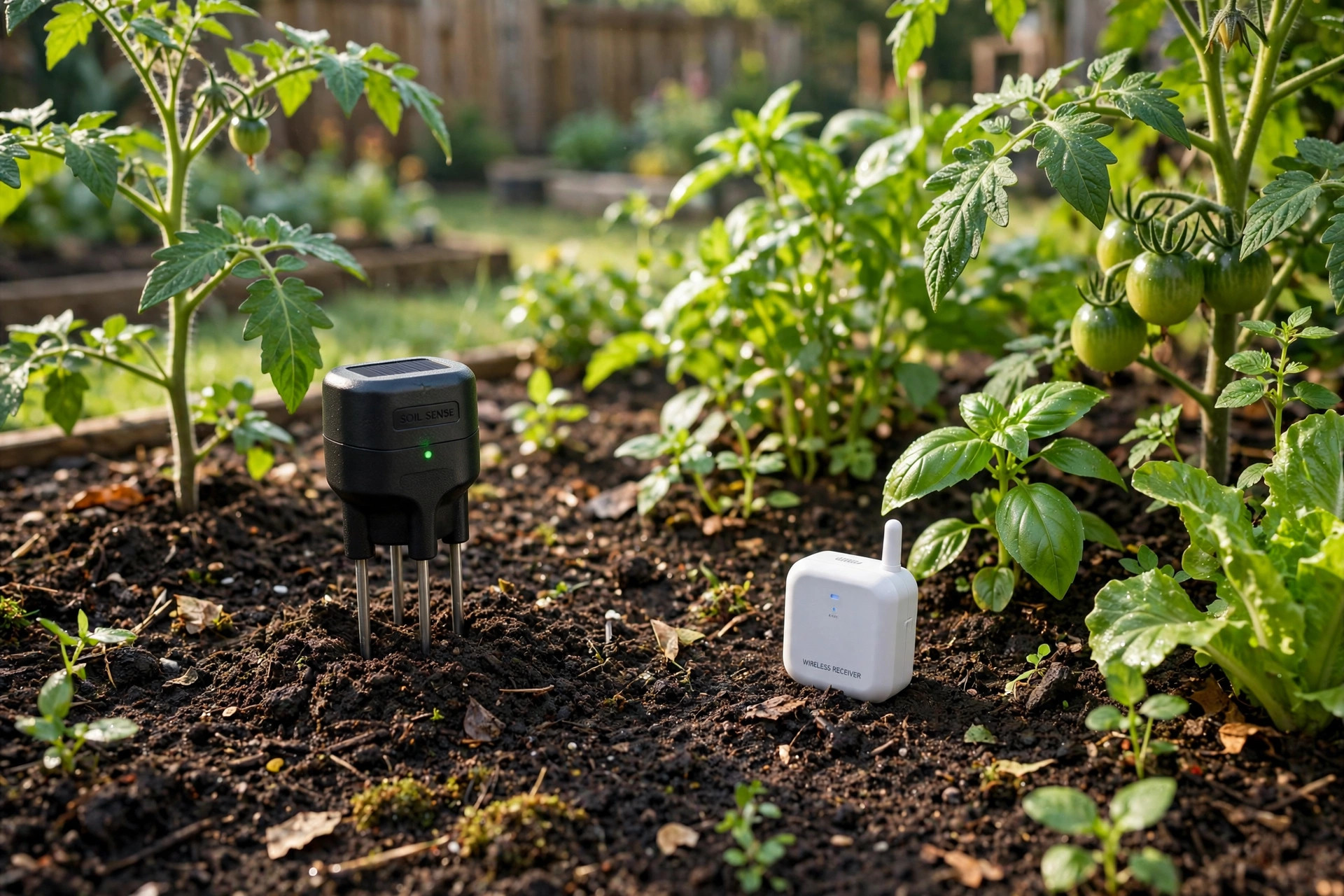

Most garden failures come from the same simple mistake. Too much water, or too little, and at the wrong time. Our smart soil moisture sensor reviews usa guide was written to solve this. These small devices sit in the soil and report moisture levels to your phone. You water when the plant is thirsty, and you stop when the soil has enough. In this guide we explain how these sensors work, what separates good models from weak ones, and which ones American gardeners trust most.
Why a Moisture Sensor Matters
Water is the single largest cost in many home gardens after soil and seed. A hose left running can waste hundreds of gallons in one afternoon. A forgotten bed can wilt a crop of tomatoes past saving. A smart sensor takes the guessing out of the job. It measures moisture deep in the root zone, where the plant actually drinks, not at the surface where sun and wind lie about conditions.
For busy homeowners the value is simple. You get a phone alert when the soil dries below your chosen level. You open the app and see a clear reading instead of pushing your finger into the dirt and hoping. For lawn owners the payoff is similar. Overwatered lawns grow shallow roots and invite fungus. Reviews from CNET have long pointed out that smart lawn devices pay for themselves through lower water bills, and soil sensors are among the cheapest of them.
How a Smart Soil Moisture Sensor Works: Smart Soil Moisture Sensor Reviews Usa
Most sensors use one of two methods. Capacitive sensors measure how much water the soil can hold by sending a tiny electric field through it. They have no exposed metal contacts, so they resist rust and last longer. Resistive sensors measure current flowing between two metal prongs. They cost less but the prongs corrode over time, and their readings drift.
The probe sends its reading by radio to a small hub or directly to your phone. Wi-Fi models connect straight to the home network. Bluetooth models need your phone nearby to sync. Zigbee and Z-Wave models talk to a smart home hub such as the ones sold through Google’s smart home store. The app draws a simple graph of moisture over days and weeks, and most apps let you set low and high alarms.
What to Look for When You Choose One
Buying a sensor is easier when you check the same points the reviewers check. Start with accuracy. A good sensor reads within three to five percent of true soil moisture. Cheap models can swing ten percent or more, which makes their alerts useless.
Next comes range and connection. A backyard sensor may sit fifty feet from the router, behind brick walls and plants full of water. Wi-Fi models reach further but drain batteries faster. Bluetooth models sip power but force you to walk out with your phone. If your garden already runs on a hub, look for a sensor that joins that hub’s system.
Battery life matters more than most people expect. A sensor buried in a raised bed should not need digging up every two months. The best models run a full season or longer on one set of batteries. Solar-assisted models do even better. Check whether the battery is a common coin cell or a strange size you must order online.
App quality is where many products win or lose. The app should show current moisture, history, and alarms on one screen. It should hold data for months so you can compare seasons. Read the app store reviews before you buy. Tests by Consumer Reports often flag devices whose hardware is fine but whose apps are hard to use, and soil sensors are no exception.
Build quality decides whether the sensor survives one winter or five. Look for a sealed body rated against dust and water. A rating of IP67 or better means it can sit in rain and mud. A flimsy stake will crack the first time a mower wheel clips it.
Finally, check what else the sensor measures. Many models also report soil temperature, and some report light and nutrients. Temperature helps you time planting. Nutrient readings are rough at best on consumer models, but they can warn you when fertilizer is running low.
Types and Options on the American Market
Single-probe sensors are the simplest kind. You push one spike into the soil and get one reading. They suit containers, small beds, and houseplants. They are cheap, easy to move, and easy to replace.
Multi-depth sensors read moisture at two or three depths along one stake. They suit lawns and deep vegetable beds where the surface can be dry while the roots are wet. They cost more but give a truer picture of the root zone.
Hub-based systems let you run four, six, or eight probes across a large yard, all feeding one app. They suit gardeners with several beds or a mix of lawn and beds. The hub plugs into your router or connects by Wi-Fi, and each probe is small and wireless. Technology reviews from PCMag note that multi-sensor kits give the best value per square foot for larger yards.
Irrigation-linked sensors go one step further. They connect to a smart sprinkler controller and can skip a watering cycle when the soil is already wet. This is the closest thing to a garden that waters itself. Coverage from The Verge has shown these pairings work well when both devices come from brands with open smart home support.
What the Reviews Say About Top Models
Across American review sites, a few patterns repeat. Sensors with capacitive probes score higher for long-term accuracy than resistive ones. Models with replaceable batteries score higher than sealed units that must be thrown away when the cell dies. Apps with clear history graphs and simple alarms beat apps packed with features nobody uses.
Battery-powered Wi-Fi sensors win on convenience. They need no hub and install in minutes. Their weak point is battery life in cold weather. Bluetooth sensors win on price and battery life. Their weak point is range, which frustrates owners of large yards. Hub systems win on range and probe count. Their weak point is the upfront cost of the hub itself.
If you are building a wider smart home, it helps to read broadly. Many gardeners start with a sensor and later add security and comfort devices from the same ecosystem. When that time comes, guides like best doorbell transformer for smart doorbell, keyless entry door lock reviews 2026 usa, and best motorized shades for large windows usa cover the next steps in the same plain style as this guide.
Cost and Price
Prices in the United States fall into clear bands. Basic single-probe Bluetooth sensors sell for fifteen to thirty dollars. They are fine for a few pots or one raised bed. Wi-Fi models with better apps and longer range sell for thirty to sixty dollars each. Multi-probe kits with a hub sell for eighty to one hundred fifty dollars, and the price per probe drops as the kit grows.
Irrigation-linked systems are the dearest. A sensor bundled with a smart sprinkler controller can pass two hundred dollars. But it can also cut a summer water bill by a third, so the payback is real for large lawns. Watch for hidden costs. Some brands charge a monthly fee for full history or advanced alerts. Others keep every feature free. Check the subscription question before you buy, not after.
Sales follow the garden calendar. Prices dip in late summer and fall as stores clear stock. Buying off season is the simplest way to save twenty percent.
Care and Upkeep
A soil sensor asks little of you, but it asks something. Pull the probe once or twice a season and wipe it clean. Salts and fertilizer crust can coat the surface and dull the reading. Push it back in at the same depth. Depth matters. A sensor that creeps upward in loose soil will start reading the dry surface and crying wolf.
Before winter, decide whether to leave it out. Most sealed models survive freezing. But a hard freeze can crack cheap plastic housings, and a snow shovel will not respect your probe. Mark each sensor with a small flag or stake so the mower and the shovel find it before the blade does. Replace batteries at the start of spring so the season begins with fresh power.
Check the app once a month. Firmware updates fix bugs and improve battery life. A sensor that stops reporting is usually a sensor with a dead battery or a lost Wi-Fi signal, not a broken sensor. Re-pairing takes five minutes.
Safety
These are low-voltage devices and they are safe by design. Still, a few rules apply. Keep small coin-cell batteries away from children and pets. The U.S. Consumer Product Safety Commission warns that swallowed button batteries can cause serious injury, and many sensors use them.
Do not bury the sensor where you dig with a spade. A struck probe is a minor nuisance, but a struck battery is not. Keep the probe away from the edge of the bed where the mower runs. If you use fertilizer spikes or granular feed, place them a few inches from the probe so the salts do not crust the sensor body.
Electrical safety is simple. The probe runs on a few volts. There is no shock risk. But keep the hub and its power plug dry and indoors, as the maker directs.
Many smart home brands publish the same kind of plain safety guidance. The product pages from Ring, SimpliSafe, and ADT each include safety and placement notes that read much like the rules above, and they are worth a look when you plan a larger smart home.
Frequently Asked Questions
How deep should I push the sensor? Push it to the middle of the root zone. For most vegetables and flowers that means four to six inches. For lawns, three to four inches. For deep-rooted shrubs, six to eight inches. The reading should reflect where the roots drink.
Can one sensor cover my whole yard? No. Soil varies across a yard. A bed in full sun dries faster than a bed in shade. A lawn on a slope drains faster than a flat one. Plan on one sensor per bed or zone, and two or three for a large lawn with mixed sun and shade.
Will it work in winter? Most sensors keep reading through winter, and winter readings are useful. They tell you when a warm spell dries the soil around evergreens. Bring cheap models indoors if hard freezes are common in your area. Frozen soil reads oddly, so treat winter numbers with care.
Do I still need a rain gauge? A rain gauge tells you what fell from the sky. A soil sensor tells you what reached the roots. They answer different questions. If you must choose one, the sensor is more useful for watering decisions.
How long do these sensors last? A well-built capacitive sensor lasts three to five years in the ground. The battery needs changing every season or two. The app and the hub usually outlive the probes. Budget brands may last two seasons before the readings drift.
Are the nutrient readings accurate? Treat them as rough guides, not lab results. Consumer nutrient sensors can show trends, such as fertilizer fading over weeks, but they cannot replace a proper soil test. Your county extension office will test a soil sample for a few dollars, and that result is far more precise.
A Short Final Word
A smart soil moisture sensor is one of the smallest and cheapest tools a gardener can buy, and one of the most useful. It ends the guesswork. It saves water. It saves plants. Choose a capacitive probe from a brand with a clear app, size the system to your beds, and let the soil itself tell you when it is thirsty.
References
ADT. (n.d.). Home security and automation. https://www.adt.com CNET. (n.d.). Technology news and reviews. https://www.cnet.com Consumer Reports. (n.d.). Product reviews and ratings. https://www.consumerreports.org Google Store. (n.d.). Smart home devices. https://store.google.com PCMag. (n.d.). Technology product reviews. https://www.pcmag.com Ring. (n.d.). Smart home security devices. https://www.ring.com SimpliSafe. (n.d.). Home security systems. https://www.simplisafe.com The Verge. (n.d.). Technology news and reviews. https://www.theverge.com U.S. Consumer Product Safety Commission. (n.d.). Product safety information. https://www.cpsc.gov
Was this guide helpful?

About Emily Rodriguez
The My Garden US editorial team writes practical, in-depth home and garden guides for American homeowners — tested advice, no fluff.
You May Also Like

How to Secure Smart Home Devices: A USA Guide
July 5, 2026 0 views
Best Wireless Doorbell Camera Reviews USA: A Plain Guide to Choosing Well
September 3, 2026 0 views
Security Camera With Local Storage Reviews USA: A Plain Buyer Guide
August 18, 2026 0 views