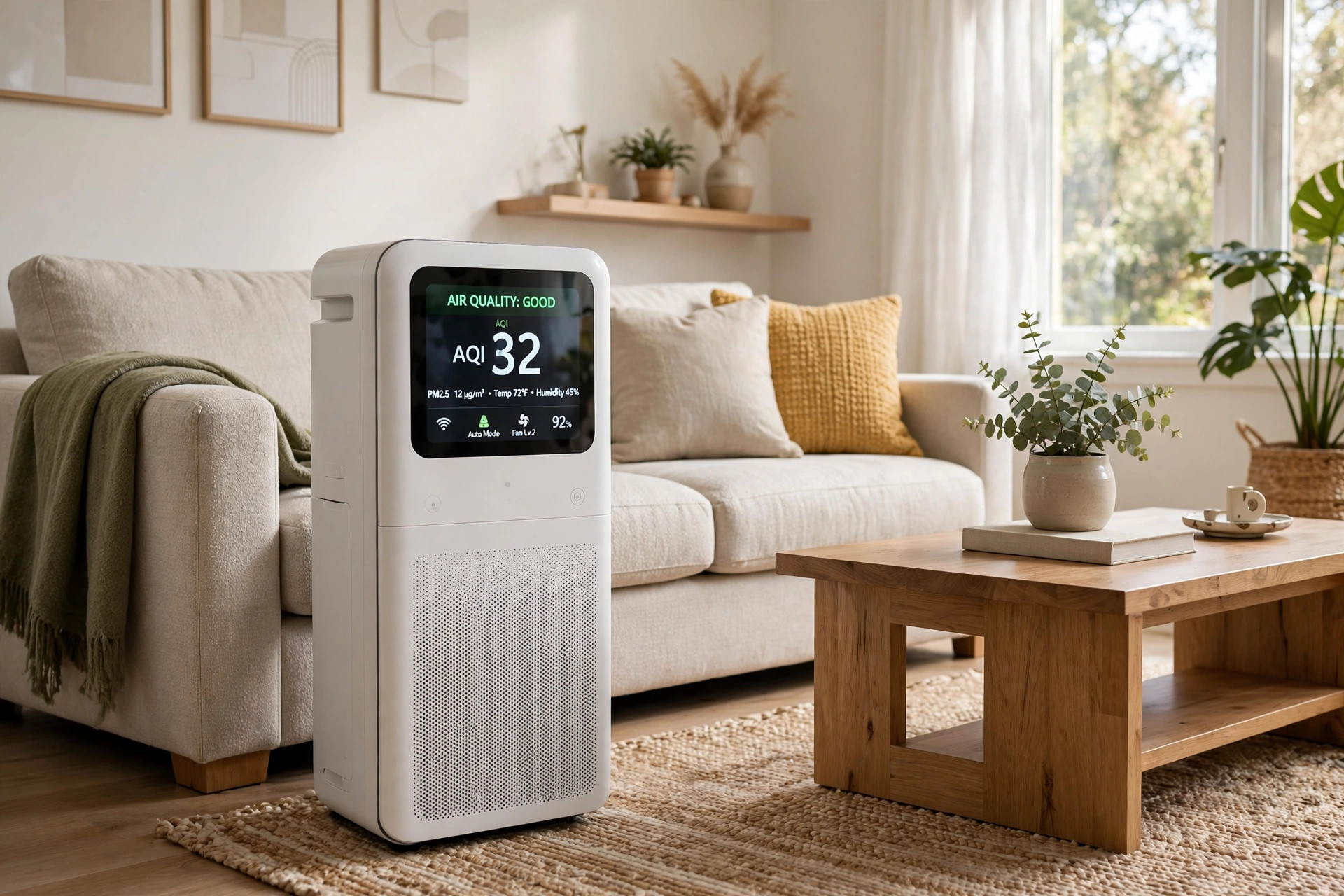

Many American families want cleaner air at home. A smart air purifier with app control can help. The phone app lets you see air quality, change fan speed, and set schedules from another room. If you are reading a smart air purifier with app reviews 2026 usa roundup, this guide will help you use it well. We will look at what the app does, how to pick the right size, what the prices are, and how to keep the unit in good shape. You do not need any special knowledge. The ideas here are plain and practical, and they will fit most American homes.
Why a Smart Air Purifier Matters
The air inside a house can hold more dust and particles than the air outside. Dust, pollen, pet hair, and cooking smoke float in the room for hours. A purifier pulls that air through a filter and pushes it back out cleaner. This can help in homes with pets, allergies, or wildfire smoke in the summer months.
The smart part is the phone app. The app connects to the purifier through your home Wi-Fi. You can turn the unit on from the kitchen while it sits in the bedroom. You can see a live air quality score. You can set a schedule so the machine runs before you come home from work. These features turn a simple fan with a filter into a tool you can manage from your pocket.
Government health pages give clear facts on indoor air quality, and they are worth a look before you trust any sales claim. The app makes the numbers visible, but the filter does the real work. A good purifier with a simple app will beat a fancy unit with a weak filter every time.
Reviews also matter because the app is half the product. A strong machine with a broken app leaves you blind to the air around you. Check that the app gets regular updates and that the maker answers user complaints. A purifier should last five to eight years, so the app should stay alive for that long too.
How to Choose the Right One: Smart Air Purifier with App Reviews 2026 Usa
Room Size and CADR
The most important number is CADR. CADR stands for Clean Air Delivery Rate. It tells you how fast the unit can clean a room. Match the CADR to the size of your room. A small bedroom needs a small number. A large open living room needs a much larger number.
Most apps list the room size the unit can handle. Check this number first. A unit that is too small will run on high speed all day and still not clean the air. A unit that is too big will waste money and space. Measure your room with a tape measure and write down the square feet before you shop.
Filter Type
Look for a true HEPA filter. HEPA filters catch very small particles. Many units also add a layer of activated carbon. The carbon layer helps with smells from cooking, pets, and smoke. It does not catch dust. It absorbs odors.
Some units add UV-C light or an ionizer. These are extras. They do not replace a HEPA filter. If a product hides its filter grade in fine print, treat that as a warning sign. A real HEPA filter will be named plainly on the box and in the app.
App Features Worth Having
Not all apps are equal. Reviews in the major tech reviews often test the app as well as the machine. Look for these features:
– A live air quality graph. You want to see how the air changes through the day. – Filter life tracking. The app should tell you when the filter needs a change. – Schedules and timers. Set the machine to run at night or before you wake up. – Speed control from your phone. This matters when the unit is in another room. – Voice control. Many units work with Alexa or the Google Home app, so you can turn them on with your voice.
Test the app reviews with care. Some apps crash. Some lose the Wi-Fi connection and need a reset. Read recent reviews, not old ones, because apps change with updates.
Noise Level
Purifiers run for hours at a time. On low speed they should be quiet. On high speed they can be loud. Look for the noise number in decibels. A sleep mode should stay under about 25 decibels, which is close to a whisper. If the app lets you switch to sleep mode on a schedule, that is a real plus for bedrooms.
Types and Options
Most smart purifiers on the American market fall into a few groups.
HEPA tower units. These are tall and thin. They fit well in corners and bedrooms. They cost less than the larger console models. They work best in rooms up to about 300 square feet.
Console units for large rooms. These are wider and stronger. They can handle living rooms and open floor plans up to 1,000 square feet. They cost more and use larger filters. The app on these units often shows more detail, like room-by-room air maps.
Activated carbon specialists. Some units focus on smoke and odor. They have thick carbon filters. They are popular in cities with traffic fumes and in homes near wildfire zones. They still need a HEPA layer for dust.
Mini and desk units. These are small and made for offices or desks. Their apps are basic. They cannot clean a whole room. They are only good for the air right next to you.
Independent product tests often compare these types side by side. The tests show that size and filter grade matter more than the brand name on the box.
Cost and Price
Prices in the USA range from about 80 dollars for a small desk unit to 600 dollars or more for a large console unit with a strong app. The middle range, from 150 to 300 dollars, holds the best value for most families.
Do not forget the filter cost. Replacement filters cost from 30 to 80 dollars each. Most last from six months to one year. The app should count the hours and warn you before the filter dies. A cheap unit with an expensive filter can cost more over time than a mid-price unit with a cheap filter.
Electricity cost is small but real. Look for energy efficient models. A certified unit uses less power at each speed. If you run the purifier all day, the power bill adds up over a year. The app can show run time, which helps you plan.
Care and Upkeep
A purifier is easy to care for if you follow a few habits.
Change the filter on time. The app tracks filter life and sends a notice. Do not ignore it. A full filter slows the air flow and the machine works harder for less result.
Vacuum the pre-filter once a month. The pre-filter catches big dust and hair. Most units let you pull it out and vacuum it clean. This step makes the main filter last longer.
Wipe the air quality sensor. Many units have a small sensor window on the side. Dust on the sensor gives false readings. A dry cloth once a month keeps the numbers honest.
Keep the unit a few feet from the wall. The purifier needs space to pull air in and push it out. Do not push it into a corner or behind a curtain. The app cannot fix bad air flow caused by blocked vents.
Write down the date when you install a new filter. The app tracks hours, but a paper note on the fridge is a good backup.
Safety
Air purifiers are safe when used as directed. Read the safety page in the app or the paper manual. Here are the main points.
Place the unit on a flat, stable floor. Keep the cord where no one will trip on it. Keep small children and pets from pushing the unit over. Some tall tower units can tip if bumped hard.
Check for recalls. The federal safety agency posts recall notices for home products. Check the model number when you buy and again once a year. This takes two minutes and it is good practice for any electric home device.
Many purifiers now join the smart home. If you already use a monitored service such as ADT or SimpliSafe, the purifier can sit on the same Wi-Fi network alongside your security gear. If you instead run a home security system without monthly fees, you can manage both from your phone. A smart deadbolt for rental property and a purifier can share the same Wi-Fi and the same app hub. Keep your Wi-Fi password strong, because a smart home is only as safe as its network.
Some units have ionizer modes that release small amounts of ozone. If you have asthma, turn the ionizer off or pick a unit without one. Check the label for ozone-free claims and compare them with third-party tests.
FAQ
Do I need Wi-Fi for the purifier to work?
No. The purifier works by itself with its own buttons. Wi-Fi is only needed for the app features like remote control and air quality graphs. If your Wi-Fi goes down, the unit keeps running on its last setting.
Will the app work with Alexa or Google Assistant?
Many units do. Check the product page before you buy. The listing should name the voice assistants by name. Some units also work with the Apple Home app. Setup takes a few minutes in the assistant app.
How often should I run the purifier?
For best results, run it all day on low or auto mode. The auto mode uses the sensor to raise speed when the air gets dirty. Running it only for an hour before bed will not clean the whole day’s dust. Many owners find that 24-hour auto mode gives the best air quality scores in the app.
How do I know the app reviews are honest?
Read a mix of sources. Store reviews can be padded with paid reviews. Tech coverage from news sites and long-term owner reviews in forums give a fuller picture. Look for reviews that mention specific bugs, like crashes after updates or lost connections. Reviews that list real problems are more honest than reviews that only praise.
Can I use a smart purifier in a rental apartment?
Yes. A purifier is not fixed to the wall. You can move it when you leave. This makes it a good fit for renters. If you are setting up a whole smart home in a rental, a smart light switch with no neutral wire can pair well with the purifier, since neither needs wiring changes.
When should I change the filter?
Follow the app notice first. As a rule, change the main filter every 6 to 12 months. Change it sooner if you have pets, if you cook a lot, or if you live near a road with heavy traffic. Write the date on the new filter with a marker so you can see it at a glance.
A Short Final Word
A smart air purifier with app control is a small but steady helper. It does not ask for much. It needs the right size, a real HEPA filter, and a phone app that works. Read the smart air purifier with app reviews 2026 usa before you buy, and check the app reviews on their own. Pick the unit that fits your room and your budget. Change the filter on time. The clean air will take care of itself.
References
ADT. (n.d.). Home security and automation. https://www.adt.com Consumer Reports. (n.d.). Product reviews and ratings. https://www.consumerreports.org ENERGY STAR. (n.d.). Energy efficient products. https://www.energystar.gov Google Store. (n.d.). Smart home devices. https://store.google.com PCMag. (n.d.). Technology product reviews. https://www.pcmag.com SimpliSafe. (n.d.). Home security systems. https://www.simplisafe.com The Verge. (n.d.). Technology news and reviews. https://www.theverge.com U.S. Consumer Product Safety Commission. (n.d.). Product safety information. https://www.cpsc.gov U.S. Environmental Protection Agency. (n.d.). Protecting human health and the environment. https://www.epa.gov
Was this guide helpful?

About Sarah Mitchell
The My Garden US editorial team writes practical, in-depth home and garden guides for American homeowners — tested advice, no fluff.
You May Also Like
Best Smart Speaker for Kitchen Reviews USA
August 8, 2026 0 views
Do Security Yard Signs Really Work? A Plain Guide for American Homeowners
January 2, 2026 0 views
Garage Door Opener Installation Cost Near Me: What Homeowners Pay in 2026
February 22, 2026 0 views