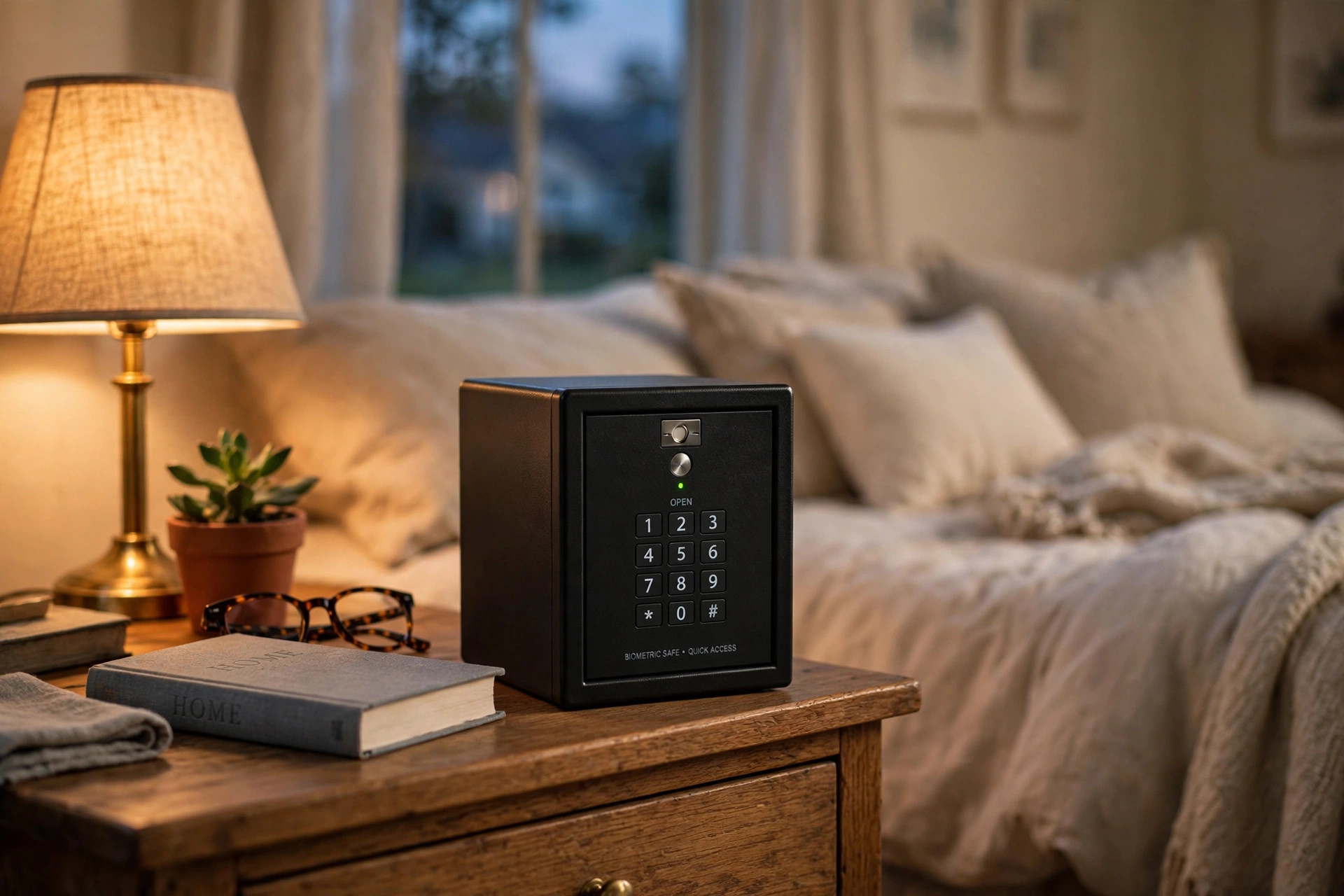

Many people in the United States now keep a safe by the bed. The reason is simple. You want your cash, papers, or firearm close at hand at night, but locked away from children and guests. A quick access bedside safe opens in seconds. You use a fingerprint, a short code, or a small RFID card instead of a slow key. Reading quick access bedside safe reviews USA before you buy can save you from a poor choice. Reviews tell you which safes open fast every time. They also tell you which ones fail when the battery is low or the room is dark. This guide walks through what matters, what the main options are, what you can expect to pay, and how to keep your safe working well for years.
Why a Bedside Safe Matters
A large floor safe is strong, but it does no good at three in the morning if it sits in the basement. A bedside safe fills that gap. It gives you a locked place within arm’s reach while you sleep. Many buyers pick one up for a handgun, and others use it for cash, watches, passports, or medicine that should not be easy for others to find.
Households with children gain the most. Young children explore. Teenagers test limits. A locked box removes the chance that a child picks up something unsafe. The Consumer Product Safety Commission has long urged families to store dangerous items out of the reach of children, and a locking bedside safe is one plain way to do it.
There is also the matter of guests, cleaners, and workmen. A safe by the bed keeps small valuables out of sight and out of temptation. It will not stop a determined thief with tools and time, but it stops the quick grab. It also bolts down, so it cannot walk off in a minute.
Think of a bedside safe as one part of a larger home plan. Home safes for documents handle passports and deeds elsewhere in the house. Alarm systems and cameras watch the rest. Each layer adds a little more calm at night.
How to Choose a Bedside Safe: Quick Access Bedside Safe Reviews Usa
Reviews across the market keep coming back to the same points. Below are the things worth checking before you pay.
The Lock Type
The lock is the heart of the safe. Most quick access models use one of three kinds. A biometric lock reads your fingerprint. A keypad lock takes a short code. An RFID lock opens with a small tag or bracelet held near the top. Many newer models mix two kinds, so you have a backup if one fails. Pick the method you can use fast in the dark, while half asleep.
Solid Build
Look for steel walls at least 14 gauge thick, or heavier. Thicker steel bends less under a pry bar. A good door seal keeps dust out of the lock. Gas struts or springs that lift the lid quickly are a plus, because the door should open fully on its own once the lock releases.
Size and Fit
Measure your nightstand. Many bedside safes are about the size of a small shoe box. That size holds a handgun and a spare magazine, or a stack of cash and a phone. If you want to store a small laptop or several boxes of papers, you need a larger model, or a different kind of safe altogether.
Battery and Backup Entry
Almost all quick access safes run on batteries. Check how the safe behaves when power runs low. The best models warn you with a light or a beep long before they die. Every safe you buy should include a backup: a physical key, a USB port for outside power, or both. Never buy a model with no backup entry.
Quiet Opening
A loud click at night is a problem. Read reviews for words like “silent entry” or “quiet mode.” Many good safes let you turn off the beeps, and their lids lift with a soft motion instead of a snap. Test this at home with batteries installed before you rely on the safe.
Testers at sites like Consumer Reports and CNET often cover build quality and lock reliability in detail, so their pages are worth a look alongside buyer reviews.
Types of Quick Access Bedside Safes
Shoppers will meet four main designs. Each has strengths and weak points.
Biometric Safes
Biometric models read your fingerprint. The best ones open in under two seconds. They store ten to twenty prints, so both partners can open the safe. The weak point is the sensor. Dust, sweat, and cuts can slow it down. Keep the reader clean, and register the same finger more than once for a better match. Read reviews closely here, because cheap sensors fail far more often than good ones.
Keypad Safes
Keypad models take a three to eight digit code. They are simple and dependable. There is no sensor to smudge. The trade-off is speed in the dark. Practice your code until your fingers know it by touch. Many keypads light up, which helps but also adds a small glow. Like biometric models, good ones offer silent mode.
RFID Safes
RFID models open when you hold a small tag, card, or bracelet near the reader. The tag can sit on a key ring or a wristband you wear to bed. Opening is very fast, often under a second. The main risk is losing the tag. Keep a spare tag in a separate room, not in the safe itself.
Hybrid Safes
Hybrid models give you two or three ways in: fingerprint plus keypad plus key, for example. These cost more, but the backup options are worth it for night use. If one method fails at two in the morning, the other gets you in. Reviews show that hybrid designs earn the highest owner satisfaction, because people trust them more.
Technology reviewers at PCMag and The Verge sometimes cover smart lock technology that shares parts with these safes, which can help you judge how mature the electronics are.
Cost and Price of Bedside Safes in the USA
Prices fall into three bands. Basic models run from about forty to eighty dollars. They use a keypad, thin steel, and simple hinges. They work, but they open slower and feel light. Mid range models run from about eighty to one hundred eighty dollars. This is the sweet spot. You get a biometric reader or a good keypad, thicker steel, gas strut doors, and a backup key. Most of the best reviewed models sit in this band.
Premium models run from one hundred eighty to four hundred dollars and up. You get heavy steel, dual or triple entry methods, interior lights, tamper alerts, and phone alerts on some smart models. These suit buyers who want the fastest and quietest opening possible.
Watch for extras that raise the real price. Some brands sell the mounting hardware or the cable tether separately. Batteries are usually included, but check. Sales around holidays often cut twenty to thirty percent off the mid range models, so patient buyers can save real money. As with any product, a very low price on an unknown brand is a warning sign, not a bargain.
Care and Upkeep
A bedside safe needs little care, but it needs it on a schedule. Check the batteries every three months. Mark the date on a calendar. If your safe has a low battery light, test that the light works by pressing the lid button each month.
Clean the fingerprint reader with a soft dry cloth. Do not use water or cleaners on it. Oil the hinges once a year with a drop of light machine oil. Wipe the inside dry if you live in a humid state. Moisture causes rust on steel, and rust causes a stuck door.
Practice opening the safe in the dark every month. Your hands should find the lock without light. If you change your code or add a new fingerprint, test the new entry ten times in a row. Store the backup key outside the safe, in a spot you can reach but a child cannot. Many owners keep it in a locked desk drawer or with a trusted neighbor.
Safety Rules to Follow
A safe is a tool, and tools need rules. First, bolt the safe down or fix it with a security cable. An unsecured safe can be carried off in seconds. Most models include a cable or bolt holes. Use them.
Second, learn your state rules. Firearm storage laws differ across the United States. Some states require locked storage when children live in the home. Check your state law before you buy, and follow it.
Third, teach your household. Tell children that the safe is off limits and not a toy. Adults in the home should know how to open it and where the backup key is. Guests should never see you open it.
Fourth, keep the safe closed and locked whenever you are not reaching inside. An open safe is no safer than no safe. Do not store the backup key inside the safe, and do not write the code on a note kept next to it.
A bedside safe works best as part of a full home safety plan. Fireproof home safes protect papers and backups in another room. Smart locks for front doors slow down intruders at the entry. Monitored alarms and cameras add more layers. Services like SimpliSafe and ADT sell monitored alarm systems, while Ring and Google sell doorbells and cameras that record who comes to your door.
Frequently Asked Questions
How fast does a quick access bedside safe open? Most good models open in one to three seconds. Biometric and RFID models are usually fastest. Keypad models take a little longer because you must punch in the code. Practice brings the time down.
What happens if the battery dies? You use the backup. Every decent safe ships with a physical key or a USB port that accepts outside power. This is why you should store the backup key in a different room and test the USB port when you first buy the safe.
Are biometric safes reliable? Good ones are. Cheap ones are not. Read reviews that mention failure rates, and register each finger twice. Always have a second entry method ready, such as a keypad code or a key.
Can a thief just carry the safe away? Yes, if you do not bolt it down. A bedside safe is small by design. Bolt it to the nightstand or the floor, or fix it with a steel cable. That turns a quick grab into a hard job.
Do I need a bedside safe if I already own a big safe? Many owners keep both. The big safe holds what you rarely touch. The bedside safe holds what you may need at night. They serve different jobs.
Are these safes legal in my state? Bedside safes are legal in all fifty states. Rules about how firearms must be stored differ by state. Check your state law, especially if children live in the home.
A Final Word
A quick access bedside safe is a small purchase that brings real peace of mind. It keeps dangerous or valuable items close at night and locked away from the wrong hands. Pick a lock type you trust, choose steel thick enough to resist a quick pry, and always set up the backup entry. Read several reviews, bolt the safe down, and test it in the dark once a month. Do those simple things, and the safe will be ready when it matters.
References
ADT. (n.d.). Home security and automation. https://www.adt.com CNET. (n.d.). Technology news and reviews. https://www.cnet.com Consumer Reports. (n.d.). Product reviews and ratings. https://www.consumerreports.org Google Store. (n.d.). Smart home devices. https://store.google.com PCMag. (n.d.). Technology product reviews. https://www.pcmag.com Ring. (n.d.). Smart home security devices. https://www.ring.com SimpliSafe. (n.d.). Home security systems. https://www.simplisafe.com The Verge. (n.d.). Technology news and reviews. https://www.theverge.com U.S. Consumer Product Safety Commission. (n.d.). Product safety information. https://www.cpsc.gov
Was this guide helpful?

About David Wilson
The My Garden US editorial team writes practical, in-depth home and garden guides for American homeowners — tested advice, no fluff.
You May Also Like
Best Professionally Monitored Security System USA: A Complete Homeowner Guide
July 10, 2026 0 views
Best Wall Safe for Home Installation USA: A Plain and Simple Guide
August 16, 2026 0 views
Basement Window Security Bars Reviews USA: A Plain Buyer’s Guide
January 14, 2026 0 views