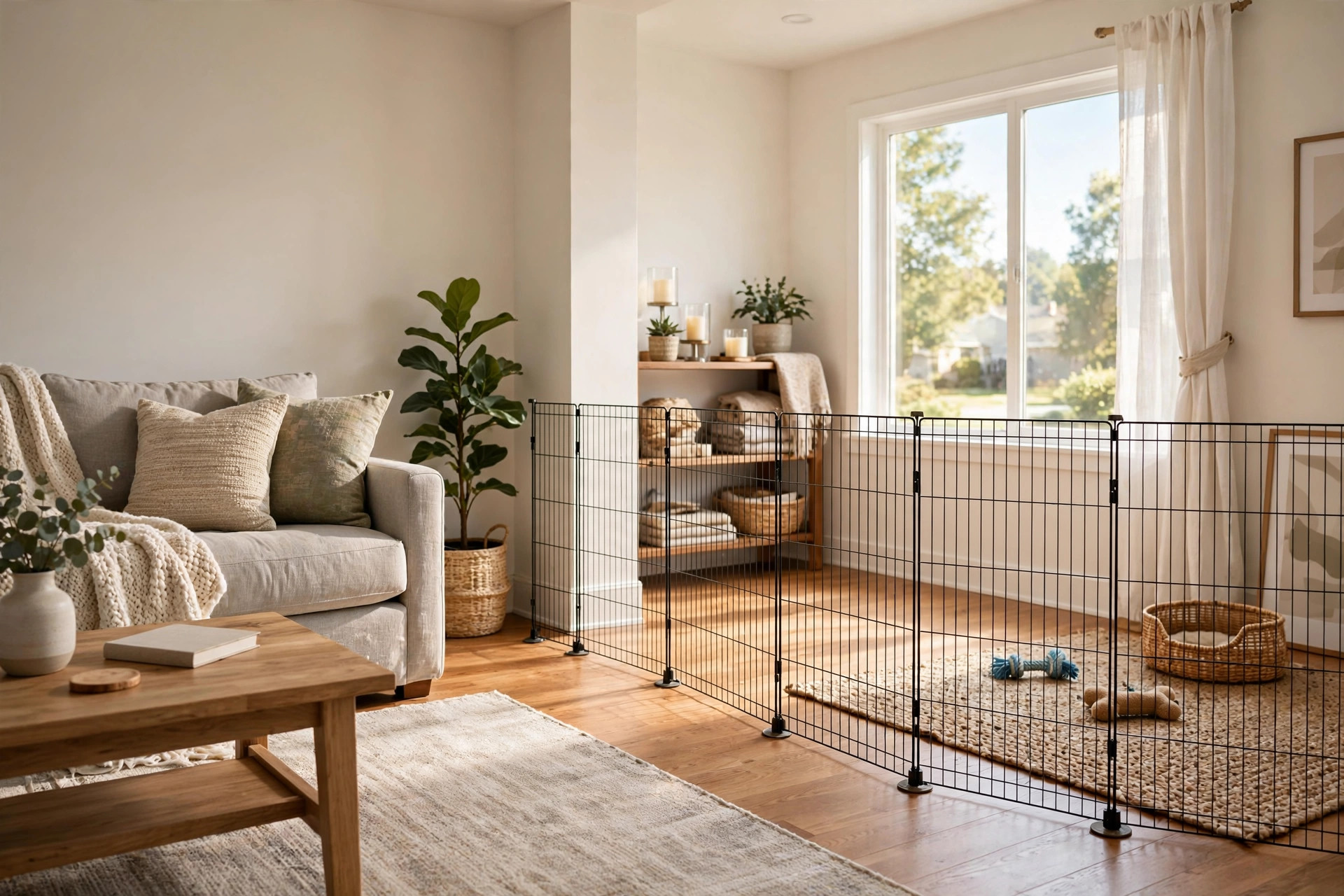

A pet fence indoor freestanding for living room is one of the simplest tools a pet owner can buy. It stands on its own. It needs no screws, no drill, and no holes in the wall. You place it where you need it, and it stays in place by its own weight and design. Many dog and cat owners use it to keep pets out of certain parts of the room, to give a small puppy a safe space of its own, or to protect a sofa, a rug, or a Christmas tree from a curious animal.
A freestanding pet fence is not a cage. It does not lock a pet in a dark corner. It is a light barrier that marks a boundary. Because it is freestanding, you can move it in seconds and fold it flat to store behind a door. This makes it useful for renters, for people in small homes, and for anyone who wants a solution without a tool box.
Why It Matters
A living room is the busiest part of most homes. Guests come through it. Children play in it. Food is served in it. For a pet, the living room is also full of temptation. Cords hang behind the television. Houseplants sit within reach. A new puppy may chew a chair leg or tear a cushion. An older dog may have an accident on an expensive rug. A freestanding pet fence lets you share the room with your pet without watching every step it takes.
Safety is the first reason to buy one. Puppies explore with their mouths. They chew cords, swallow small objects, and climb onto furniture. A fence gives them a clear, safe zone. The second reason is peace of mind. When the doorbell rings, you do not have to chase a jumping dog away from a guest. The third reason is training. A fence helps a puppy learn house rules. Over time, many owners remove the fence because the pet has learned them.
A freestanding fence also protects the pet itself. Open stairways, hot fireplaces, and tall bookshelves are common in living rooms. A fence placed in front of these hazards can prevent a fall or a burn.
What to Look For When You Choose: Pet Fence Indoor Freestanding for Living Room
Height
The height of the fence must match the pet. A small dog or a cat needs a fence of about 24 to 32 inches. A medium dog needs 32 to 40 inches. A large, athletic dog may clear even a 40-inch fence, so taller panels are better. Watch your own pet first. Some dogs jump. Some dogs push. A fence that is too low is useless, and a fence that is too tall may block your view of the room. The goal is a barrier your pet respects but does not fear.
Panel Width and Shape
Most freestanding fences are sold as a set of linked panels. Common sets have four, six, or eight panels. Each panel may be 24 inches wide. A six-panel fence covers about 12 feet in a straight line. You can also arrange the panels in a square or a circle to make a play area. Measure the space in your living room before you buy. A fence that is too long will crowd the room. A fence that is too short will not reach the wall, and the pet will slip around the end.
Stability
Because a freestanding fence has no wall mount, it must stand on its own. Good fences have feet or a wide base on each panel. Some have rubber pads that grip the floor. Test the fence in the store or read owner reports. A fence that tips over when a dog leans on it is not a fence at all. On hard floors, rubber feet help. On carpet, a wider base helps. Some models connect the panels with a slight zigzag shape. This shape gives the whole unit extra strength.
Material
Freestanding pet fences are usually made of metal wire, plastic, or wood. Metal wire is strong and easy to clean. It lets air and light through, so the pet does not feel shut out. Plastic is light and easy to move, but a strong chewer may damage it. Wood looks best in a living room. A wooden fence can match the furniture and the trim of the house. Wood needs more care, and it may not hold up to a dog that scratches. Choose the material that fits both your pet and your home.
Ease of Storage
A freestanding fence should fold flat. Look for panels that fold like an accordion. When folded, the fence should be thin enough to slide behind a sofa or into a closet. Some models come with a carry handle. If you plan to move the fence every day, light weight matters. If the fence will stay in one spot for months, weight is less important than strength.
Types and Options
Wire Panel Fences
Wire panel fences are the most common type. They are made of steel tubes or wire mesh. They are strong, they last for years, and they suit both dogs and cats. Many have a door panel with a latch so you can walk through without moving the whole fence. The open wire lets the pet see the room. These fences work well in homes where function matters more than style.
Wooden Freestanding Fences
Wooden fences look like small pieces of furniture. They are often made of pine or rubberwood with a stained finish. They suit living rooms where the owner wants the fence to blend in. They are best for small dogs, cats, and puppies. A large dog may knock over a light wooden fence or chew the rails. Wooden fences often fold flat and stand well on carpet.
Plastic and Fabric Fences
Plastic fences are light and cheap. They suit puppies and small dogs. Fabric play yards are even lighter. They fold into a small bag and are easy to carry. Fabric is not a good choice for a chewer. A determined puppy can tear fabric in an afternoon. Use fabric only for short, watched periods.
Convertible Play Yards
Some fences can change shape. You can set them up as a long barrier or fold them into a closed pen. This type is useful for puppy owners. During the day, the pen gives the puppy a safe space. In the evening, the same fence becomes a straight barrier across the living room.
Owners who want a fixed solution sometimes look at a best dog playpen for puppies indoor outdoor for full-day use, or a best dog fence for large yard no digging for the garden. A pet gate with cat door for stairway safety is another option when the goal is a doorway rather than an open room.
Cost and Price
A basic plastic freestanding fence for a small dog may cost under twenty dollars. A mid-range metal wire fence with six panels and a walk-through door usually costs between forty and eighty dollars. A large, tall fence for a big dog may cost one hundred dollars or more. A wooden fence with a furniture finish can cost between eighty and one hundred fifty dollars.
Price follows size, height, and material. A taller fence uses more steel. A wooden fence needs a finish. A fence with a built-in door costs more than a plain one. Read the weight limit on the box. A fence rated for a twenty-pound dog will not hold a fifty-pound dog.
Setting It Up
Setting up a freestanding fence takes a few minutes. Open the box and unfold the panels. Place the fence where you want it. Push each foot flat on the floor. If the fence comes with wall pads or cups, use them even though the fence is freestanding. The pads add grip. On a wood or tile floor, check that the rubber feet are clean. Dust under a rubber foot makes the fence slide.
For a straight barrier, run the panels from one wall to a piece of furniture. Leave no gap at the end. Dogs are clever. A dog will find a six-inch gap and use it. For a pen shape, close the panels into a square and lock the ends together. Put a mat or blanket under the pen so the pet is comfortable. Place water within reach. Never place the pen in direct sun from a window for long periods.
Introduce the pet slowly. Let the dog sniff the fence. Give a treat near it. Do not push the pet behind the fence on the first day. Let the fence become part of the room. Most pets accept a fence within a few days. Never use the fence as punishment. The fence should mean rest and safety, not a time-out.
Care and Upkeep
A pet fence needs little care, but it does need some. Wipe metal panels with a damp cloth every few weeks. Dust and pet hair collect on the bars. Check the hinges and latches. A loose latch can swing open at the wrong time. Tighten screws with a small screwdriver. If a rubber foot is missing, replace it. A fence that slides on a hard floor is a hazard.
Wooden fences need more care. Wipe them with a damp cloth and dry them right away. Water can warp wood. Check for chew marks. If the dog has chewed a rail, sand the rough spot smooth. A splinter can hurt a pet. If the finish is worn, a fresh coat of pet-safe sealant will protect the wood. Plastic fences can be washed with soap and water. Rinse them well and let them dry before folding.
Store the fence flat when you are not using it. Do not lean heavy boxes against it. The panels can bend. If a panel bends, bend it back gently by hand. A bent fence will not stand straight, and a crooked fence is easy for a dog to knock over.
Safety
A freestanding fence is a tool, not a babysitter. Never leave a young puppy alone behind a fence for long hours. Puppies can climb, chew, and get stuck. Check the fence each day for sharp edges. Wire fences can develop a broken weld. A broken wire can cut a paw or catch a collar. Remove any collar with tags before the pet is left near a wire fence. Tags can catch between the bars.
Place the fence away from stairs. A dog that knocks a fence over near a stairway can fall. Keep the fence away from the fireplace and the stove. A pet can jump a short fence if it is excited. Do not trust a low fence with an unsupervised dog that has jumped before. For cats, remember that most cats can jump a 32-inch fence with ease. A fence will slow a cat and mark a boundary, but it will not stop a determined cat. If you need to keep a cat fully contained, a closed room or a tall enclosure is better.
Anchor the fence on both ends when you can. A fence that runs from a wall to a heavy sofa is more stable than one that stands alone in the middle of the room. Do not place food or toys where the pet must jump the fence to reach them. The fence teaches a boundary. Mixed signals undo the training.
Frequently Asked Questions
Will a freestanding fence work on a hardwood floor?
Yes, if it has rubber feet. Rubber feet grip the floor and stop the fence from sliding. Some owners add small rubber pads under the feet for extra grip. Check the feet often. Dust and hair reduce grip. A wide-based fence is more stable on a smooth floor than a narrow one.
Can a freestanding fence hold a large dog?
It depends on the dog and the fence. A tall, heavy steel fence can hold many large dogs. But a large dog that charges or jumps can knock over most freestanding fences. For strong dogs, choose the tallest and heaviest model you can find. Anchor the ends against a wall or heavy furniture. Some owners of very strong dogs choose a pressure-mounted gate instead.
Is a freestanding fence good for cats?
A freestanding fence can work as a visual boundary for a calm cat. Many cats respect a fence that marks a no-go zone, such as a kitchen counter area. But most healthy cats can jump over a standard fence. If the goal is to keep the cat in one room, a closed door is more reliable. The fence works best as a gentle reminder, not a cage.
How do I stop my puppy from chewing the fence?
Give the puppy something better to chew. A safe chew toy placed near the fence draws the puppy’s attention away from the bars. A bitter apple spray made for pets can be applied to wooden rails. Do not use household chemicals. If the puppy chews metal bars, the puppy may be bored or anxious. More play and exercise often solve the chewing problem.
Can I use the fence outdoors?
Some metal fences can be used on a patio for short periods. Check the product label. Most indoor fences will rust if left out in the rain. Wooden fences should stay indoors. If you need an outdoor barrier, buy a model rated for outdoor use. Bring any indoor fence inside after use.
How long should a pet stay behind the fence each day?
A fence is for short periods, not all day. Puppies need play, training, and human contact. A few hours at a time is fine for an adult dog that is resting. A puppy should not be left behind a fence for more than two hours without a break. The fence is a management tool. It works best together with walks, play, and training.
A Short Final Word
A pet fence indoor freestanding for living room is a small buy that can change daily life with a pet. It needs no tools. It moves in seconds. It keeps the pet safe and the home calm. Choose the right height and the right material. Set it up with care. Check it often. Use it with kindness, and it will serve you and your pet well for years.
For more background, see ASPCA, PetMD, and American Kennel Club. For more background, see The Spruce Pets, The Home Depot, and Chewy. See also Petco and PetSmart for further detail.
References
American Kennel Club. (n.d.). Dog care and training resources. https://www.akc.org ASPCA. (n.d.). Pet care and animal welfare resources. https://www.aspca.org Chewy. (n.d.). Pet supplies. https://www.chewy.com Petco. (n.d.). Pet supplies and services. https://www.petco.com PetMD. (n.d.). Pet health information. https://www.petmd.com PetSmart. (n.d.). Pet supplies and services. https://www.petsmart.com The Home Depot. (n.d.). Home improvement products. https://www.homedepot.com The Spruce Pets. (n.d.). Pet care guides and product reviews. https://www.thesprucepets.com
Was this guide helpful?

About Michael Thompson
The My Garden US editorial team writes practical, in-depth home and garden guides for American homeowners — tested advice, no fluff.
You May Also Like

A Dog Car Seat for Small Dogs: The Console Booster Guide
January 21, 2026 0 views
Pet Gate Freestanding for Wide Doorways: A Buyer’s Guide for American Homes
May 10, 2026 0 views
Best Pet Gate for Deck Stairs Outdoor Use
September 11, 2026 0 views