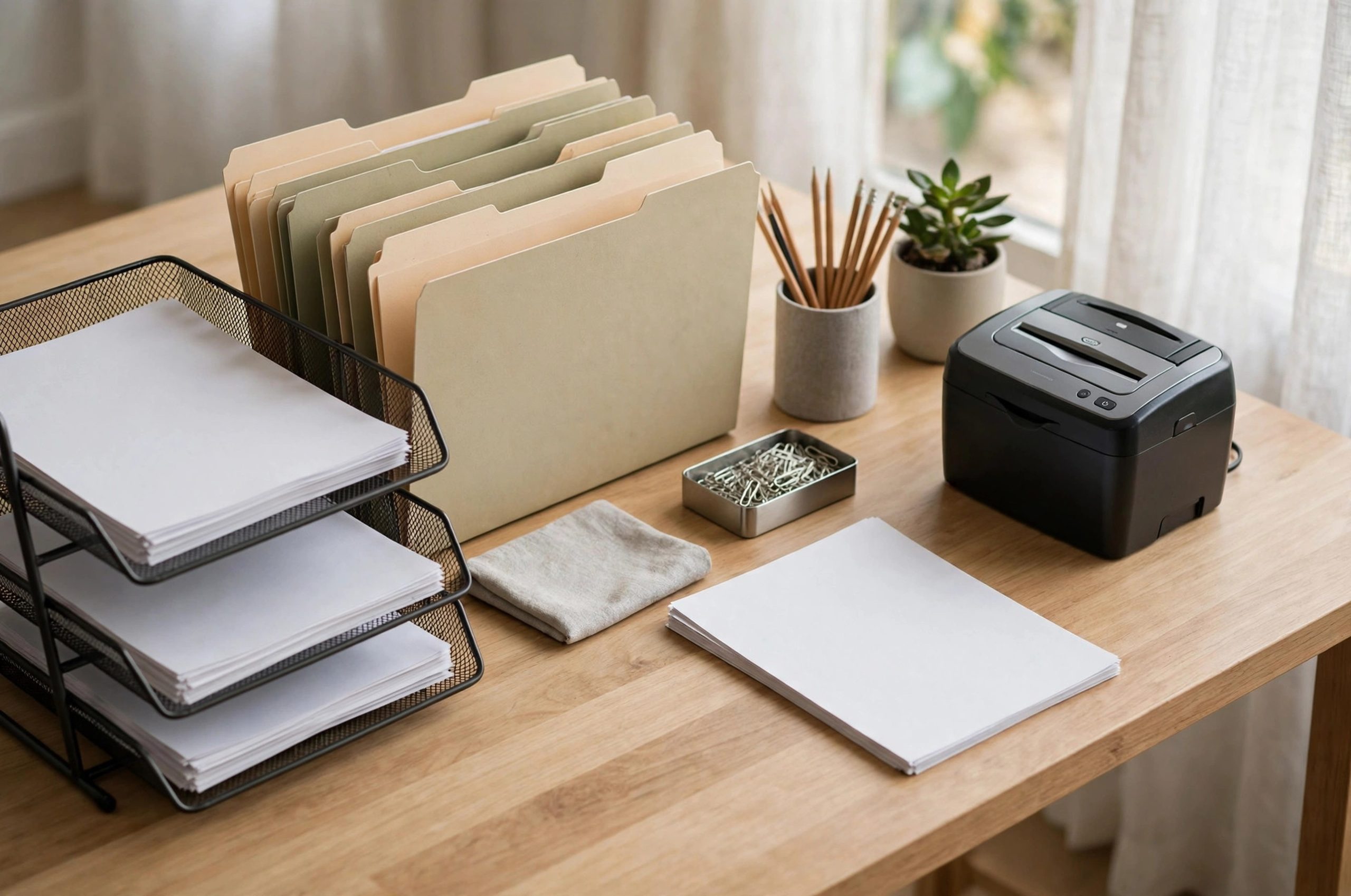
Paper is the quietest clutter in a home office. It arrives one envelope at a time: bills, school forms, receipts, catalogs, and notices you meant to read. Each piece seems harmless. Together they bury the desk, fill the drawers, and turn "I will file it later" into a permanent state. Learning how to organize a home office paper clutter problem takes one focused sorting session and a simple system to stop the piles from coming back. This article explains how to organize a home office paper clutter in simple terms.
Table of Contents
Table of Contents
- Organize a Home Office Paper Clutter: Gather and Sort the Backlog
- Shred and Recycle Without Mercy
- Know What You Must Keep
- Build a Simple Filing System
- Create an Action Station for Incoming Paper
- Digitize to Shrink the Piles
- Handle Kids' School Papers
- Cut the Inflow at the Source
- Maintain With a Weekly Reset
- References
The method has three parts: clear the backlog, build a small set of homes for paper, and cut the inflow. Do all three and the desk stays clear.
Organize a Home Office Paper Clutter: Gather and Sort the Backlog
When it comes to organize a home office paper clutter, getting the details right makes all the difference.

Many homeowners find that organize a home office paper clutter is easier than they expected once they know the basics.
Collect every loose paper in the office, and check the rest of the house too. Kitchen counters, entry tables, and nightstands all collect paper that belongs in the office system. Pile it all in one place. Seeing the full backlog is motivating, and sorting goes faster in one batch than in dribs and drabs.
Sort into five piles. Trash and recycling: junk mail, envelopes, inserts, expired coupons, and anything with no value. Shred: anything with account numbers, Social Security numbers, or personal details. Action: bills to pay, forms to sign, things with deadlines. File: records to keep, like tax documents and warranties. Reference: manuals, medical records, and school papers you might need.
Work quickly. Touch each paper once and decide. If you have not needed it in a full season and it is not a legal or tax record, you almost certainly do not need it. Apartment Therapy's paper clutter guide uses these same five categories and recommends dealing with trash and recycling immediately so the remaining piles feel manageable.
Shred and Recycle Without Mercy
Many homeowners find that organize a home office paper clutter is easier than they expected once they know the basics.
The key to organize a home office paper clutter is choosing the right approach for your space and budget.
The trash pile is the easy win. Recycle junk mail, catalogs, and envelopes right away. For the shred pile, a small crosscut shredder handles a home office. Shred in batches while you do something else. Sensitive documents should never go in the recycling bin intact.
Be ruthless with these categories. Old utility bills you can download online. Expired warranties for things you no longer own. Pay stubs from jobs you left long ago. Bank statements available in your online account. Duplicates of anything. When in doubt, scan it before shredding so you keep a digital copy without keeping the paper.
Know What You Must Keep
The key to organize a home office paper clutter is choosing the right approach for your space and budget.
With a little planning, organize a home office paper clutter can fit even a busy schedule.
Some paper has to stay. The IRS advises keeping tax returns and supporting documents until the period of limitations runs out, generally three years after filing, longer in special cases like bad debt deductions or unfiled returns. Keep property records as long as you own the asset plus several years after selling. Employment tax records have their own four-year rule.
Beyond taxes, keep: birth certificates, Social Security cards, car titles, deeds, insurance policies, medical records, and active warranties. These deserve a fireproof box or a safe, not a desk drawer. Everything else in the file pile should fit in one filing drawer or one portable file box. If it does not fit, you are keeping too much.
Jackson Hewitt's record-keeping guide breaks down the three-year, six-year, and indefinite retention rules in plain language, which helps you decide what stays and what goes with confidence.
Build a Simple Filing System
With a little planning, organize a home office paper clutter can fit even a busy schedule.
Before you start, it helps to understand how organize a home office paper clutter works in real homes.
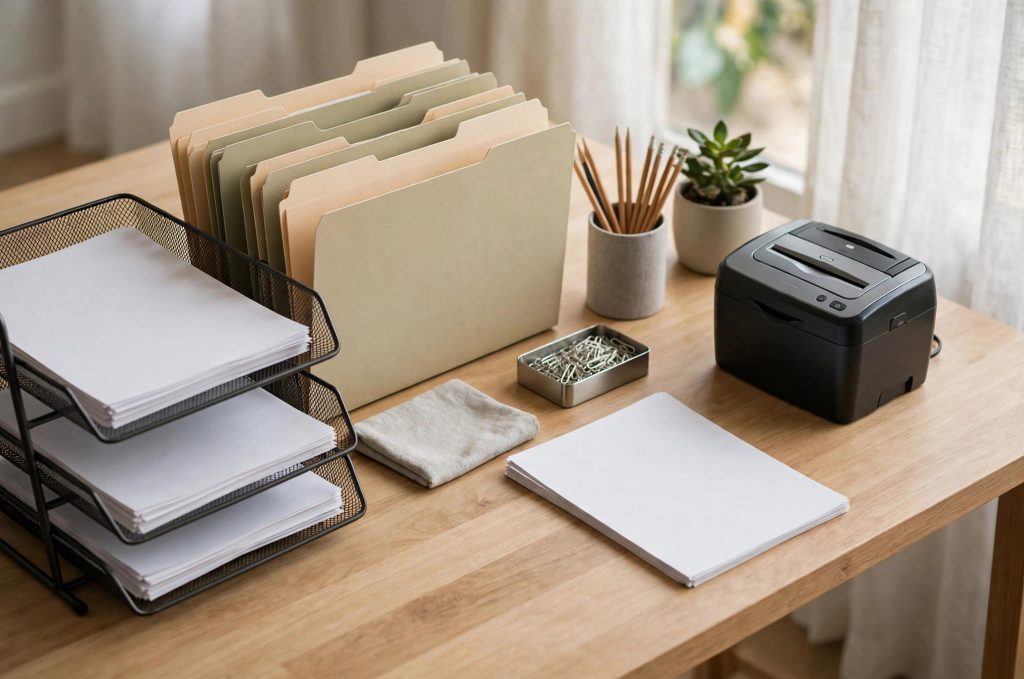
A filing system fails when it has too many categories. Keep it to a handful of broad folders: Taxes, Home, Medical, Insurance, Vehicle, Work, School, and Personal. Use one hanging folder per category in a single drawer or file box. Subdivide only if a category overflows.
Label folders clearly and file from the action tray weekly. A system with thirty micro-categories never gets maintained. A system with eight broad folders does. Put the filing drawer or box within arm's reach of where you open mail. Distance kills filing habits.
For active projects, use a desktop file sorter or a small set of trays. Livingetc's desk organization guide recommends trays labeled "To Do," "To File," and "Done" so paper has a visible next step instead of forming anonymous piles. Our guide to desk organizer sets for small desks covers trays and sorters that fit tight workspaces.
Create an Action Station for Incoming Paper
Before you start, it helps to understand how organize a home office paper clutter works in real homes.
A good plan for organize a home office paper clutter saves time, money, and frustration.
Most paper clutter is really a decision backlog. Mail arrives, you glance at it, and it lands on the desk because the decision takes effort. An action station forces the decision at the door.
Set up three spots near where mail enters: a tray or wall pocket for action items, a shredder or shred bag for junk with personal data, and a recycling bin for the rest. Open mail standing at the station. Toss, shred, or file immediately. Only true action items, bills to pay and forms to complete, earn a place in the action tray.
Process the action tray on a schedule. Twice a week works for most households. Pay the bills, sign the forms, make the calls. Then file or recycle the results. Apartment Therapy's paperwork cure recommends a weekly paper review to keep the system from backsliding, treating it like any other household routine.
Digitize to Shrink the Piles
A good plan for organize a home office paper clutter saves time, money, and frustration.
For most people, organize a home office paper clutter comes down to a few smart choices.
Scanning turns paper piles into searchable files. A small sheet-fed scanner chews through a backlog fast. For occasional scanning, a phone app works fine. Scan tax records, receipts, warranties, manuals, and kids' school papers. Name files clearly: "Electric Bill - March" beats "scan001.pdf."
Store scans in a simple folder structure that mirrors your paper files: Taxes, Home, Medical, and so on. Back up to a cloud service or an external drive. The IRS accepts digital records and even encourages scanning paper tax documents into encrypted, backed-up formats.
Once a document is scanned and backed up, shred the paper unless it is one of the must-keep originals. The whole point of digitizing is to let the paper go. A scanned receipt in a labeled folder is more useful than a fading thermal-paper original in a shoebox.
Handle Kids' School Papers
For most people, organize a home office paper clutter comes down to a few smart choices.
School papers deserve their own mini-system, or they will swamp the office. Set up one inbox tray per child near where backpacks land. Each evening, pull out the papers, sign what needs signing, and recycle the rest immediately. Most worksheets, flyers, and notices have a lifespan of one day.
Keep a single keepsake folder per child per school year for the truly special items: the first story, the prize-winning drawing, the class photo. When the folder fills, curate it down to the best ten pieces before starting a new one. Everything else gets recycled or photographed for a digital keepsake album. This keeps sentiment from turning into storage.
Cut the Inflow at the Source
If you are new to organize a home office paper clutter, start with the simplest option and build from there.
The best paper system is the one that receives less paper. Switch bills, bank statements, and investment accounts to paperless. It takes an afternoon to enroll, and the mail pile shrinks dramatically.
Opt out of junk mail and catalogs. Most catalogs have an opt-out link or phone number. Pre-approved credit offers can be stopped through the official opt-out service. Unwanted phone books can be declined at the source. Every subscription you cancel is paper you never have to sort.
Rethink printing. Before printing, ask if a digital copy works. For the occasional necessary print, print it, use it, and recycle it the same day. Apartment Therapy's home office guide stresses preventing buildup first: opt out of unnecessary mail and question every print job before the paper ever reaches the desk.
Maintain With a Weekly Reset
When it comes to organize a home office paper clutter, getting the details right makes all the difference.
Paper systems die from neglect, not design flaws. Build a fifteen-minute weekly reset. Open the week's mail at the action station. Process the action tray. File what needs filing. Shred what needs shredding. Recycle the rest.
Keep supplies stocked: folders, labels, envelopes, stamps. A missing stamp is a silly reason for a bill to sit for two weeks. Keep a small stock of everything the system needs so friction never builds.
Do a deeper purge twice a season. Pull the file drawer, toss expired records, and confirm the categories still make sense. Life changes: kids' school folders become medical folders, old warranties expire. The system should evolve with you.
For the physical side of the office, our guides to bookshelf and desk combos, wall-mounted desk shelves, and trash cans with lids for documents help keep the workspace itself as tidy as the paper system. A stable desk chair rounds out a comfortable, clutter-free setup.
Paper clutter feels overwhelming because it never stops arriving. But it is one of the easiest clutter types to beat permanently. Sort the backlog once, keep only what the rules require, file in broad categories, digitize the rest, and choke off the inflow. The desk stays clear, the records stay findable, and the paper stops running the office. That is all it takes to organize a home office paper clutter with confidence.
References
Apartment Therapy. (n.d.). How to deal with piles of paperwork in your house. https://www.apartmenttherapy.com/decluttering-paperwork-37685481
Apartment Therapy. (n.d.). How to reduce paper clutter in your home office. https://www.apartmenttherapy.com/how-to-remove-home-office-paper-clutter-37046910
Apartment Therapy. (n.d.). How to stop holding onto your paper clutter. https://www.apartmenttherapy.com/how-to-declutter-paper-clutter-37688140
Internal Revenue Service. (n.d.). How long should I keep records? https://www.irs.gov/businesses/small-businesses-self-employed/how-long-should-i-keep-records
Internal Revenue Service. (n.d.). Tax preparedness series: Tax records, what to keep. https://www.IRS.gov/newsroom/tax-preparedness-series-tax-records-what-to-keep
Jackson Hewitt. (n.d.). How long should you keep tax records? https://www.jacksonhewitt.com/tax-help/tax-tips-topics/filing-your-taxes/record-keeping/
LegalClarity. (n.d.). What are tax records and how long to keep them? https://legalclarity.org/what-are-tax-records-and-how-long-to-keep-them/
Livingetc. (n.d.). My desk was a clutter hotspot, until I followed these tips. https://www.livingetc.com/advice/clutter-free-desk
Was this guide helpful?

About My Garden US
The My Garden US editorial team writes practical, in-depth home and garden guides for American homeowners — tested advice, no fluff.
You May Also Like

Stackable Shoe Storage Racks for Texas Homes: A Practical Guide
July 15, 2026 18 views
Patio Cushion Storage Bags Reviews and Buying Guide
January 25, 2026 17 views
Spice Rack Organizers Reviews and Buying Guide: Choose the Right One for Your Kitchen
May 11, 2026 22 views