---
Table of Contents
Table of Contents
- Raise Calcium Hardness Pool Water: Why Calcium Hardness Matters
- Know Your Target Range
- How Much Calcium Chloride to Add
- How to Add Calcium Chloride Safely
- What If Your Fill Water Is Soft
- Calcium and Your Other Chemicals
- Signs Your Calcium Is Off
- Common Mistakes
- Frequently Asked Questions
- The Bottom Line
- References
Calcium hardness is the quiet one in pool chemistry. Owners test chlorine and pH all the time, but calcium sits in the background until something goes wrong. Too little calcium and your water turns hungry: it starts pulling calcium out of plaster, grout, and concrete, etching surfaces and corroding metal parts. Too much and you get cloudy water and crusty scale on everything the water touches. This guide covers raise calcium hardness pool water in plain steps.
If your test shows calcium hardness below the safe range, you need to raise it. The fix is straightforward: add calcium chloride, the standard calcium hardness increaser, in measured doses. This guide covers the target ranges, how to calculate your dose, how to add it safely, and the mistakes that cause more harm than low calcium ever did.
Raise Calcium Hardness Pool Water: Why Calcium Hardness Matters
When it comes to raise calcium hardness pool water, getting the details right makes all the difference.
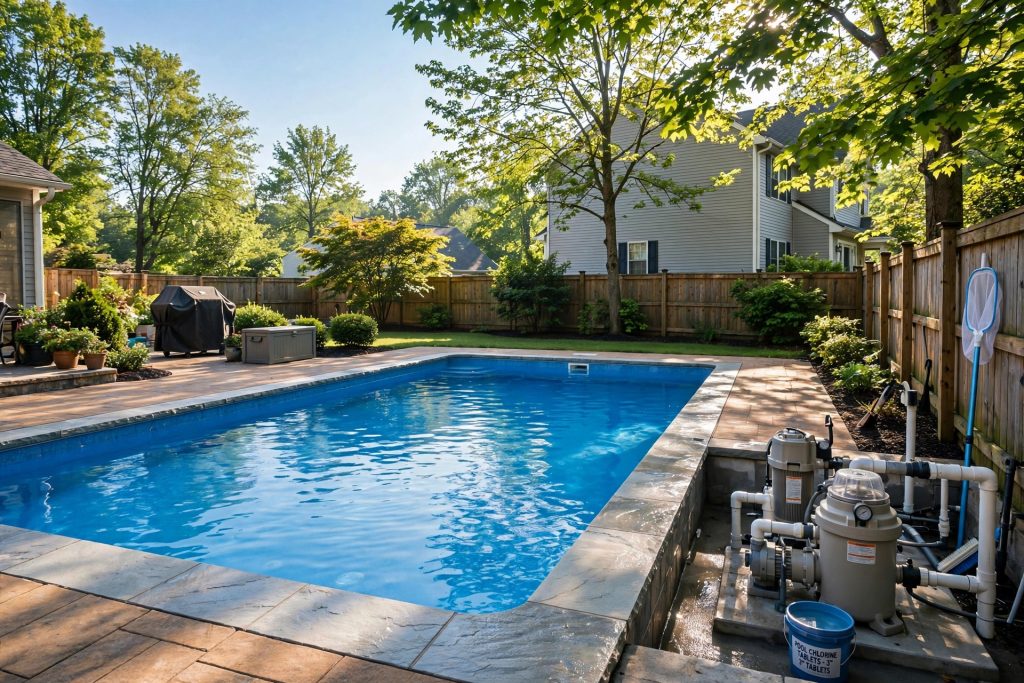
Many homeowners find that raise calcium hardness pool water is easier than they expected once they know the basics.
Water wants to be balanced. When calcium is low, water becomes aggressive. It dissolves calcium from wherever it can find it: your plaster finish, your tile grout, your concrete coping. Over a season or two, that etching shows up as rough spots, pitted plaster, and thinning grout lines. Repairs cost far more than a bag of calcium chloride.
Low calcium also hurts equipment. Heaters, pump seals, and metal fittings corrode faster in soft, hungry water. And soft water foams more easily, which hot tub owners notice first.
On the other side, high calcium causes its own trouble: cloudy water, scale on the waterline tile, and crust inside the heater and salt cell. The goal is the middle ground, not the maximum. The Swim University calcium guide puts the ideal pool range at 200 to 400 ppm, with spas running a bit lower.
Know Your Target Range
Many homeowners find that raise calcium hardness pool water is easier than they expected once they know the basics.
The key to raise calcium hardness pool water is choosing the right approach for your space and budget.
Test first, then decide. The ranges below are the widely used standards:
- Concrete, plaster, or gunite pools: 200 to 400 ppm
- Vinyl liner or fiberglass pools: 175 to 225 ppm is often enough, since there is no plaster to protect
- Spas and hot tubs: 150 to 250 ppm
Use a proper test kit, not a guess. Test strips work for a rough read, but a drop-count titration kit gives a real number you can dose from. Test at the start of the season and monthly during swim months, plus any time the water turns cloudy without an obvious cause. The Pool Chemical Calculator calcium guide suggests testing monthly through the season and any time you see scaling or corrosion.
Write down your starting number. You will need it for the dose math.
How Much Calcium Chloride to Add
The key to raise calcium hardness pool water is choosing the right approach for your space and budget.
With a little planning, raise calcium hardness pool water can fit even a busy schedule.
Calcium chloride is the product to use. It is sold as calcium hardness increaser at pool stores. The standard dosing rule: about 1.25 pounds of calcium chloride per 10,000 gallons of water raises calcium hardness by roughly 10 ppm. The Hunker walkthrough uses this same ratio with a bucket-dissolve method.
Work the math for your pool:
1. Find your pool volume in gallons. Length times width times average depth times 7.5 gives a close estimate for a rectangle. 2. Subtract your current calcium reading from your target. That is the ppm increase you need. 3. Multiply: (ppm increase / 10) x 1.25 pounds x (pool gallons / 10,000).
Example: a 20,000-gallon pool at 150 ppm targeting 250 ppm needs a 100 ppm rise. That is (100 / 10) x 1.25 x 2 = 25 pounds of calcium chloride.
Start with a little less than the math says. You can always add more tomorrow. Taking calcium out is much harder than putting it in. If you need a large increase, split it across two or three days rather than dumping it all at once.
How to Add Calcium Chloride Safely
With a little planning, raise calcium hardness pool water can fit even a busy schedule.
Before you start, it helps to understand how raise calcium hardness pool water works in real homes.
Calcium chloride gets hot when it dissolves. That heat is normal, but it demands respect. Wear gloves and eye protection, and keep children and pets away while you work.
1. Balance pH and alkalinity first. Get pH between 7.2 and 7.8 and total alkalinity between 80 and 120 ppm before you add calcium. Adding calcium to wild pH can cause it to precipitate out as cloudy white dust. If you are also working on alkalinity, the guide to raising pool alkalinity walks through that step.
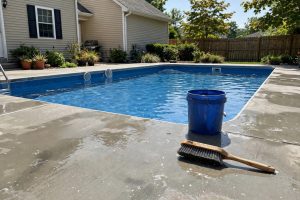
2. Pre-dissolve in a bucket. Fill a clean bucket with pool water, then add the calcium chloride to the water, a little at a time, stirring gently. Never add water to dry calcium chloride, and never exceed about five pounds per bucket. The solution will get warm. That is the expected chemical reaction, not a problem. The Orenda procedures guide caps each bucket at five pounds for the same reason.
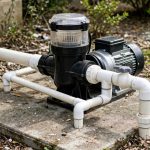
3. Pour around the pool with the pump running. Walk the deep end and pour the dissolved mixture slowly near the return jets. Keep the pump running for at least six to eight hours so the calcium distributes evenly.
4. Brush any settled granules. If you see undissolved bits on the floor, brush them around. Granules sitting on plaster can leave marks.
5. Retest the next day. Give the water a full day of circulation, then test calcium again. Add a second partial dose if you are still short of target.
Never pour calcium chloride into the skimmer. The concentrated solution can damage plastic components and filter parts. Broadcast it in the pool or pour pre-dissolved mixture at the returns. The Engineer Fix dosing guide warns that adding dry chemical directly to the pool risks localized over-concentration that can damage the surface finish.
What If Your Fill Water Is Soft
Before you start, it helps to understand how raise calcium hardness pool water works in real homes.
A good plan for raise calcium hardness pool water saves time, money, and frustration.
Some regions have naturally soft tap water. If your fill water tests under 100 ppm calcium, every top-off dilutes your pool's calcium level. You will find yourself adding calcium chloride more often than owners in hard-water areas.
A few things help. Test your fill water once so you know what you are working with. Keep a bag of calcium chloride on hand through the season. And go easy on backwashing and splash-out replacement, since each refill drags the number down again. Owners dealing with very soft source water sometimes look at whole-house treatment; the water softener regeneration frequency guide covers how softening schedules work, which is useful background if your home runs a softener that feeds the hose bib.
Getting raise calcium hardness pool water right takes a little patience, but the steps are simple.
Calcium and Your Other Chemicals
A good plan for raise calcium hardness pool water saves time, money, and frustration.
For most people, raise calcium hardness pool water comes down to a few smart choices.
Calcium does not act alone. It interacts with pH, alkalinity, and temperature in what chemists call the saturation balance. The practical version:
- High pH plus high calcium equals scale. Keep pH in range and scale stays away.
- Low pH plus low calcium equals corrosion. This combination eats plaster and metal fastest.
- Add chemicals one at a time. Do not dose calcium on the same day you adjust pH or alkalinity by large amounts. Space major adjustments by a day so each one settles.
Salt pool owners should pay extra attention. Salt cells scale up faster when calcium runs high, which cuts chlorine output. Keep calcium in the middle of the range, not the top, if you run a salt system.
Signs Your Calcium Is Off
For most people, raise calcium hardness pool water comes down to a few smart choices.
If you are new to raise calcium hardness pool water, start with the simplest option and build from there.
Too low: Etched or rough plaster, pitting on concrete surfaces, corroded heater parts, persistent foaming in the spa, and water that feels harsh despite balanced pH.
Too high: Cloudy water that will not clear, white crust on the waterline tile, scale flakes in the skimmer basket, and reduced flow through the heater.
Either direction calls for a test and a correction. The basic chemistry targets on the Swimming Pool Steve chemistry page list calcium alongside pH, alkalinity, and sanitizer so you can check the whole panel at once.
Common Mistakes
If you are new to raise calcium hardness pool water, start with the simplest option and build from there.
Dosing without testing. Guessing the dose is how pools end up at 600 ppm. Test, calculate, and dose.
Adding it all at once. Large single doses overshoot. Split big increases across days.
Mixing calcium adjustments with pH adjustments. Do one, wait a day, then do the other.
Pouring granules straight into the skimmer. Pre-dissolve, always.
Ignoring the fill water. If your tap water is liquid rock at 400 ppm calcium, you may never need to add calcium at all. Test the hose water before you buy the product. The Perfect Pools dosing guide notes the standard pool target of 200 to 400 ppm, which many hard-water regions reach without any additions.
Forgetting that some chlorine products add calcium. Calcium hypochlorite shock (cal-hypo) adds calcium with every dose. If you shock with cal-hypo weekly, your calcium climbs on its own. Liquid chlorine and salt systems do not add calcium, so owners using those need to watch the low end instead.
Frequently Asked Questions
When it comes to raise calcium hardness pool water, getting the details right makes all the difference.
Can I swim right after adding calcium chloride? Wait until the product is fully dissolved and distributed, and retest to confirm levels. Most guides suggest waiting until the next day. At minimum, give it several hours of circulation.
Will calcium chloride raise my pH? It has a mild effect, but the bigger risk is precipitation if pH is already high. That is why you balance pH first.
Is calcium hardness increaser the same as calcium chloride? Yes. Pool store "calcium hardness increaser" is calcium chloride, sometimes with a small amount of other salts. Check the label for the active ingredient and its concentration, since weaker products need larger doses.
My calcium is too high. How do I lower it? Partial drain and refill with lower-calcium water is the reliable fix. There is no chemical that removes calcium. If your fill water is also high in calcium, a reverse osmosis treatment or a portable water softener for the fill hose can help.
The Bottom Line
Many homeowners find that raise calcium hardness pool water is easier than they expected once they know the basics.
Raising calcium hardness in pool water is simple when you test first and dose with care. Know your pool volume, know your starting number, add calcium chloride in pre-dissolved batches with the pump running, and retest the next day. Keep calcium in its range and your plaster stays smooth, your heater stays clean, and your water stays comfortable. It is a twice-a-season task that protects some of the most expensive surfaces you own. For related water-quality topics, the chloramine filter reviews and the catalytic carbon versus activated carbon filter guide cover what comes out of the tap before it ever reaches your pool. With these steps, raise calcium hardness pool water stays simple and safe.
References
- Engineer Fix. (n.d.). How much calcium hardness to add to pool. https://engineerfix.com/how-much-calcium-hardness-to-add-to-pool
- Hunker. (n.d.). How to raise calcium hardness in a swimming pool. https://www.Hunker.Com/13417973/how-to-raise-calcium-hardness-in-a-swimming-pool/
- Metapress. (n.d.). Water wellness: The official guide to swimming pool wellness. https://metapress.com/water-wellness-the-official-guide-to-swimming-pool-wellness/
- Orenda Technologies. (n.d.). How to raise calcium hardness in water. https://procedures.orendatech.com/how-to-raise-calcium-hardness?hs_amp=true
- Perfect Pools. (n.d.). Calcium hardness increaser 10kg. https://perfectpools.co.nz/products/calcium-hardness-increaser-10kg
- Pool Chemical Calculator. (n.d.). Pool calcium hardness: The complete guide to perfect water balance. https://poolchemicalcalculator.com/news/pool-calcium-hardness/
- Swim University. (n.d.). How to balance calcium hardness in your pool. https://www.swimuniversity.com/calcium-hardness-pool/
- Swimming Pool Steve. (n.d.). Basic pool water chemistry values. https://SwimmingPooLSteve.com/pages/chemistry.html
Was this guide helpful?

About My Garden US
The My Garden US editorial team writes practical, in-depth home and garden guides for American homeowners — tested advice, no fluff.
You May Also Like
How to Clean Pool Ladder Steps: A Complete Guide for Pool Owners
September 5, 2026 5 views
How to Add Cyanuric Acid to Pool Water Safely
April 7, 2026 4 views
Best Pool Heater for Inground Pools: A Complete Buyer Guide
July 2, 2026 6 views