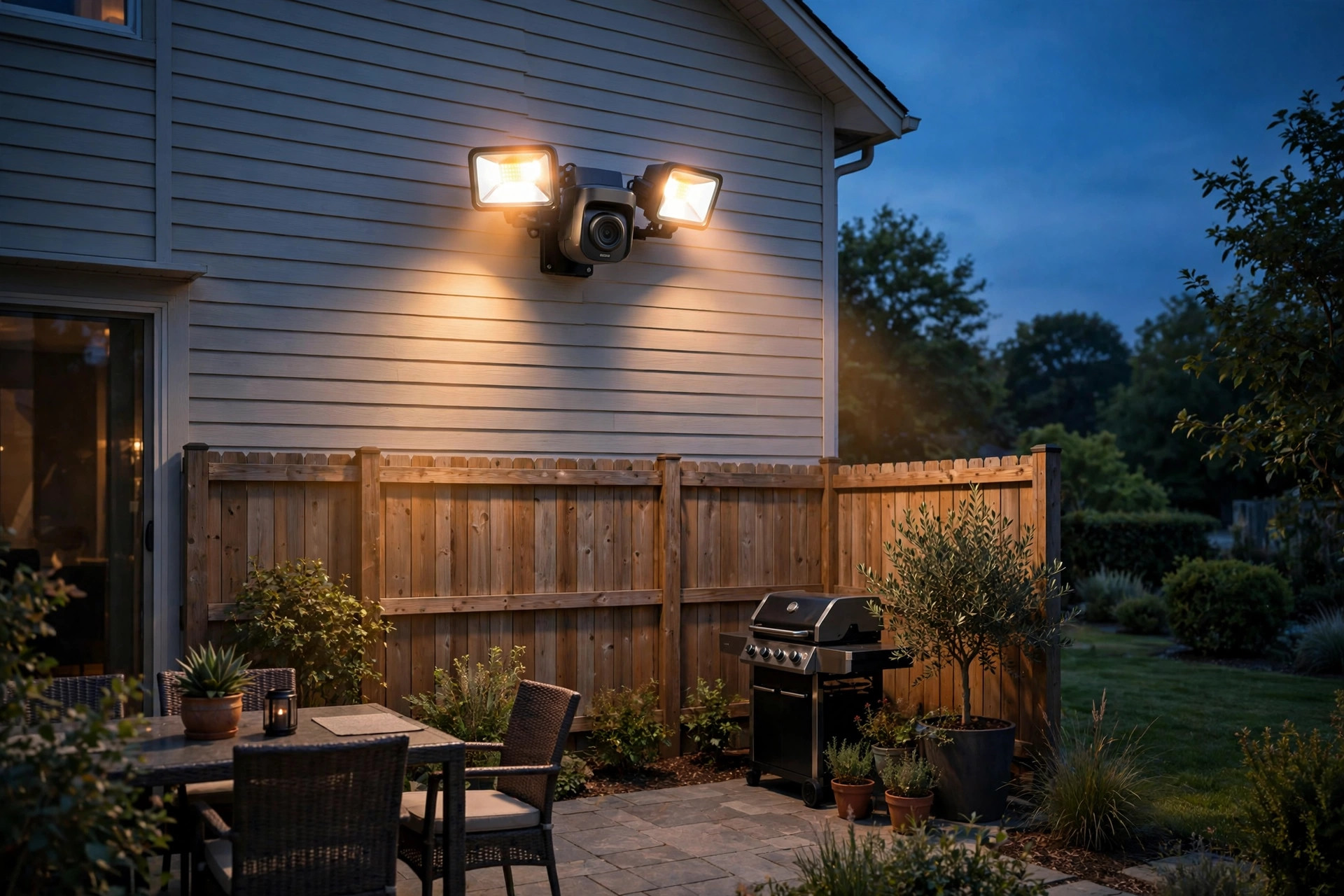

A good floodlight camera can make a house feel safe. It lights up the yard when it senses motion. It records video of what it sees. Many models do this well. The catch is the monthly fee. Many brands charge for cloud storage and smart alerts. These floodlight camera reviews without subscription usa show which cameras work well with no monthly plan.
The idea is simple. You pay once for the camera. You store video on a card or a hard drive in your own home. No one bills you each month. This guide walks through how these cameras work, what to look for, what they cost, and how to keep them running.
Why It Matters
Most camera brands run on a subscription model. The camera itself is sold at a fair price. The profit comes later, month after month. Cloud plans often cost between five and fifteen dollars a month for each camera. A house with three cameras can pay over three hundred dollars a year in fees. Over five years, the fees cost more than the cameras did.
A camera with no required subscription ends that cycle. You own the hardware. You own the video. There is no account that stops working if you miss a payment. Many buyers read floodlight camera reviews without subscription usa for this exact reason. They want full function on day one, with no monthly bill.
There is also a privacy angle. When video goes to a company server, the company holds it. When video stays on a memory card inside the camera, or on a recorder in your closet, you hold it. Many home owners prefer that. Reviews from consumer testing sites often note which cameras keep video local and which ones push it to the cloud.
What to Look For When You Choose: Floodlight Camera Reviews Without Subscription Usa
Video Quality
Look for at least 1080p video. This is full high definition. It is sharp enough to read a face at a fair distance. Many no-subscription models now offer 2K or 4K. Higher resolution helps when you zoom in on a license plate. It also fills up storage faster. For most homes, 2K is a good middle ground.
Night vision matters as much as daytime quality. A floodlight camera has a real advantage here. When the lights switch on, the camera records in full color instead of grainy black and white. Check reviews for night clips. Some cameras show clean color at night. Others show a dim, noisy image even with the lights on.
Local Storage
This is the heart of a no-subscription camera. The camera must save video somewhere you control. The most common choice is a microSD card slot. A 128 GB card can hold days or weeks of motion clips. A 256 GB card holds more.
Some systems use a base station with a hard drive. Others connect to a network video recorder, called an NVR. Both keep video in your home. When you read floodlight camera reviews without subscription usa, check what the reviewer says about storage. A camera that claims “no subscription needed” but only saves short clips to the cloud is not truly fee free.
Motion Detection and Alerts
A floodlight camera should turn on its lights when something moves. The best ones let you draw zones on the screen. You can watch the driveway and ignore the street. This cuts down on false alerts from passing cars.
Look for a camera that tells the difference between a person, a pet, and a car. This feature is called smart detection. Some brands only give it to paid subscribers. The models worth buying give it to everyone, for free. Tech reviews on CNET often test how well each camera handles false motion, and their results are worth a read.
Two-Way Talk
Most floodlight cameras have a speaker and a microphone. You can talk to a visitor through your phone. You can also warn off a stranger. The speaker should be loud and clear. A weak speaker is a common complaint in cheap models.
Power and Wi-Fi
Floodlight cameras are wired to your house power. They replace an existing outdoor light fixture. This means they need a junction box with constant power. If you do not have one, an electrician must add it.
Wi-Fi must reach the spot where the camera sits. A camera at the far corner of a large yard may lose its signal. A strong home network, or a mesh system, solves this. Some models connect to a base station with its own wireless link, which is more stable.
Types and Options
Hardwired Floodlight Cameras
These are the most common type. They wire into a standard outdoor light box. They get steady power, so the lights can stay bright and the camera can record around the clock. Installation takes an hour or two for someone handy. If you are not sure about wiring, hire an electrician. Electrical work on a wet outdoor fixture is no place to guess.
Solar and Battery Models
A few makers offer floodlight cameras with a solar panel and a battery. These go where no wires run, such as a shed or a gate. They work, but the light is dimmer and the battery needs sun. In cloudy states, the camera may sleep through long nights. For a main entrance, a wired model is the safer pick.
Camera and Light Sets
Some brands sell the floodlight and the camera as separate units that talk to each other. The light mounts low on a garage. The camera mounts high on a corner. This split setup covers a wider area. It costs more and takes longer to install. It suits large yards and long driveways. Shoppers looking at a smart floodlight for the backyard often pair it with a separate camera for full coverage.
Wired Systems With an NVR
A small number of floodlight cameras connect to a network video recorder over a wire. The recorder sits inside the house and stores weeks of video on a hard drive. Nothing leaves the home network. This is the most private option. It costs the most up front. It suits buyers who want zero cloud use of any kind.
How These Cameras Compare to Other No-Fee Options
A floodlight camera is not the only way to avoid a subscription. Many buyers also look at an outdoor security camera without a Wi-Fi subscription for spots where a bright light is not wanted. Others pair the floodlight with a separate camera that saves to local storage so the yard has two angles of coverage. The same rules apply to all of them: free local storage, free alerts, and no locked features.
Standalone motion lights are cheaper still. A plain motion floodlight lights the yard but records nothing. Pairing one with a small local-storage camera can cost less than a single floodlight camera. The trade is convenience. One device, one app, one mount is easier to live with.
Cost and Price
A good no-subscription floodlight camera costs between one hundred and three hundred dollars. The low end buys 1080p video, a card slot, and basic motion alerts. The middle range buys 2K video, brighter lights, and smarter detection. The top end buys 4K, dual-band Wi-Fi, and a wide field of view.
Add the cost of storage. A 128 GB microSD card costs about twenty dollars. A 256 GB card costs about thirty-five. Buy a card rated for constant recording, often marked “high endurance.” Plain cards wear out fast in a camera that writes all day.
Installation adds cost if you hire help. An electrician may charge one hundred to two hundred dollars to wire a new fixture. Many homes already have a porch light or a garage light box. Swapping a camera in place of that light is a simple job.
There is one cost to watch for: the “optional” cloud plan. Some no-subscription cameras still sell a cloud plan as an add-on. You do not need it. The camera should work fully without it. Read the fine print before you buy. If a feature you want, such as person alerts, sits behind the paywall, the camera is not truly subscription free.
Care and Upkeep
A floodlight camera needs little care, but a few habits keep it sharp.
Clean the lens twice a year. Dust and spider webs blur the image. A soft cloth and a little glass cleaner do the job. Do not press hard. The lens coating scratches easily.
Check the memory card once a year. Cards wear out. Most cameras can report the health of the card in the app. Replace the card when the app warns you, or every two to three years. Keep a spare card in a drawer so a failure does not leave you blind.
Aim the lights with care. The floodlight should cover your yard, not your neighbor’s bedroom window. Many cities have rules about light trespass. A quick check with a neighbor avoids hard feelings later. Safety guidance from the Consumer Product Safety Commission is also worth a look when you mount any electrical device outdoors.
Trim plants that grow into the camera’s view. A branch that sways in the wind will trigger motion alerts all night. A small trim in spring and fall prevents the problem.
Update the camera software when the app offers it. Updates fix bugs and close security holes. A camera that never updates is an easy target for hackers.
Safety
Floodlight cameras run on house current, which is 120 volts in the United States. Always switch off the breaker before you touch the wiring. Test with a voltage tester. Water and power do not mix. If the fixture box is cracked or rusted, replace it.
Mount the camera high enough that no one can reach it easily. Eight to ten feet is a good height. It is out of reach, but low enough for a clear view of faces.
Think about where the camera points. A camera that looks into a neighbor’s yard or window can cause trouble. Some states have laws about recording where people expect privacy. Point the camera at your own property. Use the privacy zones in the app to block out a neighbor’s window if it sits in the frame.
Finally, change the default password. Many cameras ship with a weak default login. Set a long, unique password. Turn on two-factor login if the app offers it. Security writers at PCMag and The Verge repeat this advice often, and it is good advice.
What the Big Brands Offer
Ring makes popular floodlight cameras, and you can browse the full line on the Ring homepage. Their cameras work without a paid plan for live view and motion alerts, but longer video history needs a subscription. That is a common pattern across the big brands: the hardware works, but the full history costs extra.
Google sells outdoor cameras through the Google Store. Their wired floodlight camera keeps a few hours of recent events free. Longer storage needs a paid plan.
This is why the no-subscription niche exists. Smaller brands, and a few big ones, sell cameras where the card slot does the real work. Reviews on SimpliSafe and ADT homepages show how the professionally monitored side of the market works, and they help explain what you give up when you go the self-monitored route. For many buyers, the trade is worth it: no monthly bill, and video that stays in the house.
FAQ
Do floodlight cameras work with no subscription at all?
Yes, if you pick the right model. The camera must save video to a memory card, a base station, or a recorder in your home. It must also give you motion alerts and live view for free. Some models do this. Others lock key features behind a plan. Check reviews before you buy.
How much video can a memory card hold?
A 128 GB card holds about one to two weeks of motion-triggered clips at 1080p. At 2K, it holds less. At 4K, it holds far less. The camera records only when it sees motion, so the exact time varies with how busy your yard is.
Can I watch the video from my phone?
Yes. The free app shows a live view and plays back saved clips from the card. You can also download clips to your phone. You do not need a cloud plan for this on a true no-subscription camera.
Will the camera work if the internet goes down?
The lights and the motion sensor keep working. The camera keeps recording to its card. But you will not get phone alerts, and you cannot watch live video until the internet comes back. A few models with a local hub keep working on the home network even without internet.
Are these cameras hard to install?
They are a medium-difficulty job. If a light fixture already sits where you want the camera, you can often swap it in under an hour. You need basic comfort with wiring: black to black, white to white, ground to ground, breaker off first. If that sounds new to you, hire an electrician.
Do no-subscription cameras have worse video than big brands?
Not always. The sensor and the lens decide the image, not the cloud plan. Some no-fee models match the big brands on sharpness and night color. Where they sometimes fall short is the app. Big brands spend more on software. Read floodlight camera reviews without subscription usa that show real night clips, and judge the image with your own eyes.
A Short Final Word
A floodlight camera without a subscription is a simple deal. You buy the hardware once. The video stays in your home. No one sends you a bill each month. The best models give you sharp night video, bright lights, smart motion alerts, and a memory card slot that does the real work.
Take your time before you buy. Read the reviews. Watch the night clips. Check that every feature you want works with no plan. A little research now saves you from a monthly fee for years to come.
References
ADT. (n.d.). Home security and automation. https://www.adt.com CNET. (n.d.). Technology news and reviews. https://www.cnet.com Consumer Reports. (n.d.). Product reviews and ratings. https://www.consumerreports.org Google Store. (n.d.). Smart home devices. https://store.google.com PCMag. (n.d.). Technology product reviews. https://www.pcmag.com Ring. (n.d.). Smart home security devices. https://www.ring.com SimpliSafe. (n.d.). Home security systems. https://www.simplisafe.com The Verge. (n.d.). Technology news and reviews. https://www.theverge.com U.S. Consumer Product Safety Commission. (n.d.). Product safety information. https://www.cpsc.gov
Was this guide helpful?

About Lisa Anderson
The My Garden US editorial team writes practical, in-depth home and garden guides for American homeowners — tested advice, no fluff.
You May Also Like
Smart Water Valve Shutoff Reviews 2026 USA: An Honest Guide
July 23, 2026 0 views
Whole Home Automation Cost Calculator USA: A Plain Guide to Smart Home Prices
September 21, 2026 0 views
Wireless Outdoor Security Camera Reviews 2026
June 5, 2026 0 views