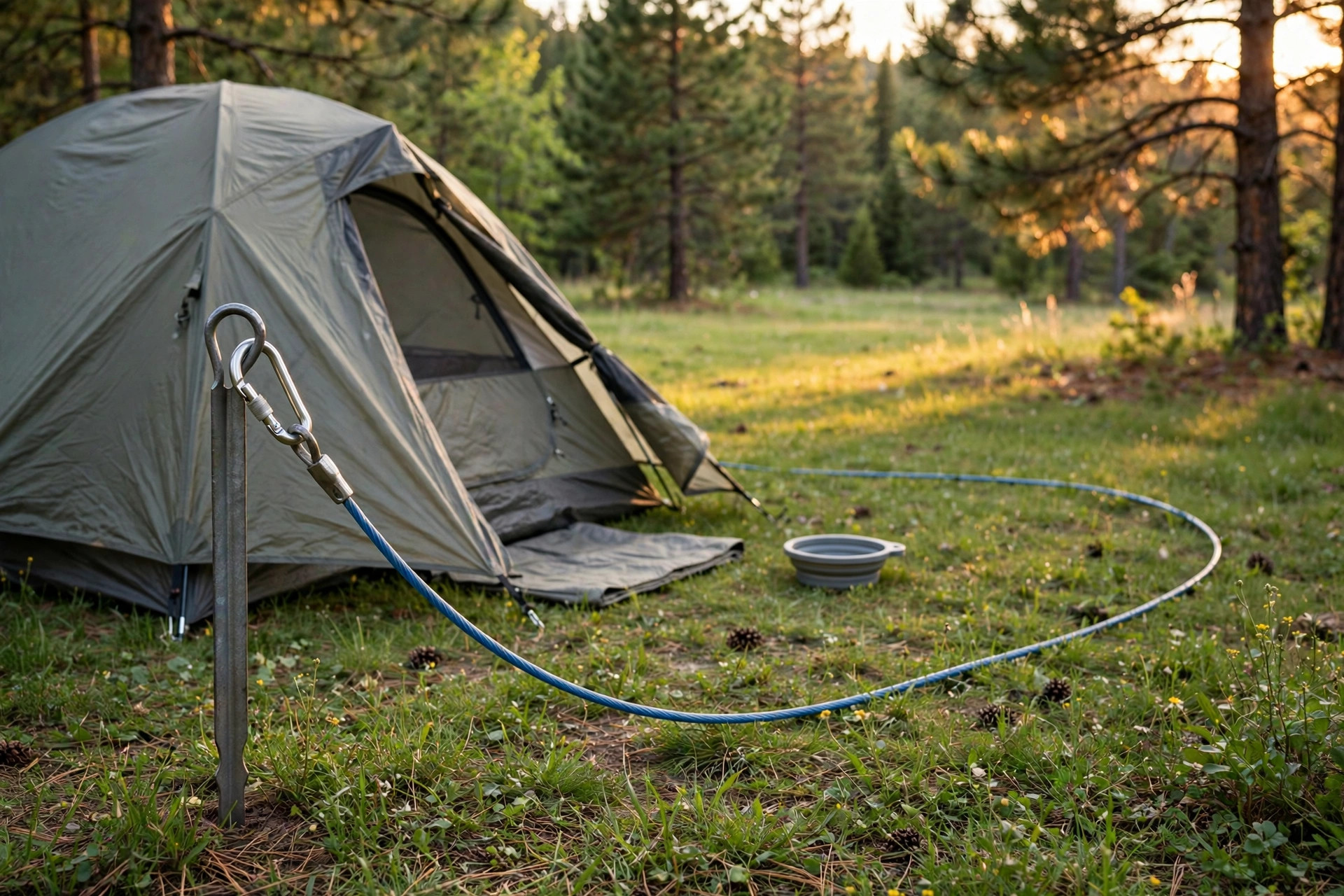

A dog tie out cable for camping and yard use is a simple tool with a simple job. It keeps a dog in one safe area while the owner works, cooks, rests, or tends the fire. No fence is needed. No leash is needed in the hand. The dog gets room to move, and the owner gets peace of mind. This guide explains how to pick the right cable, how much to pay, how to use it with care, and what to watch out for.
Why a Tie Out Cable Matters
Dogs like to move. They sniff, they walk in circles, and they lie down in the shade. On a camping trip there is no fence. In many yards there is no fence either. A tie out cable fills that gap. It lets the dog stay outside with the family instead of locked in the car or the tent.
A good cable gives the dog a wide circle of ground. Inside that circle the dog can drink, nap, and watch the world. The owner can set up camp, cook dinner, or rake the yard. Both stay calm. For more on keeping a large yard safe without digging, see our guide on best dog fence for large yard no digging.
The cable also protects other people. Campgrounds have rules about loose dogs. Neighbors do not like a strange dog in their yard. A tie out cable keeps the dog where it should be. That is good manners and good sense.
Tie out gear is not a cure for boredom. A dog that sits alone on a cable all day will get bored and loud. The cable is meant for short, watched periods. The owner should stay close and keep an eye on the dog. A cable is a tool, not a babysitter.
What to Look For When You Choose a Cable: Dog Tie Out Cable for Camping and Yard
Not all cables are the same. A few simple facts matter most. The rest is noise.
Length
Length sets the size of the dog’s world. Most tie out cables run from 15 to 30 feet. A 20 foot cable is a common pick for the yard. A 30 foot cable suits an open campsite where there is room to spare.
Longer is not always better. A long cable can wrap around trees, picnic tables, and tent poles. It can tangle the dog’s legs. Pick a length that fits the spot. Measure the open ground first. Leave room so the cable cannot reach the road, the neighbor’s lot, or the fire pit.
Strength and Weight Rating
Every cable carries a weight rating. The rating tells how strong a dog the cable can hold. Small cables suit dogs under 50 pounds. Heavy cables suit dogs up to 125 or 150 pounds. Always buy a cable rated above the dog’s real weight, not at it.
A big strong dog can pull hard when it sees a squirrel. A weak cable will snap. A snapped cable means a loose dog in the woods. That is a bad day. The package will show the weight limit in plain numbers. Read it before you buy. If in doubt, go one size up.
The Clip and the Swivel
The clip hooks to the dog’s collar or harness. It must be strong and easy to open with one hand. Many owners like clips that lock, so the dog cannot paw them open. The clasp should feel heavy and solid, not thin and flimsy.
The swivel is a small part that turns freely. It sits between the cable and the clip, and sometimes at both ends. It stops the cable from twisting into knots as the dog walks in circles. A cable without a good swivel will knot up in an hour. Look for brass or steel swivels on both ends. That is the mark of a well made cable.
The cable itself is usually steel wire wrapped in a vinyl coat. The coat keeps the wire from rusting and keeps it kind to the dog’s coat. Check the coat for cracks before each trip. A cracked coat lets water reach the steel. Rust follows. A rusty cable is a weak cable.
Anchor gear matters too. A tie out cable for camping and yard use needs something solid to hold it. In the yard, many people use a screw in ground stake made of steel. At a campsite, a stake or a strong tree works. The anchor must go deep and sit firm. Test it with a hard pull before the dog goes on the cable. The ASPCA notes that outdoor tethering gear should always be checked for wear, and the American Kennel Club reminds owners that tied dogs must be supervised at all times.
Types of Dog Tie Out Cables
Tie out cables come in a few common styles. Each has its fans.
Cable with ground stake. This is the classic set. A steel stake screws into the ground, and the cable clips to a ring on top. It works well in soft soil at campsites and in many yards. It does not work in rock or hard clay. Bring a different plan for those spots.
Tree or post cable. Some cables are made to wrap around a tree or a post. They have a loop at one end. The owner wraps the loop around the trunk and clips it back on itself. This is handy at campsites with good trees. Pick a living tree with thick bark, and do not hang the cable high. Check park rules first. Some parks do not allow ropes on trees.
Overhead trolley runs. A trolley run strings a line between two trees or posts. The cable hangs from a pulley on the line and slides along it. The dog gets a long rectangle of ground instead of a circle. Trolleys suit narrow campsites. They cost more and take more time to set up. They also keep the cable off the ground, which means less tangling.
Reflective and coated cables. Some cables come with a reflective coat or a bright color. These help at night. A headlamp beam will catch the shine. That helps the owner see the cable and helps drivers see it at the road edge. For night trips, a bright or reflective cable is worth the small extra cost.
Cost and Price
A dog tie out cable for camping and yard use is not dear. Basic cables run about five to ten dollars. Heavy duty cables with strong swivels run ten to twenty dollars. A full set with a ground stake may cost fifteen to twenty five dollars. Trolley runs cost twenty five to forty dollars.
Price rises with length and strength. A 30 foot cable for a large dog costs more than a 15 foot cable for a small one. That is fair. The extra steel costs money.
Cheap no name cables cut corners on the clip and the swivel. Those are the parts that fail. It is wise to spend a few dollars more for a known brand. Chewy, PetSmart, Petco, and Home Depot all sell tie out gear from name makers. Prices vary by store, so it pays to compare.
Care and Upkeep
A cable lasts for years with small care. Follow these steps each time you use it.
First, look the cable over before every use. Run your hand along the vinyl coat. Feel for cracks, rough spots, or kinks. A kinked cable is a weak cable. Throw it away and buy a new one. Kinks do not heal.
Second, test the clip. Open it and close it three times. It should snap shut with a clear click. The spring should feel firm. If the spring feels soft or slow, replace the clip. Do not wait for it to fail.
Third, test the swivels. Twist them with your fingers. They should turn free and smooth. If they stick, a drop of oil may help. If they still stick, replace the cable.
Fourth, clean the cable after trips. Mud and salt wash off with a hose. Dry the cable before you store it. Do not coil it tight around your hand. A tight coil puts kinks in the steel. Loop it loose in wide circles and hang it on a hook in the garage.
Stakes need care too. Pull the stake out of the ground before it rusts in place. Wipe it dry. Check the ring on top for cracks. A bent stake still works in soft ground, but a cracked ring does not. Replace it.
PetMD advises checking all outdoor gear for wear on a regular schedule, and The Spruce Pets has a helpful overview of tie out safety basics for new dog owners.
Safety Rules for Tie Out Use
A tie out cable for camping and yard use is safe only when it is used with care. These rules matter.
Never leave the dog alone on the cable. This is the first rule. Stay where you can see and hear the dog. A tied dog cannot run from danger. A stray dog, a wild animal, or a sudden storm can reach a tied dog fast. Keep watch.
Use a harness, not just a collar. A collar pulls on the neck when the dog lunges. A harness spreads the pull across the chest and shoulders. Many vets favor harnesses for tie out use. If you travel with a small dog, a secure pet carrier backpack for small dogs hiking is a better choice for long walks on the trail.
Keep water within reach. Set the water bowl inside the dog’s circle, away from the edge. In summer heat, a dog without water can overheat fast. Refill the bowl often. In cold weather, check that the water has not frozen.
Give shade. Dogs cannot take full sun for long. Place the cable so part of the circle sits in shade. Move the stake or the tree tie as the sun moves. A panting dog in full sun needs help now.
Keep the cable short enough to be safe. The dog should not be able to reach the road, the fire pit, or the neighbor’s yard. The cable should not reach another dog tied nearby. Two cables will tangle, and two tied dogs can fight.
Never tie a puppy or an old, weak dog and walk away. Puppies tangle fast and panic. Old dogs may fall and cannot get up. Both need a person close by.
Check local rules. Many towns and parks have rules about tethering dogs. Some set time limits. Some ban it in public parks. Read the campground rules when you check in. The Consumer Product Safety Commission sets standards for many pet products sold in the United States, and Consumer Reports tests pet gear for strength and safety.
Do not tie two dogs to one cable. One dog per cable. Two dogs on one line will twist together. They can choke or panic. Buy a second cable and a second stake.
Frequently Asked Questions
How long should a tie out cable be?
Fifteen to twenty feet suits most yards. Twenty to thirty feet suits open campsites. Measure your space first. The dog should reach shade and water but not the road or the fire pit.
What weight rating do I need?
Buy a cable rated above your dog’s weight. Dogs under 50 pounds suit light cables. Dogs up to 125 pounds need heavy duty cables. A strong puller can exert far more force than its body weight, so go one size up if your dog pulls hard.
Can I use a tie out cable at any campground?
No. Some campgrounds ban tie outs. Some allow them only at the tent site. Read the park rules when you check in. Always keep the dog on a short leash when walking to and from the site.
Is a cable or a rope better?
A steel cable beats a rope. Rope frays, stretches, and chews through fast. Dogs can chew through rope in minutes. A vinyl coated steel cable resists chewing and weather. Rope is fine for a short leash walk. It is not fine for tie out.
Should the clip attach to the collar or the harness?
A harness is the safer choice. A sudden lunge on a collar can hurt the neck. A harness spreads the force. Make sure the harness fits well. A loose harness can slip off. Check the fit before each trip.
How often should I replace the cable?
Replace it at the first sign of damage. Kinks, cracked coating, rust, a weak spring in the clip, or a stuck swivel all mean the cable is done. With good care and light use, a quality cable can last several seasons. Inspect it every time.
A Short Final Word
A dog tie out cable for camping and yard use is a small buy that solves a real problem. It keeps the dog safe, near, and part of the day. Pick the right length. Pick a rating above your dog’s weight. Check the clip and the swivel. Set it up with shade and water. Stay close and keep watch. Do these simple things and the cable will serve you well for many trips to come.
If your cat likes the outdoors too, read our guide on a cat harness and leash set for outdoor walks for a safe way to bring them along.
References
American Kennel Club. (n.d.). Dog care and training resources. https://www.akc.org ASPCA. (n.d.). Pet care and animal welfare resources. https://www.aspca.org Chewy. (n.d.). Pet supplies. https://www.chewy.com Consumer Reports. (n.d.). Product reviews and ratings. https://www.consumerreports.org Petco. (n.d.). Pet supplies and services. https://www.petco.com PetMD. (n.d.). Pet health information. https://www.petmd.com PetSmart. (n.d.). Pet supplies and services. https://www.petsmart.com The Home Depot. (n.d.). Home improvement products. https://www.homedepot.com The Spruce Pets. (n.d.). Pet care guides and product reviews. https://www.thesprucepets.com U.S. Consumer Product Safety Commission. (n.d.). Product safety information. https://www.cpsc.gov
Was this guide helpful?

About Michael Thompson
The My Garden US editorial team writes practical, in-depth home and garden guides for American homeowners — tested advice, no fluff.
You May Also Like
The Best No Pull Dog Harness for Strong Pullers: A Plain Guide
September 9, 2026 0 views
Outdoor Pet Gate for Deck and Patio Safety
August 10, 2026 0 views
Cat Scratching Pad for Couch Arm Protection: A Plain Guide for Cat Owners
March 9, 2026 0 views