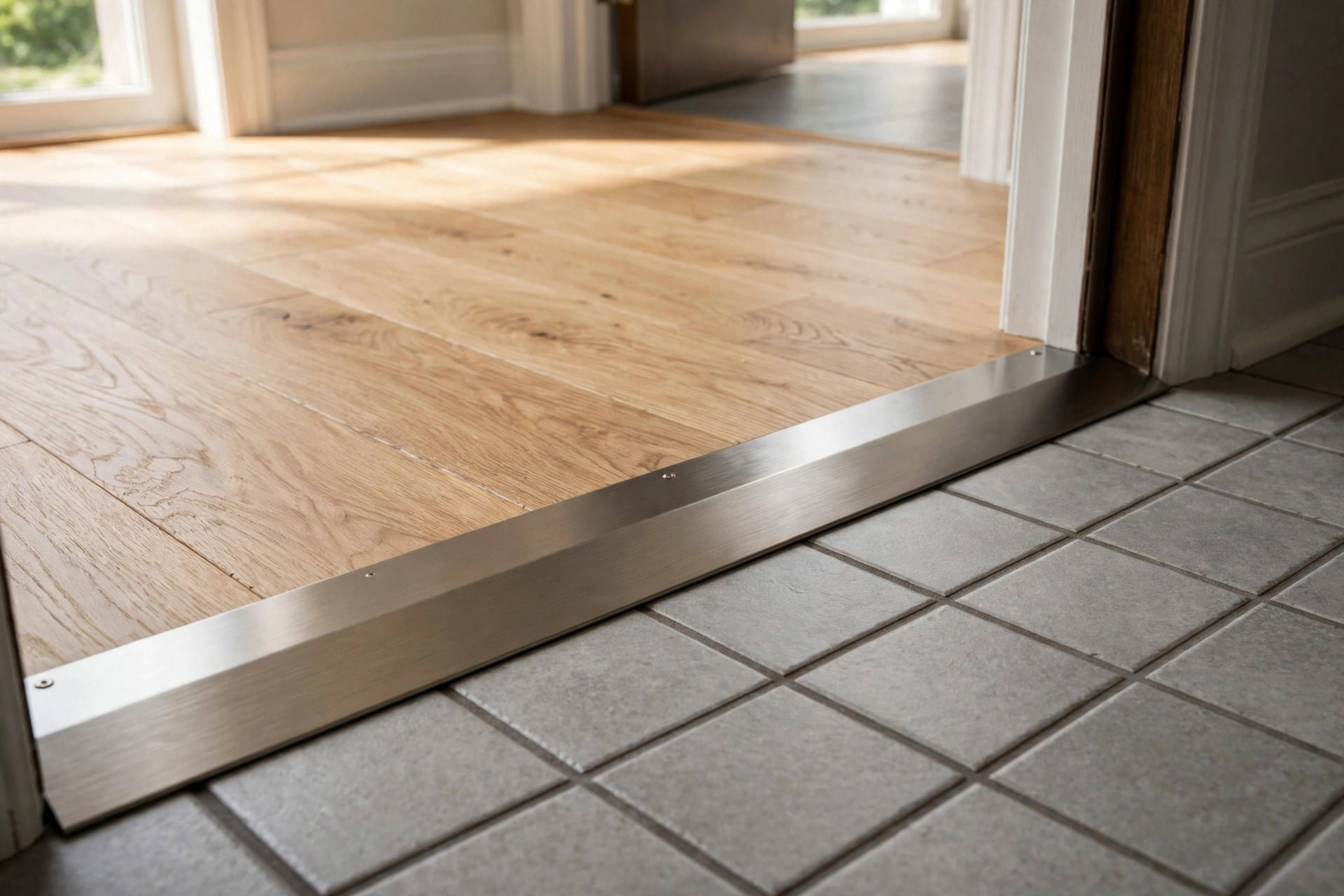
Walk from a tiled kitchen onto a wood-framed living room floor, and you may feel a small lip under your shoe. That lip is common in American homes. One room may sit a quarter inch higher than the next. Sometimes the gap is wider. Left alone, the edge chips, the vacuum catches, and toes stub. If you have searched for the best transition strips for uneven floors usa, you already know the fix is simple: a shaped strip of metal, wood, or vinyl that ramps the high side down to the low side. This guide explains which strips work for which gaps, what they cost, and how to fit one without calling a contractor.
Why Uneven Floor Joints Matter
Floor height differences appear for honest reasons. A tile floor sits on cement board and thinset, so it ends up thicker than the carpet or vinyl next to it. An old addition rests on a different subfloor than the original house. A slab in a basement dips where the concrete settled years ago. None of this means the house is failing. It means the two surfaces were built at different times, with different materials.
A bare joint causes three problems. First, it is a trip hazard. A rise of even a quarter inch can catch a tired foot at night. Second, the exposed edge takes damage. Tile edges chip. Wood planks splinter where shoes strike them. Third, dirt collects in the seam, and no mop cleans it well. A transition strip solves all three. It covers the raw edge, smooths the step, and gives the joint a finished look.
Home inspectors and appraisers also notice these joints. A clean transition tells a buyer the work was done with care. A ragged edge suggests shortcuts. When you shop for flooring products from the big home improvement stores, you will see whole aisles of strips, which shows how common the need is.
How to Choose the Right Strip: Best Transition Strips for Uneven Floors Usa
The right strip depends on three facts: the size of the gap, what sits under the floor, and what you want it to look like. Get these right and the strip lasts for years.
Measure the Height Gap
Lay a straight board or a level across the joint, from the high floor to the low floor. Slide a tape measure under the board on the low side. That number is the height difference you must bridge. Most homes show gaps between one eighth of an inch and one half inch. Tile next to vinyl plank can differ by three eighths. Older remodels sometimes show three quarters or a full inch.
Buy a strip rated for your gap. A low-profile reducer handles up to about a quarter inch. A tall reducer or ramp profile handles up to three quarters. For a full inch, look for an adjustable ramp or a beveled threshold made for ramps. Do not force a small strip to cover a large gap. It will rock, loosen, and fail.
Check What Lies Beneath
The subfloor decides how the strip attaches. Over plywood or oriented strand board, small screws or nails hold well. Over a concrete slab, you will need masonry anchors or a strong construction adhesive. Many readers laying best basement flooring for concrete slab usa options face this exact question, because slab joints are common in below-grade rooms.
Radiant heat tubing can run under the floor near doorways, so check your heat layout before drilling. A glue-down strip avoids that risk entirely. If you rent your home, a glue-down strip also comes up more cleanly when you move out.
Match Material and Finish
Metal strips in aluminum or brass suit modern rooms and stand up to heavy traffic. Wood strips stained to match the floor disappear into a classic room. Vinyl reducers are cheap, flexible, and fine for low-traffic joints, though they scuff sooner. The finish matters more than most shoppers think. A brushed nickel strip next to a gold faucet looks wrong in a way guests cannot name but always feel. Match the metal to the hardware nearby.
Also consider the floor types on each side. When one side is vinyl plank, it helps to know your options before you buy; many homeowners read luxury vinyl plank flooring reviews 2026 to compare plank thickness, because a thicker plank changes the height gap and the strip you need.
Types of Transition Strips for Uneven Floors
Not all strips do the same job. The four profiles below cover nearly every home situation. Learn what each one does before you buy.
Reducer Strips
A reducer is the workhorse for uneven floors. It is a long piece with a tall side and a low side. The tall side sits on the higher floor, and the strip slopes down to meet the lower floor. Reducers come in standard and tall versions. Standard reducers handle gaps up to about a quarter inch. Tall reducers, sometimes called high reducers, handle gaps up to three quarters of an inch.
Installers use reducers where tile meets vinyl, where hardwood meets laminate, and where an old floor meets a new floor laid on top of underlayment. They attach with track, glue, or screws depending on the brand. Reducers made by flooring companies such as LL Flooring are shaped to fit common plank thicknesses, which makes the fit cleaner than a generic strip.
T-Molding
T-molding looks like the letter T from the end. The top bar covers both floor edges, and the stem drops into the gap. It works best when the two floors are nearly the same height, within about an eighth of an inch. Many floating floors need T-molding at doorways because the floor must expand and contract. The stem sits in a metal track screwed to the subfloor, and the top snaps in without glue, so the floor can still move.
Do not use T-molding for a real height gap. Its top bar is flat, so one edge would hover over the low floor and snap underfoot. That is a common mistake in do-it-yourself jobs.
Carpet Transition Strips
Where hard flooring meets carpet, a carpet reducer or Z-bar does the job. The carpet tucks into a toothed edge or under a folded flap, and the strip ramps down to the hard surface. Pet owners often worry about claws catching at these joints, so many read about pet friendly flooring options for usa homes before choosing both the carpet and the strip.
Carpet strips also work at stairs. A carpet-to-wood strip on the top step ramps the nose down to the landing. Choose a metal strip here. Stair noses take heavy wear, and plastic strips break.
Threshold and Ramp Profiles
For gaps near one inch, or for wheelchairs and walkers, use a threshold ramp. These are wider, gentler slopes, often three to four inches across. They meet accessibility guidelines better than steep strips. You will find them at Lowe’s and other large retailers in the accessibility aisle as well as the flooring aisle.
Ramp profiles also suit exterior doors. A door threshold that steps down to a patio or garage floor often leaves a gap of half an inch or more. An adjustable aluminum threshold with a vinyl seal can close the gap and keep drafts out. Seal the joint with silicone so rain cannot seep under it.
Cost and Price
Transition strips are one of the cheapest fixes in home improvement. A basic vinyl reducer costs a few dollars for an eight-foot length. Aluminum strips run about ten to twenty dollars per length. Solid hardwood or brass strips cost thirty to fifty dollars per length. Prices vary by region and store, so check the current Home Depot pricing or a competitor before you budget.
Professional installation adds cost. A handyman usually charges fifty to one hundred dollars per doorway, including the strip. A flooring contractor may charge more but will also undercut doors and fix subfloor dips at the same visit. Most strips are a fair do-it-yourself project. You need a hacksaw or miter saw, a tape measure, and either adhesive or a drill. Plan one hour per strip for a first attempt.
One hidden cost is door trimming. When the new strip raises the joint, the door may drag. Budget time to shave the door bottom or hire help for it. Consumer guides at Consumer Reports often remind buyers to count these small extras, and they are right. The strip is cheap. The hour you spend adjusting the door is the real price.
Care and Upkeep
Transition strips need little care, but they do need some. Vacuum metal strips with a soft brush so grit does not scratch the finish. Wipe aluminum and brass with a damp cloth, then dry them. Harsh cleaners dull the coating on anodized aluminum, so use mild soap only.
Wood strips need the same care as the wood floor around them. Sweep them weekly. Damp mop with a wood cleaner, never soaking wet. Recoat the finish every few years if the strip sits in a sunny doorway. Sunlight fades stain faster than most people expect.
Check screws and tracks once a year. Foot traffic loosens them. A loose strip rocks and lets water under it, which ruins both floors. Tighten screws by hand. If a screw spins in place, move it half an inch and drill a fresh pilot hole. For glue-down strips, re-glue any lifted edge with construction adhesive and tape it down overnight. Replacement is easy. Most strips pop out of their tracks, and a new one snaps in.
Safety
Safety is the main reason to fix an uneven joint, so install the strip with care. Cut the strip to fit tight between the door jambs. A short strip leaves an exposed corner that catches toes. File the cut ends smooth. A sharp metal edge can cut bare feet.
Glue-down strips need a clean, dry surface. Old wax or dust keeps adhesive from bonding. Scrape the area, vacuum it, and let it dry. Press the strip down hard and keep traffic off it for the hours the tube lists. Step-by-step repair guides like those from This Old House show the same rule for every adhesive job: patience beats strength.
On stairs, never use a strip that sticks up above the tread nose. The strip must sit flush or slightly below. At exterior doors, pick a strip with a non-slip surface or add a thin anti-slip tape. Wet shoes on smooth aluminum are slick. If anyone in the home uses a wheelchair or walker, choose the widest, gentlest ramp profile you can find. Practical project advice from the Family Handyman library echoes this point: the gentler the slope, the safer the passage.
Frequently Asked Questions
What is the best transition strip for a half-inch height gap?
A tall reducer strip is the best choice for a half-inch gap. It ramps from the high floor down to the low floor in one smooth slope. Measure the exact gap first, because tile thickness varies by brand. Tile makers such as Daltile publish thickness specs for their lines, which helps you match the strip.
Can I use a transition strip on an uneven concrete slab?
Yes. Use a glue-down reducer or a ramp profile with construction adhesive. Do not screw into a slab unless you know its depth and what lies under it. Grind any high spots with a concrete grinder first, so the strip sits flat. Fill deep dips with self-leveling compound and let it cure before you glue the strip.
Do transition strips work between tile and vinyl plank?
They do, and this is one of the most common uses. Tile is usually thicker than vinyl plank, so a reducer bridges the difference. Leave the expansion gap the plank maker requires, and let the strip cover it. Large carpet and hard-surface makers such as Shaw Floors and Mohawk sell reducers sized to their plank lines.
How long does a metal transition strip last?
An aluminum strip lasts ten to twenty years in a home doorway. Brass lasts longer. The finish wears first, especially in sunny spots or where shoes pivot. The metal beneath usually stays sound. When the finish looks tired, replace the strip rather than repaint it. Paint peels off metal under foot traffic.
Should I hire a pro or do it myself?
Most homeowners can fit a straight strip at a doorway in about an hour. Hire help if the joint is curved, if the subfloor needs repair, or if the gap changes along its length. A pro can also grind a slab or pour leveler, which is dusty work best left to someone with the right mask and tools. Home guides at The Spruce walk through both the DIY path and the signs that you should call a contractor.
A Final Word
An uneven floor joint is a small flaw with an outsized effect. It trips, it chips, and it makes good flooring look unfinished. The fix costs little and takes an afternoon. Measure the gap, pick the right profile, and fit it with care. Years from now you will walk through that doorway and never think of it again, which is exactly what a good transition strip should do.
References
Consumer Reports. (n.d.). Product reviews and ratings. https://www.consumerreports.org Daltile. (n.d.). Ceramic and porcelain tile. https://www.daltile.com Family Handyman. (n.d.). DIY home repair and maintenance. https://www.familyhandyman.com LL Flooring. (n.d.). Hardwood, vinyl, and tile flooring. https://www.llflooring.com Lowe’s. (n.d.). Home improvement products. https://www.lowes.com Mohawk Flooring. (n.d.). Flooring products. https://www.mohawkflooring.com Shaw Floors. (n.d.). Flooring products. https://www.shawfloors.com The Home Depot. (n.d.). Home improvement products. https://www.homedepot.com The Spruce. (n.d.). Home and garden advice. https://www.thespruce.com This Old House. (n.d.). Home renovation guidance. https://www.thisoldhouse.com
Was this guide helpful?

About Michael Thompson
The My Garden US editorial team writes practical, in-depth home and garden guides for American homeowners — tested advice, no fluff.