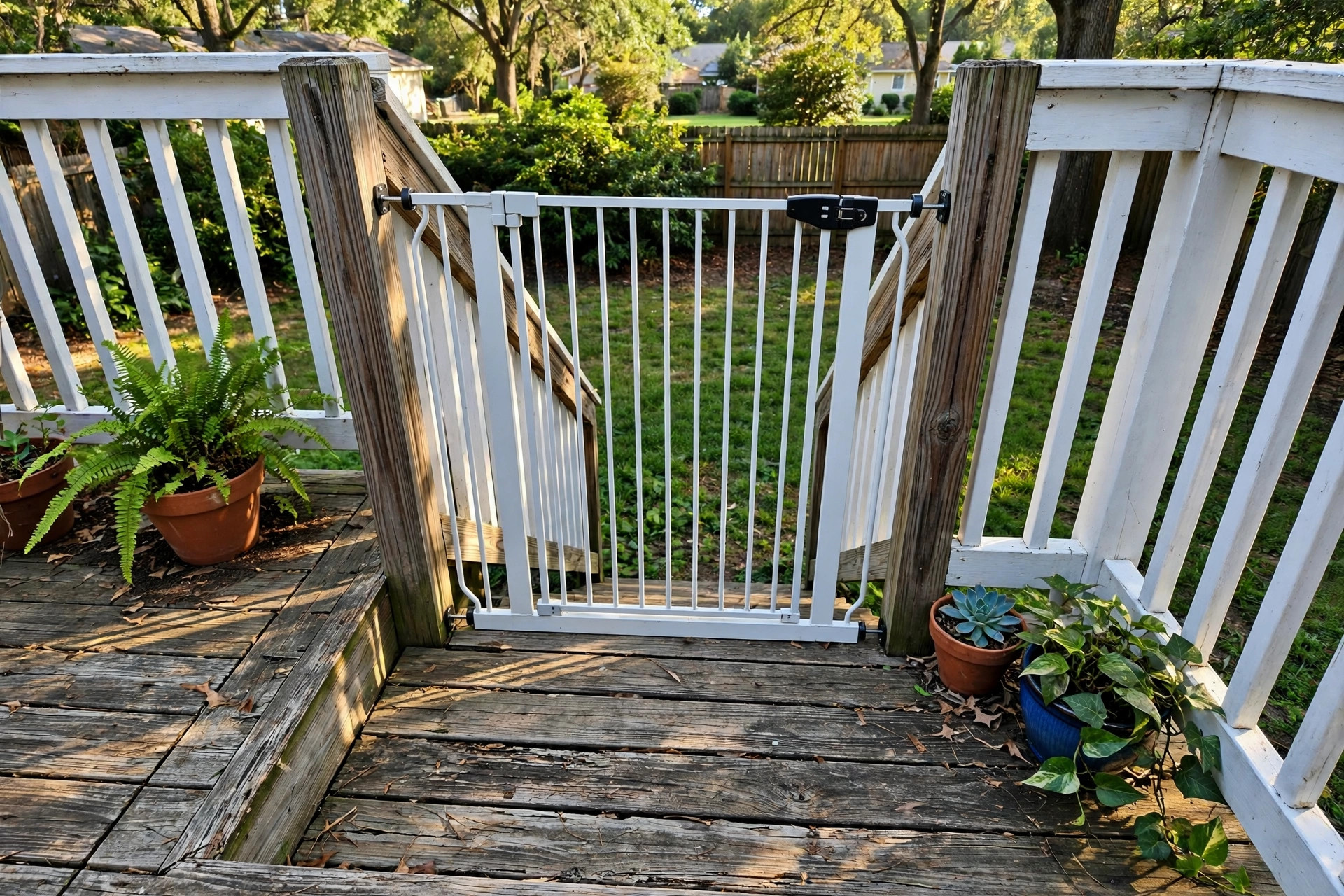
A dog that races down deck stairs can twist a leg. A curious cat that slips past an open rail can land in a hot yard or a busy street. The best pet gate for deck stairs outdoor use solves both problems at once. It blocks the steps, it stands up to rain and sun, and it opens easily when a person needs to pass.
Deck stairs are not like indoor stairs. They face weather. They grow slick with rain. They collect pollen, leaves, and ice. A gate that works fine in a hallway may rust, warp, or fail on a deck. That is why outdoor use calls for its own kind of product and its own kind of planning.
This guide walks through what matters. It covers size, material, mounting, cost, care, and safety. It answers the questions pet owners ask most. By the end, you will know how to pick a gate that fits your deck and keeps your animals safe.
Why a Deck Stair Gate Matters
Pets love decks. A deck smells like the yard, the street, and every bird that passed that morning. It gives a dog a place to watch the world. It gives a cat a warm board to lie on. The stairs, though, are a risk.
Small dogs fall between open risers. Old dogs lose their footing on worn tread. Puppies chew railing posts and learn to squeeze through gaps. Cats climb and jump from heights that invite a bad landing. A gate turns the stairwell from an open path into a controlled one.
There is a second reason. Many yards connect to driveways, sidewalks, or roads. A gate at the top of the deck stairs keeps a pet on the deck when the fence door stands open. It adds a layer of protection when visitors leave a door ajar. Pet owners who use a dog fence for large yard no digging often add a stair gate as a backup barrier near the house.
Insurance adjusters and pet safety groups agree on one point: falls from decks and stairs send many animals to the vet each year. A simple barrier prevents most of these trips. The ASPCA offers plain-language guidance on keeping pets safe around stairs and decks.
What to Look for in an Outdoor Gate: Best Pet Gate for Deck Stairs Outdoor Use
An outdoor gate must do three jobs. It must fit the opening. It must resist weather. It must stay shut when a pet tests it.
Size and Fit
Measure first. Use a tape measure at the top and the bottom of the stairs. Deck railings often lean a little, so the width at the top may differ from the width at the bottom. Write down both numbers. Buy a gate that covers the larger number.
Most gates fit openings from 26 to 42 inches. Wide models and extensions reach 60 inches or more. For very wide stairwells, two gates can join with a connector. Height matters too. A gate should stand at least 30 inches tall for a medium dog. Large, athletic breeds need 36 inches or more. Cats need height plus narrow bar spacing, since a cat can slip through a gap of about two inches.
Check the shape of the opening. Deck posts are often thick squares. A gate with adjustable brackets will grip a 4×4 post better than one made for thin indoor trim. Test the latch before you buy. It should lock with one hand and resist a paw.
Material and Weather Resistance
Indoor gates use painted steel or light plastic. Outdoor gates need more. Look for powder-coated steel, aluminum, or vinyl-coated metal. These materials resist rust. A gate that claims to be weatherproof should have sealed joints and rust-proof hardware.
Wood gates look fine on a deck, but wood swells in rain and cracks in sun. If you want wood, choose cedar or pressure-treated lumber, and seal it each year. Metal lasts longer with less work. The Home Depot stocks many weather-rated gates and lists material details on each product page.
Hardware matters as much as the frame. Screws and hinges should be stainless steel or zinc coated. Cheap screws rust in one season. Rust stains the deck and weakens the mount.
Mounting Style
Pressure-mounted gates press between two surfaces. They need no screws. They work well for rental homes and for decks where you do not want holes in the posts. But pressure mounts can slip on slick wood. They are a poor choice for very active dogs.
Hardware-mounted gates screw into the posts. They hold firm. They take more effort to install, but they stay put when a large dog leans on them. For deck stairs, hardware mounting is the safer pick in most cases. Consumer Reports has tested gate stability and recommends hardware mounts for stairs.
Some gates combine both styles. They screw in at the top and press at the bottom. These hybrid models suit decks where the lower rail sits at an odd angle.
Types of Gates for Deck Stairs
The market offers several designs. Each suits a different home and a different pet.
Swing gates open like a small door. They mount on one side and latch on the other. They are easy for people to use. A swing gate with a hold-open feature lets you carry groceries up the stairs without juggling the gate.
Retractable gates use a mesh screen that rolls into a housing. They save space and look tidy. But the mesh can snag claws, and some dogs learn to push through it. They suit calm pets, not chewers or jumpers.
Freestanding gates stand on their own with wide feet. They move from place to place. They do not attach to the deck. A strong dog can knock one over, so they work best for small breeds and for short visits.
Walk-through gates with a pet door add a small flap for cats or tiny dogs. The large gate stays shut while the small pet passes. Owners who need a pet gate with cat door for stairway safety find this design keeps big dogs in while cats roam free.
Extra-tall gates rise to 40 inches or more. They suit jumping breeds and tall dogs that lean. They pair well with solid lower panels that block small paws.
Pick the type that matches your pet’s habits. A calm older dog needs less gate than a young terrier. Watch your pet for a week before you buy. Note where it pushes, jumps, and chews.
Cost and Price
Outdoor pet gates cost more than indoor ones. Weatherproof materials and strong hardware raise the price. Here is what to expect.
Simple pressure-mounted gates run from 40 to 80 dollars. They fit small dogs and calm pets. Hardware-mounted metal gates run from 80 to 180 dollars. These are the workhorses for most decks. Extra-wide or extra-tall models run from 150 to 300 dollars. Custom wooden gates built by a carpenter can cost 300 dollars or more.
Price is not the only cost. A cheap gate that rusts in a year costs more over time than a good gate that lasts ten. Read the warranty. A one-year warranty is common. Better brands offer two or three years on outdoor models. Chewy and other pet stores show real owner reviews that reveal how gates hold up after a season or two.
Factor in extras. You may need extension panels for wide openings. You may need angled brackets for odd posts. These parts add 20 to 60 dollars. Budget for them before you order.
Care and Upkeep
An outdoor gate needs a little care each season. The work is small, but it keeps the gate safe.
In spring, check all screws and bolts. Winter frost can loosen them. Tighten what is loose. Oil the hinges with a light silicone spray. Wipe the latch clean so it locks smoothly.
In summer, wash the gate with mild soap and water. Pollen and dust can gum up the lock. Check for rust spots, especially near screw heads. Sand a spot lightly and touch it up with outdoor metal paint.
In fall, clear leaves from the base of the gate. Wet leaves hold moisture against metal. Trim plants that press against the mesh or bars. A vine can push a gate out of line over time.
In winter, clear ice from the swing path. A gate that cannot close fully is a gate that does not work. Do not force a frozen latch. Warm it with your hands or a cloth soaked in warm water. The CPSC reminds owners to check outdoor products for freeze damage each year.
Store retractable gates indoors during hard freezes if the maker advises it. Most metal swing gates can stay out all year.
Safety
A gate is a safety tool. It must itself be safe. Keep these points in mind.
Bar spacing should be narrow enough to stop a head from passing through. For small dogs and cats, two inches or less is the rule. For large dogs, three inches is fine. If a pet can push its head through, it can get stuck.
Never mount a gate with the crossbar low enough to form a foothold. Dogs climb. A gate with horizontal bars near the bottom invites a clever dog to scale it. Vertical bars are harder to climb.
Keep the latch out of paw reach on the pet side if you can. Some dogs learn to lift latches. A double-lock latch stops most of them. PetMD has notes on pet-proof latches and child-safety standards that apply to pet gates too.
Check the gate weekly. Look for loose bolts, bent bars, and worn latches. Replace worn parts at once. A gate that fails when no one watches is worse than no gate, because it teaches the pet that barriers can be beaten.
Teach the pet the boundary. Walk the dog to the gate, reward calm behavior, and never chase a pet through a closed gate. Cats need the same calm training. A gate works best when the pet accepts it as a wall, not a challenge. The AKC offers training tips for teaching dogs to respect gates and boundaries.
For homes with both dogs and cats, plan the whole space. A gate at the stairs plus an outdoor dog run with roof for backyard gives each animal a safe zone. The Spruce Pets covers multi-pet home setups in plain terms.
Frequently Asked Questions
Can I use an indoor pet gate on deck stairs?
You can, but it will not last. Indoor gates lack rust-proof coating. Rain will spot them within weeks. Sun will fade the paint. The mounting hardware may not fit thick deck posts. An outdoor-rated gate costs more up front but lasts years longer.
What width do I need for deck stairs?
Measure the opening between the posts. Most deck stairwells run 36 to 48 inches wide. Buy a gate that adjusts to your exact width. If your opening is wider than 60 inches, look for extension panels or a custom build.
Are pressure-mounted gates safe for stairs?
Hardware-mounted gates are safer for stairs. Pressure mounts can slip, and a slip at the top of stairs is dangerous. Use a pressure-mounted gate only for a calm, small pet, and check the tension often. Good Housekeeping rates gates for stairs and favors screw-mounted models.
How tall should the gate be?
For most dogs, 30 to 36 inches is enough. For jumpers and large breeds, choose 40 inches or more. For cats, height helps, but bar spacing matters more. Keep gaps under two inches so a cat cannot squeeze through.
Will a gate damage my deck?
Hardware-mounted gates need screws. The holes are small and easy to fill later. Use mounting pads or rubber caps to protect the wood. Pressure-mounted gates leave no holes but can mark the finish. Bob Vila has guides on mounting hardware to deck posts without splitting the wood.
A Final Word
The best pet gate for deck stairs outdoor use is not the most costly one. It is the one that fits your opening, resists your weather, and stands firm against your pet. Measure twice. Choose weatherproof metal. Mount it with screws when you can. Then keep it clean and check it each season.
A gate is a small thing. It takes an afternoon to install. But it buys peace of mind every day your dog lies on the deck and every night your cat sleeps near the stairs. Pick well, install it right, and let your pets enjoy the outdoors in safety.
References
American Kennel Club. (n.d.). Dog care and training resources. https://www.akc.org ASPCA. (n.d.). Pet care and animal welfare resources. https://www.aspca.org Bob Vila. (n.d.). Home improvement advice. https://www.bobvila.com Chewy. (n.d.). Pet supplies. https://www.chewy.com Consumer Reports. (n.d.). Product reviews and ratings. https://www.consumerreports.org Good Housekeeping. (n.d.). Product reviews and home advice. https://www.goodhousekeeping.com PetMD. (n.d.). Pet health information. https://www.petmd.com The Home Depot. (n.d.). Home improvement products. https://www.homedepot.com The Spruce Pets. (n.d.). Pet care guides and product reviews. https://www.thesprucepets.com U.S. Consumer Product Safety Commission. (n.d.). Product safety information. https://www.cpsc.gov
Was this guide helpful?

About James Carter
The My Garden US editorial team writes practical, in-depth home and garden guides for American homeowners — tested advice, no fluff.