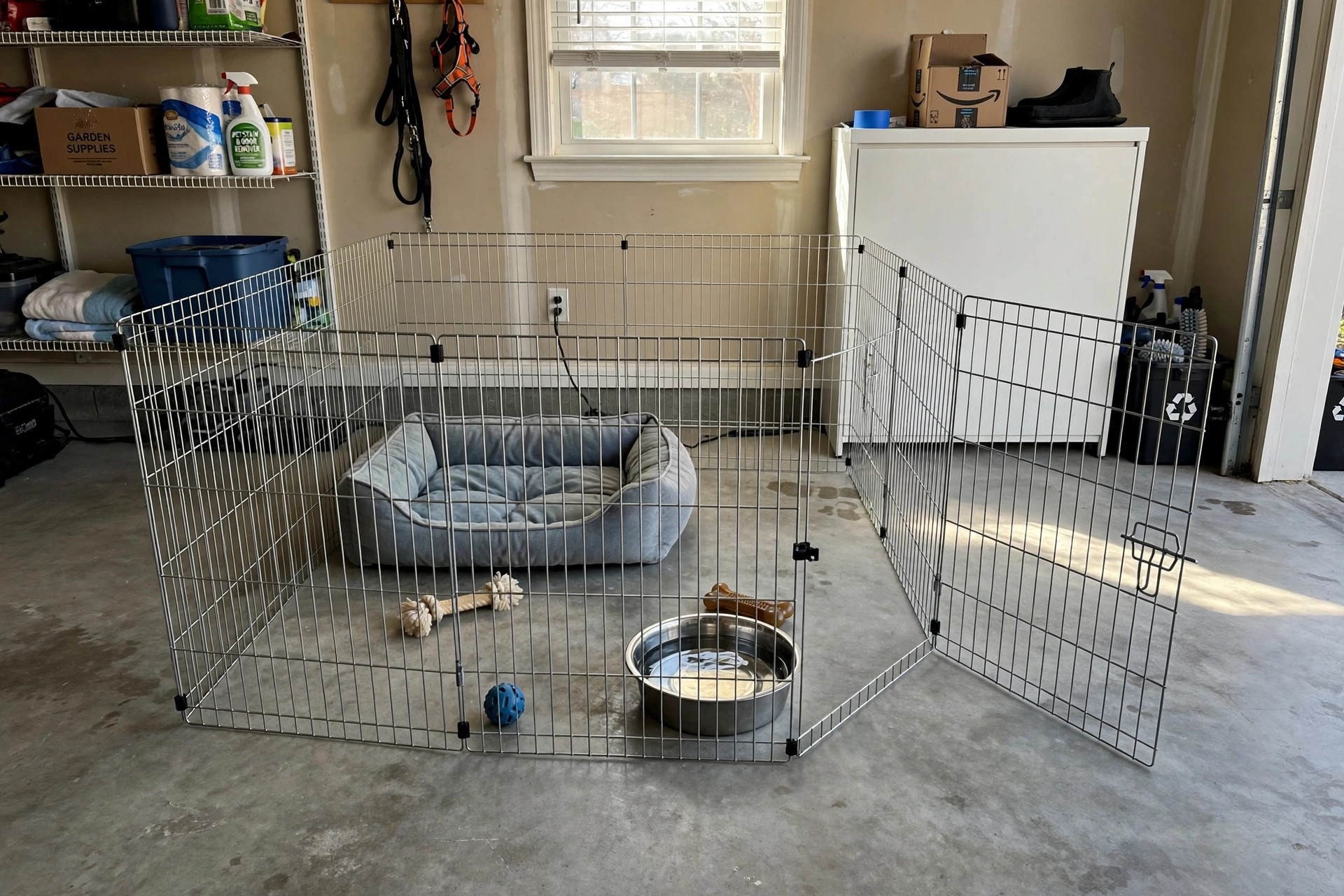
A dog pen for garage and basement containment is one of the simplest tools a dog owner can buy. It gives your dog a clear, safe space inside the house when you cannot watch him. Many owners use the garage during the day and the basement at night, or the other way around. The pen keeps the dog away from tools, paint cans, stairs, and cords. It also keeps the rest of the house clean.
This guide explains what these pens are, why they matter, and how to pick the right one. It covers the main types, what they cost, and how to set one up safely in a garage or a basement. By the end, you will know exactly what to buy and how to use it.
Why It Matters
Dogs are curious. A garage holds lawn chemicals, sharp tools, and car fluids that can poison a dog. A basement may hold a furnace, stored boxes, and damp corners. A free-roaming dog can get hurt in these rooms in seconds. A dog pen for garage and basement containment solves this problem. It draws a clear line between the safe zone and the rest of the room.
A pen also helps with training. Puppies chew. Young dogs jump. Older dogs may pace or get anxious when left alone. A pen gives the dog one space to learn. He learns where to sleep, where to drink, and where to rest. The dog feels secure in a small, defined area. It becomes his den.
There is also the question of guests and workers. A repairman may need the garage. The dog may bark or run out the door. A pen keeps the dog still and calm while strangers come and go. In the basement, a pen can keep the dog away from laundry, boxes, or a home office.
Many vets and trainers recommend a confined resting area for dogs. The American Kennel Club offers guidance on crate training and confinement that can help owners set fair routines. The ASPCA also provides advice on safe dog housing. Reading these trusted sources helps you use a pen in a kind way, not as punishment.
What to Look for When You Choose: Dog Pen for Garage and Basement Containment
A good pen fits your dog, your room, and your budget. Here are the main points to check.
Size
The pen should be large enough for the dog to stand up, turn around, and lie down fully. It should also hold a bed, a water bowl, and a toy. For a small dog, a pen that is three feet across may be enough. For a large dog, you may need a pen that is four to six feet across.
Think about the room too. A garage has floor space but also cars, shelves, and bikes. A basement may be long and narrow. Measure the spot before you shop. Many pens come in panels that fold, so you can change the shape. A square, a rectangle, or an octagon all work. Keep at least two feet of clear space around the pen so you can reach in easily.
Height
The walls must be taller than the dog can jump. A small dog needs walls about two feet high. A medium dog needs three feet. A large or athletic dog may need four feet. A pen with a door is a must. The door should latch firmly. Some dogs learn to nudge doors open, so a double latch is better.
Material
Most indoor pens are made of metal wire, heavy plastic, or wood. Metal wire is the most common. It is strong, easy to clean, and lets air flow. Plastic panels are lighter and easier to move. Wood looks nice in a finished basement but can be chewed. For a garage, metal wire is usually the best choice. It stands up to rough floors and damp air.
Check the finish. Powder-coated metal resists rust. Plain steel can rust in a damp basement. Galvanized wire lasts long but may have sharp edges. Run your hand along the bars before you set it up. If you feel sharp points, file them down or pick another pen.
Floor and Base
A pen does not come with a floor. You must protect the garage or basement floor yourself. Concrete can be cold and hard. A waterproof mat or a washable rug under the pen keeps the dog warm and dry. In the basement, a mat also stops the pen from sliding on smooth tile.
Some owners add a crate inside the pen. This gives the dog a dark, quiet place to sleep. If you go this route, read about escape-proof crates for anxious dogs before you buy. A crate plus a pen is a strong setup for a new puppy.
Types and Options
There are four main kinds of pen used for garage and basement containment.
Wire Exercise Pens
These are the classic choice. They fold into panels of metal wire. You can set them up in a minute. They come in many heights and sizes. They are strong and simple to clean. Most owners who want a dog pen for garage and basement containment start here. You can find them at large pet retailers like Chewy or farm stores like Tractor Supply.
Plastic Panel Pens
These pens use thick plastic panels that snap together. They are lighter than wire pens. They work well for small and medium dogs. They do not rust. But a strong dog can chew the plastic. Check the joints often.
Freestanding Fence Panels
Some owners build a pen from freestanding indoor fence panels. These panels stand on their own feet. You can join several together to make a long run along a garage wall. This works well in a wide basement. They are easy to buy at home stores such as Home Depot or Lowe’s.
Custom or Built-In Pens
A handy owner can build a pen from lumber and wire mesh. This can fit a strange corner perfectly. It can also look nicer than a store pen. But it takes time and tools. Make sure all wood is sealed so the dog cannot chew off splinters. Never use treated lumber with old-style chemicals. Use safe, pet-friendly finishes.
For dogs that spend time both inside and outside, you may also want to look at outdoor dog runs with roofs for the backyard. A yard run and an indoor pen make a full system.
Cost and Price
Prices vary by size, material, and brand. Here is a rough guide for the United States.
– Small wire pen (24 inches high): 30 to 60 dollars. – Medium wire pen (30 to 36 inches high): 50 to 100 dollars. – Large wire pen (42 to 48 inches high): 90 to 180 dollars. – Plastic panel pen: 40 to 120 dollars. – Freestanding fence panels: 60 to 200 dollars for a set.
A waterproof mat adds 20 to 60 dollars. A good dog bed adds 30 to 80 dollars. A no-spill water bowl costs about 10 to 20 dollars. All told, most owners spend between 80 and 250 dollars to set up a full dog pen for garage and basement containment.
Check prices across several stores before you buy. Large online sellers like Amazon and Wayfair carry many brands. Pet health sites like PetMD and The Spruce Pets review pens and explain what each type does well.
Setting Up in the Garage
The garage is a working room. Set up the pen with care.
1. Pick a corner away from the car, the water heater, and any chemicals. 2. Sweep the floor clean. Put down a waterproof mat. 3. Set up the pen. Make sure every joint locks. 4. Place the bed at one end and the water bowl at the other. Dogs like to sleep away from where they drink. 5. Add one or two safe chew toys. 6. Keep the garage temperature in mind. Garages get hot in summer and cold in winter. Use a fan in summer. In winter, add a warm blanket or a safe heated pad. Never leave a dog in a freezing garage.
Store all chemicals on high shelves or in locked cabinets. Antifreeze tastes sweet to dogs and is deadly. Even a small spill can kill. Wipe the floor clean before the dog enters.
Setting Up in the Basement
The basement is often quieter than the garage. That can be good for a nervous dog. But basements have their own risks.
1. Pick a dry spot. Damp floors breed mold. A dog that sleeps on damp concrete can get skin problems. 2. Raise the bed off the floor with a cot-style bed or a thick mat. 3. Check for exposed wires, sump pumps, and open stairwells. Fence these off. 4. Make sure the basement has fresh air. A small window or a vent helps. 5. Add light. A basement can be dark. A simple lamp on a timer keeps the space from feeling like a cave.
If the basement is unfinished, dust and concrete chips can irritate the dog’s paws. A large washable rug under the pen fixes this.
Care and Upkeep
A pen needs simple, regular care. Wipe the bars down once a week with warm water and mild soap. Check all latches and joints each month. Tighten anything loose. A loose panel can pinch a paw.
Rinse the water bowl daily. Replace chew toys when they break into small pieces. A broken toy is a choking hazard.
In the garage, watch for rust. Humidity and road salt speed it up. A quick spray of rust-proof paint on bare spots keeps a wire pen strong. In the basement, watch for mold on mats. If a mat smells musty, wash it or replace it.
Safety
Safety is the whole point of a pen. Keep these rules in mind.
– Never leave a puppy in a pen for more than two to three hours at a time during the day. Young dogs need breaks. – Never leave any dog in a pen all day with no walk, no play, and no company. A pen is a tool, not a substitute for care. – Remove collars before pen time. A collar can catch on a bar and choke the dog. – Keep the pen away from cords, blind strings, and anything the dog could pull through the bars. – Make sure the garage door cannot be opened by the dog. Some dogs learn to paw at buttons. – In hot weather, check the garage temperature with a thermometer. If it is above 85 degrees, move the dog inside the house. – Keep a first aid kit near the pen. Ask your vet what to include.
If your dog shows signs of stress in the pen, such as constant barking, chewing the bars, or trying to escape, change the setup. Add a crate for denning. Move the pen to a quieter room. Give more exercise before pen time. A tired dog rests better.
Some owners also use fences around the yard for outdoor time. If your yard is large, read about no-dig dog fences for large yards to see how outdoor and indoor systems can work together.
Frequently Asked Questions
How long can a dog stay in a pen in the garage?
For an adult dog, four to six hours is fine if the garage is at a safe temperature and the dog gets exercise before and after. Puppies need shorter stays of two to three hours. No dog should live in a pen full time. The pen is for parts of the day, not the whole day.
Is the basement too cold for a dog pen?
It can be. Basement floors are often cold concrete. Use a raised bed and a thick mat. Keep the room above 55 degrees in winter. Small and short-haired dogs feel the cold more. If you can see your breath in the basement, it is too cold for the dog.
Wire pen or plastic pen: which is better?
Wire pens are stronger and last longer. They suit most dogs and most garages. Plastic pens are lighter and easier to move. They suit small, calm dogs. For a strong chewer or a large dog, pick wire.
Can I use a dog pen for two dogs?
Yes, if the pen is large enough and the dogs get along. Each dog needs room to lie down without touching the other. Two large dogs need a very large pen. Watch them at first. Some dogs guard food or toys. Feed them apart if there is any tension.
What size pen does a large breed need?
A large breed, such as a Labrador or a German Shepherd, needs a pen at least four feet across and 42 inches high. Bigger is better. The dog must be able to stand, turn, and stretch fully. If the pen feels tight, go up a size.
Do I need a top on the pen?
Most dogs do fine without a top. But some dogs climb. If your dog climbs out, add a top panel or switch to a taller pen. Tops also help if cats or small children are around. Make sure a top still lets air flow.
A Short Final Word
A dog pen for garage and basement containment is a simple answer to a real need. It keeps your dog safe from the dangers of the garage and the basement. It gives him a calm place of his own. And it gives you peace of mind when you cannot watch him.
Take time to pick the right size and material. Set it up with a clean floor, a good bed, fresh water, and safe toys. Keep the space at a fair temperature. Clean it often. Used with care and common sense, a pen is one of the kindest things you can buy for your dog.
References
Amazon. (n.d.). Online shopping. https://www.amazon.com American Kennel Club. (n.d.). Dog care and training resources. https://www.akc.org ASPCA. (n.d.). Pet care and animal welfare resources. https://www.aspca.org Chewy. (n.d.). Pet supplies. https://www.chewy.com Lowe’s. (n.d.). Home improvement products. https://www.lowes.com PetMD. (n.d.). Pet health information. https://www.petmd.com The Home Depot. (n.d.). Home improvement products. https://www.homedepot.com The Spruce Pets. (n.d.). Pet care guides and product reviews. https://www.thesprucepets.com Tractor Supply Co. (n.d.). Farm and ranch supplies. https://www.tractorsupply.com Wayfair. (n.d.). Furniture and home goods. https://www.wayfair.com
Was this guide helpful?

About Robert Taylor
The My Garden US editorial team writes practical, in-depth home and garden guides for American homeowners — tested advice, no fluff.