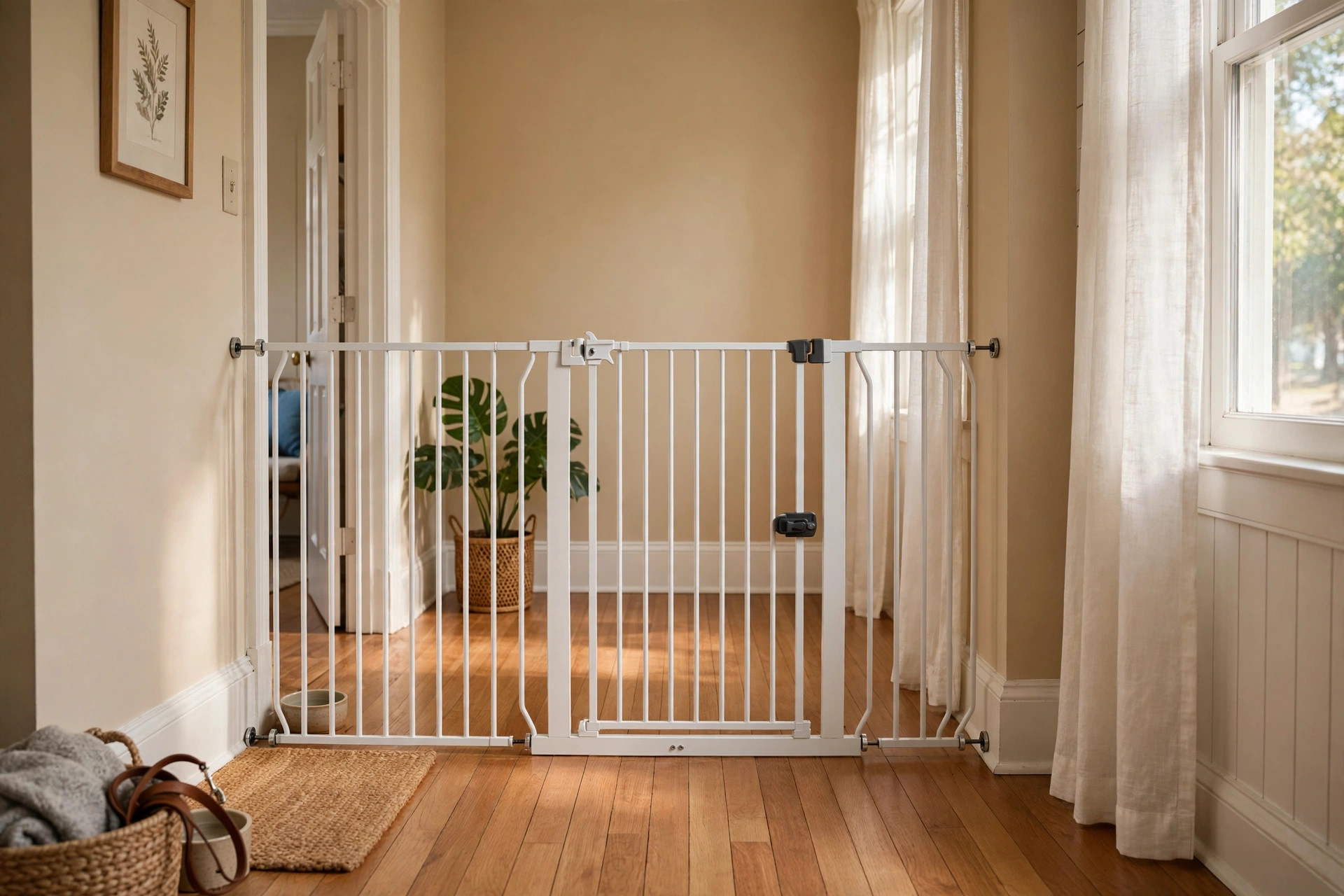

Many homes have a hallway that leads to rooms where a pet should not go. The best pet gate for hallway with door opening keeps dogs and cats in their safe area while people walk through with ease. A gate with a door opening means you do not have to step over the gate or lift it out of the way each time you pass. You simply open the small door, walk through, and close it behind you.
This guide explains what to look for when you shop for a hallway pet gate with a door opening. It covers size, latch types, mounting styles, cost, care, and safety. By the end, you will know how to pick a gate that fits your home and keeps your pet safe.
Why a Hallway Gate With a Door Opening Matters
A hallway often connects the front door, the kitchen, and the stairs. These are busy places. A dog may bolt for the front door when a guest arrives. A cat may slip into a bedroom where the door is open. A gate across the hallway draws a clear line.
Gates without a door force you to step over them. That is hard on the knees, and it is risky when you carry groceries or a laundry basket. It also teaches clever pets to jump over. A gate with a built-in door solves these problems. The door swings open for people and closes for pets. Most models close on their own with a small spring or a magnet, so you never forget.
Families with small children also find these gates useful. The door can have a childproof latch. That keeps toddlers out of the kitchen or away from the stairs, and it keeps the dog in its area at the same time. One gate can serve two purposes.
What to Look for When You Choose One: Best Pet Gate for Hallway with Door Opening
Measure Your Hallway
Before you buy, measure the width of your hallway at three points: low, middle, and high. Walls are not always straight. Use the smallest number as your true width. Hallways in American homes are often 36 to 48 inches wide. Most gates fit 28 to 48 inches, and many come with extension panels for wider openings.
Also measure the height. A gate should be at least 30 inches tall for most dogs. Large or athletic dogs may need a gate 36 to 42 inches tall. For cats, height matters less than bar spacing, since cats climb and squeeze through small gaps.
Door Opening Size and Latch Type
The door opening is the part you walk through. Look for a door that is wide enough for you to pass with comfort, usually 18 to 24 inches. Check that it swings in both directions. Two-way swing is handy in a narrow hallway.
The latch is the heart of the gate. It must be easy for adults and hard for pets and small children. Common types include:
– Push-button latches: press with one hand while the other hand is free. – Lift-and-pull latches: lift the door slightly, then pull it open. – Dual-action latches: squeeze and lift at once, which stops most dogs and toddlers.
A one-hand latch matters more than you might think. You often walk through a hallway with a baby, a plate of food, or a leash in your hand.
Mounting Style: Pressure-Mounted or Hardware-Mounted
Pressure-mounted gates press against the walls with rubber pads. They need no tools and no holes. They are the best choice for renters and for hallways where you do not want to mark the walls. Their weak point is strength. A large, strong dog can push them loose.
Hardware-mounted gates screw into the wall or the door frame. They are much stronger. If you have a large dog, or if the gate will sit near the top of stairs, choose hardware-mounted. The screws leave small holes, but most are easy to fill when you remove the gate.
Some gates offer both options. You can start with pressure mounting and add screws later if the gate starts to shift.
Types of Pet Gates With Door Openings
Metal walk-through gates are the most common. Steel frames with vertical bars last for years. The bars are usually spaced about two inches apart, which is safe for most pets. Many models include a stay-open feature that holds the door back when you carry things through.
Wooden walk-through gates suit homes with classic decor. Oak and pine frames look warm and match wood trim. Wood gates are often heavier than metal ones. They work best in hallways where the gate will stay in place for a long time.
Extra-wide gates with door openings cover hallways wider than 48 inches. They come in sections with extension panels. The walk-through door sits in one section. These gates need hardware mounting because they are heavy.
Freestanding gates with door openings stand on their own feet. They are rare, and they work only for small, calm dogs. A determined dog can push them over. Do not use them near stairs.
Tall gates with door openings rise 36 to 42 inches. They suit large breeds and jumpers. Make sure the door latch is still within easy reach.
Cat-friendly gates with small pet doors are a special type. If you also want to let your cat pass while the dog stays back, look at a pet gate with cat door for stairway safety. These have a small door for the cat built into the lower part of the gate.
Cost and Price
Pet gates with door openings sell at many price points. Basic pressure-mounted metal gates cost about 40 to 70 dollars. They are simple and they work well for small to medium dogs.
Mid-range gates cost 70 to 130 dollars. These often have better latches, one-hand operation, and stronger frames. Wooden gates usually sit in this range.
High-end gates cost 130 to 250 dollars. They are extra tall, extra wide, or made from fine hardwoods. Hardware-mounted models for large dogs also cost more.
Price is only one part of the cost. Think about how long you will use the gate. A strong 90-dollar gate that lasts five years costs less per year than a weak 40-dollar gate that breaks in six months. Buyers can find current models and prices at retailers like Chewy and Home Depot.
Care and Upkeep
A pet gate needs little care, but a small amount keeps it working well.
Wipe the frame with a damp cloth once a week. Pet hair and dust gather on the bars and in the corners. For metal gates, dry the frame after wiping to stop rust. For wooden gates, use a mild cleaner and never soak the wood.
Check the latch every month. Press it several times and make sure it clicks shut. If it feels loose, tighten the screws. If the gate is pressure-mounted, check that the pressure knobs are still firm. Walls can shift with heat and cold, and the gate may need a quarter turn to stay snug.
Watch for chew marks. Some dogs chew on gate bars. If paint flakes off, sand the spot and touch it up with pet-safe paint, or replace the gate. Loose paint chips can harm a pet that swallows them.
Lubricate hinges twice a year with a small drop of household oil. The door should swing and close on its own without sticking.
Safety
Safety is the reason you buy a gate. A few rules keep it safe.
Keep bar spacing under two and a half inches for puppies and small dogs. Wider gaps can trap a head. The American Kennel Club offers general guidance on pet safety in the home at AKC.
Never use a pressure-mounted gate at the top of stairs. A dog that pushes hard can knock it loose, and a fall down stairs can cause serious harm. Use a hardware-mounted gate there.
Keep the walk-through door closed when you are not passing through. An auto-close model helps, but always check the latch.
Do not let children swing on the gate or hang from it. Gates are barriers, not toys. The Consumer Product Safety Commission notes that children can be hurt by climbing on gates; see CPSC for general child product safety information.
If your pet is anxious or aggressive near barriers, speak with your veterinarian. Sites like PetMD describe signs of stress in pets and when to seek help. A gate should lower stress, not raise it.
For general advice on keeping pets safe at home, the ASPCA keeps a library of care articles. And The Spruce Pets publishes buying guides for many kinds of pet gear.
Frequently Asked Questions
What size gate do I need for a standard hallway?
Most hallways are 36 to 48 inches wide. Measure your hallway at three heights and buy a gate that covers the smallest number. Many gates adjust from 28 to 48 inches, and extension kits cover wider halls.
Can I use a baby gate as a pet gate in a hallway?
Yes, in many cases. Baby gates and pet gates share the same basic design. A baby gate with a walk-through door works well for dogs and cats. Just check the bar spacing and the latch. Some baby gates have wide bar spacing that a small dog could slip through.
How do I stop my dog from jumping over a hallway gate?
Buy a taller gate, at least 36 inches for medium dogs and 42 inches for large or athletic breeds. Never stack gates or place furniture near the gate, since dogs use it as a launch pad. Training helps too: reward calm behavior near the gate.
Will a pressure-mounted gate damage my walls?
It should not. The rubber pads press against the wall without screws. On very soft paint or fresh drywall, the pads can leave light marks. You can place small felt pads behind the contact points to protect the finish.
Should the gate door swing one way or both ways?
Both ways is best for a hallway. You may approach from either side, and a two-way door saves you from backing up in a narrow space. Make sure the door has a stop so it does not hit the wall.
How long will a good hallway pet gate last?
A well-made metal gate lasts five to ten years with light care. Wooden gates last as long if you keep them dry. Replace the gate if the latch fails, the frame bends, or paint peels where your pet can chew it.
A Short Final Word
The best pet gate for hallway with door opening is the one that fits your hallway, suits your pet, and makes daily life easier. Measure first. Choose a strong latch you can work with one hand. Pick pressure mounting for easy setup or hardware mounting for strength. A good gate keeps your pet safe, protects your home, and lets people pass through without trouble. Take your time, compare two or three models, and choose the one you will be glad to use every day.
If your dog also needs help getting into the car or onto the bed, you may like a dog ramp for SUV and high bed access. If you want a dog to come and go through a glass door on its own, read about the best dog door for sliding glass door installation. For general product reviews of pet gear, Consumer Reports and Good Housekeeping both test home and pet products. Dog owners who travel with pets can find sitters and walking tips at Rover.
References
American Kennel Club. (n.d.). Dog care and training resources. https://www.akc.org ASPCA. (n.d.). Pet care and animal welfare resources. https://www.aspca.org Chewy. (n.d.). Pet supplies. https://www.chewy.com Consumer Reports. (n.d.). Product reviews and ratings. https://www.consumerreports.org Good Housekeeping. (n.d.). Product reviews and home advice. https://www.goodhousekeeping.com PetMD. (n.d.). Pet health information. https://www.petmd.com Rover. (n.d.). Pet sitting and dog walking services. https://www.rover.com The Home Depot. (n.d.). Home improvement products. https://www.homedepot.com The Spruce Pets. (n.d.). Pet care guides and product reviews. https://www.thesprucepets.com U.S. Consumer Product Safety Commission. (n.d.). Product safety information. https://www.cpsc.gov
Was this guide helpful?

About Robert Taylor
The My Garden US editorial team writes practical, in-depth home and garden guides for American homeowners — tested advice, no fluff.
You May Also Like

Best Outdoor Dog Bed Waterproof for Patio: A Practical Guide
September 8, 2026 0 views
The Best Cat Brush for Long Haired Shedding Control: A Complete Grooming Guide
August 11, 2026 0 views
Pet Stairs for High Bed Small Dogs Seniors: A Simple Guide to Safe Climbing
August 3, 2026 0 views