Summer in Texas is long and hot. Air conditioners run for months at a time. The best seer rating for texas homes 2026 is not the highest number on a sales sheet. It is the rating that keeps a house cool through a July heat wave and keeps the electric bill low at the same time. This guide explains what SEER means, what changed in the federal rules, and how to pick the right rating for a Texas home.
Why the SEER Rating Matters So Much in Texas
Most of Texas sits in one of the hottest cooling zones in the country. A central air conditioner in Houston or San Antonio may run over two thousand hours in a single year. A home in Amarillo or El Paso runs its system less, but the cooling season is still long. Every hour the compressor runs uses power. A unit with a better rating uses less power to do the same job.
SEER stands for Seasonal Energy Efficiency Ratio. It measures how much cooling a system gives over a full season for each unit of electricity it uses. A higher number means a more efficient system. An old 10 SEER unit uses roughly twice as much power as a 20 SEER unit to cool the same house. When power rates climb in August, that gap shows up in the bill.
Texas homeowners feel this more than most. Cooling can be half or more of a summer electric bill. Choosing the right rating is one of the biggest money decisions a homeowner makes. It matters more here than in states where the air conditioner runs for only a few weeks a year.
How to Read SEER, SEER2, and EER: Best Seer Rating for Texas Homes 2026
In 2023, the federal test rules changed. The old SEER test did not match real home conditions very well. The new test, called SEER2, uses higher outside air pressure in the lab. This makes the numbers a little lower than the old ones for the same equipment. A unit rated 17 SEER under the old test is about 16.2 SEER2 under the new test. Both labels may still appear on boxes and brochures, so it helps to know they are not the same scale.
The government also set minimum ratings. For homes in the South, including all of Texas, the minimum for a new central air conditioner is 15.2 SEER2. Split-system heat pumps must reach 15.2 SEER2 as well. Units below this line cannot be sold or installed. When you shop in 2026, every new unit you see will carry a SEER2 number.
EER is a related term. It stands for Energy Efficiency Ratio. It measures efficiency at one fixed outdoor temperature, usually 95 degrees. EER matters in Texas because real summer days sit at or above that temperature for weeks. A system with a strong EER holds up better on the hottest afternoons. Many energy experts suggest looking at both SEER2 and EER before buying.
You can find official rating tables and fact sheets on the federal energy websites. The ENERGY STAR program lists certified central air conditioners and heat pumps with their tested SEER2 ratings. The Department of Energy publishes plain-language guides on how these ratings are set and why the test changed.
How to Choose the Right Rating for Your Home
There is no single best seer rating for texas homes 2026 that fits every house. The right choice depends on how much you run the system, how long you plan to stay, and what your home is like.
Start with your cooling load. A big house in Dallas with poor insulation runs its system hard from May to October. In that case, a rating of 18 to 20 SEER2 or higher can pay for itself in saved power within a few years. A smaller, well-shaded home in the Hill Country may do fine with a 16 or 17 SEER2 unit.
Next, think about how long you will keep the home. A high-efficiency unit costs more up front. The extra cost is repaid through lower bills. If you plan to sell in two years, the payback may not land in time. If you plan to stay ten years or more, the math almost always favors the better rating.
Look at your current bills. Pull a full year of electric bills and find your summer peak. If cooling is a large share, a jump from an old 13 SEER unit to a new 18 SEER2 unit can cut the cooling portion of the bill by a third or more. A dealer can run a load calculation, known as a Manual J, to size the system right. An oversized unit wastes money and cools poorly. A right-sized unit with a good rating is the goal.
Brand reliability matters too. Major makers such as Carrier, Trane, Lennox, and Rheem all sell high-SEER2 lines with strong warranties. Goodman offers lower-cost high-efficiency options that many budget-minded buyers pick. Compare warranty terms, parts availability, and the reputation of the local installer. A great unit installed badly will never reach its rated efficiency.
Types of Systems and Their Ratings
Central air conditioners are the most common choice in Texas. Standard split systems pair an outdoor condenser with an indoor coil. In 2026, common ratings run from the 15.2 SEER2 minimum up to about 22 to 24 SEER2 for top models. Most buyers land in the 16 to 18 SEER2 range.
Heat pumps are a strong option for much of Texas. They cool like an air conditioner in summer and heat in winter by moving heat instead of making it. Modern heat pumps handle Texas winters with ease. Their SEER2 ratings are similar to central air conditioners. If you are weighing your options, read a heat pump vs furnace cost comparison before you decide, since many Texas homes can skip the furnace entirely.
Two-stage and variable-speed compressors change the picture. A single-stage unit is either fully on or fully off. A two-stage unit runs at a low level most of the time and steps up only when needed. A variable-speed unit adjusts in fine steps. Variable-speed models carry the highest SEER2 ratings, often 20 or above. They also dehumidify better, which matters in humid parts of Texas like Houston and the Gulf Coast. Better humidity control lets you set the thermostat a degree or two higher and still feel cool.
Ductless mini splits are another path. They serve one room or zone at a time and can reach very high ratings, some above 22 SEER2. They work well for additions, garages, and homes without ducts. A mini split vs central ac cost comparison can help you see when zoning makes sense for your house.
Packaged units, which put everything in one outdoor cabinet, are common in some Texas neighborhoods. Their ratings are a bit lower on average, but newer models still clear the federal minimum with room to spare.
Cost and Price Ranges
Price follows the rating. In Texas in 2026, a basic 15.2 to 16 SEER2 central system, installed, often falls in the range of $6,000 to $9,000 for a typical home. A mid-range 17 to 18 SEER2 two-stage system often costs $9,000 to $13,000 installed. A top-tier variable-speed system at 20 SEER2 or above can run $13,000 to $18,000 or more installed.
Heat pumps sit in similar ranges. Ductless mini splits cost less per zone but add up fast in a whole-house setup. To plan your budget, look up a heat pump installation cost near me guide for your city, since labor rates in Texas cities vary.
Rebates can narrow the gap. Texas utilities and the federal tax code both offer credits for high-efficiency heat pumps and air conditioners. A heat pump that meets the federal efficiency bar can qualify for a tax credit worth up to 30 percent of the cost, with annual caps. Some Texas utilities add their own rebates for units above a set SEER2 level. Check current offers before you sign, because programs change year to year.
The payback math is simple in a hot state. Suppose a high-efficiency unit saves $400 a year on cooling over a basic one. If the price gap is $2,500, the extra cost is repaid in a little over six years. After that, the savings are pure gain. In the hottest parts of Texas, the savings can be larger and the payback shorter.
Care and Upkeep
A high SEER2 rating is a lab number. Your real efficiency depends on upkeep. A dirty filter alone can cut airflow and force the system to work harder. Check the filter every month in summer. Replace it when it looks gray or clogged.
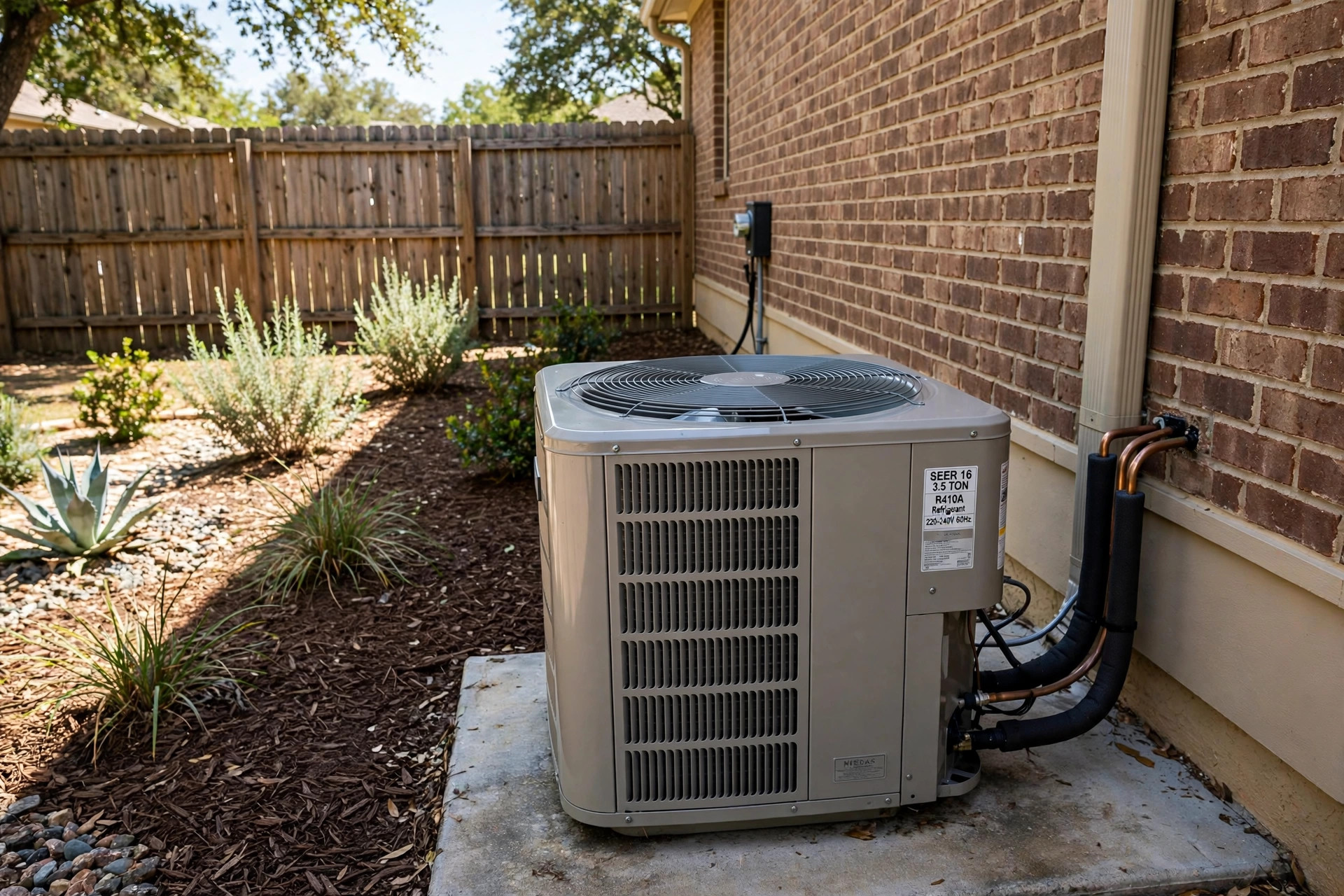
Keep the outdoor condenser clear. Leaves, grass clippings, and cottonwood fluff block the coil. Leave at least two feet of open space around the unit. Rinse the coil gently with a hose in spring, with the power off. Do not bend the thin metal fins.
Have the system serviced once a year, in spring before the heat arrives. A technician checks refrigerant charge, cleans the coils, tests the capacitor and contactor, and clears the drain line. A clogged drain line can flood a closet or attic in a Texas summer. Yearly service keeps the warranty valid on most brands.
Seal your ducts. Many Texas homes lose 20 to 30 percent of cooled air through leaky ducts in hot attics. No SEER rating can fix that waste. A duct test and sealing job often pays for itself in one or two summers.
Set the thermostat wisely. Each degree you raise the set point in summer cuts cooling cost by a few percent. A programmable or smart thermostat that eases off when no one is home is one of the cheapest upgrades you can make.
Safety
Air conditioners are safe when installed and kept well, but a few rules matter. High-voltage wiring feeds the outdoor unit. Never open the electrical panel of the condenser yourself. If a breaker trips again and again, call a technician instead of resetting it over and over.
Refrigerant is sealed inside the system. It is not a fuel and does not get “used up.” If your system needs a refill every year, there is a leak. Leaks should be found and fixed by a licensed pro. Do not try to charge the system yourself.
Keep children and pets away from the outdoor unit. The fan inside can cause serious harm. Make sure the disconnect box and any covers stay closed and latched. During storms, a whole-house surge protector can guard the control board, which is the most costly part to replace after a lightning strike.
Carbon monoxide is a furnace issue, not an air conditioner issue, but many Texas homes have both in one closet. If you have gas heat, keep a working carbon monoxide detector near the bedrooms and have the furnace checked each fall.
Frequently Asked Questions
What is the best seer rating for texas homes 2026 for most families? For most Texas homes, 16 to 18 SEER2 is the sweet spot. It clears the federal minimum with margin, keeps bills low, and does not carry the high price of top-tier variable-speed models. Homes with very high cooling bills or long hot seasons may gain from 19 to 22 SEER2.
Is a higher SEER rating always worth the extra money? Not always. The value depends on how much you cool. In the hottest parts of Texas, where systems run eight months a year, the payback is strong. In milder spots or for homes that will be sold soon, a mid-range rating is often the smarter buy.
What is the difference between SEER and SEER2? SEER2 is the newer test standard that took effect in 2023. It tests under tougher, more realistic conditions. SEER2 numbers run about 5 percent lower than old SEER numbers for the same machine. A 17 SEER unit is roughly equal to a 16.2 SEER2 unit.
What is the minimum SEER2 rating allowed in Texas in 2026? The federal minimum for new central air conditioners and heat pumps installed in the South is 15.2 SEER2. Older units already in homes can stay, but any new installation must meet or beat that line.
Does EER matter as much as SEER2 in Texas? Yes, arguably more on the worst days. SEER2 averages a whole season. EER measures efficiency at a fixed 95-degree outdoor temperature. Texas sees many days at or above that mark. A unit with a strong EER keeps its cool, and its efficiency, when the heat peaks.
Should I replace my working 14 SEER unit to get a better rating? A working unit is rarely worth replacing early just for efficiency. But if it is over 12 to 15 years old, needs a major repair, or uses the old R-22 refrigerant, replacement starts to make sense. Get repair and replacement quotes side by side before you decide.
A Final Word
The best seer rating for texas homes 2026 is the one that fits your house, your budget, and your plans. Learn the labels, look past the sales pitch, and size the system to the home. A right-sized 17 SEER2 unit that is installed well and kept clean will beat a poorly installed 21 SEER2 unit every time. Pair a smart rating choice with sealed ducts, a clean filter, and a sane thermostat setting, and your Texas summers will be cooler and cheaper for years to come. Practical homeowner guides from sources like This Old House and Family Handyman offer step-by-step upkeep advice that keeps any system running near its rated best.
References
Carrier. (n.d.). Heating and cooling systems. https://www.carrier.com ENERGY STAR. (n.d.). Energy efficient products. https://www.energystar.gov Family Handyman. (n.d.). DIY home repair and maintenance. https://www.familyhandyman.com Goodman. (n.d.). Heating and cooling equipment. https://www.goodmanmfg.com Lennox. (n.d.). Heating and cooling systems. https://www.lennox.com Rheem. (n.d.). Heating, cooling, and water heating. https://www.rheem.com This Old House. (n.d.). Home renovation guidance. https://www.thisoldhouse.com Trane. (n.d.). Heating and air conditioning. https://www.trane.com U.S. Department of Energy. (n.d.). Energy efficiency and renewable energy. https://www.energy.gov
Was this guide helpful?

About Sarah Mitchell
The My Garden US editorial team writes practical, in-depth home and garden guides for American homeowners — tested advice, no fluff.